

We’re back, Beby.
FIGHT!



We’re back, Beby.
FIGHT!



BREAKING The European Commission AstraZeneca contract has been published. It’s below, follow the PDF linkhttps://t.co/wzkUxmHRaU
— Tony Connelly (@tconnellyRTE) January 29, 2021
Oh.
This morning/afternoon.
The European Commission published a redacted version of its contract with drugs giant AstraZeneca on Friday, hoping to prove the company had breached a commitment on coronavirus vaccine deliveries.
Releasing the document, EU spokesman Eric Mamer said it would show that the contract covers AstraZeneca plants in the UK and that “these plants will contribute to the effort … to deliver doses to the European Union”.
EU publishes redacted AstraZeneca vaccine contract (RTÉ)
Yesterday: Non-Vintage
Meanwhile…
Some KPMG staff working with the Health Service Executive (HSE) have received the Covid-19 vaccine, the consultancy firm has confirmed.#vaccines #coronavirus https://t.co/oeLFsANjNS
— Mick Caul 😷 (@caulmick) January 29, 2021
Ah here.


When asked to sum up the year in an emoji, the top five chosen by teens were the face-mask emoji, the crying emoji, the sick emoji, the confused emoji and the poo emoji.
Are the kids alright?
Katie Allen writes
An online survey of over 1,000* secondary school students by Irish mobile education app, Exit Entry has highlighted the challenges faced by Irish teens during 2020. The vast majority (88%) stated that their education had been adversely affected in 2020, due to having missed out on a conventional school year.
At an age when friendships are all-important, over half of those surveyed (55%) found not seeing their friends to be the most challenging aspect of Covid-19, ahead of home-schooling, the disrupted school year or anxiety about contracting the virus.
While a lifeline for some, only 5% of students have used Zoom to connect with friends. TikTok currently reigns supreme as the social media app of choice with 58% choosing it as their favourite, with Snapchat as second choice with 20%….
…To find out more about the Exit Entry app and how to enter to win one of 5 Huawei Smart Phones, visit here.
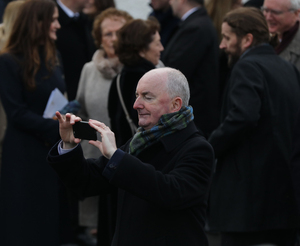

From top: Tommie Gorman and Vincent Kearney
Thrilled to be announced as next Northern Editor for @rtenews Tommie Gorman will live very big shoes to fill and I’m delighted to have been chosen to fill them. Looking forward to the next chapter @WilliamsJon
— Vincent Kearney (@vincekearney) January 29, 2021
This morning.
RTÉ have announced the appointment of Vincent Kearney to replace Roy Keane-bothering veteran Tommie Gorman as Northern Editor for RTÉ News.
Via RTÉ:
Vincent has previously worked as a reporter and producer for daily news and documentaries at the BBC including four years with BBC Northern Ireland’s Spotlight programme. Prior to joining RTÉ he was Home Affairs Correspondent for BBC Northern Ireland, Northern Ireland Correspondent with The Sunday Times and also worked for the Belfast Telegraph for nine years. Vincent is a native of west Belfast but has spent the last 31 years living with his wife Louise and family in Lurgan, County Armagh.
Meanwhile,paying tribute to Tommie Gorman, RTÉ News boss Jon Williams said:
“For 41 years, from Brussels to Belfast, via Sligo and Saipan, Tommie Gorman has been the beating heart of RTÉ News. He has earned the trust of audiences, north and south – and of all sides in Northern Ireland, telling their story, sharing his insights, and championing RTE’s role as an all-island news organisation.”
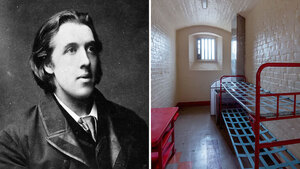
 From top: Oscar Wilde; his cell in Reading Gaol as it is today; David Langwallner
I recently pre covid did a crown court case in Reading and, after a bizzare development whereby my client indicted on charges of robbery was simultaneously a witness in a murder case in an adjacent court, the case was adjourned. I thus sauntered out of the sleek new court, reflecting on life being stranger than fiction, and took the very brief walk down the road to a prison closed for the last number of years, Reading Gaol. It is three minutes walk away.
The prison is now a non-accessible if rather imposing oasis. Doors firmly shut but there is a number on the wall to phone security. So I did. A most helpful man, who does not wish to be named or identified, came to the door and asked me what I wanted.
Is it possible, I asked, to view the cell of Oscar Wilde, former prisoner here. He knew where the cell was and also who Wilde was, I explained my Irish background, produced a barrister’s calling card and was fortuitously allowed in, despite the prison closure.
The prison had been open a few years previously for a Wilde celebration of sorts. It is cell C22, rather anonymously named, but still the extant cell redecorated in bright colours, lots of red. Not the spartan colours Wilde must have faced but very pleasant, for it had been converted to a youth offenders’ institution. The thought did occur to me that Wilde of course, had abused the youth in conventional parlance.
The window from the poem “The Ballad of Reading Gaol” that he gazed out of is famously still there and I checked closely, and it seems historically authentic. I scrambled around to see if there was any WIldean graffiti but it has been done over so many times there did not appear to be any. But I did look out of the room with a degree of lift and gazed downwards confronting the Gorgons head, the prison courtyard.
In the poem it is of course clear that he saw the execution yard just below the window, and there it is a bit like looking into your garden.
It really is thus just below his room, or his confinement. Words matter, and he was a master of words beautifully crafted and phrased, the wit of all wits. Perhaps he used a suitably masked phrase to express his predicament.
By happenstance in a charity shop later I found a small treasury book of his witticisms, but I knew many of them already.
It should be stressed that he should never have been there in the first place, save for an error of judgment and perhaps hubris, to which we are all susceptible. His error of judgment was his wit. Words misplaced. As a Greek scholar he would have perhaps reflected on hubris and Icarus and flying too close to the sun.
The context of his confinement, let us use the polite word, at the height of his fame was of course that the Marquis of Queensbury left a calling card at his club to Oscar Wilde ‘posing as a sondomite’. Now of course the brutish inventor of the rules of boxing could not spell but the implication was clear and Wilde sued for libel, always, then and now, very dangerous.
He should not have done so, people should not conceal their failings or lie about them privately.
Wilde was lying and thought wit and theatrics could pull it through, and it nearly did save Edward Carson, a Trinity contemporary of Wilde’s. Mediocre lad, but a brilliant and tenacious cross examiner. Wilde got over confident about his innocent meetings with boys and Carson popped a surprise question. The true genius of the art of cross examination. After Oscar regaled the courtroom with the art of ridicule, dismissing any ulterior purpose to his many associations with boys, Carson asked about Grainger, said “did you kiss him?”. Wilde’s witty response, leading to his premature death,was “oh no he was far too ugly”.
The gate was thus open and other boys, less ugly, by implication were kissed. Reading Gaol Was the ultimate outcome.
It has always been a source of wonder why Carson was so vicious towards Wilde in court, considering they had played together as children in Ireland in Waterford, meeting again as students at Trinity College, Dublin, and in London. As the respective sons of a surgeon and an architect, Wilde and Carson were both born in 1854 to affluent Irish Protestant families in Dublin, and lived just a few streets apart
The Irish can be, of course, a deeply malicious lot. Anything goes and always has. Our downfall, collectively as a nation, is the art of cutting down tall poppies and destroying national heroes. Parnell suffered the same fate.
In any event, by a verbal mistake, Carson crucified him and, after several trials later culminating in a criminal prosecution, Mr. Wilde was off to do some hard labour in Reading gaol.
One should never be overconfident and should always see the pothole coming. Wilde did not. The intoxication of success blurred his judgement.Being cross examined, and cross examining, is a fine art and I have been at both the giving and receiving end so should know.
Wilde was also out of his depth, or should that be his milieu, and he did not understand the context. A courtroom is not a source of public entertainment, particularly if you are a witness. It is not a stage for a performance. Short precise honest responses are desirably required.
I have also visited Wilde’s gaudy grave in Père Lachaise, sponsored by his acolytes. It is, in that kitschy Art Deco way, over-inflated and slightly pop star-like, belying the grubby reality of what happened and what led to his early death.
Post release, or in the modern vernacular, post conviction he was a shattered man. A phrase such as a dandy in aspic does not quite cover it. His health was broken. The lubrications and dissipation of a certain lifestyle led him utterly unequipped to deal with the rigours of a Victorian prison. Dead in Paris a few years later. T
It is a grave risk always, as aforementioned, to submit to cross examination and Wilde should not have sued, unless capable of proving his innocence. He was too remote, in his gilded cage of artistic approbation in London, to get what he was confronting, namely the puritanical zealot that was Carson and the law courts, of which he was unfamiliar, and which he treated as a stage.
Carson did not, to be fair, it was said, pursue him any further after the initial damage had been done. The poor man has suffered far too much he said, refusing the criminal brief.
A smidgen of basic northern Irish decency if nothing else, a southern Irish person might well have accepted it for a few shillings? Well clearly not?
Now I would not have been there in Reading had my trial not been aborted, or if the friendly security guard had not let me in or, for that matter, if I was not practising law in London and had not got the brief to go to Reading. Causas causans.
So much of our success or opportunity in life thus is happenstance and accident.
Wilde should have realised, in Irish terms, he was on the pig’s back in London, that he had been embraced and accepted. He should have realised what people realised about him, and he should have acknowledged his foibles and certainly should not have crowed about them.
So, Wilde should not have sued and, all brilliance aside, and despite his death bed witticisms of dying beyond his means and the wallpaper or he needed to go, he died in a grubby hotel in Paris.
Reading Gaol seems to me modeled on Bentham’s panopticon based on the surveillance techniques he outlined. Constant watch where, by constant surveillance, the dignity of the prisoner is undermined. Wilde, expansive and gregarious, must have felt completely stifled.
The butterfly broken by brute force. It’s wing clipped.
I do not like cages, and God knows how Oscar was so confined. When he expresses in the ballad the fears, apprehensions and indeed dread of the man facing the gallows it is more noble than you might think. For when he gave evidence he signed his own death warrant, and must have been conscious of the dying of the light in prison.
He of course lobbied for prison reform as a result of his experiences in Pentonville Prison and Reading. My experiences in London so far suggest nothing other than people getting irretrievably psychologically and physically damaged by prison.
Certainly, the prison of constant surveillance and the harsh work culture are disgraceful as are the recidivist drug and abuse infested infernos we create today though they perhaps should incarcerate many of our right wing politicians and lawyers at least as therapy.
Not all artists, it should be said, lack wisdom and judgment. Beckett, a life well led and long, is in a different cemetery in Paris, distinguished to the end. Growing older gracefully. A less gaudy grave but a lot of tributes in Montparnasse.
I suppose what Wilde lacked Beckett had. Judgment. And judgment of people and context is so important.
Honesty also. Lies catch up on people over time and if you do lie do not turn it into a circus, Carson in his way, mediocre or not, saw this.
And now one more twist in the tale.
Long after Carson’s death in 1935, the son of one of his friends confided in a 1950 recently discovered letter:
“I was never able to get Carson to admit that Wilde possessed any ability at all. ‘Ah,’ he used to say angrily, ‘he was a charlatan.’’
Lod Birkenhead’s letter reveals the extent of Carson’s loathing:
“His distaste for Oscar betraying his own social class – consorting with people from the lower classes, as he’d have seen it – was almost as strong as his feelings of disgust about what Oscar had done.”
So Carson was not being honest about his motivations for taking the case. He wanted to do Wilde for his moral disapproval.
Though I love Oscar Wilde and think the Importance of being Earnest a greater play than Godot, because of its sparkling wit, it should be noted that Beckett wrote Godot at 50 with greater works like Endgame, The Trilogy and his wonderful evocation of childhood in Leopardstown in Company at 80. He preserved his dignity to the last.
In the interests of any degree of politicisation, which this contribution does not have, The Ballad of Reading Gaol is one of the greatest arguments against the death penalty, homosexual convictions and persecutions.
Given That the death penalty is still in Africa and other places still awarded for homosexuality the treatment of Oscar and his denouement is thus of piquant contemporary relevance,
But overconfidence in cross examination can be very dangerous. Wilde must have been conscious of this in his dying room in Paris witty to the last as aforementioned with two famous alleged deathbed lines.
“One of us must go: the wallpaper or me.”
Or
“I am dying beyond my means” (as he guzzled champagne).
Beckett opens Company with the lines to one on his back in the dark. Imagine.
One wonders what Oscar imagined.
David Langwallner is a barrister specialising in public law, immigration, housing and criminal defence including miscarriages of justice. He is emeritus director of the Irish innocence project and was Irish lawyer of the year at the 2015 Irish law awards. His column appears here every Tuesday and Friday. Follow David on Twitter @DLangwallner
Getty/BBC


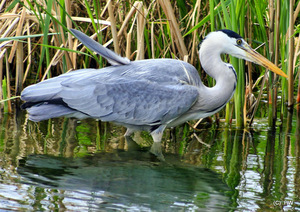


Ranelagh Gardens Park, Dublin 6.
Harry Warren writes:
If you are passing through Ranelagh in Dublin, I would heartily recommend a stroll through Ranelagh Gardens Park. It is a delightful small park somewhat hidden in plain sight making it easy to bypass.
The main entrance to the park is via a fine granite archway underneath the Luas line. It also has a few little-known entrances around the side roads of Ranelagh that are mainly familiar to locals. The gardens consist of an ornamental pond surrounded by green space and mature trees with plenty of wildlife, swans, ducks, Leisler bats and fish whose stock was depleted on the day I visited by a hungry heron.
At the Chelmsford Ave end of the park there is a commemorative statue of Richard Crosbie. The park is well worth a visit and it has a very interesting aeronautical history whose story should be told.
Originally the site of the 18th century Willsbrook House, the house and its gardens were bought by the entrepreneur, William Hollister, who created a five-hectare pleasure garden and opened them in 1769 for the enjoyment of Dublin’s gentry, featuring carnivals, balls and such like pleasures.
Hollister named the gardens after Lord Ranelagh from Co Wicklow who owned similar gardens by the Thames in London. He was a canny businessman always on the lookout for new attractions and publicity, hitting gold when he allowed Richard Crosbie to attempt the first balloon ascent in Ireland from his gardens on January 19th, 1785. Crosbie was a pioneering aeronaut and was born at Crosbie Park, Co. Wicklow, in 1755.
Richard Crosbie has an interesting history. When he was a student at Trinity college, he was the leader of the notorious Pinking Dindies, one of the many armed gangs in Dublin at the time along with the Bucks and the Cherokees. Their members were from the upper echelons of society and they terrorised “single men and citizens who neither wore fine clothes nor swords” also extorting money from brothel madams and their customers whilst still finding time to engage in duels and fights with their gang rivals.
The “Pinks” were armed with short swords from which they derived their name, they also carried knives, falchion and shillelaghs. When they weren’t fighting one another, they had vicious battles with members of the city’s Night Watch.
“They were of imposing appearance, being handsome and well made in general; so that, individually, you could not suspect them: it was by their acts only you could convict them, and they commonly pursued their schemes in parties, and by night; and they were so well prepared for battle that the ancient and quiet watchmen, the only protectors of the citizens of Dublin at that period, were worsted in almost every attempt made to subdue them…”
Outside of being a leader of the Pinking Dindies, Crosbie was described as being:
“…beyond all comparison the most ingenious mechanic I ever knew. He had a smattering of all sciences and there was scarcely an art or trade of which he had not some practical knowledge … he was very good tempered, exceedingly strong and as brave as a lion – but as dogged as a mule. Nothing could change a resolution of his when once made and nothing could check or resist his perseverance to carry it into execution’”
Inspired by the first ever hot air balloon ascent by the Montgolfier brothers in France in 1783, Crosbie constructed a balloon his own “Aeronautical Chariot”. Displaying his scientific knowledge, he chose hydrogen gas rather than hot air to create lift in his balloons. His ascent was to take place in Ranelagh.
Prior to his manned flight he tested his balloons. To entertain his audience and to drum up publicity, he used a tethered balloon to send up various animals culminating in a free flight with a cat on board. The balloon floated away and was reported being visible off the coast of Scotland. Carried by the wind it eventually descended into the Irish Sea near the Isle of Man. Fortunately the cat, presumably having lost one of its nine lives, survived its adventure and both the cat and balloon were recovered by a passing ship.
On the 19 January 1785 thirty-year-old Richard Crosbie; wearing an extravagant outfit of a long robe of oiled silk, lined with white fur coupled with a waistcoat and breeches of white quilted satin, red Morocco boots and a Montero cap of leopard skin climbed into the gondola of his balloon in Ranelagh Gardens.
The balloon flamboyantly decorated with the Arms of Ireland and images of Minerva and Mercury soared aloft. A huge audience for its time, over 30,000 spectators witnessed Crosbie’s ascent, the first successful human flight in Ireland. He had set himself the task of flying across the Irish Sea but he got no further than making a safe landing in Clontarf. His flight was a great success and it was a truly remarkable feat coming only 14 months after the first-ever manned balloon flight by the Montgolfier Brothers in November 21, 1783.
Crosbie now an established aeronaut, made several other flights in Ireland and America. In July 1785 he again attempted an Irish Sea crossing but inclement weather forced him to land in the sea just off the Welsh coast. Crosbie became famous in Ireland and abroad for his aeronautical exploits.
A few years later in 1787 the new Rotunda Gardens opened on the North side of Dublin and they began to draw the fashionable set, Hollister losing business decided to sell the gardens. They were soon reopened by another entrepreneur but the gardens gradually became less successful over time.
In 1788, Ranelagh Gardens were sold off to a community of Carmelite nuns who moved into Willsbrook House. It was an enclosed order resulting in Ranelagh Gardens being closed to the public for close on 200 years. After the Carmelites left Ranelagh for pastures new, various portions of the gardens were sold off to developers and what was left of the gardens, now shrunk to 1 hectare were taken over by Dublin City Council who now maintain them today.
So, if you find yourself in the gardens pause for a moment and spare a thought for the remarkable aeronautical pioneer Richard Crosbie who made the first successful human flight in Ireland.
All pics by Harry Warren

Yesterday.
Exact location unidentified, Dublin.
Thanks Ciarán Cahill


