Tag Archives: Noirin O’Sullivan

osullivan-1

Garda Commissioner Nóirín O’Sullivan before the justice committee in March

Today.

At 2.30pm.

Garda Commissioner Nóirín O’Sullivan will appear before the Public Accounts Committee to discuss the recent audit of the Garda College in Templemore which showed serious financial irregularities. It examined financial transactions between 2009 and 2015.

Readers will recall how Ms O’Sullivan described the irregularities as “legacy issues” in an interview with Seán O’Rourke shortly after the story first broke in The Sunday Times.

Ahead of the meeting, the committee’s chairman Seán Fleming, of Fianna Fáil, said:

“The findings of an internal audit carried out by An Garda Síochána have highlighted serious issues in relation to financial controls and mismanagement of funds at the Garda College in Templemore.”

“The audit of the Garda College has raised a number of concerns in relation to compliance with standard accounting practice and corporate governance. It is important that an effective system of internal financial control is maintained and operated by An Garda Síochána in all areas of it operations.”

“[Today] we will meet with Garda Commissioner Nóirín O’Sullivan to discuss the report in more detail as it relates to the appropriation accounts. The committee will be keen to ascertain how budgetary control is exercised within An Garda Síochána and what changes have been implemented to address the serious issues which have arisen in relation to the college.”

Members of the Public Accounts Committee are: Alan Farrell, FG; Alan Kelly, Labour; Bobby Aylward, FF; Catherine Connolly, Independent; Catherine Murphy, Social Democrats; David Cullinane, SF; Josepha Madigan, FG; Marc MacSharry, FF; Mary Lou McDonald, SF; Noel Rock, FG; Peter Burke, FG; Sean Fleming, FF; Shane Cassells, FF.

G’wan the Catherines.

Watch live from 2.30pm here

Previously: ‘I Knew Full Well It Hadn’t Been Discussed At PAC Because I’m A Member Of PAC’

Screen Shot 2017-04-27 at 10.58.01

Screen Shot 2017-04-27 at 11.05.04

Garda Commissioner Nóirín O’Sullivan will be appearing before the Policing Authority from 11am until 1pm (watch live in link above) and will be fielding questions on breath tests, fixed penalty notices, Fennelly Commission and the internal audit on the Garda College in Templemore.

Further to this…

This morning, the Irish Independent reports:

Garda management has ordered a major investigation into “irregularities” surrounding vehicle checkpoints in the Cork district, the Irish Independent has learned.

Senior Garda bosses are probing whether false checkpoints were logged on Pulse – the official Garda computer system.

Two rank-and-file gardaí are under investigation and face the prospect of disciplinary action, according to well-placed sources.

The gardaí are suspected of having set up false checkpoints while on the clock.

Two gardaí under investigation after allegedly setting up fake checkpoints while on the clock (Niall O’Connor, Ralph Riegel, Irish Independent)

Screen Shot 2017-04-18 at 13.28.44

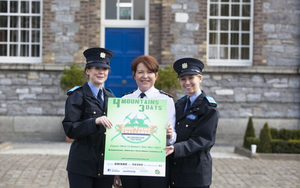
Trainee gardaí Laura Ryan, from Rathfarnham (left), and Patrice Ryan, from Tipperary (right), with Garda Commissioner Nóirín O’Sullivan this morning to launch a charity Four Peak Mountain Challenge in which 100 serving and retired gardai will take part in May

At the weekend.

Hugh O’Connell, in the Sunday Business Post, reported:

Some 25 gardaí are currently suspended from duty for suspected misconduct, including one sergeant who has been suspended for over seven years.

The Department of Justice has confirmed that out of the 13,000-strong force, 20 rank-and-file members are suspended, three sergeants, and two retired gardaí.

…“It’s very strange that proportionately the far highest number of suspensions and investigations in agencies under the Department of Justice are taking place in the Gardaí, far outstripping almost any other department,” [People Before Profit TD Richard Boyd Barrett] said.

Boyd Barrett has called for her suspension for the duration of its hearings and said the figures show a “double standard” between the treatment of ordinary gardaí and the Commissioner.

“It suggests a fundamental dysfunctionality within the force and given the treatment of whistleblowers like Maurice McCabe, it raises a question as to why these people may have been suspended,” he said.

Three sergeants among 25 gardaí suspended for alleged misconduct (Hugh O’Connell, Sunday Business Post)

Leah Farrell/Rollingnews

Screen Shot 2017-04-13 at 09.18.38

Sinn Féin TD Pearse Doherty

Yesterday evening.

The Dáil debated Sinn Féin’s motion of no confidence in Garda Commissioner Nóirín O’Sullivan.

During the debate, Sinn Féin’s Pearse Doherty spoke about another Donegal Garda whistleblower Kieran Jackson, who is now retired.

Mr Doherty said:

“There are many reasons why Nóirín O’Sullivan should leave her position as Garda Commissioner and there are many Members in the House who have outlined those reasons. I support the motion, obviously, that Sinn Féin has tabled.

I will recall for the Minister of State, Deputy Stanton, the case of a former garda in the Donegal division, with whom I have engaged over the past number of years and who has engaged with the Garda Commissioner over that period. In May 2001, a former garda in the Donegal division met two detective inspectors from the Garda Bureau of Fraud Investigation in a hotel in County Monaghan. Accompanied by a witness, the detectives had invited the officer to meet them. During this exchange, the now retired garda disclosed to the interviewing detectives a number of very serious allegations against a former Garda superintendent, since retired, who was also stationed in Donegal. These allegations related to suspected tax evasion, social welfare fraud and persons being in possession of a fraudulent bank account into which thousands of pounds were being lodged regularly. This meeting in Monaghan lasted for over five and a half hours. As the meeting drew to a close, the detectives stated that they would be in contact again with the whistleblower shortly in order to take a written statement. However, this did not happen.

In September 2014, a solicitor acting on behalf of the whistleblower wrote to then acting Garda Commissioner, Noirín O’Sullivan, in which he divulged all of the allegations of criminal wrongdoing suspected of having been committed by the whistleblower’s former colleague. The letter also expressed his client’s alarm at the apparent lack of any follow-up having been carried out on the part of the investigating gardaí. A similar letter, dated 24 September 2014, was subsequently sent to the Minister for Justice and Equality, Deputy Fitzgerald, around which time the whistleblower himself contacted me to request that I bring the case to the Minister’s attention, which I did.

On 16 December 2015, the Minister replied to me in a letter in which she stated that inquiries were being made with the Garda Commissioner regarding the whistleblower’s complaint. A further letter, issued in May 2016, declared that inquiries into the claims were ongoing. Then, last September, the whistleblower finally received the news that he had long suspected. The Garda advised him that, following an extensive search of files and records held locally and at Monaghan Garda station, no record of his complaint or of any subsequent investigation could be found. The correspondence went on to say that inquiries made with the Garda Bureau of Fraud Investigation revealed that no investigation was ever carried out by personnel in respect of the whistleblower’s allegations.

The whistleblower to whom I refer is former Garda Kieran Jackson. His story leads us to one of two conclusions. First, either Kieran Jackson is lying – I have no reason to believe that he is and there are other former gardaí who will corroborate his story – and no meeting between him and the detectives ever took place. The other conclusion is that somebody in An Garda Síochána has gone out of his or her way to cover it up and to ensure that his claims never saw the light of day.

If the latter conclusion is the case, then questions need to be asked as to who took the decision? Kieran Jackson informs me that a failure to follow up or investigate a criminal incident is, in itself, a crime. Questions must be asked about who took the decision to not pursue his complaint. Why has Garda Commissioner Nóirín O’Sullivan – who has known about this for over two and a half years – done nothing about it?

The Tánaiste and Minister for Justice and Equality, Deputy Fitzgerald, and her Government say that they have full confidence in the Garda Commissioner. Try telling that to Garda whistleblowers across the State. Try telling that to Kieran Jackson who has had no response from the Commissioner in respect of the allegations he brought forward many years ago, and again in 2014, to the Garda Commissioner and to the Minister, with absolutely no action whatsoever taken.

We hear time and again, however, that the Tánaiste and the Commissioner embrace whistleblowers. The results are clear. There is only one course of action left for the Government, namely, to express no confidence in the Commissioner.”

Continue reading →

Screen-Shot-2017-03-31-at-14.03.44-e1490969002472

Garda Commissioner Nóirín O’Sullivan, and other senior gardaí, at the Joint Oireachtas Committee on Justice and Equality on March 30

You may recall how Garda Commissioner Nóirín O’Sullivan’s recent appearance before the joint Oireachtas committee on justice and equality, in the wake of the near 1million false breath tests and 14,700 wrongful convictions. See a timeline of the matters here.

After the meeting, the committee asked Ms O’Sullivan to respond to 27 questions by noon yesterday.

The following are some of the questions sent to Ms O’Sullivan, parts of her answers that are pertinent to the questions and some notes on the same.

It would appear Ms O’Sullivan and the Medical Bureau of Road Safety’s accounts of events still do not tally.

Q1. Can you confirm that the anonymous April 2014 letter from the Garda reservist in the Western Region was the only prompt for the initial audit of breath test figures in the Southern Region, and the subsequent national audit? Or is it the case that the information from the MBRS given to An Garda Siochana had a role to play in the audits being ordered?

A. The anonymous letter originating from a Garda Reserve in the Western Region was the catalyst for the examination in the Southern Region and the subsequent national examination. A number of other actions were also taken before the examinations commenced, which are set out below. An Garda Síochána had no information in July 2015 from the Medical Bureau of Road Safety to influence the decision to initiate the examination in the Southern Region.

The examination in the Southern Region had already commenced when concerns were first mentioned, informally, to a Superintendent from the Garda National Traffic Bureau by the Director of Medical Bureau of Road Safety. He stated, at the time, that these concerns were not raised as a ‘red-flag’ issue, however reassurance was given that any concerns he had in this regard would be addressed in the context of the examination underway.

…The letter, dated 22nd August, 2014, from the Medical Bureau of Road Safety pertained solely to procurement matters. It did not highlight discrepancies in the records held by An Garda Síochána and those of the Medical Bureau of Road Safety.

Broadsheet: During an interview with RTÉ’s Cathal Mac Coille, on Morning Ireland, on March 28, 2017, Denis Cusack of the MBRS said that the MRBS wrote to An Garda Siochana in July 2014 about discrepancies between the figures the MBRS had for the breath test mouthpieces that they had supplied to the gardaí and the number of breath tests that the gardai claimed to be carrying out. Of this letter in July 2014, Mr Cusack said:  “It was an alert that something wasn’t adding up.”

Continue reading →

I160101_192627_30845159oTextTRMRMMGLPICT000079045824o-190405701

From top: Garda Keith Harrison; Garda Commissioner Nóirín O’Sullivan

You may recall Garda whistleblower Keith Harrison whose allegations will be looked at as part of the Charleton Inquiry.

He’s been on sick leave from Donegal Town Garda Station since May 2014.

He was on partial pay (33%) from May 2014 until September 2015 but has not received any pay from An Garda Siochana since September 2015.

Garda Harrison is going back to work on Monday, following mediation talks this week which were chaired by the former head of the Workplace Relations Commission Kieran Mulvey.

The mediation talks, which focussed on returning to work and the payment of arrears, followed a report on RTÉ’s This Week last weekend concerning Garda Harrison.

The report effectively explained how, in late January of this year, Garda Harrison was ordered to return to work in Donegal Town Garda Station – despite a series of Garda-commissioned medical assessments recommending that Garda Harrison not be returned to the station where he had previously worked.

Some more details about these reports:

In September 2014, Garda Keith Harrison met Dr Oghenovo Oghuvbu, who was a specialist occupational physician with the Garda Occupational Health Department at the time.

On October 6, 2014, Dr Oghuvbu wrote a report to the Executive Director Human Resources and People Development at An Garda Síochána John Barrett, about Garda’s Harrison.

In his report, Dr Oghuvby stated that he believed Garda Harrison’s illness could have been born out of a work-related environment and that he would be fit to return to work, on the basis that a safe work environment would be provided for him.

He wrote:

“[Garda Harrison] continues to experience some impairment in his sense of well-being. This is particularly in respect of his returning to his current workplace (Donegal division) while the investigation is ongoing. This is also of concern to his treating clinical physicians.”

Dr Oghuvbu also required an “urgent case conference” in relation to Garda Harrison’s return to work that would encompass local Garda management, staff from Garda human resources and the Chief Medical Officer.

It’s understood this case conference did not take place and it’s unclear how Garda management actually responded to Dr Oghuvbu’s call for an “urgent case conference”.

In November 2016, the Garda’s Assistant Chief Medical Officer Dr Richard Quigley met with Garda Harrison.

Dr Quigley carried out a more in-depth assessment of Garda Harrison and determined that Garda Harrison should return to work and that his issues or illnesses were related to the work environment.

Specifically, Dr Quigley wrote to Garda human resources, stating:

“Given work circumstances, which are well known to management, I consider it prudent if consideration is given to Garda Harrison being assigned to duties in a station other than his previous location.“

In addition, Dr Quigley recommended that Garda Harrison be seen by an independent specialist.

In turn, the Garda Commissioner Noirin O’Sullivan commissioned a report from Dr Patrick Devitt, a Dublin-based consultant psychiatrist.

In January, 2017, as the commissioned independent specialist, Dr Devitt stated that Garda Harrison’s injuries were born out of his workplace environment and that he firmly agreed with Dr Quigley’s recommendation for Garda Harrison to return to work.

But it was also stipulated that Garda Harrison should not be returned to the station he previously worked in.

Garda Harrison only obtained details of these three reports, and their findings, last Friday – days before the This Week report and the mediation talks earlier this week.

Had Garda Harrison and his legal team not had sight of these reports – in which the Garda’s own medical assessments state his illness was work-related and that it was recommended he be placed somewhere other than Donegal Town – it may have been difficult for him to argue for a placement other than Donegal Town station.

If An Garda Siochana insisted that he still had to go to Donegal Town station, this would have contradicted the advice given to them by their own medical assessments.

It should also be noted that Garda Harrison and his team continuously looked for these reports since 2014 but didn’t get anywhere with their requests.

At the mediation talks, during which the chief superintendent involved sat in another room, Garda Harrison did eventually get permission to go to a station other than Donegal Town station.

However, on the matter of pay, and getting paid in arrears for the time he’s been on sick leave, An Garda Siochana did not budge – despite their own reports stating he was out because of work-related issues.

Also.

Garda Harrison’s legal team was told by mediator Kieran Mulvey that Garda Commissioner Noirin O’Sullivan will “face down” any complaints and had the support of every garda in the Donegal division.

A Garda press officer said the force does not comment on “remarks by other parties” but denied the Commissioner had ever made such a statement.

Previously: A Breathtaking Timeline

Listen to the This Week report in full here

Rollingnews, Irish Mirror

oadsafetyFrom left: Denis A Cusack, Director, Medical Bureau of Road Safety, Chief Superintendent Aidan Reid,, Ms Moyagh Murdock, Chief Executive, Road Safety Authority, Shane Ross, Minister for Transport, Tourism and Sport, Maggie Martin, Research Manager, Road Safety Authority, outside Store Street Garda Station in Dublin as they launched a Road Safety Authority (RSA) and An Garda Síochana drink drive safety campaign last Summer.

Screen Shot 2017-03-28 at 14.41.29

Top: Figures showing significant discrepancies between the number of breath tests recorded by PULSE and the number of tests recorded by the actual devices; Director of the Medical Bureau of Road Safety Professor Denis Cusack on Morning Ireland

This morning.

On Morning Ireland.

Professor Denis Cusack, director of the Medical Bureau of Road Safety (above), spoke to RTÉ’s Cathal Mac Coille about the near one million breath tests that gardaí recorded they took between November 1, 2011 and October 31, 2016, but conceded last week they didn’t take.

Professor Cusack explained the MBRS’s role in supplying breath tests to An Garda Síochána and outlined the timeline of events from when the MBRS first became aware of concerns about breath tests, in July 2014, up to An Garda Síochána requesting the MBRS’s database on March 8, 2017.

Readers will note how An Garda Siochana have already said that on April 11, 2014, the then Minister for Transport Leo Varadkar wrote to the Garda Commissioner [Noirin O’Sullivan] about information that was sent anonymously to chairman of the Road Safety Authority Gay Byrne.

The information contained allegations in relation to the manner in which Mandatory Alcohol Testing (MAT) checkpoints were being performed in the west of Ireland.

Mr Varadkar passed this information on to Ms O’Sullivan but, almost a year later, on January 8, 2015, a report issued by the gardaí to the Department of Justice and Equality found it was not possible to identify the author of the information sent to Mr Byrne and so it was not possible to progress the matter.

Further to this…

Denis Cusack: “We’re responsible for approving, in other words, checking out that the device is fit for purpose. We’re also responsible for testing it from time to time which we do every six months, every single device in the country. And we also supply the device, the breathalyser to the gardai. And we’ve about 1,200 that we supply to garda stations nationwide.”

Cathall Mac Coille: “Just to be clear about this, because you’ve got a breathalyser in front of you and I know you’re going to explain to us what you do with it: you check out and approve and issue every single one, not batches?”

Cusack: “Well, what happens is the board of the bureau is presented with a report, whenever there’s a new device so, for example, shortly we’ll again be going through a process for the roadside and Garda station drug testing device. So, a report is drawn up, this is called the Drager Alcotest 6510. So, after a competitive process, a number of manufacturers will have put in their devices, we’d look, which is the most suitable, all of that specification is then given to the board which says, ‘yes, we approve this device’ and that is what is meant by approval. And then each device is approved by that process, not individually but we test each and every single device every six months to make sure that it’s still doing what it’s meant to do. And indeed, if there’s ever a problem in between times, the garda will bring it to the bureau.”

Mac Coille: “And the device you have in front of you there, has it a specific number on it? Issued by you?”

Cusack: “Yes, each device is Garda station specific so we know that, when a device is brought in and…each device is Garda station specific so when it’s returned, every six months or so, and if it’s not returned we follow up and remind the gardai that they’re meant to return it because we need to test it to make sure that it’s still well within what it should be doing.”

Mac Coille: “And each device can be used how many times?”

Cusack: “Oh, limitless. And that’s how we know. I’m pressing a button now [holds it up to microphone] and, in a moment, it’s going to tell me how many tests have been carried out on this device, I tested it myself again last night at home, so it comes up with a number. So let’s say, for example, a garda has a device at a Garda station, he’s going out to one of the checkpoints, it’ll say test number, let’s say 200, and if the garda returns later that evening and it says 220, the guard knows that 20 tests have been carried out. And the protocol that we’ve recommended is that it be noted and the number of tests done. And then, every six months, when it comes back to us, if, for example, we have that device at 200 today and it comes back in six months time to us with 500, we know that 300 tests have been done and we confirm that with the Garda and that’s how we’re able to do that.”

Later

Mac Coille: “When did you first raise the question of the number of tests being carried out? And the number of devices being used with the gardaí?”

Cusack: “There’s been a lot of discussion about this. We need to be very clear. In summer 2014, as part of our process, we have to buy the mouthpieces and I have one here with me that you see there, each one is individual in terms of its packing. It’s to make sure that it’s not contaminated with alcohol and, indeed, nobody wants to put in their mouth something that’s been used by two or three drivers beforehand. So, each breath test, has one mouth piece.”

Mac Coille: “Wrapped in plastic.”

Cusack: “Wrapped in plastic. It’s sealed there, I’ve opened one there and another is sealed. So we buy them every year, we’re buying between 400,000 and 600,000, it costs anywhere between €80,000 and €120,000. We became aware that there appeared to still be a large number…”

Mac Coille: “What do you mean? How did you become aware of it?”

Cusack: “A large number..well, we liaise very closely with the Garda stock keeping, central stock, in Santry. So they ask us, from time to time, and we became aware that there wasn’t a request in and, clearly, on the Garda website, we noted that there were more than, between 400,000 and 450,000.”

Mac Coille: “What?”

Cusack: “Breath tests on the website there.”

Mac Coille: “Carried out?”

Cusack: “Carried out.”

Mac Coille: “In that year? 2014?”

Cusack: “No, over the last year, two previously.”

Mac Coille: “Ok.

Cusack: “So it was very simple. We said, ‘look, you know, the numbers just don’t add up, we need clarification because if those numbers being done, clearly we wouldn’t have expected that there would have been that number of mouthpieces left. So for the purpose, first of all, of actually purchasing them, we had to look at it.”

Mac Coille: “So you wrote to them?”

Cusack: “We wrote to the gardai…”

Mac Coille: “Can you put a date on it?”

Cusack: “Yes, it was in July 2014. I must be very clear. We didn’t know what we were dealing with at the time except that the numbers didn’t add up.”

Mac Coille: “We should mention by the way, just to get the timeline straight, this is after Noirin O’Sullivan has taken over as provisional Garda Commissioner. Later that year she became, she was confirmed as the Commissioner. She was in charge. So in July 2014, you wrote to them and said, was it a question?”

Cusack: “No, it was simply, could you set out, and we, for the equipment. Now usually we didn’t write, we would be able to do this by just our meetings, we’ve very regular meetings with the gardai to make sure that we’re helping them and supplying them with these. So all it was was an alert that something wasn’t adding up. And, some months later, we got a reply to say they weren’t seeking any more but we didn’t order any more mouthpieces for 2015 or 2016. And we keep in close consultation with the gardai. So that’s where it lay until about 2015…”

Mac Coille: “But at that stage, just to be clear. In either 2014 or 2015, did you ask them the question: you appear to be carrying out or, at least according to your records, carrying out more breath tests than you’re using these mouthpieces. Did you ask that question?”

Cusack: “That would have come up in the discussions at the meeting but it…”

Mac Coille: “In 2014?”

Cusack: “In 2014/2015 but I must be very clear: the gardai wouldn’t have known themselves it appears because we didn’t learn of the figures until last Thursday and I’ll come to that in a moment…”

Mac Coille: “But you knew enough in 2014 to ask the question, correct?”

Cusack: “Well, simply, we said: the numbers don’t add up. And it was in the context of the number of mouthpieces we should be purchasing.”

Mac Coille: “Did you have a meeting with them?”

Cusack: “We have regular meetings with..”

Mac Coille: “So you would have met them subsequent to this letter in July 2014. Did you have a meeting with them that year to discuss this?”

Cusack: “Well simply they said we didn’t need any more mouthpieces. So we don’t in any way become involved in in Garda operation matters. We take that at face value.”

Mac Coille: “So you left that there in 2014. In 2015?”

Cusack: “2015, in fact it was on foot of a newspaper article where questions were raised about the numbers of tests. So at that point, I asked the staff, our senior staff, could they actually look at this because clearly the numbers were still not adding up. So, in August 2015 we actually carried out a survey of 200 of the 1,200 devices and what we found at that time was, on the estimation of the average use and so on, for those 200 devices that it appeared that there were not 400,000-plus tests being done on our devices but rather closer to 200,000.”

Mac Coille: “When did you tell the gardai about this?”

Cusack: “We told the gardai, and again it had to be in the sense that we were quite surprised, obviously that there was such a difference so we alerted the gardai…”

Mac Coille: “When?”

Cusack: “In the end of summer 2015.”

Mac Coille: “Can you put a month on it?”

Cusack: “It was August to September 2015.”

Mac Coille: “And, by the way, your communications with the Gardai are to whom, are they to the Commissioner or what level?”

Cusack: “We meet with members of what was then the garda traffic bureau but again you must remember…”

Mac Coille: “That’s headed by or was it headed at the time by Garda, Assistant Commissioner John Twomey?

Cusack: “Yes and…”

Mac Coille: “So it was to him?”

Cusack: “Well it was to his staff and my staff would have met his staff about that. So it was an alert and, again, nobody knew what they were dealing with at that stage except that there was a discrepancy.”

Mac Coille: “Of 400,000 reported tests but only 200,000, according to …”

Cusack: “And that was the first time we had firm, solid information. So we alerted the gardai and, in fairness to the gardai, they reacted and they said they were going to carry out an audit. They carried out the audit, as I understand it and it’s a matter for the gardai to give the details in 2015 and 2016. And then earlier this year, after the gardai had completed their audit, they then asked us in March if we could share our database information about the devices with them and we’re very happy to do so, to help them in any way and then when they compared their audit with our numbers, they come up with the answer which, again, we didn’t know about until last week and coincidentally, or perhaps it was both good and bad news, it corresponded quite closely to what we had found in 2015 – that there did appear to be twice the number recorded by the gardai as our devices indicated.”

Mac Coille: “And we find that out nearly three years after you first raised this.”

Listen back in full here

Pic: An Garda Siochana

C7_-c5eWkAANCj4

Fianna Fáil TDs Willie O’Dea, Jim O’Callaghan and Michael McGrath this morning

Páraic Gallagher, of Newstalk, tweetz:

Fianna Fáil’s Jim O’Callaghan says the answers for these Garda scandals have not been given and want answers from Tanaiste… The party says it’ll consider options after hearing from Tanaiste today and Commissioner attends committee on Thursday.

Meanwhile…

Leaders’ Questions begin at 2pm and can be watched live here

Previously: Clarifying Matters

Untold Damage

Evidence Within Reach

Screen Shot 2017-03-27 at 13.08.24

Garda Commissioner Noirin O’Sullivan

Further to Garda Commissioner Noirin O’Sullivan’s two-hour meeting with Tánaiste and Minister for Justice Frances Fitzgerald this morning in relation to the one million breath tests that were recorded to have taken place, but didn’t…

And the 14,500 road traffic convictions that are going to be quashed…

And the fact concerns about the breathalyser figures were first raised by the Medical Bureau of Road Safety in July 2014…

RTÉ reports:

Taoiseach Enda Kenny has restated that he retains confidence in Garda Commissioner Nóirín O’Sullivan.

Speaking in Tralee, he said today’s meeting between the Commissioner O’Sullivan and Minister for Justice Frances Fitzgerald would allow the commissioner to outline all the facts available on what was a “very serious and important matter”.

Meanwhile…

Kenny restates confidence in Garda Commissioner O’Sullivan (RTE)

Previously: Breathtaking

Rollingnews

Screen Shot 2017-02-24 at 14.54.46Screen Shot 2017-02-24 at 14.56.49

From top: Garda Commissioner Noirin O’Sullivan and chair of the Policing Authority Josephine Feehily at the Griffith Conference Centre in Dublin yesterday

This morning.

On RTÉ’s Today with Sean O’Rourke.

Chair of the Policing Authority Josephine Feehily spoke to Mr O’Rourke following Garda Commissioner Nóirín O’Sullivan’s appearance before the authority yesterday.

During the interview, Ms Feehily was asked if she had confidence in Ms O’Sullivan.

In addition, during the interview, Ms Feehily referred to a report by RTE journalist Paul Reynolds, on Thursday, February 16.

This was eight days after Labour TD Brendan Howlin claimed in the Dail that a journalist had contacted him to tell him “they had direct knowledge of calls made by the Garda Commissioner to journalists in 2013 and 2014, in the course of which she made very serious allegations of sexual crimes having been committed by Sgt Maurice McCabe”.

Mr Reynolds’ report on February 16 stated that the Policing Authority had expressed confidence in Garda Commissioner Nóirín O’Sullivan and senior garda management via a statement.

In an online report, RTE reported:

“In a statement this afternoon, the authority said it is satisfied with garda management’s ability to do its important, challenging, and difficult job.”

From this morning’s interview:

Josephine Feehily: “We think that it is hugely important, now that the decision has been made by Government, to have an investigation, that it is held in public and that it moves along at a pace to bring, to bring finality, hopefully, to a saga that’s been running for a very long time. Which is potentially corrosive, potentially damaging for public confidence and policing and damaging for the moral of the men and women who work in An Garda Siochana, whether civilian or otherwise. It’s also, I suppose the authority, the authority’s remit is about policing, it’s management, some of it is tedious, some of it is boring. But it is about being persistent and pressing the Garda Siochana to implement their plan to deliver on their targets and to achieve their objectives. And we really need this out of the way because, in the last couple of weeks, policing got lost in the noise around all of this. So, for all sorts of reasons. But it’s also important, I think, that all parties get a chance to say their piece and I’ll say no more than that, about the matters before the tribunal.”

Sean O’Rourke: “One of your colleagues on the authority, Maureen Lynott, felt it necessary towards the end of yesterday’s session to offer a word of warning it could be called, to the members of the Garda management that they should be aware of the dangers of falling into group think, as they prepared for that. Is that a concern that you would share?”

Feehily: “Well I think. Maureen is a very, very experienced person, working in lots of large organisations and I think rather than a ‘warning’ it was perhaps more by way of advice. We have a concern about the culture of the gardai. This is not a concern that’s new to the authority. There are books and tomes written, back to Morris [Tribunal] and so on about that. We pressed the Garda Siochana last year, following O’Higgins [Commission of Investigation] to do a culture audit and they are now out to tender for that to be done by a professional firm. So, I guess it was in the context of our concern about culture and ethics which we talked a lot about yesterday because the authority has launched recently a code of ethics for the Garda Siochana. It was in that context of culture, of closed-ness. Closed organisations, and it’s not unique to the Gardai, can fall victim to group think, that’s just a fact. So, I think I would say advice rather than…”

O’Rourke: “Yeah, and you also had a, I suppose, a little caveat that you entered yourself when one of the members of the other side of the management team was talking about how they appreciated the support of the authority in the way they were implementing the code of conduct and you, you slighted resiled or resisted that motion, that you were supporting them, what exactly is your motivation there?”

Feehily: “OK, this is about the protected disclosure policy and what he actually did was he welcomed our endorsement and that was just going too far from the authority’s point of view. The background to this is that, last summer, following O’Higgins, we called on the commissioner to publish the protected disclosure policy of the Garda Siochana, this is a requirement in law. Every organisation, certainly the public sector has to have one. So, the policy was published, the authority reviewed it. It found some deficiencies in the policy. We shared those back with the gardai. They accepted some of our recommendations, some took a little bit of encouragement to get them to accept. Others then, they haven’t chosen to accept just yet. So, in that context, endorsement was just a bridge too far for me. And we will be working with them, over the next year, to push those recommendations a bit further.”

O’Rourke: “What’s the contested area?”

Feehily: “Well, the original contested area was about the motivation of protected disclosures. Which is not, the Act is very clear that motivation cannot be a factor when you’re assessing how to, when you’re assessing a disclosure. You can’t question the motivation. You have to take it as it is and assess what it stated in it. So, that was the first contested area. And they’ve accepted that and they’ve changed policy and that’s good and we welcome that. The other contested areas have to do with location of the responsibility for protected, for handling. I made the remark afterwards to the same gentleman that, you know, having the function, even partly located in a part of the organisation called internal affairs could be somewhat chilling. So those are the areas of our concern…”

Later

O’Rourke: “Going back to the start of your answer, motivation, of course, is at the heart of matters which will be explored by the tribunal now, the Charleton Tribunal of Inquiry. And the authority took the view that, and this is a matter of public controversy, that for the duration of the inquiry, it wasn’t necessary, it’s not necessary for the commissioner to step back from her position. What led you to that decision?”

Feehily: “I suppose what led us to that decision was the same that what led many other commentators to that decision, it’s  a matter of fair procedure. It’s a matter of fair procedure. It’s a matter of everybody, whether it’s the, in this organisation or any other organisation, being entitled to their good name, be entitled to fair procedure, being entitled to have their side heard. And I suppose that the other point I tried to make yesterday, maybe not strongly enough, there’s a very clear provision in the law that says the Commissioner is accountable to the minister and the Government. The Government, having decided that the only way that they could adjudicate between matters that were put before the minister in protected disclosures was to have, first, a commission, and then a tribunal. We had access to nothing, could not come to a different conclusion.”

O’Rourke: “In other words, it wasn’t your job to make a ruling on that?”

Feehily: “It absolutely wasn’t our job. Also…”

O’Rourke: “So, did you feely, why should you have said anything about it so?”

Feehily: “We actually didn’t say anything about it…”

O’Rourke: “You did take ten days, I think?”

Feehily: “Well, no, I think I maybe should explain. We didn’t say anything for 10 days because the matters that were being debated were not our job, they weren’t within our remit. And to be honest, Sean, and I think you know this very well. The story was moving extremely fast and it became political very quickly and that’s something we absolutely have no role in because we’re apolitical body.”

O’Rourke: “Going back to what you said, sorry…”

Feehily: “But we didn’t issue a statement, I’d like to clarify that because the notion that we issued a spontaneous statement of support, we were asked a question by your colleague Paul Reynolds and we have a principle of transparency, so we answered the question and we expressed confidence in the senior team of An Garda Siochana to do a very difficult job and, by extension, of course the senior team includes the Commissioner. So that’s actually what happened.”

Later

O’Rourke: “Do you, as chairperson of the Policing Authority, have full confidence in the Garda Commissioner’s ability to do her job while this Charleton Inquiry is going on?”

Feehily: “I would say we have a degree of confidence but we are concerned. And I’m not saying that that’s a deep concern at this point. The Tribunal hasn’t begun but we have flagged that concern to the commissioner, we asked her the question in public yesterday and so I think it remains to be seen whether, as I put in my remarks yesterday, the accelerator can be kept to the floor in policing and in modernising the organisation while servicing a tribunal. So, it’s a question. We do have confidence in the commissioner’s and her senior team’s capacity to run the guards.”

O’Rourke: “Right, but if events at the tribunal raise, or increase, the level of those concerns, what do you do about it?”

Feehily: “We’ll see when it happens. It will depend significantly on context and whether, something in which we have a rol

O’Rourke: “That’s a less than a wholehearted endorsement of the commissioner, if I may say so?”

Feehily: “It’s, it’s not a, it’s a wholehearted endorsement, in terms of her capacity and the capacity of herself and her team to run the guards . It’s the, the, how will I put it, the parallel running of a very complex organisation that does need to keep the foot on change and modernisation while servicing a tribunal. And until that stats to play out, I’m just saying we don’t know.”

Yesterday: Damage

Listen back in full here

Sam Boal/Rollingnews