Tag Archives: Project Eagle

dundrum

screen-shot-2016-09-19-at-02-57-36

hammersonjewelirr

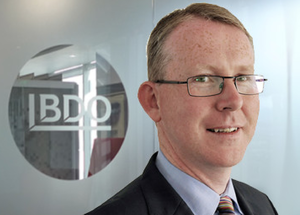
From top: Dundrum Town centre, part of portfolio of loans known by Nama as Project Jewel: NAMA board member Brian McEnery  British property giant Hammerson’s statement on Project Jewel, June 2016

Nama Wine Lake writes:

On Sunday last, Brian McEnrey a board member of NAMA was on the Marian Finucane show defending NAMA and badmouthing the Comptroller’s report [Into Project Eagle].

During the interview, Mr McEnry made this statement

“Project Jewel, Dundrum Shopping Centre held until we were at the very height of the market and sold for about a billion euros profit into Nama.”

It has some in the property and investment sectors scratching their heads as to how it could be true.

So what is Project Jewel?

This was a portfolio of loans linked to Joe O’Reilly, a NAMA Top 10 borrower. The loans had a par value of €2.57bn and were secured on collateral which included the Dundrum Town Centre shopping centre in south Dublin, Joe O’Reilly’s 50% stakes in the Ilac centre in Dublin city centre and the Pavilions shopping centre in Swords.

Other property collateral included an area around North O’Connell Street/Moore Street which has planning permission for a major new shopping centre.

How much did NAMA pay for Joe O’Reilly’s loans?

We don’t directly know. We do know the loans were acquired in two steps. Step #1 was in 2010 when NAMA acquired loans for the top developers from several Irish banks and building societies (Bank of Ireland, AIB, Anglo, EBS and Irish Nationwide)

Step #2 was unusual, and involved NAMA buying from Ulster Bank its €129m loans which were secured on the Dundrum Town Centre. NAMA paid Ulster Bank par value for the loans, in other words, it paid €129m.

We do know, in general, that NAMA acquired all of its €74bn loans from the banks in 2010-2012 for at an overall 44c in the euro. NAMA paid less for loans which had poor collateral. Dundrum Town Centre and the Ilac and Pavilions would have been considered good collateral.

How much did NAMA sell Project Jewel for?

€1.849bn was the price when NAMA sold the portfolio in early October 2015. The buyer was a venture between the British property giant Hammerson and the insurer Allianz.

Is it possible NAMA made a profit of €1bn on the sale of Project Jewel?

If the sale price was €1.849bn and NAMA made a profit of €1bn, that suggests the NAMA cost of the loans was €849m (€1.849bn minus €1bn). If NAMA paid €129m for the Ulster Bank loans, that suggests the cost of the other loans was €720m (€849m minus €129m).

Deducting the Ulster Bank loans from the par value of Project Jewel suggests the par value of the Step #1 NAMA loans was €2.44bn (€2.57bn minus €129m). That suggests the NAMA cost of €720m versus the par value of €2.44bn was 30c in the euro, which was worse than the average NAMA acquisition price.

The perceived wisdom would be the cost of Joe O’Reilly’s loans would have been greater than the average 44c in the euro because the collateral was so good.

It seems very unlikely to the point of incredibility that NAMA made a €1bn profit on Project Jewel, at least in the way it was presented by NAMA last Sunday.

There may be complicating factors such as the interest charged on the loans by NAMA in 2010-2015, and NAMA may be including that interest in its “profit”, but that would be disingenuous and at odds with how NAMA’s loss on Project Eagle was calculated.

Was October 2015 “the height of the market”?

No, according to the JLL Irish commercial property indices, prices have been increasing for all property, including retail up to June 2016, the latest period for which JLL has issued its indices.

Between Q3,2015 (the end of which NAMA sold Project Jewel) and Q2,2016, Irish commercial property overall has increased by 9.4%, whilst retail, which forms the greatest element of Project Jewel increased by 8.4%.

Q3,2015 was certainly not the “height of the market”.

Are the buyers now making a profit on Project Jewel?

Oh yes, at least on paper. Hammerson, one of the parties to the venture which bought Project Jewel, issued a statement in June 2016 which said:

“Project Jewel was accretive to 2016 EPS and with opportunities for valuation growth, the portfolio provides an attractive projected five year ungeared IRR of 7-8%, excluding development returns”.

Translated into basic finance, Hammerson expects its purchase from NAMA will make a €870m profit in five years, excluding financing costs, and also excluding any unforeseen profits from developing the properties including the property at Upper O’Connell Street.

Yesterday: Taking The Michael

Nama Wine Lake

Rollingnews

This afternoon.

The Fianna Fáil think-in begins in the Seven Oaks Hotel in Carlow.

Hmmm.

Meanwhile…

Earlier: Taking The Michael

Previously: ‘It’s Almost As If There Was No C&AG Report’

Screech

screen-shot-2016-09-19-at-02-57-36 finucane

Nama audit committee chair Brian McEnery, a partner on the Corporate Finance & Recovery Team at BDO Ireland; and RTÉ’s Marian Finucane

Yesterday.

On RTÉ Radio One’s Marian Finucane show.

The chair of Nama’s audit committee Brian McEnery gave a one-to-one phone interview with Ms Finucane while her panel was in the studio, in light of the recent C&AG report into Nama’s Project Eagle sale.

Ms Finucane explained, before the 25-minute interview began, that the accountant, who was in London, did not wish to be a part of the panel discussion.

Ms Finucane didn’t mention that Mr McEnery was a member of Nama’s Northern Ireland Advisory Committee, of which Frank Cushnahan and Ronnie Hanna were members.

She also didn’t mention that Mr McEnery was director of elections for Fine Gael’s Michael Noonan, now Minister for Finance, before the general election in 2011.

Mr McEnery was first appointed to Nama on December 22, 2009, for a four-year term, by the late former Minister for Finance Brian Lenihan, while he was re-appointed for a five-year term on December 22, 2013.

The Northern Ireland Advisory Committee was established on January 7, 2010 and dissolved in September 2014, after the sale of Project Eagle.

In 2013, the then Minister for Health James Reilly appointed Mr McEnery as chairman of the Health Information and Quality Authority (HIQA).

Mr McEnery was also on the board of directors for Limerick City of Culture board in 2014.

In addition…

Readers may wish to note the following excerpt from the book, The Untouchables: The people who helped wreck Ireland – and are still running the show, written by the now Minister for Transport, Tourism and Sport Shane Ross and Nick Webb in 2012:

McEnery was a partner at Horwath Bastow Charleton, which, according to its website, ‘can support businesses in preparing business plans and in dealing with Nama and their other bankers’. In April 2012, he joined BDO Ireland as a partner.

The firm examined developer business plans on behalf of Nama and is on the state agency’s panel of receivers.

in June 2011, McEnery’s new employer was appointed as a receiver to developer David Daly’s Irish and UK assets. Daly owed €457million and was one of Nama’s biggest clients.

BDO was also a close adviser to one of Nama’s top ten clients, Dundrum Shopping Centre developer Joe O’Reilly.

Turlough Flynn, who works at O’Reilly’s Crossridge Investments, was listed as a guest of BDO at the Chamber of Commerce dinner in the Four Seasons in February 2012. Nama chairman Frank Daly was the keynote speaker that night.

Nama’s board is in receipt of commercially sensitive information, the kind of stuff that clients of a firm like BDO would kill for. Having the inside track on an organisation as secretive as Nama would be hugely valuable for dealmakers trying to buy assets from Nama or even for negotiations with clients.

McEnery will need all of his wits to avoid all the potential conflicts of interest that his new career move has brought.

But back to the interview…

Marian Finucane: “Brian McEnery, good morning to you, and you’re welcome to the programme.”

Brian McEnery: “Good morning, Marian, thank you very much.”

Finucane: “From your perspective, can you address this secrecy issue?”

McEnery: “I will, Marian. Well, I’ll try my best. We’re, I suppose, in a way, Marian, we’re like a bank. And, when you’re dealing with a bank, but it’s even worse cause we’re dealing with a bank which is effectively trying to deal with debtors where their assets are distressed. And that means that a lot of value they once upon a time had, or felt they had, is now gone, and so, it is, the relationship, quite frankly, I suppose, is that it is around distressed debt. And, for us, take the one or two times, Marian, and you say, I do need to say, it isn’t as if everything has been perfect in Nama, there have been one or two leaks…”

Finucane: “Oh my goodness.”

McEnery: “…of information.”

Finucane: “Uh-hum.”

McEnery: “And when that happened, you know, we came in for a mighty, mighty amount of criticism that items of information got out into the public arena and so, in some ways, and I believe we justifiably got criticism for that. Former employees of Nama who intentionally did things wrong and, but, in those instances, you know, the secrecy is terribly important around debtors’ commercial dealings, the level of debt that they have outstanding, how it’s going to be best achieved, income on behalf of the State and if we did operate in a much more transparent way, I think, we would not get the same kind of yield that we have got back on behalf of the taxpayer. So, to go back to your discussion a minute ago…”

Finucane: “Uh-hum.”

McEnery: “Where, it was said, if it was known about the strategy, as to the realisation of the Northern Ireland portfolio, wouldn’t that damage Nama’s commercial interests and that is true, Marian. If there is a lot of information out there, which is commercially sensitive, it absolutely will damage the commercial interests of Nama which is the commercial interests of the taxpayer.”

Finucane: “Well, what people are puzzled by, is that if Mr Cushnahan informed Nama that he was acting for six or seven of the clients, he would have been part, maybe not, we don’t know, it’s an allegation, of the actual figures, but he would have been aware of the strategy?

McEnery: “I tell you. So. To go back into talking about Mr Cushnahan for a second and it’s, I think, you’ll, you’ll recognise it’s important that I don’t say that he has done anything wrong…”

Finucane: “Absolutely..”

McEnery. “Yeah.”

Finucane: “Absolutely…yeah.”

McEnery: “Those investigations are ongoing and we’ll see where they go to. But. Firstly, I can tell you, if, if they do come out to be true, there will be nothing form my perspective other than utter disgust. However, that said, originally, Marian, the Northern Ireland government wanted a director on the board of Nama. If that had happened, I believe we would be in a terrible place now – if we had the same cast of characters. [Late former Finance Minister] Brian Lenihan resisted very heavily and, clearly [Finance Minister] Mr Noonan has done the same. That was a recurring request, from the Northern Ireland government, that it wouldn’t just be on a little committee of Nama, that it would be at the main board, thankfully that didn’t happen. In relation then, and on the basis, of some element of diplomacy, this Northern Ireland Advisory Committee was established. We continuously resisted the request for board membership from Northern Ireland, for good reason. It’s the Irish taxpayers that are, the Republic of Ireland taxpayer who’s funding this, not the Northern Ireland one. So, that was resisted, and that is really the critical point. In terms of Mr Cushnahan and the Northern Ireland Advisory Committee – he was nominated by the DUP. And the other nominee was Brian Rowntree. They were the two nominees on it. We absolutely made it clear, from day one, there would never be a debtor discussion, of any description, there would never be a screed of information about a debtor given to the Northern Ireland Advisory Committee. They never saw…”

Finucane: “But, presumably, they would have known of the decision to get rid of the loans, all in the one go, so to speak. And they…”

McEnery: “In actual fact, Marian, when that arose, the Northern Ireland Advisory Committee was not consulted…”

Finucane: “But would they have been aware of it?”

McEnery: “I don’t believe so. When. Because. It was kept from the Northern Ireland Advisory Committee, in actual fact, we didn’t meet. The Northern Ireland Advisory Committee would only meet periodically.”

Finucane: “Uh-hum.”

McEnery: “And when Nama, as a board, was making its decision making around, around this, it did not consult with the Northern Ireland Advisory Committee.”

Finucane: “So, what did you talk to the Northern Ireland Advisory Committee about, when you met?

McEnery: “I tell you what we did talk about, we talked about commissioning research from the University of Ulster, around the property indexes in Northern Ireland and whether property was going to generally going be going up or going down or, that’s what we talked about, we kept it intentionally at a very, theoretical high level. And I can tell you this: in terms of the so-called data that Mr Cushnahan had, he didn’t get it from Nama. Because if he did, the data would have been right and it was very wrong. It was up to 80% out on some of the balances in relation to the Miskelly letter. So, he didn’t get it and I think, quite frankly, I believe, and my sense is, that Mr Cushnahan was peddling influence that he didn’t have..”

Finucane: “Well..”

McEnery: “Peddling that he had data which he didn’t have.”

Finucane: “Well that remains to be seen now and there will be investigations done on that. It is alleged that, in some of the sales, if we leave the [Project] Eagle one aside for the moment, that, in some of the sales, and I presume aggrieved debtors, that the property changed hands, big property, big money, was sold off at such a low price, that it was flipped by the buyer, within one or two years – is that true?”

McEnery: “Marian, I tell you what we, what we do. We have a very, very robust process. And, you see, take, take a house, Marian, as an example…”

Finucane: “Uh-hum.”

McEnery: “I want to give you a very fair but accurate answer.”

Finucane: “Yeah.”

McEnery: “Say you buy a house and I’ve sold it to you for 100,000 but let’s say, nobody knows, Marian, that you might have put in another 20,000 euros into it and redecorated it because I hadn’t put any money into it in 10 years beforehand and you go and sell it for 125,000 and you’d say, jeez, they made a 25% increase on the value of the property, wasn’t he an awful fool for selling it for 100,000 euros..”

Finucane: “But if you go back to the principle of the bad bank, my understanding of the bad bank was that you took the toxic loans off the balance sheets of the banks.”

McEnery: “Correct.”

Finucane: “…to allow them to function and the idea was then to hold on to some fantastic properties until the market would start to rise again which it has always done. But it seems that..but, just to come back to this.. because from more than one story, I was told by three different sources, about certain properties and the loans were sold off, say at around 200million and were flipped for 400million.”

McEnery: “Yeah, you see, you just don’t know what happened the assets in the intervening time period, Marian.”

Finucane: “In a very short period of time. In other words, there was a feeling that there was a fire sale going on and that there was a rush to get rid of all this…”

McEnery: “I tell you what we did..”

Finucane: “Instead of holding on to it, which, I understood, was the principle behind a bad bank.”

McEnery: “No, absolutely So, we took the assets over in 2010, Marian and the objective was, was to have all of Nama completed by 2020. Government sent Nama the objective of expediting that to 2018 – for the benefit of the sovereign, for the benefit of Ireland to get back out and show that it was dealing with its issues and 2020 became 2018. So that’s fine. And that became our objective but to do exactly what you have also said, Marian which was to be, to give you an example, Project Jewel, Dundrum Shopping Centre held until we were at the very height of the market and sold for about a billion euros profit into Nama. Other assets that we have dealt with, sold, now what we did do in the early days of the strategy, was not to, was in actual fact to try and sell the London assets because there was good yields in London property and, aswell as that, if we put a lot of the Irish property into the marketplace in 2010 and 2011, we’d have made the Irish property market an awful lot worse so we did warehouse Irish property and it was only, as you know, in the relatively recent times that we sold off, and we are still selling some of the prime assets and I can tell you we are making profits and, overall…”

Finucane: “But, if you take the overall sums you’re dealing with.”

McEnery: “Yeah.”

Finucane: “Like 2 billion, we’ve got so used to billions in this country, that we talk about them like snuff at a wake but, anyway, in the order of things, proportionally, 2 billion doesn’t seem like a huge profit, given the level of billions we’re dealing with?”

McEnery: “Well. Ok. What are we going to do, so? The goals have been set that we develop 20,000 housing units and we further do out and put in all the infrastructure and to put office accommodation into the Dublin Docklands. That’s the, the three objectives now of Nama, at this point in time are: continue to sell off the loans and deleverage and to repay the bonds. The original objective and it was the prayer, I think, of all Irish taxpayers back in 2009/2010 was that Nama would not lose money and there was an awful lot of commentary that this was going to be a disaster; it was going to be an unmitigated burden on the taxpayer forever more. It won’t be, Marian. We are guiding that we will make a 2.5billion euro profit…”

Finucane: “On what turnover?”

McEnery: “On. So. We, we issue bonds to the tune of about 32billion and we will repay both the senior and the subordinated bonds and we will make a profit for the exchequer of about an extra 2.5billion. It may vary upwards by the end of the day but that’s what we’re guiding at the moment. In addition, we will have developed 20,000 housing units by 2020. We’ve over 4,000 developed in the last year and a half and we will put infrastructure in the Dublin Docklands which will allow big new companies to come into Dublin city centre. That’s, they’re the three objectives but it won’t be a loss, it will be a profit..”

Finucane: “Yeah but..when you say a profit, that sounds very positive and we’re all very glad, thank you very much for any profit we can get but you couldn’t call it a mega profit.”

McEnery: “No, no it isn’t a mega profit..”

Finucane: “No.”

McEnery: “But you know what…when we bought the loans..”

Finucane: “It comes back to the point that if you take the story about the 200million flip to 400million, you know, it looked like this was a fire sale and I know that on that one, the person involved had never missed a payment to a bank and it seemed that they were all treated the same way – whether they were performing or whether they weren’t performing and, indeed, that was the point that Mr Kelly was making in his article today, too.”

McEnery: “Well, Marian, and I listen to your, I listen to your programme every Saturday and Sunday.

Finucane: “I’m delighted to hear it.”

McEnery: “I’ve heard debtors who give out about Nama on your programme, and I’ve heard debtors who come in and say Nama is tough to deal with but we’ve got on, we’ve had a relationship with them and we’ll continue to develop with finance that Nama has put out. I can tell you, but truthfully, we would, we would, there would be a much, much, much bigger issue for the Irish taxpayer if people were coming on, saying Nama is nice, they’re great people to deal with…”

Finucane: “The other thing is, some of these guys, and I’ll come back to the Eagle project then, some of these guys that we’re talking about, would have described in the past as like masters of the universe and, as I understand it, from another contributor on the programme, who used to work with Nama, and she was saying that they, the debtors, had to sign a confidentiality. Now I fully understand how Nama has to be, have to have confidentiality about everybody’s business. But each individual should surely have the right to talk about their own business and they were terrified to.”

McEnery: “That was around the original business planning and, I mean, ultimately, when you say that it’s important that Nama keeps its strategy close and plays its cards close to its chest because that’s important in delivering value to the taxpayer, that’s what we try and do, we do try and ensure that if, that if there’s a strategy agreed with debtors that it’s not, no more than, if you go in and you borrow from, from other banks..”

Finucane: “Yeah.”

McEnery: “You know, you don’t go around, telling other people exactly what you’re…”

Finucane: “But I could, I could, like the bank couldn’t. But I could. And I could say I borrowed 125,000 to buy a house off Brian McEnery, I mean I can say that because it’s my business. I mean the bank has to retain confidentiality but I can tell the pope of Rome if I want to..”

McEnery: “Yeah. Well. I can tell you this. If a debtor, and we are working with a number of debtors around Dublin where they’re building houses and they’re absolutely perfectly free to go out and talk about their interactions. We would actually be happy for them to go and talk about their interactions with Nama.”

Finucane: “Then why did they have to go and sign a contract to say they wouldn’t?”

McEnery: “That was in relation to the original business planning process. They don’t now, they don’t now have to go off and sign confidentiality agreements.”

Finucane: “All right. Now, every time it comes up at the PAC, the Public Accounts Committee, about the non-answerability, the secrecy, oversight and all of that, it has always been said, by the two gentlemen, oh the C&AG, the Comptroller and Auditor General’s office has oversight, we are answerable to the Comptroller and Auditor General, as somebody said, it was the blanket behind which it was hidden and the minute the Comptroller and Auditor General says, I don’t like this, I’m not happy with that, you get very, very exercised. We have invited Nama, for a spokesperson on this programme, I cannot tell you how many times and not a dickie bird, not questions to be answered and I’ve no doubt that other journalists, and print journalists, have done the same. But, out of the traps, was Frank Daly. Then we see Brendan McDonagh iand thank you very much for coming on our programme but you don’t accept the Comptroller and Auditor General’s authority?”

McEnery: “No, and I’m going to tell you why. I’m going to tell you why. And I’m glad cause I’d like a minute or two to talk about this, if I could. And, firstly, I’d be delighted to come on the Marian Finucane show anytime..”

Finucane: “Oh, well, that’s good, thank you.”

McEnery: [Laughs] But. So. I’m an auditor and accountant myself, that’s my background, Marian. And I’m chairman of the audit committee [at Nama]. I interact with the C&AG every month. It comes to our, or his [Seamus McCarthy] staff come to our audit committee meeting and, you know, when I do hear Michael McDowell saying, it’s wrong, the C&AG shouldn’t be challenged. It’s wrong for anybody in Nama to say that Nama shouldn’t be challenged..”

Finucane: “He didn’t actually say that. What he said was: neither speaks ex cathedra. He was referring to yourself and to the Comptroller and Auditor General. That’s [him] writing [in the Sunday Business Post] today.. in other words, neither party, everybody should be questioned in other words.”

McEnery: “Ah well, yeah. Let me. So. I believe, and I’m going to try and go through the, go down through one or two points as to why I believe, as an experienced auditor, I’m president of our accounting body and I’m going to try and tell you why I believe he’s wrong. Firstly, I do agree with somebody who said if the C&AG is right, Nama is wrong. And for Nama to be right, the C&AG has to be wrong. And I think he is wrong and I’ll tell you why. Firstly, I think it was [former Labour leader] Pat Rabbitte said, earlier on, the discount factor of 5.5%. It’s as if they’re the prima facies in the whole of Ireland, the United Kingdom and Europe to use a discount factor of 5.5% – it’s ridiculous.

I made my decision that this was the right thing to do. The carrying value of the loans, Marian, at that day, at the 31st of December, 2013, was 1.48billion pounds. I said the minimum discount factor, because these, and another one of your commentators is absolutely right in saying these were poor and secondary Northern Ireland assets and they were assets out of the north of England. We had German, one or two Northern Ireland borrowers had German assets, we sold those off separately. So, these are secondary assets, it would be at least a 10% discount. C&AG has we’ve made that point to C&AG on a number of occasions and how he can say that a 5.5% discount is the right discount factor to use, is, in my opinion wrong. Now, second thing is originally the C&AG went out and tendered for expert commercial advisory services, to help him with this report. He didn’t get any and he didn’t appoint any and, as a consequence, I think even by the fact he went out looking for it is an indication that he did not have good commercial expertise on this and this is ultimately…whether the taxpayer got…”

Finucane: “Yeah, but, do you know, can I just cut across you there?”

McEnery: “Yeah.”

Finucane: “I mean I have no doubt of the good intentions of everybody that’s involved on your board. But you could equally say about Mr Daly, he was a civil servant who was a head of Revenue, which would have had very little indeed…”

McEnery: “Sure.”

Finucane: “To do with the kinds of deals you’re talking about now but presumably you learn as you go along?”

McEnery: “No but now, there’s a big difference Marian, we do appoint external experts, we do not make a decision without that expertise, we had Lazards. We would not have been able, as a board, to make that conclusion that this was the right thing to do. So..”

Finucane: “And did you, at any stage, consider breaking up the package?”

McEnery: “Oh we did, we did, one of your commentators…”

Finucane: “And why did you decide against that?”

McEnery: “One of your commentators this morning said this was a very big portfolio to bring at 1.3billion. In actual fact, we’ve done transactions on the size of 3billion. There are players, Marian, in the marketplace, these big companies that you talked about: Pimco, Cerberus, loans that are, there’s many of these there and in actual fact, quite truthfully, if they’re not of a certain size, they won’t participate. They need..”

Finucane: “But doesn’t that not also exclude people who would be lesser mortals than Pimco?”

McEnery: “Correct, that is true but, ultimately, we’ve got to try and devise the best strategy that we believe will ultimately get the best value. Now.”

Finucane: “OK.”

McEnery: “A little question, though, Marian is C&AG, and as I said, I interact with him 10 or 11 times a year. He did the audit himself in 2013, he did the audit in 2014. Project Eagle was across those two years. He gave us clean audit reports, he looked at Project Eagle, he didn’t say there was a problem with Project Eagle in 2013 audit or the 2014 audit. Yes, an audit is about the truth of the financial statements but it’s also about, do the controls exist to maximise the return to the shareholders. He gave, the C&AG looked at that twice before this report and he signed off a clean audit report. The next and most important thing and fair process is awfully important and I’m chairman at HIQA and when we do an investigation in HIQA, where it’s complex, we get external expertise to assist us. So, for instance, in the Portlaoise inquiry, we had four external experts. We always meet with the party that we’re investigating. I requested three meetings with the C&AG and he refused to meet…”

Finucane: “Well.”

McEnery: “I have to say, I think that’s wrong.”

Finucane: “Well, I mean, clearly, you’re all very cross indeed with the Comptroller and Auditor General but the fact is that he is a constitutional role within Ireland and he’s a very important person as the guardian of our financial welfare so to speak. So, I presume there is now going to be an inquiry..”

McEnery: “Well he is important and, you know what, it isn’t easy for me to, it isn’t, I’m not happy coming out and saying this but I don’t think there was proper process. He didn’t meet Lazards, our expert advisors, for instance, I mean, it’s hard to, it’s hard to see how somebody could come to a conclusion but I want to say one other important thing…”

Finucane: “Yeah, and then I’ll have to go, yeah.”

McEnery: “Yeah, which isn’t known. We get, we got a number of drafts from the C&AG, where he was doing his work and he’d send a draft. We’d go through it and then put in a response and that happened on maybe three or four occasions. And in every one of those, the word [s] ‘potential loss to the taxpayer’ was inside in it. When, when he published it, without us having a chance to go through it and having left us with the previous version which is that there was a potential loss of value to the taxpayer, he changed his wording and said there was a probable loss…”

Finucane: “Well, there you go. He arrived at that conclusion.”

McEnery: “But, well he did, but I mean, ultimately, when you talk about interacting with somebody you’re investigating, you don’t let them know about that. I mean, that’s. I have to say, that’s, I thought that was extraordinary. He gives us the draft and, down on them, the one where he asks us to give us the comment back on the word, there was a potential loss, which we would contest anyway…”

Finucane: “But I mean obviously you would because you had arrived at the decision. But it doesn’t necessarily mean that you are infallible..”

McEnery: “No, we’re not..”

Finucane: “The general tone, from Nama, is one of absolute infallibility..”

McEnery: “No.”

Finucane: “No queries, no questions, no criticism, no differences of opinion, it could be the fact that the man, and his office, differ in their opinion to the opinion of your board and that’s..”

McEnery: “But I’m trying to say, Marian, there is a process and that process would be at very much variance with how investigations would be done by, for instance, HIQA, as an example..”

Finucane: “Ok, listen, I’m going to have to, I’m going to have to leave it there cause I’ve to come back to my panel here in studio, Brian and thank you very, very much indeed for talking to us this morning. That was Brian McEnery of Nama. We’ll take a break.”

Listen back in full here

Previously: ‘The Taxpayer Got Full Value For Money’

‘A Probable Loss Of Value To The State Of Up To £190million’

screen-shot-2016-09-14-at-19-54-26

screen-shot-2016-09-14-at-19-55-05

This evening.

On RTÉ’s Six One.

Chairman of Nama Frank Daly was interviewed by Brian Dobson.

At the very  end of the interview:

Brian Dobson: “You still say tonight, that the taxpayer got full value?”

Frank Daly: “I say, absolutely, the taxpayer got full value for money. And I say it even more strongly now in a post-Brexit environment. If we were trying to sell that portfolio now – we would not get offers anywhere near £1.32billion).”

Watch back in full here

Alternatively…

Namawinelake writes:

What loss did Nama make on the Project Eagle transaction?

Depends on how you define “loss”!

The Nama projection of its ultimate profit by 2020 is €2.3billion. If it hadn’t sold Project Eagle in 2014, and worked the loads out between 2014-2020, the ultimate profit would be €2.74billion. So, the loss is €440million*.

By selling the loans in 2014, Nama did not generate £1.68billion in projected net cash receipts by 2020 on those loans. Instead, it sold the loans for £1.3billion.

So, the loss is £380m (€444m). This loss arose from two decisions (1) the decision to sell in 2014 rather than manage the loans until 2020 and (2) the decision to sell the loans below Nama’s own valuation.

On the other hand, if you compare the safe value of the loans in 2013 (£1.3billion) versus the Nama valuation of the loans in 2014 (£1.49billion), the loss is £190million (€222m).

Facts

1-  Nama has until 2020 to manage its loans so as to maximise their value for the taxpayer. Nama did not have to sell the loans in 2014; it could have managed the loans until 2020, which would have resulted in the loans generating £1.68billion, according to Nama’s own projections.

2-  Nama used the proceeds from the sale of Project Eagle to redeem senior bonds which have a zero (technically a minus) interest rate. Nama could have used the proceeds from the Project Eagle sale to invest in its assets, but it didn’t; Nama used the cash to pay down its own debt which cost it nothing.

Report Extracts (which emphasis added).

“In a paper submitted to the Board for the December 2013 meeting (reproduced in Appendix C) the Nama executive sought the Board’s approval for the sale of the loans. The paper indicated that the total Nama debt for the loans at the end November 2013 was £1.98 billion – equivalent to 43% of the par debt.”

“Cash flow projections indicated that Nama would realise net receipts totalling £1.68 billion over the period 2014 to 2020 if it worked out the loans through the sale of the underlying assets in line with its formal strategy.”

“The minimum price of £1.3billion set for the sale of the Project Eagle portfolio was significantly less than Nama projected it would realise from working out the loans – an estimated £1.68billion, equivalent to £1.49billion in NPV terms, using Nama’s standard discount rate.”

The difference between the minimum price and the projected NPV of the workout was up to £190million, depending on the extent to which the adjustment of the 2017 disposal proceeds was valid.”

“As a result, the decision to sell the loans at £1.3billion involved a significant profitable loss of value to the State.”

“Ultimately, the loss incurred when the sale was completed was recognised in Nama’s financial statements for 2014.”

Previously: ‘A Probably Loss Of Value To The State Of Up To €190million’

UPDATE:

proxy

Independents 4 Change TD Mick Wallace writes:

“For too long the Minister for Finance and Taoiseach have displayed breathtaking indifference, and at times arrogance, to any form of oversight of NAMA.

The C&AG report deals with just one aspect of NAMA’s operation – if the Government want all the truth in the open, only a truly Independent Commission of Investigation has any chance of exposing just how dysfunctional this organisation has been, and what the cost has been to the people of Ireland.

 Until then, the proceeds of the sale of Project Eagle should be frozen, under the ‘Proceeds of Crime Act’ and all NAMA activities should be suspended.

Previously: Project Eagle And the €3.5billion Haircut

screen-shot-2016-09-14-at-16-20-45

screen-shot-2016-09-14-at-17-56-07 screen-shot-2016-09-14-at-17-56-18

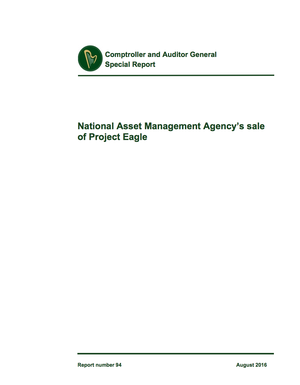
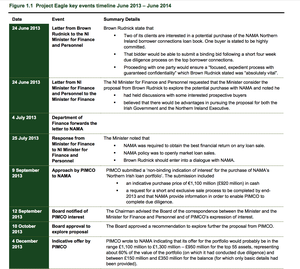
The Comptroller & Auditor General’s report into Nama’s Project Eagle sale and a timeline of the sale, as set out in the report

The Comptroller & Auditor General’s report into Nama’s sale of its Northern Ireland property portfolio, Project Eagle, to Cerberus has been published.

From page 10 of the 158-page report:

The sales of Northern Ireland debtor assets outside Project Eagle involved disposals of 125 properties – mainly in Germany and Great Britain – and represented about one eighth of the carrying value (after impairment) of the Northern Ireland debtor portfolio.

On average, NAMA incurred losses of around 1% on those sales. The corresponding loss rate on Project Eagle was 13%.

From page 11:

In a paper submitted to the Board for the December 2013 meeting (reproduced in Appendix C), the NAMA executive sought the Board’s approval for the sale of the loans.

The paper indicated that the total NAMA debt for the loans at end November 2013 was £1.98 billion – equivalent to 43% of the par debt.

Cash flow projections indicated that NAMA would realise net receipts totalling £1.68 billion over the period 2014 to 2020, if it worked out the loans through the sale of the underlying assets in line with its formal strategy. The paper recommended a minimum price of £1.3 billion be set for a loan sale.

…In June 2013, the NAMA Board endorsed the use of a standard discount rate of 5.5% to evaluate the viability of potential transactions or commercial decisions, including decisions whether to hold or sell an asset.

The examination team applied that standard rate of 5.5% to the projected cash flows in NAMA’s December 2013 paper, and estimated the loans had a NPV of £1.49 billion. This amount represents the probable value to NAMA, as at the end of 2013, of working out the Northern Ireland debtor loans.

As a result, the decision to sell the loans at a minimum price of £1.3 billion involved a significant probable loss of value to the State of up to £190 million in NPV terms.

…The paper presented [by the NAMA executive] to the [NAMA] Board projected the end-December 2013 carrying value of the loans at £1.48 billion. This was a forecast of the value of the loans that would be reported in NAMA’s 2013 annual financial statements.

However, the paper proposed a downward adjustment of £85 million in the carrying value to reflect additional expected impairment, resulting in an ‘adjusted carrying value’ of £1.39 billion. This examination found that the records supporting the December 2013 paper did not provide evidence justifying the adjustment.

Other evidence presented by NAMA during this examination supports a downward adjustment of, at most, around £8 million in cash terms. Consequently, the adjusted carrying value of £1.39 billion presented in the paper to the Board underestimated the value of the Project Eagle loans.

From page 12:

The NAMA paper for the Board recommended that the minimum price for the sale of the loans should be £1.3 billion, but did not state that this would represent the best achievable return, or what the recommended minimum price was based on.

From pages 12 and 13:

…the Board has stated that its decision on setting a minimum price was based on the portfolio’s adjusted carrying value (i.e. £1.39 billion) and on the Board’s acceptance that a purchaser’s discount of at least 10% would apply if the loan sale were to proceed. The Board also stated that the minimum reserve price was the best price deemed achievable through a loan sale.

The argument that a discount rate of 10% would have been appropriate in calculating NAMA’s workout value for the loans is not persuasive.

From page 13:

The minutes of the meeting on 12 December 2013 record that: “The Board agreed that the paper and analysis presented therein presented a compelling commercial case to sell the portfolio, and that in addition such a portfolio sale would release NAMA from what had been a disproportionate burden of effort in light of the relative size of the portfolio.”

From pages 17 and 18:

During NIAC meetings and in annual statements of interests, one external NIAC member, Mr Frank Cushnahan, declared his involvement as an advisor, mainly on a non-fee basis, to six NAMA debtors and to a third party engaged in a joint venture with a seventh debtor.

The examination team estimated that the loans of the six debtors represented about half the value of the Northern Ireland loan book.

The NAMA Board should have formally considered whether Mr Cushnahan’s engagement in discussion of the strategy – including the PIMCO/Brown Rudnick approach – was consistent with his ongoing involvement as financial advisor to a significant proportion of NAMA’s Northern Ireland debtor connections.

NAMA sought and relied on an assurance from Cerberus that no fee or payment was payable to anyone connected with NAMA “in connection with any aspect of our (Cerberus) participation in the Project Eagle sales process”.

NAMA only learned of Brown Rudnick’s engagement with Cerberus on 2 April 2014, and do not appear to have asked Cerberus when it engaged Brown Rudnick, or what was the precise nature of the services Brown Rudnick and Tughans were providing to Cerberus.

The allegations of Mr Cushnahan’s involvement in an arrangement to share fees with Brown Rudnick and Tughans (or the managing partner of Tughans) warranted more action by NAMA when the matter came to light, such as seeking advice from the unit within the National Treasury Management Agency that was responsible for providing compliance support to NAMA, or writing to Mr Cushnahan to seek confirmation or an explanation.

Lazard was not briefed on the disclosures, and was not asked for its assessment of the potential implications for the integrity of the sales process. NAMA appears to have taken a narrow approach, focusing on what were its legal obligations, rather than on what were the options for action that should be considered.

Meanwhile…

UPDATE:

More as Namawinelake we reads it.

Read the report in full here

screen-shot-2016-09-12-at-15-12-58

[soundcloud url=”https://api.soundcloud.com/tracks/282537894″ params=”auto_play=false&hide_related=false&show_comments=true&show_user=true&show_reposts=false&visual=true” width=”100%” height=”450″ iframe=”true” /]

Taoiseach Enda Kenny, and Martin Hayden, chairman of the Fine Gael parliamentary party, at the party’s think-in in Newbridge, Co Kildare this morning, and the audio of an interview Mr Kenny gave to KFM Kildare this morning

On Saturday, Pat Leahy, in the Irish Times, reported that the C&AG found that hundreds of millions may have been lost in the sale of Nama’s Northern Ireland property portfolio, Project Eagle, to US investment firm Cerebrus.

It was reported that this loss may have been due to what the C&AG found to be “shortcomings” and “irregularities” in the sale.

The C&AG report is due to be published on Wednesday.

The report about the C&AG study followed a BBC Northern Ireland Spotlight programme into Project Eagle broadcast last week, which followed an earlier Spotlight programme in March – both of which made serious allegations about the Project Eagle sale.

Readers may recall how, on June 1, Taoiseach Enda Kenny told the Dáil:

There has not been any allegation of wrongdoing against NAMA”.

In addition, on June 8, Mr Kenny told the Dáil:

“Nobody has presented me with evidence of wrongdoing by Nama”.

Further to this.

Taoiseach Enda Kenny spoke to Shane Beatty, of KFM Kildare, this morning, ahead of the Fine Gael’s knees-up think-in starting today in Keadeen Hotel, Newbridge, Co Kildare.

The C&AG report into NAMA was discussed.

From the interview…

Enda Kenny: “If I find… if I find, and our colleguess in Government, find that there is a case to be examined well then I won’t be opposed to that.”

Shane Beatty: “But viewers of BBC’s Spotlight will say we’ve already seen a case that I think we need to have an inquiry, why do we have to wait until Thursday?”

Enda Kenny: “There are two criminal investigations going on in a different jurisdiction.”

Shane Beatty: “None here.”

Enda Kenny: “None here, and the National Crime Agency in the UK have confirmed that there is no case that they have, or are in pursuit of, in repsect of NAMA down here. So, the C&AG’s report is about a ‘value for money’ audit and you, as was pointed out on many occasions… depending on the process you follow for valuations, you might get different results.

“If you, for instance, were to dispose of the properties now with the devaluation of Sterling you’d get a different result also. But I think this is an extensive report, we do need to read it, everybody needs to reflect on it. And if there are questions arising from the Public Accounts Committee’s engagment with NAMA, they are due in before them very shorty [September 22], I’m not adverse [sic] to taking action, but I need to know what is we are taking action on.

Shane Beatty: “Did you watch the Spotlight programme?”

Enda Kenny: “Yes I did, and I saw that, and I found it quiet incredible, but you know, Shane…”

Shane Beatty: “Incredible, how?”

Enda Kenny:Nothing suprises me at the kind of activites that take place in politics. And in that sense I found it extraordinary to hear the audio report of engagements and meetings of certain personnel.”

KFM Radio

‘Hundreds of millions lost by Nama’ in sale of Northern properties, report finds (Irish Times, Saturday, September 10, 2016)

Previously: Screech

That Nama Vote In Full

Meanwhile, yesterday….

Labour TD and vice chairman of the Public Accounts Committee (PAC) Alan Kelly was interviewed on This Week by Colm Ó Mongáin following the reported findings of the C&AG report.

During the interview Mr Kelly said, in recent days, he was approached by a senior member of Nama ahead of Nama’s appearance before PAC on September 22.

From the interview…

Alan Kelly: The [C&AG] report on this should be released, and obviously then, Nama will come before the PAC. It’s a matter for Nama whether they want to make public statement on it, I believe they should, I believe they’ve been quite naive to a point in relation to this.

Even this week, a senior member of Nama contacted me to brief me before they met before the PAC. I redirected him to the chair of the PAC. I was not comfortable that selective briefings was the way to go to be appropriate given the situation we find ourselves in. But that just shows another level of naivety, I believe, in relation to Nama.

Colm Ó Mongáin: These briefings that were offered by Nama, how was that approach made and by whom?

Kelly: “Ah well, I won’t, eh, get into individual, but, ah, just a call during the week to meet up. Look, I just explained the Public Accounts Committee is a different committee to every other committee, you know, it has different powers. And it wouldn’t be abnormal for other organisations to brief committee members of other committees but, in relation to this scenario, I think selective briefings wouldn’t be the way to go. And, obviously, I referred to the chairman in relation to this. But, for me, I didn’t think it was appropriately the way to deal with things.

Ó Mongáin: Is it your understanding that all members of the committee were offered these briefings?

Kelly: “I have no idea, I was going to raise it with my committee colleagues when we meet. I doubt it, but I don’t know so I wouldn’t like to say indefinitely. But I will say this, I don’t think there was necessarily anything malicious or intentional in that way in relation to that contact… It’s another sense of naivety, I feel on the part of Nama in relation to how they do things. It gave me some concerns.”

Ó Mongáin: “Well, what did they want to tell you?

Kelly: “Well that’s a matter for Nama. I understand that they’re in front of us in the coming weeks and I suppose they wanted to brief us on various different actions, but that would be a matter for Nama to state because obviously I don’t know because I didn’t meet them.”

Listen back to interview in full here

Transcript via Namawinelake

Earlier: ‘I Didn’t Enjoy The Election… But I’ve Got My Mojo Back’

‘Nama Has Done Nothing Wrong’

‘Nobody Has Presented Me With Wrongdoing By Nama’

Eamonn Farrell/Rollingnews

Screen Shot 2016-09-07 at 10.59.11

https://www.youtube.com/watch?v=g0F_ArGMExQ


Last night.

Uploaded In full (above) BBC Northern Ireland’s second Spotlight programme – presented by Mandy McAuley – on Nama’s Northern Ireland property deal, otherwise known as Project Eagle.

The documentary includes a reconstruction (top) of Frank Cushnahan, then a member of Nama’s Northern Ireland Advisory Committee, receiving £40,000 – in bundles of two – from property developer John Miskelly.

Good times.

More as we watch it.

Previously: Spotlight On Noonan

That Nama Vote In Full

175009581-e433a031-27f6-4494-829c-fd4bd0ff76d0 Frank Cushnahan1.jpgScreen-Shot-2016-06-08-at-16.03.18
From top: Ronnie Hanna, Frank Cushnahan and Enda Kenny

You may recall how Taoiseach Enda Kenny has repeatedly rebuffed calls from various TDs for a Commission of Investigation into Nama’s sale of its northern Ireland portfolio, Project Eagle.

The calls came after two men were arrested in Co. Down on May 31 in relation to the sale and later released pending further inquiries.

Earlier this month, in the Dáil, Mr Kenny said, “Nobody has presented me with evidence of wrongdoing by Nama in this jurisdiction” and, on another occasion, Mr Kenny said: “Nama has done nothing wrong”.

Just last week, Mr Kenny stated: “I am informed that this loan sell was executed in a proper manner. Despite all the comments and allegations, there are no claims of wrongdoing against NAMA.”

Further to this…

Frank Connolly, in Village magazine, reports:

The arrest of two men in connection with the criminal investigation into the sale of Project Eagle, the single largest disposal of Irish state assets, has discharged a seismic shock through the establishment, north and south.

…Ronnie Hanna, a former head of asset management at NAMA in Dublin and Frank Cushnahan, a former member of the agency’s Northern Ireland Advisory Committee were arrested by police who also seized documents and computers during raids on a number of properties in Belfast.

Village has learned that the arrests came just days before the BBC ‘Spotlight’ programme was due to reveal fresh information concerning the role of both men in the Project Eagle saga.

The arrests of the two men by the NCA forced the cancellation of the programme, for legal reasons.

On Thursday, 2nd June, the Irish News reported that Hanna and Cushnahan had been arrested two days earlier by the National Crime Agency (NCA) and were being released on bail “pending further enquiries”.

It was the only news organisation to identify those arrested although, in its report, the Irish Times mentioned the pair as having been previously named in the Dáil by Mick Wallace in connection with the Project Eagle controversy.

… It is utterly wrong to say there is no allegation of wrongdoing against NAMA, when a central figure to its Dublin operation has been arrested, in the North.

The figleaf the Taoiseach and Michael Noonan sought, that there was no taint on the southern operation, has now been blown out of the water.

Kenny and Noonan under pressure and in denial (Frank Connolly, Village magazine)

Previously: Spotlight Falls On Noonan

Pics: Irish News

Screen Shot 2016-06-15 at 09.23.01

Yesterday.

During Leaders’ Questions, Fianna Fáil leader Micheál Martin again raised the controversial sale of Project Eagle by Nama in Northern Ireland.

It followed Sinn Féin leader Gerry Adams calling for a Commission of Investigation into the sale twice in the past two weeks.

Mr Martin said there are rumours that further arrests are on the way in relation to the sale – following the arrest in May of two men in Co. Down on suspicion of fraud offences, by the British National Crime Agency.

They’ve since been released on bail.

In response, Taoiseach Enda Kenny maintained that the sale was “was executed in a proper manner” – echoing his previous responses to Mr Adams.

From their exchange:

Micheál Martin: “The UK’s National Crime Agency is investigating this. There have been two arrests and there are rumours of more arrests on the way. It is being investigated in the United States. The Northern Ireland finance committee has had an inquiry. At the very least, NAMA should have attended that inquiry. It is the biggest sale since the agency was established and there are huge concerns about it. Yet we, in the Republic, seem to have adopted an attitude that there is nothing to see here, that everything is fine on this side of the equation.”

“I put it to the Taoiseach that at the time that PIMCO revealed that people were seeking fees, surely that was the time for the entire deal to be called off, for both NAMA and the Minister for Finance, who was alerted to it, to call a halt to that deal and say there were too many questions about it. It was something from which they should have pulled back. The Irish taxpayer lost out to an extraordinary degree but worst than that, the deal is tainted, of that there can be no question.”

An Ceann Comhairle Seán Ó Fearghaíl: “Has the Deputy a question?”

Martin: “All of this could have been avoided if the Government had not decided to sell such large blocks of assets under NAMA and to force the pace in terms of accelerating the disposal of assets at steeper discounts than were necessary.”

Later

Enda Kenny: “On Deputy Martin’s point in respect of NAMA and Project Eagle, I want him to understand that, as I have said here on many occasions, I am informed that this loan sell was executed in a proper manner. Despite all the comments and allegations, there are no claims of wrongdoing against NAMA. That loan portfolio was sold following an open process to the highest bidder for what it was worth. NAMA paid no moneys to any party on this loan sale against whom allegations of wrongdoing are now being made. Anyone with evidence of wrongdoing needs to report it immediately to the proper authorities, as I am sure Deputy Martin will do if he has information in that regard.”

“The Government and NAMA take very seriously, and why should they not, any accusations of NAMA employees or former employees breaching the NAMA Act.”

Later

Martin: “A consistent thread in the Taoiseach’s replies to various people on this question during the last Dáil and this one is that there has been no wrongdoing on NAMA’s behalf.

Kenny: I said “No allegations of wrongdoing against NAMA”.

Martin: “The allegations are about the deal. That is the point but the Taoiseach keeps almost deliberately ignoring it. The allegations are about the entirety of the deal, its ethics and its rightness or wrongness. Surely, when people heard that there was up to €7 million in an offshore account, it raised eyebrows. Surely, the deal should have been called off when PIMCO alerted NAMA to elements of what was going on and when the Minister for Finance, Deputy Noonan, was himself alerted to what was going on at that stage. There is no point in saying that everything on our side was fine and we have covered our backs, that all our paperwork is clear and clean in the Republic and in NAMA headquarters and the fact that others may have got up to all kinds of activity is of no concern to us.

Ó Fearghaíl: “I thank the Deputy.”

Martin: “That is what has come back to us in regard to this. It is the sense that has come from Ministers, the Taoiseach and NAMA in a very defensive mode. Instead of saying that if something is rotten in the state of Denmark in regard to this deal, it is in our interests to tackle and deal with it.

Ó Fearghaíl: “Thank you, Deputy.”

Martin: “Did it ever occur to the Taoiseach that we should have set up a commission of investigation when the National Crime Agency, the US Securities and Exchange Commission and others were pursuing this? The Taoiseach mentioned the Northern Assembly. There seems to be a sense of a connection and a nexus between politics and all of this in the North as well. That may emerge in the coming weeks.

Ó Fearghaíl: “Deputy, the time has elapsed. Thank you.”

Martin: “I put to the Taoiseach the question of whether he ever asked the Minister of Finance, Deputy Michael Noonan, the question as to why the shutters were not pulled down on this deal when PIMCO gave its information to NAMA in regard to third parties.”

Kenny: “If Deputy Martin makes the case, the Government is in no way defensive about this issue. If there is something rotten, as the Deputy says, in the state of Denmark relative to this case, what he is saying is that the process by which this sale was completed was wrong, was not up to standard and was not in accordance with proper procedure. I am informed that the sale was conducted under proper conditions, that it was sold following an open process to the highest bidder for what it was worth.”

Martin:Someone pocketed €7 million.”

Kenny:Is that right or is it not right? That is what I am informed. If I am being misinformed here, if somebody has got evidence to that effect, I would certainly like to hear it. The Deputy makes the point that the sale should have been stopped. Where is the evidence that the process that was followed was not open—–”

Gerry Adams: “The €7 million.”

Kenny: “—–was not above board—–”

Martin: “The offshore account.”

Kenny: “—–and was not fair?”

Adams: “There are seven million reasons.”

Ó Fearghaíl: “One speaker, please.”

Martin: “The offshore account and the money paid in fixers’ fees.”

Ó Fearghaíl: “The Taoiseach to conclude.”

Kenny: “In the sale being concluded, the information that I am given, standing here in the position that I hold, is that this was conducted in a proper and open process, and was sold to the highest bidder for what it was worth….”

Meanwhile, last week…

And yesterday…

Previously: ‘Nama Has Done Nothing Wrong’

‘Nobody Had Presented Me With Evidence Of Wrongdoing By Nama’

Dáil transcript: Oireachtas.ie

Screen Shot 2016-06-08 at 16.06.06Screen Shot 2016-06-08 at 16.03.18

From top: Sinn Féin leader Gerry Adams and Taoiseach Enda Kenny in the Dáil this afternoon

This afternoon.

During Leader’s Questions.

Sinn Féin leader Gerry Adams raised Nama’s controversial sale of Project Eagle again with Taoiseach Enda Kenny, calling, again, for a Commission of Investigation into the sale.

From their exchange…

Gerry Adams: “Some of the allegations are shocking. Between May 2010 and November 2013, a member of Nama’s advisory board is alleged to have been charging a fee for advice about Nama. It’s further alleged that the same individual had an unethical working relationship with a senior Nama officer, which gave him access to additional and sensitive commercial information.”

“It is also alleged he was lobbying on behalf of clients to reduce loan repayment demands, and in return he would secure cash payments – so-called ‘fixer fees’ – which were shared with the senior Nama officer.”

“Now when Nama decided to sell its Northern loan book to US vulture fund, Cerberus, this individual was offering to disclose information relating to the value of the loans to a bidder called Pimco. It’s alleged that Pimco discovered that payment of a fixer fee of £15million  was requested. This was to be paid if Pimco were successful. Pimco reported this to Nama and withdrew from the process.”

“According to a Sinn Fein freedom of information request, Minister Noonan was updated by the Nama chairman regarding these transactions and it’s still today unclear why the minister did not intervene to exercise his general powers of direction over Nama to suspend the sale’s process until these matters were fully investigated. Taoiseach, if found to be accurate, these are serious allegations of financial corruption and insider trading in which the taxpayer has suffered a huge loss.”

Later

Enda Kenny: “If you want to give me, if you want to give me evidence of why there should be a Commission of Investigation in this jurisdiction, I’d be quite prepared to listen to it.”

“I’ve got, I hear allegations, rumours and speculation but that’s not the basis for setting up a Commission of Investigation for any particular matter. Minister Noonan dealt with the question of a company that was in a tender position here which was not proceeded with when the question of a fixer’s fee arose.”

“Now if you have other information beyond that deputy, obviously, you know yourself, you bring that to the gardaí. But if you produce evidence to me here in the House, as to why a Commission of Investigation should take place in this jurisdiction, when there are legal cases being pursued in Northern Ireland, in where we would not have jurisdiction in the Commission of Investigation set up here.”

The principal personnel with Nama were in front of the relevant committees here, they gave long and detailed explanations. Nobody has presented me with evidence of wrongdoing by Nama in this jurisdiction and the allegations that you make relate to other areas…”

Previously: ‘Nama Has Done Nothing Wrong’

Spotlight Falls On Noonan