






MORE to folly.



MORE to folly.

Paul Kelly, Founder and Chief Executive of Console has this evening stepped down from his position(s) at the charity.
Nothing to do with that RTÉ Investigates programme of course.
Earlier: Staying In Tonight?


From top: Part of a Twitter project organised by the Dublin Tenants’ Association; William Campbell
A new episiode of William Campbell’s excellent Irish current affairs Here’s How podcast looks at rubbish and wicked landlords.
Wiilliam writes:
The podcast features Mick Byrne of the Dublin Tenants’ Association telling renters’ horror stories and discussing what can be done to improve the situation.
Listen here
Dublin Tenants’ Association (Facebook)

RTÉ reports:
A former employee of NAMA has been before Dublin District Court, charged with disclosing confidential information.
Paul Pugh, 56, from Clontarf Road in Dublin is charged with intentionally disclosing confidential information about McCabe Builders UK, by email to Gehane Tewfik, in a London-based investment company Connaught and Whitehall Capital UK, on 6 June 2012.
He is charged under the 2009 NAMA Act with disclosing the information when not authorised or obliged to do so.
Man charged with disclosing confidential NAMA information (RTÉ)



Gravity defiance by Spanish artist Pejac in London ahead of a debut solo show next month.
Previously: Keyholes and Windows
Related: Street Runners

Geraldine writes:
Can any of your readers recommend a good place in Dublin to view the match on Sunday [France Vs ireland, 2pm kick off]. I was among the crowd in your photo (above) from the Sweden match [in Dame Lane, Dublin 2] . I’m looking for somewhere less busy and with a French twist (I will be with two visiting frogs). Anyone?
Previously: Remember To Breathe
Rollingnews
Meanwhile, earlier in the Dáil…

Tánaiste Frances Fitzgerald during Leaders’ Questions earlier today
Towards the end of Leaders’ Questions earlier today.
Labour TD Brendan Howlin asked Tánaiste Frances Fitzgerald – who was fielding questions on behalf of Taoiseach Enda Kenny – if it would be possible for Dublin City Council or the Government to erect a big screen in the capital for Sunday’s Ireland V France match.
Brendan Howlin: “I join with other parties on my behalf and that of the Labour Party in congratulating the Irish team on the magnificent result gained by them last night. I specifically congratulate the manager and fans. Every other major city involved in this occasion has a fan zone with a big screen. We have done something similar for all-Ireland finals and even for the equality referendum result. Is there any prospect that either the Government or Dublin City Council could by Sunday provide a facility for fans to enjoy the magnificent atmosphere if they cannot get to France?
An Ceann Comhairle Seán Ó Fearghaíl: “That is one for the Tánaiste.”
Tánaiste Frances Fitzgerald: “The Government could certainly approach the relevant bodies. We handled the public screening of the results of the marriage equality referendum very well at Dublin Castle last year. I am sure that could be replicated.”
Via Oireachtas.ie
UPDATE:

Get in!

A family of raccoons form, well, a raccoon chain to rescue a cub from the highway at Camdenton, Missouri last week, as captured by police officer Chris Williams.

Gulp.
A contrite collaboration between Ships and Dave Tynan for the French Academy of Arts and Techniques of Cinema exploring the theme The Night.
Featuring new music by Ships.
Thanks Dave Leahy

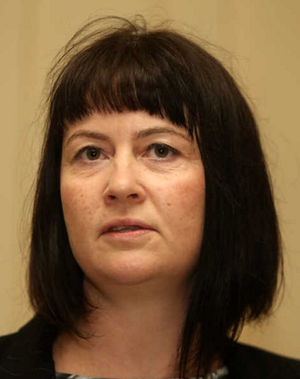
From top: Turkish soldiers patrolling in Hatay province along Turkey’s border wall with Syria in Feburary; and Edel McGinley, director of the Migrant Rights Centre Ireland
The development of EU border security is not only costing lives, it’s also serving to deepen the demographic dilemma facing Europe.
Edel McGinley writes:
Last Saturday, at the start of World Refugee Week, Turkey’s border guards shot dead 8 Syrian refugees – four women, one man, and three children – fleeing a war-torn country. This is truly appalling, but it received very little media attention. Is this our new normal?
There is no good reason to deny people seeking protection access to a country, though people with vested political and economic interests will try to say otherwise.
Let’s take a step back and look at what is often missing from the debate surrounding such terrible tragedies.
Border security creates violence, dehumanises and increasingly facilitates the indiscriminate killing of innocent people. This is not just on the Turkey-Syria border, but at borders across the world and at our EU borders, in our name and paid for with public funds.
The EU Turkey deal – an external border agreement to readmit refugees and migrants from Greece to Turkey – reinforces the EU policy approach of externalising our borders. This was the case with Libya, whose agreement with the EU blocked the movement of people from Africa to the EU until the fall of Gadhafi.
A lucrative industry has grown up around border security. The excellent Migrants’ Files follows funds that flow through public and private hands to expose corporate interests and arms dealers at the heart of EU border security and policy development.
But the shoring up of EU borders is not a new phenomenon and has been in progress for a long time. Between 2007 and 2013, EU funds favoured border investment over investment in people seeking protection. In Spain, the EU gave 30 times more to border controls than it spent on refugee supports. In the same period, Greece was allocated 10 times its refugee budget to ‘control’ its borders.
So no veiled approach there – clearly, EU policy favours exclusion and coercion over rights integration and inclusion. This is not surprising, given the EU’s response to people seeking protection at our borders. However, the crisis facing the EU’s migration system is not limited to its borders and the large-scale movement of people.
Missing from political debate are the facts that the EU needs labour; there are limited channels to allow that labour to come; and our policies deny rights and protections to those who do come.
Europe faces demographic challenges: there is a declining population of working age and the number of dependent older people is increasing. The fact is that the EU’s workforce will decline by approximately 50 million by 2060.
In tandem, long-term care is the fastest-growing area in the health and social care sector within the OECD. The number of people aged 65 and over is projected to almost double over the next 50 years to reach approximately 152 million in 2060. People living with long-term illness and disability are also projected to increase.
In Ireland, someone turns 80 every 30 minutes.
The lack of joined-up thinking in response to the humanitarian crisis of our times is astonishing. Connecting the large-scale movement of people and the need for up to 50 million workers would seem like a no-brainer. A small child could join these dots better than the EU Commission and our political leaders.
As of May 30th 2016 (last available stats) out of the 4,000 people Ireland has agreed to accept under relocation and resettlement fewer than 300 people have been resettled and only one family of 10 relocated from Greece.
I am not saying that everyone who comes to Ireland will have the qualities, skills and desire to provide care services, but that we are in a pivotal moment: a moment where we have to pay attention to demographic change and how to address it.
Unemployment is falling and our economy is growing. We need more people to support our aging populations, through tax revenue and to bolster our social welfare system. As a society we have a duty to care for those who are vulnerable, including older people, children and people seeking refuge. Unfortunately we have never been great at forward planning, despite repeated warnings issued to the Government.
It seems like we want it every way. We need a strong social welfare system to provide a social safety net for our aging population but don’t want to open up channels for migration outside of the EU which will alleviate this. We want cheap flexible labour with limited rights so people find it so unbearable that they don’t put down roots, and we think this is how to extract the best labour from them.
The irony is we could have it all. We could have more secure pensions and a greater tax take; we could have stronger links with countries all over the world; we could have a care system that works for carers and those in need of care; and we could reach out to people fleeing war, conflict and destitution and give them a safe place to live and work. These possibilities are not mutually exclusive – in fact, they’re deeply intertwined.
If Ireland is to be attractive to people to come here, to live and work and raise families, we need a system that is responsive, that strengthens rights and protections for families and workers. Ireland and the EU must adapt to our new reality.
The inescapable fact is that we need more migration not less; that we can’t survive on our own and that we live in an inter-reliant world.
Edel McGinley is the director of the Migrant Rights Centre Ireland (MRCI) and Chair of PICUM, the Platform for International Co-operation on Undocumented Migrants.
Pic: Human Rights Watch/Anadolu Agency
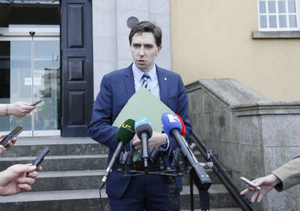
Fine Gael TD and Minister for Health Simon Harris
You may recall how last year Independents 4 Change TD Clare Daly proposed a bill which would have allowed abortions in cases of fatal foetal abnormalities.
It was voted down 104 to 20 with Government TDs at the time claiming it was unconstitutional, following advice from Attorney General Máire Whelan.
You may also recall Legal Coffee Drinker’s take on the matter.
At the time, LCD said:
“…it is not possible to say with certainty, or even as a matter of probability, that the Bill is unconstitutional. Many Bills, including those put forward by governments, have constitutional question marks hanging over them. That this will happen is expressly recognised by the Constitution itself, Article 26 of which provides that the President, before signing a Bill, may refer it to the Supreme Court to have a decision taken as to its constitutionality.”
“To regard possible unconstitutionality, falling short of certainty, or even probability, as a ground for not voting for legislation would have ruled out much of the most important legislation passed in this jurisdiction. Constitutional rights – even the right to life of the unborn – are not absolute; nor, in this case, is the question of unconstitutionality. Indeed, it could be argued that, if anything, it is in the public interest that we get the opportunity to hear more, from the Supreme Court, on the meaning and scope of Article 40.3.3.”
Further to this, fellow Independents 4 Change TD Mick Wallace is planning to propose an identical bill in the Dáil next Thursday, June 30.
There have been reports that three Independent Alliance ministers – Shane Ross, Finian McGrath and John Halligan – have been planning to support Mr Wallace.
But today, on RTÉ’s News At One, Health Minister Simon Harris told presenter Richard Crowley that Mr Wallace’s bill is… unconstitutional.
Richard Crowley: “The 8th amendment. What’s happening with the Mick Wallace bill which was to come into the Dáil next Thursday?”
Simon Harris: “Well I fully understand what Deputy Wallace is trying to do and I’ve said very clearly, on the record, that I find the current situation facing parents experiencing fatal foetal abnormalities in this country to be utterly unacceptable. But I am duty-bound, as Minister for Health, to make sure that any actions we take are constitutional, that they’re legal and that they’ll actually have an impact.”
“I’ve been consulting the Attorney General, in relation to Deputy Wallace’s bill. This bill is pretty identical to a previous bill tabled in the Oireachtas last year and the advice available to me, and the advice available I will be making available to Government colleagues is that the bill is not constitutional and that arises from the fact that there is a very explicit protection of the right to life of the unborn in our constitution.”
“So, really, these issues need to be addressed through a Citizens’ Assembly whereby they can be discussed, a proper debate can take place, expert views can be heard and ultimately that is the right forum. So as I very much respect what Deputy Wallace is trying to do, I won’t be in a position to accept the bill because, quite frankly, it won’t make the meaningful impact that he thinks it will because it’s not constitutional.”
Listen back here