Yearly Archives: 2016

410269-207117

A lamb that was attacked by a pine marten on Pauraic Brady’s farm

Anthony Jordan, in the Farmer’s Journal, reports:

Numerous pine marten attacks on livestock have been reported by farmers in Co Longford, the Irish Farmers Journal has learned. Farmers in the Midlands have expressed concerns and anger over increased attacks on animals by pine martens.

The attacks have been ongoing over the past 18 months, with fowl and sheep being the most targeted livestock.

Farmer Michael Quinn has been the victim of numerous pine marten attacks in the last two years, with seven lambs killed this year and four killed the year before.

“It is not nice to go out and see your stock attacked and killed by a pine marten,” Quinn told the Irish Farmers Journal.

“Every morning you go out you hope that there is no damage done in your field. It is really hurting farmers around the area.”

Recently, a farmer had €600 worth of pheasants wiped out in a single pine marten attack, while another farmer reported that a dog was attacked.

Drumlish farmer Pauraic Brady, who has had two lamb fatalities himself this year, believes that the situation has become critical around the county.

“Farmers are coming to the stage where they are fed up. Fowl is being wiped out, lambs are being attacked and the cost for farmers from vet’s bills is extensive.”

Pine martens have been protected in Ireland since 1994 under the Habitat Directive, but Brady, who is also a local councillor, believes numbers are rampant in Longford.

“The population has become out of control in the county. I know of up to 20 farmers who have had stock attacked. It is coming to the stage where something has to be done.”

The Irish Farmers Journal has been in contact with the Department of Art, Heritage and the Gealtacht on the topic but has not received any comment on the issue.

There are fresh calls from local farmers to have to the protected status of the pine marten lifted after the series of attacks on livestock.

Pine marten?

Pine marten attacks sheep in Longford (Irish Farmers Journal)

Thanks Aisling Hussey

Screen Shot 2016-04-28 at 11.25.38

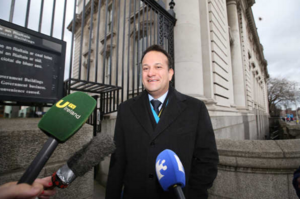
Health Minister Leo Varadkar

Health Minister Leo Varadkar spoke to Keelin Shanley on RTÉ’s Today with Seán O’Rourke this morning following the announcement that An Bord Pleanála has granted planning permission for the new children’s hospital on a campus shared with St James’s Hospital in Dublin.

During their discussion, they talked about Irish Water and Mr Varadkar was asked if he’d like Taoiseach and Fine Gael leader Enda Kenny’s job.

Grab a tay…

Leo Varadkar: “The fact that they [Fianna Fáil] went to the wire and threatened an election and not to facilitate a Government on water, I just think is ridiculous..”

Keelin Shanley: “So you think Fianna Fáil’s negotiating point of view is ridiculous – is that what you’re saying?”

Varadkar: “I just, I just think that of all the issues to pick, you know, of all the issues to drive us to the brink of a general election, to threaten not to support a minority government, of all the issues they could have picked like I really  thought maybe they would say, you know, that we insist that Ireland must develop a national health service over the next five years, you must find the 3 or 4 million to do it, you know, you need to drop your promises on the USC – not at all. You know it was all down to water charges that cost €3 a week and the worst thing is, you know, and you know water charges are being suspended – they’re not being abolished – but it’s the wrong thing to do. It’s not in the public interest to do this. And yet this is the issue…”

Shanley: “So why are you doing it? Were you not able to stand up to them on it?”

Varadkar: “Well we haven’t, what we did stand up to, we said we wouldn’t give up on the principle of a national utility, we don’t think Irish Water should be broke back and everything sent back to 30-something local authorities, I don’t think even deep down Fianna Faáil believes that that’s a good idea even though that was their policy. And on water charges what we’ve agreed is a suspension for nine months and during that period we will continue to make the case in favour of water charges. And I’m in favour of water charges. I was in favour of them in 2011 and I was in favour of them in this general election and I always told me that this is the right thing they should do and they should pay those and I keep saying that. There’s two reasons: one because it’s the only way people will conserve water, it should be metered and it should be charged for it. And secondly, we actually need a dedicated stream of income to upgrade our water and sewerage services, to get rid of boil notices, to get rid of the situation where we’re still putting sewage into our rivers and our seas. And it’s a real disappointment to me that that Fianna Fáil wants us to go back on water and like it was actually Fianna Fáil in 2010 that started this, before the Troika arrived, they can’t even blame the Troika.”

Later

Varadkar: “Maybe we will have to fight an election sooner rather than later, I’d actually rather we fight an election on those things [economy, housing] then on the issue of water. I just think that would have been a nonsense. I actually think that the people would have been very annoyed about it and would have been, ‘a plague on all your houses’.”

Shanley: “So you think everyone would have done badly out of an election on water. What was your thinking for Fine Gael going to the electorate on the basis of water. You know your option there was either an election or give way on water.”

Varadkar: “Yeah I just, I just think it would have been insane to have an election on Irish Water.”

Shanley: “Would you have lost further seats do you believe?”

Varadkar: “Possibly I don’t know, possibly not, it’s impossible to judge that but like I say, we have an opportunity now to form a minority government it’s not going to be easy, it’s going to be difficult and it’s going to be different but, you know, Government’s really tough but it can also give you the opportunity to do wonderful things and things like the Children’s Hospital are exactly why you do all the bad days because there are great days too and you can only do that when you’re in Government.”

Later

Shanley: “Will he [Enda Kenny] lead the party into the next election?”

Varadkar: “Well, he’s already said that he won’t.”

Shanley: “Are you interested in the job?”

Varadkar: “Ask me when the vacancy arises. I’m down on so many other things but, like I say, that’s not for today.”

Shanley: “Ok, Minister Leo Varadkar thank you very much indeed for coming out to us this morning.”

Listen back here

13043685_1596551603993796_221792983128432967_n

aboveDatAddicted ft. Christiana Underwood

What you may need to know…

01. Comprised of legendary Cork DJ Stevie G and Ian Ring (one half of much-fancied electronic-pop duo Young Wonder), aboveDat have this week released debut single Addicted.

02. Releasing via Stevie’s own Soul Jamz label, Addicted is available for download via iTunes from May 6th.

03. Featuring vocals from Leeside-based songstress and regular Stevie collaborator Christiana Underwood, the tune is an admitted ’80s throwback, all strident synths. It’s streaming in the widget above.

04. The duo has DJ appearances coming up throughout 2016, stay tuned to their social media for more.

Verdict: Groovy, summery stuff from a soulful supergroup.

aboveDat

frongoch3dan

From top: Roadside memorial at Frongoch, Merionethshire, North Wales  Dan Boyle

After the Easter Rising hundreds of Irish ‘prisoners of war’ were sent to Frongoch, a distillery-turned-internment camp in Wales.

All that is left is a fading plaque.

Dan Boyle writes:

Last Sunday on the 100th anniversary of The 1916 Rising, I made a planned visit to Frongoch. There was once housed an internment camp where more than 1800 Irish prisoners from The Rising were taken.
What strikes you on arriving is the sparsely populated isolation of the place. What exists there is a primary school and a small shop/cafe. Nothing else.

The road it is on links the not exactly sprawling but picturesque metropolis of Bala and the eerie destination of Trawsfynedd, which hosts one of the two (now decommissioned) nuclear plants in Wales.

The region seems to have been ideal for generations of decision makers as the best repository for social, political and environmental dumping.

It seems there was once a more thriving Frongoch. The internment camp had once been a distillery. I imagine some Whitehall wag thought this was the most appropriate place to send a small town of bothersome Irish people to.

Nothing exists now of that distillery or the prison it became. There is a just an empty field. A thought occurs that like Hitler’s Berlin bunker, someone has decided it should not be seen as it once was, lest it becomes a place of unwelcome pilgrimage.

On the roadside as part of a parking lay by a memorial stone has been erected. The plaque has lost its lustre. On it a simple sentence of historical fact has been embossed. It is in Irish, Welsh and English.

At its base there are a smattering of ageing flowers, a plastic tricolour and a laminated Declaration of The Republic. The impression given is that of a handful of souls who want it to be remembered, with no body being officially responsible.

For the few brief years of its history as a place of incarceration, Frongoch seemed to almost transcend its grimness. It became known as the University of the Irish Republic.

These idealistic young men, once detached from blood lust, sought to imagine a new nation. For the most part they succeeded.

The place where they plied their learning deserves more recognition than it has. Perhaps the thought of the British Empire beginning to collapse from within Britain itself is not a narrative some may want to hear. We should hope that relations between our nations have since evolved beyond that.

Separatism as a movement has gained a lot traction in recent years in the UK. I can’t see any real parallels with the Brexiters of today. They are seeking to renew old dreams of past glory into a new world of splendid isolation. The internees of Frongoch were more intent on bringing a new nation to stand with and work alongside other nations.

I remain uncomfortable with the use of violence to further any political end. I have come to accept that the context of then cannot be applied to now. That tolerance does not, nor should it apply, to those from 1970 who sought to emulate the Frongoch generation.

That generation was engaged in a programme of nation building, the other has been an exercise of national frustration.

Dan Boyle is former Green Party TD and campaign manager works with the Greens in Wales. Follow Dan on Twitter: @sendboyle