Yearly Archives: 2016

0006644753_10

Robocobra Quartet – jazzy hardcore from Belfast

What you may need to know…

01. Despite their designation as a quartet, sax-laden spoken-word hardcore outfit Robocobra Quartet call on any of fourteen members for their incendiary live excursions.

02. Having gigged on the regular since 2014, the collective have done the festival grind, including Electric Picnic and Brilliant Corners Jazz fest, as well as having released a limited lathe-cut 7″ via Smalltown America.

03. Streaming above is the band’s debut album in its entirety, Music for All Occasions, recorded in studios and venues around Belfast city.

04. Available now in various formats from their Bandcamp. Having finished the UK/NI swing of their album launch, more UK/IE dates are likely for next year.

Verdict: Dour, downtuned, swaggering post-hardcore as a framework for world-weary spoken word broadsides.

Robocobra Quartet

screen-shot-2016-11-22-at-12-01-36

screen-shot-2016-11-22-at-12-07-15

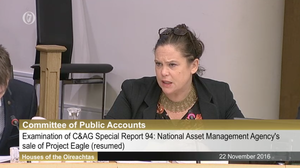
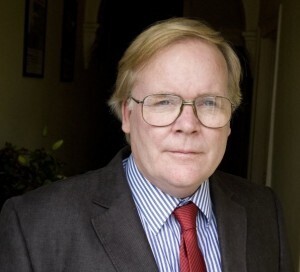
Patrick Long, of Lazard and Co Ltd and Mary Lou McDonald, deputy leader of Sinn Féin

This morning.

At a meeting of the Oireachtas Public Accounts Committee.

Patrick Long, of Lazard’s – Nama’s loan sales advisor on the sale of Project Eagle – is answering questions in relation to the Project Eagle sale.

From the meeting…

Watch proceedings live here

384056ce00000578-3792576-image-a-44_1474040941528

cxjbowlweaa-3gi

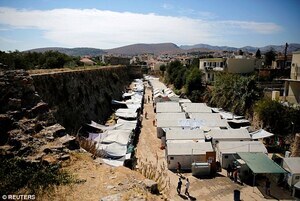
The refugee camp set up in the shadow of the Castle Of Chios, called Souda, on Chios Island, Greece and how parts of the camp looked after recent attacks on the camp 

On Friday last, The Guardian reported:

Dozens of people have been driven out of a refugee camp on the Greek island of Chios after two successive nights of attacks by a far-right group.

At least two people were wounded after attackers threw Molotov cocktails and rocks as big as boulders from elevated areas surrounding the Souda camp, activists said.

Three tents were burned down and three others were hit by rocks. A 42-year-old Syrian man was assaulted, while a Nigerian boy was hit by a rock.

Fearing a third attack on Friday night, about 100 former occupants refused to re-enter the camp, instead taking shelter in a nearby car park. “We do not have any kind of protection,” Mostafa al-Khatib, a Syrian refugee, told the Guardian. “No one cares about us.”

The mayor of Chios said the attackers were thought to be affiliated with Greece’s main far-right party, Golden Dawn. “Of course Golden Dawn supporters are suspected to have participated,” Manolis Vournous told the Guardian.

Activists and camp occupants said the rocks appeared to have been thrown with the intention of killing people. Tan said: “These rocks were probably the size of a shoebox, weighing approximately 15kg. Some of them I can’t even lift.”

There were conflicting reports about who started the clashes on Wednesday. According to Vournous, the unrest began after Algerians and Moroccans stole alcohol and fireworks from a shop, frightening local residents. But some activists claimed the events escalated after a planned assault by Golden Dawn.

The attacks followed a two-day visit this week to Chios and Lesbos, the adjoining Aegean island, by a team of MPs from the neo-fascist Golden Dawn and far-right parliamentarians from Belgium.

Further to this…

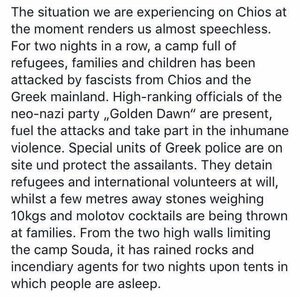
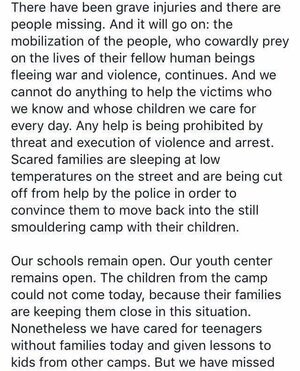
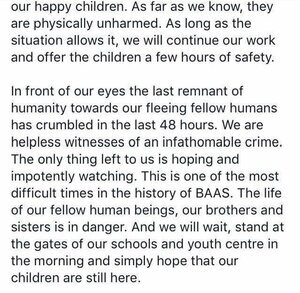
John Underwood, whose sister is volunteering on Chios with Be Aware And Share tweeted yesterday:

My sister, currently helping run a refugee school in Greece, has asked me to pass this on. The Nazis are literally back.

cxzrseyxuaaubl-2

cxzrs04wqaqg61r-1cxzrtk9weaeaiqq

Readers may wish to note an academic paper published in 2013, called The Crisis before “The Crisis”: Violence and Urban Neoliberalization in Athens by Dr Dimitris Dalakoglou, of the University of Sussex.

In it, Dr Dalakoglou wrote:

Historically, since the 1920s the so-called para-state far-Right in Greece has functioned as the long arm of the state violent apparatuses, targeting people with left-wing affiliations during most of the twentieth century. The rise of the extreme Right after the outbreak of the 2010 crisis is a continuation of that tradition. Besides the Left or the anarchists, the current victims of extreme Right violence are mainly migrants.

A typical example of this escalation was in mid-May 2011, a few days before the start of the Syntagma Square movement, when a man in his forties was killed and robbed in the center of Athens, allegedly by migrants. Local extreme right-wing groups seized upon this incident to organize one of the country’s first large-scale anti-migrant attacks, with the tacit or explicit support of the police.

Anti-fascists and radicals were also targeted. Due to these organised fascist attacks, certain parts of the center became a no-go zone for migrants, especially people of colour.

The most prominent xenophobic group, the neo-Nazi Golden Dawn, was allegedly involved in many of these actions. Their unapologetic racism appears to be gaining in appeal. Golden Dawn received 7 percent of the votes in the national elections of May and June 2012; about half of the police officers serving in Athens voted for Golden Dawn, marking, if nothing else, the ideological links between state and para-state violent apparatuses.

The Crisis Before The Crisis (Dimitris Dalakoglou, Academia.edu)

Greece: Police must protect refugees from ongoing far-right attacks (Amnesty International)

Previously: Chios on Broadsheet

Pics: Reuters and Amnesty International

imag0906


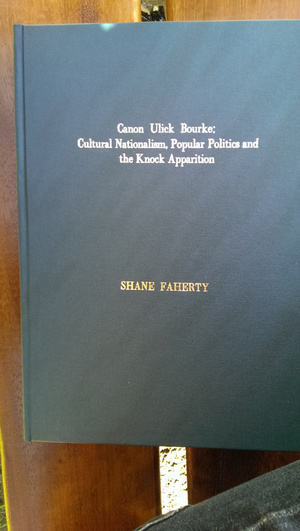
Shane Faherty, from academia/humanities blog Modern Distortions, discussing the disappointments of pursuing a Ph.D., the attitudes towards Ph.Ds in the post-austerity jobs market, and the inevitable trudge through call centres.

“When, at the age of 30, I started a Ph.D. in history in University College Cork I was pursuing a passion. Nobody does a Ph.D. in humanities for monetary gain, however, I did think that my employment prospects would be improved somewhat.

Little did I think that upon completion, four and a half years later, I would be facing into a year and a half of unemployment, underemployment and precarious employment where on two separate occasions I would find myself working in call centres.

The week I submitted my doctoral thesis in April 2015 my wife and I discovered we were expecting our first baby. The following week I was in the dole office. I didn’t expect to be there.

This should have been the most exciting time of my life. However, the multiplicity of feelings I was experiencing were underpinned by exhaustion and uncertainty. When I tried explaining why I was there tears welled up. The lady behind the counter told me to take my time. I told her I hoped this would only be temporary arrangement.

I applied for jobs. All sorts of jobs. I wasn’t expecting to get an academic position overnight but I thought I would get something that was halfway decent. I spent hours on some applications, days on others.

I didn’t even get an interview for any teaching or research positions but what was more surprising was my lack of success in applying for other work which I was more than capable of doing. It seemed the private sector weren’t falling over themselves to hire historians.

I got some occasional hours invigilating exams and doing instructional design work in UCC but nothing that lasted more than a few weeks. I graduated at the end of October, my family came down and it was a nice day, but underlying everything was a sense of anxiety. I still didn’t know how we were going to manage.

With our baby due in December I needed any kind of work fast. I applied for a temporary customer service role with Amazon in their Cork contact centre. This centre serves the UK marketplace. Seasonal work in Amazon is sort of an institution for a certain demographic in Cork.

My team were a mixed bunch and mostly overqualified. There was one other person with a doctorate but also a medical doctor, a computer programmer, a poet, a musician, a sports therapist and a variety of other people who really shouldn’t have been there.

They were a good bunch. Science fiction was openly discussed and critiques of consumerism were part of the daily routine…”

More here: Confessions of a Call Centre Academic by Shane Faherty

13123418_524591381082857_1560430343464621657_o

We’re not even into December and people are wishing this year away through sweary, extremely NSFW song.

Musical comedy sisters Flo and Joan count down the ways in which 2016 has been of royal disservice, including a rundown of deaths and questionable decisions.

Flo & Joan

90431884Michael Taft

From top: Minister for Public Expenditure Pascal O Donohue with Minister for Finance Michael Noonan present Budget 2017; Michael Taft

In the immediate aftermath of Budget 2017 there were serious voices raised that we were about to descend into fiscal chaos. And, yet, Ireland has one of the better deficit records in the Eurozone.

Michael Taft explains:

These days any question of increased resources – whether for investment, public services or social protection – is met with ‘how can we afford it?’, ‘the fiscal rules won’t allow it’ and ‘you just want to return us to the bad ol’ days’.

In short, there are no more cookies left in the cookie jar. Such is what passes for debate over fiscal policy.

The fact is that in many cases we can afford it (always, of course, within limits), the fiscal rules do allow it and the only ones determined to return us to the bad ol’ days is the government itself.

In the immediate aftermath of Budget 2017 there were serious voices raised that we were about to descend into fiscal chaos and imprudence. The Irish Fiscal Advisory Council claimed that the tax and spend numbers went ‘beyond what was prudent and was set to breach key EU rules’.

The Irish Times was even more dramatic:

‘The notion of a prudent Budget appeared threadbare after Michael Noonan announced a package of measures in the Dáil stretching the so-called “fiscal space” to near-destruction.’

And, yet, Ireland has one of the better deficit records in the Eurozone.

cookie-jar

We’re well into bottom half of the table, far away from fiscally-troubled countries like Spain, France and Portugal. This is not chaos. Even our debt level is well below the Eurozone average.

In 2017, the Government estimates government debt to be 74.3 percent of GDP; Eurozone debt is 90.6 percent. Ireland is closer to the parsimonious Germans (with a 65.7 percent debt to GDP) than the Eurozone average. Irish debt is falling faster than any other country – from nearly 120 percent of GDP in 2013.

This is not to be complacent but it is a warning against scare-mongering. As for the ‘can’t afford it’, etc. arguments, let’s run through some points.

First, the Government cut the deficit more than was necessary in Budget 2017. The fiscal rules require we reduce the structural deficit by more than 0.5 percent. Instead, the Government cut the structural deficit by 0.8 percent.

This may seem fractional but had the Government stuck to the rules this would have provided an additional €550 to €800 million more for investment, public services and social protection.

Second, the Government has been actively cutting its own revenue. In the last three budgets, the Government has cut tax revenue by €2.6 billion. Some of these cuts were valid enough – removing the PRSI step-effect for minimum wage workers, for instance.

There might be other valid tax cuts such as inflation indexing thresholds and credits (that would have only been relevant for next year). But if the Government had been less reckless at cutting the tax base – say 50 percent less – then there would have been €1.3 billion extra to spend in 2017. If you keep cutting your own revenue you will have, as a matter of arithmetic, less to spend on.

Third, the Government is intent on continuing to drive revenue into the ground, thus depriving us of more resources. Tax revenue will be cut by over €2.6 billion by 2021.

This will reinforce our low-tax status. In 2014, tax revenue as a % of GDP (this could be the last year we can use the Fiscal Council’s adjusted GDP to allow for the activities of multi-nationals) was €14 billion below what it would be had we been taxed at the Eurozone average .

We are €22 billion below the average of our peer group – other small open economies; but who’s counting.

And then there are those who complain we’re still borrowing. Recently one commentator lamented that we were still borrowing to keep the lights on; over €20 million a week (that’s to scare the children with big numbers).

The fact is we don’t borrow for day-to-day expenses. Next year we will have a €2 billion surplus on the current side; that will buy a lot of light bulbs. We are borrowing for investment and in a saner world with saner rules we’d be borrowing a lot more for investment, especially with interest rates on the floor.

This is all about choices. And there’s another choice coming up. The EU Commission has done an about-turn and is now urging Governments to fiscally expand. EU austerity may not be over but it is, at least, being temporarily suspended – no doubt a response to the social disquiet that the far-right is exploiting.

They are proposing that governments spend an additional 0.5 percent of GDP on expansionary programmes. It’s only once-off and far too little to get the EU out of its rut, but you take what you can get.

In Ireland it would be worth approximately €1.2 billion. The Government seems hesitant but a rational response would be to take this money and kick-start housing builds in Dublin. This could build an additional 6,000 to 7,000 units. Again, a relatively small amount but forensically targeted could help key disadvantaged groups such as the homeless.

Don’t reduce the deficit so fast, increase spending (even if it’s allowable under the fiscal rules), increase taxes, take a fiscal holiday – isn’t all this a return to the bad ol’ days? Hardly. It’s the Government that is returning us to pre-crash fiscal policy:

  • Eroding the tax base which leaves us exposed to external shocks – think Trump protectionism, think Brexit
  • Pumping the property market through mortgage and rent subsidies
  • Over-reliance on an emerging tax revenue bubble – this time, corporate tax revenue
  • Basing projections on dubious assumptions – the Government’s budgetary numbers don’t factor in the potential structural change in the UK sterling exchange rate.
  • And don’t, no don’t, mention the A word, the potential impact of the Apple ruling and the acceleration of European tax coordination – just like not mentioning astronomical house prices prior to the crash

Now that’s a return to the bad ol’ days.

We have choices. Yes, there are limitations. How could there not be after years of recession and austerity? We cannot solve every problem today or tomorrow and, therefore, are forced to prioritise resources. That puts an even bigger premium on smart allocation and prioritisation.

But the next time you ask the Government for a cookie and they just shrug their shoulder and point to any empty jar – just remember: it was the Government who stole the cookies.

Michael Taft is Research Officer with Unite the Union. His column appears here every Tuesday. He is author of the political economy blog, Unite’s Notes on the Front. Follow Michael on Twitter: @notesonthefront


screen-shot-2016-11-22-at-09-35-58

The system of direct provision.

Introduced as a six-month measure.

Sixteen years ago.

Rabble writes:

This country is no stranger to emigration, at its highest point only three fifths of those born here stayed. The others left without skills and mostly from the poorest parts of the country. For every 100 migrants that left, only six returned. Millions of Irish have left these shores in search of a better life and it’s still happening, there are over 200,000 less twenty-somethings in Ireland today compared to six years ago, one in six Irish born people live abroad.

Compare this to our treatment of those seeking asylum in Ireland. Direct provision, introduced as a temporary measure in 2000, is still with us today. Adults receive €19.10 per week, children receive €15.60, asylum seekers are not allowed to cook, nor to work. The average amount of time spent in direct provision is 38 months, one third of those in direct provision are children, of which 55% have spent over five years in the system.

Since its inception until 2015, the Irish State has paid €890million to providers who run direct provision centres. Companies are paid €30 per day per person in privately owned centres, €15 per day in State-owned centres. Certain companies have established entities in offshore jurisdictions and are under no obligation to publish their profits. From the period of 2011-2015, nine companies have been paid in excess of €10million from the State.

In the preceding year to June 2016, Ireland had received 2,780 asylum applications, a mere fraction of the amount of similar size European countries like Denmark (21,000 applicants) and Norway (28,000 applicants). Figures from the Office of Refugee Applications Commissioner in 2015 showed that only 9.8pc of applications were granted leave to remain.

Céad míle fáilte?

Video by Jamie Goldrick and DK.

A hundred thousand welcomes (Rabble)

15181182_163283757474559_8050389837168057938_n


Heather Thompson writes:

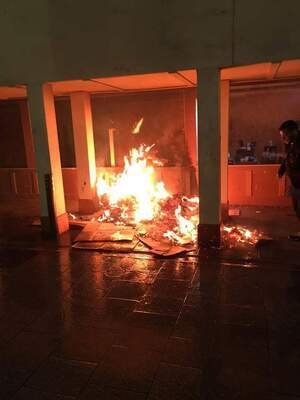
Some absolute scumbag lit a homeless person’s few belongings on fire last night in Dublin city centre  heartbreaking. fortunately, volunteers were out at the time to help the victim.

Anyone?

Via Tony Walsh