

This afternoon.
The White House, Washington DC
President Obama and President-Elect Donald Trump have their first meeting.
*squirm*
FIGHT!



This afternoon.
The White House, Washington DC
President Obama and President-Elect Donald Trump have their first meeting.
*squirm*
FIGHT!
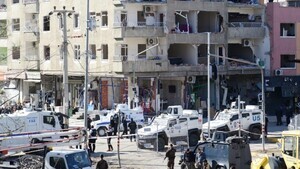
A police building in Diyarbakir, south-east Turkey, where there was a suicide bomb attack last Friday. When the attack took place, several (pro-Kurdish People’s Democratic Party) HDP politicians were being held inside
You may recall a post in January, co-written by researchers Francis O’Connor and Semih Celik, about how certain academics in Turkey had been arrested, detained and beaten.
It followed the signing of an open letter – by 1,128 professors, researchers and students from Turkey and around the world – calling for an end to state violence in the Kurdish region of south east Turkey.
Readers may also recall the failed coup in Turkey during the summer.
Further to this, Francis, from Limerick, writes:
The political situation in Turkey continues to deteriorate in the wake of the attempted coup d’état in July 2016, allegedly organized by the Gülen Movement, a former ally of the ruling Justice and Development Party (AKP).
It has, in fact, led to a slow incremental counter-coup where Erdogan and his cronies have progressively jailed, marginalized and silenced opponents of all hues — but especially the Kurdish movement.
The botched coup has conceded the Erdogan regime the pretext to arrest 80,000 suspects, 40,000 of whom remain in custody, while forcing the shutdown of more than 150 publications, the firing of more than 100,000 civil servants and the re-staffing of the army’s upper echelons with Erdogan loyalists.
It has also furnished Erdogan with the opportunity to eradicate his principal political opponent, the pro-Kurdish, leftist People’s Democratic Party (HDP), which had been hindering his assumption of complete parliamentary control. Erdogan’s campaign culminated in the arrest of twelve HDP MPs, including its co-chairs Selahattin Demirtas and Figen Yüksekdag last Friday.
The HDP had no role in the coup attempt. The party immediately repudiated the coup — it was even commended for its stance at the time by Erdogan’s puppet Prime Minister, Binali Yildirim. In spite of Erdogan’s calculated sabotage in 2015 of the peace process, which had been intended to bring an end to the conflict between the Kurdish Workers’ Party (PKK) and the Turkish state, there was no Kurdish support for the 2016 coup.
Indeed, many of the senior military figures who have subsequently been unveiled as the coup’s instigators were directly involved in the brutal counter-insurgency in Kurdistan in the recent past.
Nonetheless, since July, the Erdogan regime has used emergency rule legislation to relentlessly target all elements of the pro-Kurdish political spectrum. A range of municipally-funded grassroots cooperatives have had all financial support stopped. Language schools were shut down and 1,000 Kurdish teachers were fired. Even Zarok TV, a Kurdish language TV station for children, was closed.
In September, the government passed a decree that dismissed 28 municipal governments and replaced them with directly appointed trustee governors. Twenty-four of the 28 municipalities were in Kurdistan and under the control of the HDP’s local sister party, the DBP.
Currently, around 30 elected Kurdish mayors are in prison and a further 70 have been fired. This blatant interference in local governance overrode the democratically expressed wishes of the millions of Kurds and other ethnic and religious minorities in Kurdistan that voted for their municipal authorities. In October, the co-mayors of Diyarbakir Gultan Kisanak and Firat Anli were arrested on multiple trumped-up charges, including facilitating the return of Kurdish guerrillas’ bodies for burial.
However, the arrest of the high-profile and internationally recognised HDP leadership is a marked escalation by the Turkish government. It does admittedly follow in Turkey’s notorious tradition of both legal and extra-legal victimization of the Kurdish parliamentary party since the 1990s.
Violence against the HDP and its supporters peaked in the summer 2015 when the party passed the 10 percent electoral threshold for the first time to take its place in the Turkish parliament. Its presence in parliament denied Erdogan the possibility of the overall majority required to amend the constitution to transform the Turkish government into a presidential system, wherein he would personally have hugely enhanced powers at the expense of the assembly.
A report by Turkish human rights organization IHD confirmed that 114 attacks were conducted against the HDP in the lead-up to the June election, resulting in 47 injuries. There was also an ISIS bombing of a HDP rally in Diyarbakir, which killed three party supporters and injured hundreds. The violence intensified after the election with a series of ISIS bomb attacks against the HDP in Suruc and Ankara, which resulted in huge casualties.
Although, it remains to be confirmed, there are strong grounds for suspicion that elements within the Turkish security forces colluded with ISIS or at least had forewarning of these attacks.
Furthermore, in autumn 2015, the Turkish security forces launched a huge military campaign to dislodge Kurdish youths affiliated to the PKK from a number of Kurdish city centers. The campaign resulted in hundreds of civilian deaths and the destruction of a number of historic and culturally symbolic Kurdish city centres.
The imprisonment of the HDP deputies should be seen as a continuation of Erdogan’s anti-Kurdish campaign, and will lead to the almost certain proscription of the party overall. Given the electoral balance of power in Kurdistan, it is evident that the AKP will obtain the ousted HDP’s seats allowing the AKP, with the potential support of the far-right MHP, to realize their vision of a reconfigured governmental structure, headed inevitably by Erdogan.
Aside from the domestic political developments, there is also a regional aspect to Erdogan’s strategy. Turkey has recently intervened in the Syrian civil war, ostensibly targeting ISIS but in reality dedicating all its efforts to combating the Syrian Defense Forces forces, aligned to the PKK’s sister party in Syria, the Democratic Union Party (PYD).
Turkish forces have bombarded Kurdish positions in Syria and are evidently concerned with maintaining the Jarablus corridor, which prevents territorial contiguity between the three Kurdish cantons ruled by the Kurdish movement and its local allies in Rojava.
Turkey’s increasing military belligerence is rooted in a policy shift that favors the taking of pre-emptive action outside of Turkey’s borders to protect its self-defined interests. It has already launched Euphrates Shield to weaken the Kurds in Syria and is currently positioning itself to engage more broadly to “protect” Sunni and Turkmen in Mosul. The campaign against the Kurds outside Turkey’s borders must be considered as part of a regional anti-Kurdish strategy which targets not only the armed PKK and PYD but also the parliamentary Kurdish representatives.
It remains to be seen how the Kurdish movement will respond to these recent developments. On November 4, a suicide bomb attack was launched against a police building [in Diyarbakir] where many of the HDP deputies had been detained. Two of them, Figen Yüksekdag and Ankara deputy Sırrı Süreyya Önder, were actually in the building at the time of the attack, and local DBP politician Recai Altay was fatally wounded. The bombing was claimed by ISIS (interestingly, they have not publicly claimed any of its previous attacks within Turkey).
The HDP immediately issued a statement demanding that the police release all information regarding the attack. At the very least, it seems to have been a remarkable coincidence that an ISIS bomber would target this particular building shortly after some of the HDP’s most prominent politicians were held there. To add to the confusion, a PKK splinter group named TAK has also claimed the attack and apologized for Altay’s death.
Aside from this bombing, there has not been a marked upsurge in violence — but with the closure of any institutional political avenues it seems only a question of time before Kurdish political frustrations are channelled toward the PKK and its armed forces.
Through her lawyer, Yüksekdag released the following brief statement:
Despite everything, they can’t consume our hope, or break our resistance. Whether in prison or not, the HDP and us, we are still Turkey’s only option for to freedom and democracy. And that’s why they are so afraid of us. Do not, not a single one of you, allow yourself to be demoralized, do not drop your guard, do not weaken your resistance. Do not forget that this hatred and aggression is rooted in fear. Love and courage will definitely win.
Her courage and hopefulness can only be admired, but without prospects of any peaceful stabilisation of the conflict, it would be unrealistic to speak of resolution at this stage.
As the respected Turkish intellectual Cengiz Candar put it, “with what happened in the last week, Turkey is steadily moving on the road to fascism.”
It seems that an EU associate member and NATO member is heading toward outright dictatorship — to the broad indifference of the European Union. In the absence of concerted international pressure on Turkey to rein in Erdogan’s megalomaniacal authoritarianism, the only plausible outcome is further and much more extensive violence.
Francis O’Connor is from Monagea, close to Newcastle West in Co. Limerick, and he has completed a PhD at the European University Institute in Florence, Italy. He has worked on the conflict in Turkey between the PKK and the Turkish state and is currently an external collaborator of the Scuola Normale Superiore in Florence. His research interests include social movements and political violence.
HDP arrests: on the road to dictatorship in Turkey (Roar)
Previously: Turkish Repression
Pic: AFP

They re-building this city.
On shi*ts ‘n’ giggles.
Barry writes:
The NEW Dublin Comedy Club will bring you the very best of Irish and international stand up comedy on the last Friday of every month. at Flanagans, Upper Connell Street, Dublin 1 (near the Spire) A top quality two hour live show consisting of two headline acts and hosted by an award winning MC. Located on O’Connell Street,
Flanagans has a beautiful theatre stage that will host three of Irelands finest comics on its opening night (top clockwise from left) Edwin Sammon (RTE’s Republic of Telly, Bridget and Eamon), Ger Staunton, (The Edinburgh Fringe Festival, Electric Picnic) with – performing above – MC Danny O’ Brien (Melbourne International Comedy Festival, Comedy Central).
Friday, November 24, doors 8pm, 12 euros.
Tickets here


Car space owners.
Beware of Germans bearing dodgy cheques.
Conor writes:
I just wanted to share an attempted (and quite convincing) scam that was tried on me. I placed an ad on DoneDeal a couple of weeks ago advertising a parking place.
A gentleman from Germany contacted me about it and wanted to rent it up front for two years as his business was relocating him to Dublin and the business was able to pay for it up front.
He sent me a cheque and I lodged it to my account. At this point he told me he wanted it only for one year and was looking for a refund of half the value and to pay it to his account.
It’s quite a sneaky scam because on lodging the cheque the money appeared in my account and was accessible to me immediately. The kicker is as it’s a foreign cheque it can take up to 10 days or even longer to clear.
Needless to say I wasn’t willing to send him any money till the cheque cleared. I haven’t heard from him since telling him this!
I was fortunate not to fall for the scam but others I’m afraid will be not so lucky. Is there any chance you could put a warning on your site about this?
And if anyone is looking to rent a car park space in city centre I have one available ;) The email address he was using is now shutdown.
GotterdamminFIGHT!
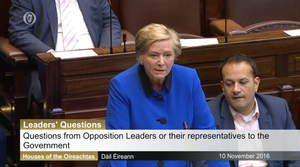

Independents4Change TD Clare Daly, Ceann Comhairle Seán Ó Fearghaíl and Justice Minister Frances Fitzgerald
This morning.
During Leaders’ Questions which were held by Minister for Justice and Tánaiste Frances Fitzgerald.
Independents4Change TD Clare Daly raised the matter of Judge Iarfhlaith O’Neill’s investigation into allegations made by Garda whistleblowers – which is due to be given to Ms Fitzgerald next week – and informed the Dáil that she and fellow TD Mick Wallace have met with six new gardaí who have, or are about to, make further protected disclosures.
During their exchanges, Ceann Comhairle Seán Ó Feargháil interrupted to warn Ms Daly not to make allegations about Garda Commissioner Nóirín O’Sullivan in the Dáil, as to do so would be “inappropriate”.
Readers may recall how Judge O’Neill is investigating protected disclosures which allege that, within the gardai, there was an orchestrated campaign to destroy the reputation of whistleblower Sergeant Maurice McCabe.
Former head of the Garda press office Superintendent David Taylor was one of the people who made such a disclosure and has claimed that he was following orders from senior gardaí.
Readers may also recall how it has been reported that, in February 2015, phones and a laptop belong to Supt Taylor were seized by Garda Commissioner Noirin O’Sullivan’s husband Det Supt James McGowan – two months before Supt Taylor was arrested for allegedly leaking information to a journalist in relation to a Roma child being taken into custody.
In addition, readers may note that, last Sunday, in the Sunday Business Post, Francesa Comyn reported:
Taylor’s solicitors recently wrote to Fitzgerald and Enda Kenny highlighting the “fundamental” need for Taylor’s mobile devices to be handed over to the inquiry for an independent forensic investigation. The court heard that the government has not responded to the letter.
Further to this…
Clare Daly: “Tánaiste, five weeks ago, you referred to very serious protected disclosures from two senior gardai to a retired judge Iarlaith O’Neill for urgent inquiry. Now, the disclosures which allege that the Garda Commissioner Noirin O’Sullivan was directly involved in a systematic and organised campaign to discredit the whistleblower Maurice McCabe, with colleagues, politicians, journalist, were due to be investigated by the former judge who’s due to conclude and report back next week.”
“Now, he was given no powers of compellability, no terms of reference. Attempts made by other whistleblowers to have their cases also heard, as they too are the victims of bullying and harassment since making protected disclosures, were ignored. Despite the fact that their testimony and their experiences are current, they get to the very heart of the systemic problems inside An Garda Siochana, that what’s said in public and done privately are two entirely different things.”
“Now it was hardly an auspicious start to the inquiry, given that was its foundation and you’d be forgiven for thinking actually that it was put together as a fig leaf, maybe for you to take cover behind, for your lack of action in this regard. Now that view has been strengthened but we now we find out that, with a week to go, to the issuing of his report, the former judge has not requested any material from either of the two whistleblowers, he hasn’t met either man. He hasn’t even spoken to either man. In fact, the only interaction, about two weeks ago was a request to their legal teams to pass on the protected disclosure to the Garda Commissioner. You couldn’t make this up.”
“What sort of an inquiry do you honestly expect us to believe that this is because while this has been going on, we’ve had the Garda Commissioner appear at the justice committee, with senior officers who are at the heart of many of the protected disclosure complaints. At the same meeting, the Garda Commissioner misled the committee by stating that she wasn’t privy to information about a campaign of harassment against any member of the force when she was actually in direct receipt of 14 occurrences and letters outlining precisely that situation. She’s been the subject of a detailed section 41 complaint which she’d been briefed on. We’re awaiting the GSOC finding and she’s lost the support of the ranks of that force, by intervening in a partisan way in their legitimate pay claim with her threats of martial law.”
“So, my question to you, Tanaiste, is why have you allowed this situation to continue to the crisis point that it’s at? On what basis do you believe that you have the right to delegate, to retired judges, GSOC and to the courts, functions that are your responsibility in law, namely to hold the Commissioner to account?”
Ceann Comhairle Seán Ó Fearghaíl: “Tánaiste.”
Frances Fitzgerald: “Well I, I would have thought, deputy, that the court of appeal ruling today would have been a solid, a very intense reminder to members of this house that we should take stock and reflect before making allegations here. The good name and reputation, I would say, of all individuals deserves respect and fair procedures. You’re putting on the record various points about a report a judge is currently conducting and is due to report on, next week. You’re saying you have access to details about that. I don’t.”
“This is an independent report by a judge. And as the House is aware, I appointed Judge Iarfhlaith O’Neill to review allegations of wrongdoing set out in some protected disclosures made to me. In addition to reviewing the allegations, Justice O’Neill has been asked to report on his conclusions, it’s a preliminary report and to make any recommendations that he considers necessary in relation to any further action deemed appropriate or warranted. The report, the review has been commenced and he asked, he has been asked to report within six weeks – which will be next week – and I’ve no reason to believe that deadline will not be met. So that’s the situation we’re in. As soon as I receive that report I will consider it very carefully, examine the recommendations that have been made and the Government will decide on future action in relation to the points that you’ve made.”
“I asked Judge O’Neill to do this review because I was very concerned, as I have stated in this house previously, at the content on the material, in the material that I have received and that’s why I decided that should be done. The Garda Commissioner, for her part, has indicated publicly that An Garda Siochana will co-operate fully with any examination of these matters and, you know, how the judge conducts his business during this six weeks, is a matter for him. I would get the report, I will examine the report and will decide on action, I can assure you in relation to the issues that he’s examined. But I’d like to see his recommendations first.”
“This was a first , if you like, a first assessment that it would be extremely useful to ask a judge to examine the first instance, the material that had been, that had been given to me. Now if for any reason, he has concerns about the level of co-operation, during the six weeks, I’ve no doubt that he will make that very clear and I will certainly be reading his report with great interest when I receive it next week.”
Ceann Comhairle: “Deputy Daly, can I say that, generally speaking, it would be my desire to ensure that every leader here had an opportunity, during Leaders’ Questions, to raise matter of important public concern. And you’re doing that. We have absolute privilege here but we should be very, very careful how we use that absolute privilege. And it has been a longstanding precedent that we would not make allegations against people outside the House. You’ve referred to the protected disclosures – that certainly is a matter that is in the public media. But you have made specific allegations about a committee being misled by the Garda Commissioner – I think that’s inappropriate, I don’t think it’s something you should do – it certainly is not something you should now repeat.”
Daly: “I take my responsibility very seriously in that regard, Ceann Comhairle, I can state again very firmly that anything I said was not an allegation at all. It was not a use of privilege, it was details of facts which can be supported by evidence and I’ve no problem in standing over any of those points.”
“The Tánaiste makes the point that it’s up to the judge to carry out the inquiry, as he sees fit. He can only do that within the confines of the powers that he has. Can the Tánaiste confirm to the house that the judge has been given the authority to request the electronic information that supports the allegations at the heart of these matters? Because people’s good names are very important and at the heart of this matter is the muddying and the tarnishing of the good name of Sgt Maurice McCabe and of the horrendous nightmare that is being experiences by members of An Garda Siochana currently, who have made protected disclosures and not just the ones whose names are in the public domain but, subsequent to a lot of this happening, myself and Deputy Wallace have met with a further six serving members of An Garda Siochana who have all either made protected disclosures or are on the verge of doing so.”
“So, what I’m trying to get my head around is: what part of this do you think is normal? And is ok? We have an enormous crisis of confidence inside An Garda Siochana, primarily and largely centred in the role of the Garda Commissioner. The civilian head of An Garda Siochana, GSOC, the courts are investigating these matters – you seem to be okay with delegating your legal responsibility for doing precisely that to other and you won’t get away with it.”
Previously: ‘A Flawed Inquiry From The Very Outset’


‘sup?
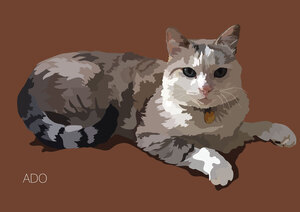
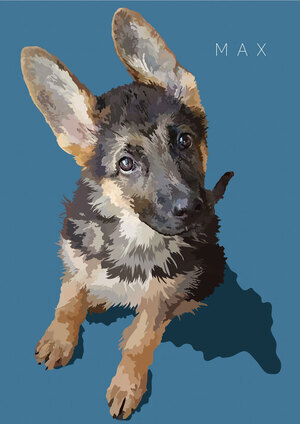
Jane Fogarty of PawPawPawPawPrints writes:
I’m not sure if you’ll remember me but I was in touch last year (around Sept). I had just started my pet portrait business and you ran a competition on Broadsheet. A lovely girl named Clare won a portrait of her dog Buddy.
Since then I have decided to leave my part time job and make try to make a success of Pawpawpawpawprints. I feel that a lot of the success and confidence in the idea came down to that promotion.The response was wonderful, it really helped to spread the word. Thank you.
I was wondering if you would like to run another competition for a free framed portrait for one of your readers? I think we could all do with a bit of cheering up this week.
To enter just complete this sentence:
‘I very badly need a portrait of my pet_________________owing to________________________________________’
Lines MUST close at 4.45pm MIDNIGHT
Last Year: I Will Paint Your Pet

Jonathan Webber tweetz:
Turns out it’s not a Trump insurgency, but a Clinton collapse. A graph that cuts straight through [yesterday’s] punditry …
FIGHT!
Earlier: Steady On
Thanks John Gallen

Former justice minister Alan Shatter
RTE reports:
Former minister for justice Alan Shatter has won his legal challenge to the findings of the 2014 Guerin Report examining the handling of claims made by a garda whistleblower.
Mr Shatter appealed against the High Court’s dismissal of his challenge.
The Court of Appeal found in Mr Shatter’s favour this morning.
Mr Shatter claimed Senior Counsel Sean Guerin should have interviewed him before reaching adverse conclusions against him or should have allowed him to respond to draft conclusions.
…In his ruling, President of the Court of Appeal Mr Justice Sean Ryan said, in his view, Mr Guerin was obliged to observe the rules of natural justice and of letting the other side be heard.
He said there was a breach of Mr Shatter’s rights because of the defective procedure that was adopted.
…The matter will come back before the Court of Appeal later this month to decide what orders or declarations the court should make.
Shatter wins appeal over Guerin Report findings (RTE)
Previously: ‘The Truth Has Been Established’
Sam Boal/Rollingnews
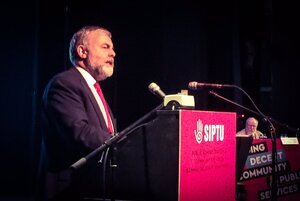
JUST IN: SIPTU to ballot its 60,000 public service members for industrial action unless Govt announces new national pay talks within a week
— Gavan Reilly (@gavreilly) November 10, 2016
Yikes.
Siptu threatens strike ballot unless pay talks begin (Martin Wall, Irish Times)
Pic: SIPTU
UPDATE:
"The world is on a trajectory towards fascism & we need to wake up to the potential crisis we are facing." – Jack O' Connor #OurSIPTU pic.twitter.com/1ILxVSpowT
— Dan O' Neill (@activedan) November 10, 2016
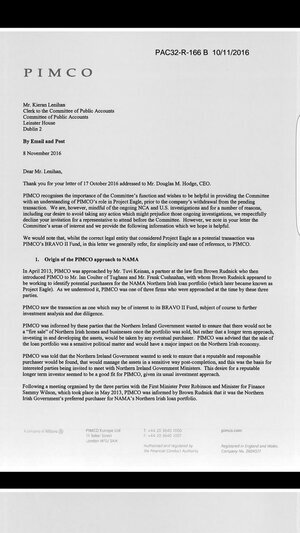

A letter Pimco has sent to the Public Accounts Committee
This morning.
At the Public Accounts Committee (PAC).
The committee briefly discussed a letter sent to PAC by Pimco – one of the bidders for Nama’s Northern Ireland property loan portfolio until it learned of a fixer fee arrangement.
The arrangement involved a sum of £16m to be split US lawyers Brown Rudnick, Belfast law firm Tughans and Frank Cushnahan, a former member of NAMA’s Northern Ireland Advisory Committee.
On July 9, 2015, Nama chairman Frank Daly told PAC that once it (Nama) became aware of the fixer fee arrangement and Frank Cushnahan’s alleged involvement in March 2014…
“…that’s why we threw Pimco out, or sorry, got Pimco to withdraw,”
However, Pimco contests this and, in the letter above, says not only did Pimco withdraw from the sale, of its own accord, Nama attempted to convince Pimco to continue with the sale despite knowledge of the fixer fee arrangement.
From the letter:
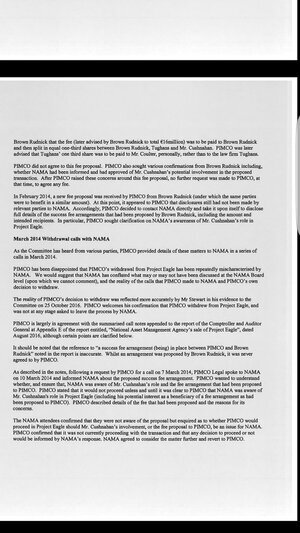
“Pimco has been disappointed that Pimco’s withdrawal from Project Eagle has been repeatedly mischaracterised by Nama. We would suggest that Nama has conflated what may or may not have ben discussed at the Nama Board level (upon which we cannot comment), and the reality of the calls that Pimco made to Nama and Pimco’s own decision to withdraw.
The reality of Pimco’s decision to withdraw was reflected more accurately by Mr [Alan] Stewart in his evidence to the committee on 25 October 2016. Pimco welcomes his confirmation that Pimco withdrew from Project Eagle, and was not at any stage asked to leave the process by Nama.
Pimco is largely in agreement with the summarised call notes appended to the report of the Comptroller and Auditor General at Appendix E of the report entitled, ‘National Asset Management Agency’s sale of Project Eagle’, dated August 2016, although certain points are clarified below.
It should be noted that the reference to “a success fee arrangement (being) in place between Pimco and Brown Rudnick” noted in the report is inaccurate. Whilst an arrangement was proposed by Brown Rudnick, it was never agreed to by Pimco.
As descibred in the notes, following a request by Pimco for a call on 7 March 2014, Pimco Legal spoke to Nama on 10 March 2014 and informed Nama about the proposed success fee arrangement. Pimco wanted to understand whether, and ensure that, Nama was aware of Mr Cushnahan’s role and the fee arrangement that had been proposed to Pimco. Pimco states that it would not proceed unless and until it was clear to Pimco that Nama was aware of Mr Cushnahan’s role in Project Eagle (including his potential interest as a beneficiary of a free arrangement as had been proposed to Pimco). Pimco described details of the fee that had been proposed and the reasons for its concerns.
The Nama attendees confirmed that they were not aware of the proposal but enquired as to wether Pimco would proceed in Project Eagle should Mr Cushnahan’s involvement, or the fee proposal to Pimco, be an issue for Nama. Pimco confirmed that it was not currently proceeding with the transaction and that any decision to proceed or not would be informed by Nama’s response. Nama agreed to consider the matter further and revert to Pimco.”
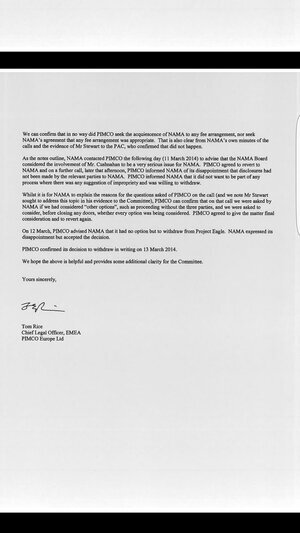
We can confirm that in no way did Pimco seek the acquiescence of Nama to any fee arrangement, nor seek Nama’s agreement that any fee arrangement was appropriate. That is also clear from Nama’s own minutes of the calls and the evidence of Mr Stewart to the PAC, who confirmed that did not happen.
As the notes outline, Nama contacted Pimco the following day (11 March 2014) to advise that the Nama Board considered the involvement of Mr Cushnahan to be a very serious issue for Nama. Pimco agreed to revert to Nama and on a futher call, later that afternoon, Pimco informed Nama of its disappointment that disclosures had not been made by the relevant parties to Nama. Pimco informed Nama that it did not want to be part of any process where there was any suggestion of impropriety and was willing to withdraw.
While it is for Nama to explain the reasons for the questions asked of Pimco on the call (and we note Mr Stewart sought to address this topic in his evidence to the committee) Pimco can confirm that on that call we were asked by Nama if we had considered “other options”, such as proceeding without the three parties, and we were asked to consider, before closing any doors, whether every option was being considered. Pimco agreed to give the matter final consideration and to revert again.
On 12 March, Pimco advised Nama that it had not option but to withdraw form Project Eagle. Nama expressed its disappointment but accepted the decision.
Pimco confirmed its decision to withdraw in writing on 13 March 2014.
In the last hour, chairman of PAC Sean Fleming said the letter would be sent to Nama “within 24 hours, asking for a paragraph-by-paragraph response, confirmation or disagreement, paragraph-by-paragraph.”
Comptroller and Auditor General (C&AG) Séamus McCarthy is now fielding questions from the committee.
Watch today’s PAC proceedings live here
Related: John McGuinness: Nama may have misled PAC (Sunday Business Post)
Pimco denies it was forced out of Project Eagle by Nama (Irish Examiner)
Pics: Jack Horgan-Jones and Hugh O’Connell
UPDATE:
Responding to Pimco letter a Nama spox ‘rejects any suggestion that it did not set out the circumstances of Pimco’s withdrawal accurately.’
— JPCampbellBiz (@JP_Biz) November 10, 2016