
From top left to right: Minister for Finance Paschal Donohoe, Minister for Public Expenditure and Reform Michael McGrath, and Tanaiste and Minister for Enterprise, Trade and Employment Leo Varadkar; Michael Taft

Back in July the Tánaiste Leo Varadkar warned of a coming economic crisis that could be ‘very divisive’:

‘ . . . it’s a very serious economic crisis and one that’s very unequal . . . The country was very united during the pandemic. The economic crisis that is coming could be very divisive.’

Unknown to us (at least based on national statistics) was that a serious crisis was emerging in 2019. The pandemic crisis is likely to give it legs and if we don’t act, it could run away from us.

The CSO has released its Survey of Income and Living Conditions (SILC) focused on the issue of enforced deprivation. According to the CSO, the enforced deprivation rate measures the proportion of households that are considered to be marginalised or deprived because they cannot afford goods and services which are considered to be the norm for other people in society.

Enforced deprivation is where a household experiences two or more of the following eleven deprivation items:

* Without heating at some stage in the last year

* Unable to afford a morning, afternoon or evening out in last fortnight

* Unable to afford two pairs of strong shoes

* Unable to afford a roast or an equivalent once a week

* Unable to afford a meal with meat, chicken or fish every second day

* Unable to afford new (not second-hand) clothes

* Unable to afford a warm waterproof coat

* Unable to afford to keep the home adequately warm

* Unable to afford to replace any worn out furniture

* Unable to afford to have family or friends for a drink or a meal once a month

  • Unable to afford to buy presents for family or friends at least once a year

During the last crisis, 30 percent of the population experienced enforced deprivation. Since that peak in 2013, the rate steadily declined.
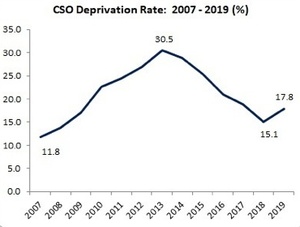
Until last year when the enforced deprivation rate suddenly and unexpectedly rose. In 2019, unemployment fell and job numbers increased along with wages and incomes. Yet deprivation rose. Even before the crisis, something in the social structure was wrong.

Those most at risk of deprivation are social housing tenants, those who can’t work because of illness or disability, and single parents. The former two categories saw a sizeable increase in 2019, while close to half of single parents suffer multiple deprivation experiences.
We tend to assume that deprivation is associated with being out of work. That would be a mistake.

Nearly one-in-eight people in work are categorised as deprived. 20 percent of households with one person working are deprived. More surprisingly (and depressingly), even where there are two people at work in the household, more than one-in-ten suffer deprivation.

Clearly, in an economy with high levels of precarious working conditions and low pay, having a job is not a ticket out of deprivation and poverty.

And for children the situation is looking even grimmer. In 2018, the deprivation rate for children (under-18s) was 19.7 percent. It rose last year to 23.3 percent.

This is not only an indictment that nearly one-in-four children in the state suffers enforced deprivation; it also undermines future growth and prosperity for these households and society at large. And in one final stat twist, 30 percent of the population still experience at least one enforced deprivation experience.

And all this in the year prior to the pandemic, during a year of growth and expansion. This raises two questions:

Will the pandemic accelerate these trends? As the Tánaiste put it – will it accelerate inequality and divisiveness?  And if the answer to the first question is yes, then what are the policies that we need to put in place starting now in Budget 2021?

For we will need to do something. If we go back to ‘normal’, we’re heading back into rising deprivation.

Michael Taft is a researcher for SIPTU and author of the political economy blog, Notes on the Front. Michael’s regular column resumes next Tuesday.

Rollingnews

Yesterday.

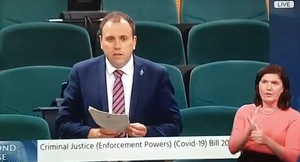
Clare Fianna Fáil TD Cathal Crowe calls out young, Irish, Covid-faking and almost treasonous TikTok users.

Good times.


From top: The demolition of the historic Sextant Bar in Cork last Friday; Dan Boyle

Last weekend a landmark building was demolished in Cork. Its demolition was met with some surprise and a great deal of unhappiness by many people.

Not by me. I had anticipated its demise despite being vehemently opposed to its inevitability.

Its destruction is indicative as to why, and to whom, laws on development benefit for what purposes.

The Sextant Bar was not a protected structure. It was listed on the National Inventory of Architectural Heritage. Within the existing Cork City Development Plan it was included as being part of an Architectural Conservation Area. It formed part of a significant streetscape.

The legislation that has allowed this vandalism is that which allows for Strategic Housing Development. This sees developments, which are for one hundred or more units, go directly to Bord Pleanala for decision. The role of the local authority being circumvented in this process.

That said, in relation to the Sextant Bar, Cork City Council has not been discouraging in allowing the destruction of this building.

With previous developments the Council had encouraged a practice of facadism, where the front elevation features of previous significant stand alone buildings were incorporated into new buildings. They have been horrible.

Instead of encouraging to build around rather than build upon, we see instead a policy of building without.

The economic foundation of encouraging any development for any reason has always been shakey. In a post COVID World it has become even more so.

Development at what was once was the Cork Docklands has been stop start. Recent years have seen a flurry of activity. This has been mainly office development, which lately has been followed by high end apartment accommodation.

Where this strategy is becoming undone is through anticipated office tenants not being available to the extent that was thought possible. An immediate uncertain economic outlook, joined with the emergence of working from home as a viable option for many, has undermined these projections.

Less companies occupying the provided office space means less well paid employees seeking nearby accommodation. We may be, and most probably are, disregarding buildings of interest being replaced by mausoleums of steel and glass, for no actual purpose.

At what price to the character of our city? The destruction of The Sextant Bar has come at a price, but perhaps it might also be a down payment towards a more sane policy of better integrating new development with existing built heritage.

In 2022 there will be a newly agreed Cork City Development Plan. As we work towards its drafting this plan, the challenge is to achieve the type of public engagement where demolitions like this not only do not surprise, they do and should not happen.

One way around this unacceptable approach to town planning would be to introduce a site value tax, that would help inhibit the incentive to remove or replace.

What we are losing is not being improved by is being proposed in its place. In terms of learning from our architectural history we seem intent to reduce it to rubble. Damned if I can see the value in that.

Dan Boyle is a former Green Party TD and Senator and serves as a Green Party councillor on Cork City Council. His column appears here every Thursday. Follow Dan on Twitter: @sendboyle

RollingNews

Pics: Twitter/Larry Cummins

‘Wet pubs’ – pubs not serving food – could reopen their doors in early October

Some government ministers think
That it’s time to go back to the drink
Just wait a month, then
We can have scoops again
Unless do-gooders kick up a stink

John Moynes

Rollingnews

Tonight.

The Spire, O’Connell Street, Dublin 1.

Meanwhile…

Earlier…

Thiago Cortes

At 5pm.

A vigil for Brazil-born Thiago Cortes, a 28-year-old Deliveroo cyclist who was killed following a hit-and-run on the north Liffey quays on Monday night, will take place at The Spire, O’Connell Street, Dublin 1.

JEH writes:

I thought this  was worth sharing as it’s a genuine tragedy and there are at least a few active cyclists on here.

Thiago  had a wife and family, doing a job that so many people take for granted when they flip a few bob to the app for that delivery fee.

Cycling around at night, going to door-to-door to complete strangers during a global pandemic, all for a couple of beans per order.

I hope everyone can spare a thought for this poor fella next time they order delivery. There’s a cost greater than the 2.50 delivery charge.

Gardaí searching for four people after fatal hit-and-run (RTÉ)

Pic via Facebook

Meanwhile…

Tonight.

Anyone?

Behold: the 1958 Porsche 356 A Speedster, or rather, an enhanced ‘restomod of the original Erwin Komenda design – a fully documented ground-up restoration with upgraded Carrera exhaust, lights, air intakes, magnesium rims, disc brakes front and back, stabiliser bars and adjustable dampers – none of which improvements detract from the original factory appearance.

Price on request.

hiconsumption

Broadsheet.ie