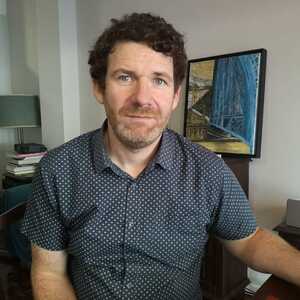
From top: lockdown loneiiness study report in The Observer; Luke Brennan
Significantly more woman will feel lonely after reading this article than men.
The above statement is true. It is a fact. The truth of that fact, however, depends on our interpretation.
Let us first accept that more women than men feel lonely, as was recorded in a recent phone poll by the UK’s Institute for Social and Economic Research:
More than a third of women (34%) said they now sometimes felt lonely, and 11% said they often felt lonely. Among men, 23% were sometimes lonely while only 6% were often lonely.
More women than men feel lonely, so therefore, even if the same proportion of women suffer increased loneliness after reading this article, it will be significantly more.
Perhaps you are asking yourself why you are reading this article at this point? You should. Perhaps it is because of the engaging photo of the lonely girl above, or, that on some unconscious level you feel you will understand yourself or the world better by adding to the information you have about it.
Perhaps you wish to avoid loneliness yourself? All of these are valid reasons. The why is not important, the important thing is that you read on, regardless, about the lonely girls. Who could leave them here on these cold paragraphs?
Another question. What if you saw the above pictured girl, with an article which opened with the following statement?
Significantly more women than men are experiencing problems with their mental health as a result of the Covid-19 pandemic.
That’s how an article online at The Observer started out last week. We have the picture, we have the statement, what about the facts? The article following with:
New research by Lisa Spantig and Ben Etheridge, economists at the Institute for Social and Economic Research at the University of Essex, suggests it is because women are more adversely affected by social isolation during lockdown.
The study reveals that the proportion of people who are reporting that they are experiencing at least one severe underlying mental health problem has increased among both genders. Among men it has risen from 7% of men before the pandemic to 18% after its onset. But for women, it has risen from 11% to 27%.
On the basis of these facts, the article’s author, Jamie Doward, continued his theorising with further information, quoting directly from one of the report’s authors, Ben Etheridge:
“It’s well documented that women have drawn the short straw on several different fronts,” Etheridge said. “For example, they are more likely to have lost their jobs.”
Other possible factors include the effects that restrictions on exercise and greater demands involving childcare and domestic work have had on women.”
He then links it with the statistical evidence regarding loneliness at the start of this article. He wraps things up with some useful web search data:
The findings are bolstered by online data which shows that many are struggling with isolation. Results from analyses of Google trends reveal that searches involving words such as “loneliness”, “worry” and “sadness” are increasing in many countries.
It seems very authoritative.
Yes. Yes, Yes. But. Does anyone else feel that their buttons are being pressed?
Jamie is a journalist of 20 years’ experience. He is writing articles for a newspaper which, as part of the Guardian, claims:
Leadership is broken. From the coronavirus pandemic and police brutality to the marginalisation of minority communities around the world, our leaders are failing us. Self-serving and divisive, they are gambling with public health and the future of younger generations. We have to make them raise their game.
This is what the Guardian is for. As an open, independent news organisation we investigate, interrogate and expose the incompetence and indifference of those in power. Your support helps us produce quality, trustworthy, fact-checked journalism every day – and publish it free so everyone can read.
Is the Observer/Guardian ever so slightly over-estimating it’s position in the world? Could it just be another newspaper?
I’m not in any doubt that the Guardian is well intentioned, or that it doesn’t do world class investigative reporting. But. In order to keep this gleaming rocket ship pointed at the stars, they have opened up a donut shop on the ground floor.
We don’t really need the lonely girl articles. Perhaps if the Guardian were a little less morally ambitious, it would be less blind to this. There is no point in being woke, but not awake.
If you look carefully at the numbers on which this article is built:
Among men it has risen from 7% of men before the pandemic to 18% after its onset. But for women, it has risen from 11% to 27%.
Among men you’ll see that a 7% to 18% rise, is a 157% rise. ((18/7 *100)-100)
For women you’ll see that an 11% to a 27% rise is a 145% rise ((27/11*100)-100)
Considering that, do you think this (again, the article opener from above) is true?
‘Significantly more women than men are experiencing problems with their mental health as a result of the Covid-19 pandemic.’
I do not understand how there could be any interpretation other than that mental health issues have increased at a greater rate in men than women. Unless you wanted it to be so.
Unless you got so good at making donuts, you forget they weren’t always good for people. Unless you had trained millions to carry around a tray of those donuts on their phones.
I don’t think it’s intentional malice, I think there is an important “but” in the author phrasing:
“But for women, it has risen from 11% to 27%.
The only reason he would add that “but”, is that he believes that the women’s rate increase is higher. His crime is not an intentional one, but rather one of poor mathematics.
One has to ask also, where are the much-vaunted fact-checkers? With these ambitious intentions, it is important part of making sure things add up.
Build a spaceship if you wish but be sure it’s foundations are rock solid. Perhaps pay more attention to morality in how the message is delivered.
Luke Brennan is an Ireland born, Portugal-based writer and entrepreneur and regularly appears on Broadsheet on the Telly.
One third of UK women are suffering from lockdown loneliness (Jamie Doward, The Observer, June 14)