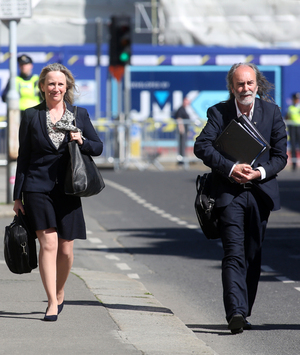
Chair of Bar Council of Ireland Micheál P O’Higgins SC
This afternoon
Further to a report in The Irish Times this morning about the Bar Council of Ireland suggesting to the Courts Service that non-jury courts be used to try “ordinary crimes”…
The chair of the Bar Council of Ireland, which represents around 2,200 barristers, Micheál P O’Higgins SC spoke to Seán O’Rourke on RTÉ earlier about the report.
He said jury trials present a problem in terms of social distancing rules which are likely to remain for some time.
Mr O’Higgins added:
“The Bar Council [of Ireland] is looking at ideas as to how best to get the normal court system back up and running when the Government eases the current restrictions. And what we’ve done is we’ve sent, we’ll call it, an overused term perhaps, but a road map of sorts, or a list of suggestions, and proposals to the Court Service and we’re aware from their very [inaudible] response that they’re, it’s being actively considered by the Courts Service and we’re hoping at Government level.”
Mr O’Rourke said that the mention of “non-jury courts” prompts one to consider the word “Constitution” because people have the right to be tried by a jury.
Mr O’Higgins replied:
“That’s absolutely right and that is why, as it happens, any consideration of diluting or abolishing jury trials does not in fact feature. I’m looking at it here, does not in fact feature in the proposal that we’ve put in.”
Returning to The Irish Times report about “ordinary crimes” being tried in non-jury courts, Mr O’Higgins said:
“It’s an academic query: the suggestion whether the DPP’s power to certify that the ordinary courts are inadequate which is something that’s currently there and we know is used in gangland contexts or the context of paramilitary crimes [this step of certification occurs before cases are sent for trial in the non-jury Special Criminal Court].
“Whether that could be, quote unquote, imaginatively interpreted so as to incorporate a right to put other matters in the Special, I think there would be, I’m speaking personally, but I imagine it would be the view of many practitioners there would be constitutional implications to that.”
“One could readily imagine that if there was to be an attempt to force, unwilling litigants, under duress…”
Asked if some defendants, in certain cases, might feel they would more likely get a “not guilty finding” from a non-jury court, Mr O’Higgins said:
“Perhaps. It’s a troublesome one. I think that certainly, it would be something that a barrister would have to advise a client on and we would certainly have major concerns if there was to be any attempt to foist such a matter on unwilling litigants because, after all, as you’ve pointed out in the opening, the right to a jury trial is embodied in the Constitution, it’s there and it’s there for good reason.”
Asked how much “of this is driven” by a drop in barristers’ income, Mr O’Higgins said:
“The reality is that for, you know, barristers earn their income from court trials proceeding. If they’re not proceeding the tap is somewhat turned off. Now in our case it’s a bit of an unusual model in that there’s a tunnel of time or a period of time during, the period of when one gets paid for a case and the doing of the case. The carrying out of your professional obligations.
“So some barristers will continued to get fees in from cases done a year ago or two years ago. Particularly younger members, I’d be particularly concerned about who are reliant upon what’s known as the split-fee arrangement in the District Court where one gets not enormous sums now but in the region of €65 for [inaudible] trial or €25 for a remand which are important matters involving custody.
“If they’re stopping, even that level of income is not available to the younger barristers.”
Mr O’Higgins also told Mr O’Rourke that he’s aware of some barristers who’ve applied for the State’s Covid-19 unemployment payments.
Bar Council looking into idea of ordinary crimes being tried in non-jury courts (Irish Times)
PA/Twitter