Rental Chart in today’s Irish Independent

This morning.

Via Charlie Weston in Independent.ie:

It now costs €70 more to rent than it did last year, a rise of 5.2pc. Over a year, the additional cost works out at €840.

Rents have risen so much that they are now €373 a month higher than the previous peak they hit during the property bubble in 2008, according to the latest Daft.ie rental report.

Dublin rents are up almost 4pc in the past year, with the average monthly cost in the capital now €2,044. This is €76 a month more expensive than the same period last year. This means it is costing a Dublin family €912 more a year for accommodation.

Revealed: Areas with highest rental hikes as country braced for ‘ten more years of rent misery’ (Charlie Weston, independent.ie)

Meanwhile…

Anne-Mare McNally, Social Democrats spokesperson on Consumer affairs, and Dublin MidWest by-election candidate, said:

“The only solution is to put in place a mandatory country-wide rent freeze for at least two years until increase in supply drives prices down

“Berlin and other cities have recognised that pricing ordinary people and families out of renting is a disaster for a city, for its people and for the economy. Berlin has limited rental increases to the rate of inflation and set caps on maximum rents. We urgently need these kinds of protections here. It’s time that this Fine Gael Government prioritised the ‘locked out generation’ – those for whom even renting a home is now becoming a daily struggle, never mind owning one.”

Fight!

Gulp.

Peter Innes tweetz:

1st part of my leg piece and probably last after that pain…

Meanwhile…

Blimey.

Kildare Village, Greyabbey, Nurney Road, County Kildare.

Enchanted Lights.

Open to the public everyday (once it gets dark) from now until the end of January.

Kasia writes:

This Christmas, the luxury shopping destination Kildare Village has been transformed with a spectacular light show created by one of Ireland’s most pioneering creative production studios, Algorithm.

The never-seen-before experiential attraction, Enchanted Lights, takes guests on a m­agical journey through the Village, with five illuminated immersive experiences to enjoy.

In fairness.

Kildare Village

File photo of worker at Western Building Systems’ site

Emma O’Kelly reports on RTÉ:

Overall €40 million has been spent by the State so far on remediation works in dozens of schools [built by Co Tyrone-based company Western Building Systems] where fire safety breaches and structural defects were discovered, RTÉ News has learned.

The figure is expected to be contained in an update that the Minister for Education Joe McHugh is expected to give to the Cabinet at its weekly meeting later this morning.

…However, the €40m bill will rise over this year and next. Work on structural repairs to eight more schools is due to begin in the New Year. Plans are being drawn up for repairs to a further 17 schools, where work is expected to begin next summer.

Meanwhile…

Eamon Melia tweetz:

The Govt have spent €40 million on repairs to new schools built by Western Building systems yet still awarding state contracts to that company. Something not right here.

Anyone?

€40m spent by State on school building remediation works (RTÉ)

Previously: Western Building Systems on Broadsheet

Last night.

Fine Gael Senator Kieran O’Donnell, from Limerick, announced that he had written to the Oireachtas communications committee and asked it to invite RTÉ Board chair Moya Doherty and RTÉ Director General Dee Forbes to appear before the committee and answer questions about the future of Lyric FM.

It follows the Limerick Leader exclusively reporting yesterday that, in late September, the University of Limerick president Dr Des Fitzgerald wrote to Ms Forbes offering to “help sustain” Lyric FM by accommodating the station on the university’s campus.

EXCLUSIVE: University of Limerick offered to accommodate RTE Lyric FM on-campus (Fintan Walsh, Limerick Leader)

Yesterday: Moya’s Merry Dance

Rollingnews

talented guitarist Luca Stricagnoli performs a multilayered cover of Coolio’s ‘Gangsta’s Paradise’ with a respectful nod to the Stevie Wonder original ‘Pastime Paradise’.

Previously: Slim Shady On Guitar

awesomer

Iain Duncan Smith (right), former British Secretary of State for Work and Pensions, is facing a severe challenge in his Chingford, Essex constituency from Labour candidate Faiza Shaheen (left) in the forthcoming UK General Election

Ode To Iain Duncan Smith
for Liam

Oh Minister for Worry and Work.
Your head is a perfect egg
waiting for the teaspoon
to come crashing down on it.

You’re on the side of hard working
arses who haven’t stopped to take
a wipe since Maggie were a lad,
men in white cars who know
there’s nothing up with the youth
of today that having pointless orders
screamed in their ears before
five in the morning wouldn’t quickly cure.

You’re delighted to this afternoon
announce that every home in Britain
whose curtains remain drawn after eleven a.m.
this coming Monday will receive
in the post a leaflet outlining the cheapest
possible methods of unassisted
suicide for the terminally work shy:
the advantages
to both themselves and the taxpayer
of a quiet razor blade
over jumping from footbridges
onto motorways
hardworking families are busy
driving up and down.

Kevin Higgins

Remainer Alliance targets Iain Duncan Smith for ‘unseating’ as Green candidate pulls out of election battle to give Labour clear run (MailOnline)

From top: Taoiseach Leo Varadkar (centre) flanked by Minister for Finance Paschal Donohoe (left) and Minister for Health Simon Harris; Michael Taft

In the debate over healthcare we get a lot of commentary on how the health budget is out of control with continual overruns, combined with waiting lists and A&E overcrowding.

In this mix we sometimes get statistical comparisons which purport to show that we already spend more than almost any other European country on health.

It’s a statistical and comparative minefield trying to get a sense if we are spending too much or not enough, never mind if we are getting value for money.

One blog is not going to answer these questions definitively. But let’s see if we can ground the debate in some hard numbers by comparing our health spending with countries in our EU peer group, using relevant indicators.

In 2017, Ireland total health expenditure was 2.8 percent above the average of our peer group, ranking 4th in the table. This would seem to suggest that we spend enough money on health care.

However, this represents all spending in the economy – government, voluntary health insurance and household out-of-pocket spending. A big contributor to Ireland’s average health care expenditure is the amount people pay on voluntary health insurance:

In Ireland, voluntary health insurance payments amounted to €634 per capita

The average in our EU peer group is €216 per capita

So the headline numbers can undermine clarity in the debate over government spending on healthcare.

Let’s focus on Government and compulsory healthcare schemes.

When we focus on Government and compulsory health expenditure (e.g. state-mandated occupational or private insurance) we find Ireland falling below average.

When comparing Euro spending per capita, Ireland would have to increase health spending by 9.5 percent.

However, when we factor in prices, Irish spending falls even further, requiring an increase of 29 percent to reach our EU peer average.

However, we have to be cautious regarding PPS (i.e. purchasing power standards). The above uses Eurostat PPS. OECD has a different PPS measurement though both work off the same data.

Using Eurostat’s PPS, Ireland would have to increase Government healthcare spending by 29 percent to reach our EU Peer average

Using OECD’s PPS, the necessary increase would be 20 percent

While the OECD shows a smaller gap between Ireland and its EU peer average this seems seems to have widened in 2018 to 23 percent, though these are only provisional figures.

We can also compare some key healthcare categories using Eurostat’s PPS.
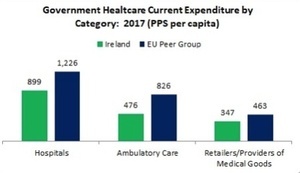
In hospital expenditure, Ireland lags far behind its EU peers. Irish spending on ambulatory care (which includes GPs and medical specialists for outpatients) is even further behind while spending on medical goods (pharmaceuticals and other goods) is closer to the EU peer average.

There are three important issues following on from all this.

First, the Eurostat data only takes us up to 2017. Between 2017 and 2020, real healthcare spending per capita rose by approximately 10 percent. This is likely to be higher than our EU peer group so the gap should have closed somewhat.

Second, demographics are a significant driver in healthcare spending. The older the population the more spending there will be. Ireland has a lower older demographic and, therefore, need to spend less on health. So, while Ireland is a health under-spender, is this merely a function of demographics. Could it be that Ireland, once age-related spending is factored in, is actually an average health spender or even higher?

It is difficult to test this given the paucity of data. The OECD does provide data from the Netherlands regarding spending on different age groups.

If we use this data and apply it to German and Irish age structures we might be able to get an insight as to whether Ireland spends too much or not enough – at least in comparison with Germany. I emphasise this is a stylised estimation and should be treated cautiously.

The gap in actual spending between German and Ireland is 16.8 percent. Demographic-based spending is 18.4 percent. This suggests that, after factoring in age, Ireland spends 1.4 percentage points more than Germany. However, when price levels (PPS) are factored in, Irish spending drops back down again as we saw above.

This is just an exercise and more data would be needed to confirm this. A similar exercise done with Dutch levels of spending shows the same outcome – near parity when age is factored in but a large gap re-emerging when prices are factored in.

Third, even though Ireland appears to be an under-spender, this shouldn’t lead us to think that merely increasing expenditure will solve all the problems in healthcare.

Whether it’s waiting times or A&E overcrowding, more resources would be welcome but we can’t be sure whether some of these issues are structural.

And then there is the upfront cost of Slaintecare – with additional costs arising from free provision of healthcare and the ending of private use of public assets.

However, what the above shows is that, when comparing like-with-like, Ireland does not appear to spend too much on healthcare and may well be a significant under-spender when factoring in both age and prices.

If this turns out to be the case then basing policy on the assumption that we spend too much will undermine sustainable and positive reform.

Michael Taft is a researcher for SIPTU and author of the political economy blog, Notes on the Front. His column appears here every Tuesday.

Rollingnews

Behold:  the Patek Philippe Grandmaster Chime Steel watch ( ref. 6300A-010) – a thing of beauty and great mechanical subtlety.

Its stainless steel reversible case has two dials. One tells the time, date, and moon phase – all rendered in rose gold. the opposing ebony dial displays calendar information. There are twenty complications, including five acoustic functions, an alarm that strikes the preprogrammed time and a repeater that sounds the date on demand. The strap is hand-stitched black alligator leather.

But never mind all that.

Last Friday, it sold at auction for €28 million, (the previous record, for a Rolex Daytona being €16.1 million) making it the world’s most expensive wristwatch.

uncrate

A court has heard a taxi driver ripped off passengers by secretly using a remote control to add €9 to fares

Taxi passengers may get a scare
As the newspapers make them aware
There’s a chance that their lift
Was part of a grift
Which strikes me as rather unfair

John Moynes

Rollingnews

Broadsheet.ie
