This evening.

Just pogoed ‘dropped’.

Via MCD:

Today Green Day, Fall Out Boy, and Weezer, three of the biggest acts in rock music, announced they will be heading out on the road together for the first time ever on THE HELLA MEGA TOUR presented by Harley-Davidson.

To celebrate the tour reveal, all three bands will perform a historic show tonight at the legendary Whisky A Go Go in Los Angeles….

Tickets on sale September 20.

Green Day Announce New Album, Share New Song “Father of All…”: Listen (Pitchfork)

This afternoon.

Dublin Bay.

The 270-foot-long Cuauhtémoc (named after the last Aztec Emperor) – one of the world’s largest Tall Ships – which was berthed at Sir John Rogerson’s Quay for a five-day visit here, leaves Dublin.

Probably worried about all the poo, but what can you do.

There’s no concealing hundreds of yards of brown water.

Darach McHugh writes:

A video I shot today of the Mexican Naval ship leaving Dublin port.

Music: Unknown brass ensemble.

Save Poolbeg.

Damn you, Blakey.

Red Hugh O’Donnell

Simancas Castle?

Simancas pic: Wikipedia
Top right: Red Hugh by Maurice Harron in Donegal

‘sup?

Yesterday

Unspecified location, Dublin.

The launch of ‘Rufus the Handwashing Hero’  – with Mason (left) and Noa Belle (right) – on ‘hand’ to help “children under five learn all about handwashing and help tackle the spread of harmful bacteria.”

Zara Brownless writes:

Rufus the Handwashing Hero” is the star of a new free educational resource pack featuring a storybook, sink poster and sticker set. Developed by safefood with the support of Early Childhood Ireland, the pack has been arriving in more than 3,500 childcare providers since last week….

How cuddly?

Arrrgggghhh.

*turns tap, rolls sleeves*

safefood

Pics: Marc O’Sullivan

The vote on Dublin City Council to reverse a May 2019 decision blocking the sale of land close to The Bernard Shaw and Eatyard (top)

Unfit for social housing, apparently.

Anyone?

ANYONE!?

Councillors Overturn Earlier Vote Not to Sell Off Patch of Land (Lois Kapila, Dublin Inquirer)

Earlier: Meanwhile, Opposite The Bernard Shaw

Yesterday: Heartbreak House

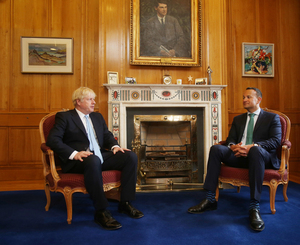
From top: Taoiseach Leo Varadkar (right) with British Prime Minister Boris Johnson in the taoiseach’s office at Government Buildings, Dublin yesterday; Derek Mooney

Boris Johnson came to call on us,

He wanted to tell all of us,

Brexit won’t put a wall ‘round us, it’s frictionless.

Not so, says Leo back to him.

We’re waitin’ for some facts from ‘em,

So it’s the Backstop we’ll be backing then, Athena.

Take him up to Monto, Monto, Monto…

If you listen closely you can just hear the ghost of George Hodnett groan at the thought of his comic folk song “Monto” having my pitiful new verse inflicted upon it.

Nonetheless, commemorating the visit of the reigning contender for the twin titles of worst and last ever UK Prime Minister to our fair city, in verse does somehow seem appropriate.

To be fair, Prime Minister Johnson did not make a show of himself… well, not by his recent standards. His remarks were coherent and almost relevant. They bordered on emollient:

“I have one message that I want to land with you today, Leo, that is I want to find a deal, I want to get a deal”.

The pity is that none of what he said amounted to a plan. Instead we got the usual Johnson line about the UK never imposing checks along the border, but nothing about how this plays out in the no-deal Brexit for which so many in his party yearn.

Johnson had even less to say about the other direct and dire consequence of an October 31 no-deal Brexit, the imposition of Direct Rule in Northern Ireland on November 1. Such a unilateral move would torpedo the Good Friday Agreement.

Through a mixture of waffle, grimaces and curious arm exercises Johnson ignored Tommy Gorman’s direct question on direct rule.

An Taoiseach did not.

Varadkar was candid, saying: “the Irish government will oppose the reintroduction of direct rule were that to happen”, adding that it would be contrary to the Good Friday and St Andrews Agreements.

The introduction of Direct Rule in Northern Ireland has been a live issue for months, particularly since a leaked April memo that quoted UK cabinet secretary Sir Mark Sedwill, as saying:

“The current powers granted to the Northern Irish secretary would not be adequate for the pace, breadth or controversy of the decisions needed to be taken through a no-deal exit. Therefore we would have to introduce direct rule.”

Sedwill’s analysis was later confirmed by the former Deputy Prime Minister David Lidington MP at a Westminster parliamentary committee and again last week on BBC radio’s Today Show.

Let’s be clear. A unilateral move by the British to impose Direct Rule would up-end three decades of progress. Ireland cannot countenance a British solo run. No ifs, buts or maybes.

While An Taoiseach did say yesterday that he would want a consultative role for Dublin under the Good Friday Agreement, as with previous comments he did not indicate how Dublin would act to protect the Good Friday Agreement from such an egregious attack.

His caveat that “ultimately, it will be the responsibility of the sovereign government, which is the UK, to manage affairs in Northern Ireland” goes the opposite direction. It risks allowing Johnson to surmise that Ireland will “wait and see” and may only respond after the fact.

We do have options, after the fact, powerful ones. As Varadkar told Johnson yesterday:

“…the story of Brexit won’t end if the UK leaves the EU on October 31st or January 31st…We all have to deal with issues like tariffs and state aid, ratified by 28 governments.”

It is a repeat of what the outgoing EU Commission President, Jean Claude Juncker told the European Parliament last April:

“…whatever happens, the UK will still be expected to address the three main separation issues.

· Citizens’ rights would still need to be upheld and protected.

· The UK would still have to honour its financial commitments made as a Member State.

· And thirdly, a solution would still need to be found on the island of Ireland that preserves peace and the internal market. The UK must fully respect the letter and spirit of the Good Friday Agreement. [My emphasis]

“No-deal” does not mean no commitments. And these three issues will not go away.”

Both statement are reminders to the UK that negotiations after a no deal Brexit will focus on the same issues, but with one important difference; they will not be run under Article 50 of the EU Treaties. That covers EU members quitting the EU.

As a third country outside the EU future talks would be conducted under Article 218. This is the 27 member-states and the European Parliament a veto over any UK deal. It’s a higher bar than Article 50.

That means a future Dáil could reflect on the damage done by the UK to, borrowing President Juncker’s phrase, the letter and spirit of the Good Friday Agreement when considering the deal.

But our approach is not limited to responding after the fact.

There is an active option available now to both governments, though Irish statecraft will have to drag or cajole the Brits to get to it. It is to resurrect the detailed partnership proposals (Plan B) announced by Bertie Ahern and Tony Blair in their joint statement of April 6th 2006.

Their response to the political challenges to devolution was to take their shared stewardship of the Good Friday Agreement seriously and declare that:

We are beginning detailed work on British-Irish partnership arrangements that will be necessary in these circumstances to ensure that the Good Friday Agreement, which is the indispensable framework for relations on and between these islands, is actively developed across its structures and functions. This work will be shaped by the commitment of both Governments to a step-change in advancing North-South co-operation and action for the benefit of all.

The timeline section (Annex D) of the St Andrews Agreement repeated the warning to all parties that there was a Plan B alternative to simple Direct Rule:

“…failure to agree at any stage, and the Governments will take forward new partnership arrangements on the basis previously announced.”

This time around it is the British government, a minority British government at that, which needs to heed this warning. As has been the case at every crisis point in Northern Ireland over the past twenty plus years, the only way forward is partnership between the two governments.

That remains the case now even though one of the parties is opting to take itself outside the wider partnership within the EU.

Derek Mooney is a communications and public affairs consultant. He previously served as a Ministerial Adviser to the Fianna Fáil-led government 2004 – 2010.  Follow Derek on Twitter: @dsmooney

Rollingnews

From top: Arnotts department store during last year’s budget address by Minister for Finance Paschal Donohoe; Michael Taft

One of the arguments for tax cuts is that it is necessary to boost people’s income, a type of rewarding the ‘wealth creators’.

Let’s leave aside the issues of whether tax cuts or social investment would be a better way to increase living standards. What is a more effective way of increasing people’s income from work?

Over the last four years the average employee has received a weekly wage increase of 8.9 percent, or approximately €4,000 for a full-time employee. In the last year, the increase was 3.8 percent, or €1,800. Without tax cuts, employees’ income is rising.

The problem, though, is that this is an average. Some sectors are growing faster than others; ditto with occupations and social class. Not everyone gets the average increase and many get more than the average, depending on market demand and other factors.

Driving employee income through wages would appear to be more socially equitable and economically efficient. Employees’ net income increases while the extra tax revenue can be used by the Government to invest in programmes that reduce living costs.

However, while tax cuts will increase employees’ net income, it will reduce the government’s capacity to invest, given the reduction in tax revenue.

Affordable childcare is one programme that would reduce living costs through lower fees; reduction of public transport fares is another. And then there’s a programme to build cost-rental housing which could substantially reduce rents.

These and other programmes would effectively boost people’s income though lowering costs. This is the benefit of linking income with wage increases.

But what would the economic impact be of rising wages?

Measuring the level of wages in the Irish economy is a challenge. It suffers from the same problems when using conventional national account data.

For instance, in other countries it is rather straight-forward to measure labour’s share in the economy. It is based on wages as a percentage of GDP.

But as we know, GDP is not reliable in Ireland. It is also becoming clear that using the CSO’s modified Gross National Income is not helpful when comparing with other countries, either. This is because the formula that the CSO uses cannot be applied to other countries.

There is another, little used measurement – Net National Income, or NNI. NNI essentially strips out capital depreciation in all countries.

It essentially measures the sum of all income – household, business and government income. The only tweaking of this measurement is to exclude the income re-domiciled companies, not something that would feature much in other countries.

When we use NNI, how does Irish labour’s share of national income compare to our peer group?

We don’t fare well. Ireland’s labour share of national income is well below that of the weighted average of our peer group in the EU. The only exception was during the recession but the ‘rise’ is misleading.

Between 2007 and 2011 employee compensation fell by 13 percent. But national income fell even more – by 20 percent.

What difference does this make?

In 2018, if Irish wages were to increase to our EU peer group average, it would mean an 11 percent increase for all Irish employees. It could also mean an increase of €6,500 for each employee (full-time equivalent).

This puts the demand for tax cuts into perspective. There is no tax cut that comes anywhere close to the amount employees would receive if they were paid at the level of our EU peer group average.

The counter-argument is that higher wages would make Ireland uncompetitive. However, our low-wage status (as defined by labour share) does not make us more ‘competitive’.

In our peer group Ireland ranks bottom – in both the global competitiveness ranking and labour share. It is not that there is a causal relation between a higher labour share and greater competitiveness; there isn’t. But equally, there is no causal relation between a low labour share and high competitiveness.

To drive wages does not require budgetary action. It requires new labour market institutions and practices; notably, collective bargaining at both firm level and across industries.

The main beneficiaries of collective bargaining are those with little economic leverage – the low paid, precarious workers, most women and non-nationals.

Collective bargaining raises the floor because by bargaining together employees can exercise greater industrial power (which is why employers don’t like it). However, without a legal right to collective bargaining, employees are at a considerable disadvantage.

There are wider economic implications of driving wages. For instance, if output doesn’t keep pace with wages or leads to a spike in imports, the economy can over-heat.

This requires a macro-economic strategy that is compatible with rising wages but seeks to promote output at the same time. In this regard, a wages strategy that is focused on the low-paid could help.

All this to say, we must find ways to reward the wealth creators – the men and women who produce the goods and services that we need or want to buy. Wages rising with productivity, wages rising with national income, wages rising for everyone – this is a way around the dangers that a Brexit-induced could bring us.

But more importantly, it is a way to ground the economy in a sustainable manner.

Michael Taft is a researcher for SIPTU and author of the political economy blog, Notes on the Front. His column appears here every Tuesday.

Rollingnews

An arresting one-take short by Australian director Tom Noakes. To wit:

Why is a metalhead singing ‘Old MacDonald’ on the side of a rural highway?

Let’s rubberneck, shall we?

shortoftheweek

Broadsheet.ie