
KILNAMANA – Hola Amiga

In the mood for blissed-out electro-indie? Then walk this way.

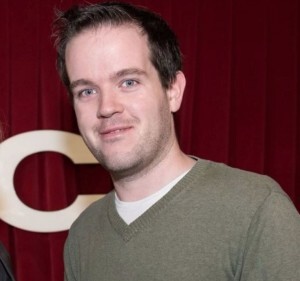
Enda Gallery and Miguel Garcia Soler named their band after the Tallaght suburb where they formed.

‘Hola Amiga’, which pulses with warm New Wave synths, is something of a swansong with the duo calling it a day once they have released their final four songs.

Enda says:

“We want to thank all the people who gave us a shot, an opportunity, and gave us their time and their love.”

Nick says: The video features Twin Peaks’s dancing dwarf… say no more!

KILNAMANA

Robbie Harris writes;

Who are these men from Mayo?

Anyone?

Update
: All from Ballyhaunis (see comments)

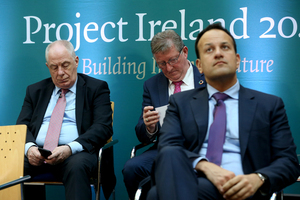
From top: David McCourt with Taoiseach Leo Varadkar at a Science Foundation of Ireland event in new York, March 2018; Economist and associate professor at University of Limerick Stephen Kinsella

This morning.

Economist, associate professor at University of Limerick and Sunday Business Post columnist Stephen Kinsella spoke to RTÉ Radio One’s Seán O’Rourke.

It followed Fine Gael Minister for Agriculture Michael Creed saying Granahan McCourt will be putting less than €200million into the National Broadband Project, compared with €3billion from Irish taxpayers.

Mr Creed’s comments were made on Clare FM last Wednesday and reported by Justine McCarthy in The Sunday Times yesterday.

Mr O’Rourke asked Mr Kinsella for his thoughts on a ministerial press statement saying that Granahan McCourt is “responsible for €2.4billion towards costs” in relation to the project.

Mr Kinsella said:

“They have to run the network but they’re not being paid to actually install it. We’re paying them to install it. So the State fronts up the money first, builds up the network and they then operate the network.

“And in operating the network they recoup fees from the operators that they’re going to contract out to – to sell you your broadband: Vodafone and so forth.

“So while they will have to invest that money, they’ll be getting it in, in revenue as they do so. So the actual amount of the money that they front up, as the minister said, will be in the region of  €180million.

“This time last week, we conservatively estimated, my colleagues Eoin Reeves and Donal Palcic, estimated it [the €180million figures] to be around €300million-€400million. And we assumed that we were very conservative when we assumed that.”

Asked if he thinks it’s a good deal for the State, Mr Kinsella said:

“…The negatives are that the advice from the Department of Public Expenditure has been ignored and the public spending code hasn’t been adhered to. And we don’t really have full confidence that the private sector is bearing enough of the risk to justify the amount of investment that the State is putting into it.”

Given Mr Kinsella’s earlier estimate of €300million to €400million now being confirmed as €180million, Mr O’Rourke asked Mr Kinsella: “how could they get it so cheap?”

Mr Kinsella replied:

“This is the question. It would be a very low-ball figure in the history of public-private partnerships like this and again my colleagues at the University of Limerick, Eoin Reeves, and and Donal Palcic are very well published on this, and around €300million-€400million would have been a conservative estimate. €180million seems quite low.”

“But again we are where we are now. The Cabinet has decided to award preferential bidder status to this company. If they decided to cancel it tomorrow there could well be very serious legal implications for the State.

“So the question is, right now: What aspect within the contract structure exists, to make sure that three or four years down the line, this company can’t just flip and asset strip it, extract the public value that is already put in there – that’s the key question for me at least.”

Listen back in full here

Earlier: Bryan Wall: Your Money And Your Broadband

Previously: “Seán, You’re Sounding Like A Member Of Fine Gael’s Frontbench”

This morning.

Irish Architectural Archive, Dublin 2

Sinn Féin EU election candidates launch the party’s European Elections manifesto. Top from left: Lynn Boylan MEP, Matt McCarthy MEP, Sinn Féin President Mary Lou McDonald TD, Martina Anderson MEP, Liadh Ní Riada MEP and Michelle O’Neill MLA.

In today’s Irish Times, Ms Boylan writes:

‘Instead of a Europe of deeper concentration of power in a centre that is unaccountable and fails to respect national sovereignty, we want to see a social Europe that place citizens at the centre and acts in their interests. Instead of a Europe of greater co-operation in furthering the neo-liberal economic agenda and in respect of militarisation, we want to see greater co-operation in tackling concerns that assist in building a more progressive Europe: issues like climate change, poverty and workers’ rights.’

Rollingnews

Meanwhile…

Taoiseach must reveal the investment of private company in broadband – Mary Lou McDonald (Sinn Féin)

Rainy in Glenageary.

An ‘unorthodox true crime documentary’ which explores the unsolved murder of 17-year Raonaid ‘Rainy’ Murray in Glenageary, County Dublin in 1999.

Directed by Graham Jones.

Sean O’Reilly writes:

Please take a moment to consider our unusual Irish documentary which tries to approach the ‘true crime’ genre in a new way. I understand Broadsheet has done some pieces on Raonaid’s murder in the past so sincere thanks for any attention you might draw to this film.

Previously: Lifting A Silence In The Suburbs

An Overlooked Suspect

Saturday.

Jervis Street Shopping Centre, Dublin 1

Scenes from the the launch of the first Irish branch of Miniso, the Chinese/Japanese lifestyle brand, with some obsessive fans queuing from 8am for the 11am opening

MINISO has over 3,000 stores globally and has already amassed a loyal following around the world for their quirky, low-cost household products and whatnot.

为了公平起见.

Miniso

Pics: Richie Stokes

Top from left: Minister for Rural and Community Development Michael Ring, junior minister with special responsibility for rural digital development Seán Canney and Taoiseach Leo Varadkar at a press conference last week approving the next step for broadband in rural Ireland; Bryan Wall

One of the major myths of capitalism promoted by its supporters is that it encourages innovation. That the best battle it out to rise to the top of the economic system, profit, and become household names.

If that was the case then why the need for massive transfers of wealth to the private sector via the state? The reason for this is because the myth of capitalism is indeed not only a myth, but a fatal flaw in the system.

Its insatiable need for new markets and constant profit is a result of it struggling to survive. And in that struggle it has always found a willing assistant in the state. Hannah Arendt argued that the colonialist and imperialist expansion of the European powers was because of the requirements of capitalism. New markets and increased profit were needed. Therefore, the might of the state was to be used to ensure this.

The same pattern continues today. Capitalism is continuing the same search but in a world where most of the markets have been filled; there is nothing more to exploit. But, there is always the chance to return to habits of old and exploit the common people directly.

In Europe, and especially here in Ireland, banks seeking out more profit by being reckless and breaking the law had to be saved, i.e., bailed out, by the government in order to ensure their profit margins were not affected. Essentially, an upward transfer of wealth. Banks profit, developers have their debts wiped, and the general population is left with the bill.

And we see this played out again and again – history repeating itself as farce – with the cost of construction of the National Children’s Hospital reaching nearly €2 billion. The more profit the better, just as long as the right people and the right companies do the profiting.

Now we have the National Broadband Plan to contend with and yet another transfer of wealth for no other reason than the fact that a transfer of wealth has to happen.

Never mind questions about private meetings the now former Minister for Communications, Climate Action and Environment Denis Naughten had with the head of the then last remaining bidder on the broadband contract.

This is the same group which the government has decided to award the contract to. It’s also the same company who will own the broadband system once construction is complete and before they’ve even fronted most of the bill for it.

An article in The Sunday Times yesterday revealed that the company will be paying less than €200 million into the roughly €5 billion project.

As David McWilliams points out in the Irish Times, it appears that the investment they make will in part be funded by people paying their broadband bills.

So, the company pays little up front, the taxpayer via the government foots the bill, the government hands over the infrastructure to the company which then makes the larger share of its initial investment. And this investment is at least partially funded by the taxpayer directly via their bills. Death by a thousand deals.

We should be shocked. In a country with a functioning democracy and appropriate oversight the citizens would be shocked. Instead, we are resigned to the fact that this has happened before and will happen again.

The litany of controversies during the lifespan of our state has made us complacent; a case of having seen one controversy, seen them all. And given the scale of bank debt that was laden on us, a few billion for a national broadband network seems like small change by comparison. But we should be shocked and we should be angry.

We should be angry at a system that has been set up to reward private investors at the expense of everyone else.

We should be angry at a system that allows the health system in the country to slowly deteriorate so that it eventually be completely privatised.

This same system thought it appropriate that the average person on the street should shoulder some of the massive debt belonging to banks.

Welcome to neo-liberal Ireland; everything for them and nothing for ourselves. Dare to question the system directly and you’ll be dismissed as a naysayer. Try and take it on directly and you’ll feel the full assault of the government both physically and in the media.

Being part of the so-called sinister fringe should be seen as a badge of honour. It means that you believe that basic services that people rely on every day should be in the hands of the public.

They shouldn’t be in the hands individuals and companies whose ethical horizon extends only as far as their quarterly financial statements. The idea that there are certain things that shouldn’t be exploited for a profit and could – horror of horrors – be operated at a loss for the public good is completely alien to these same individuals.

And as much as services like water and health should remain in public hands, the national broadband network remain there too. Like it or not our societies rely on the internet for basic functions. The National Broadband Plan is akin to the rural electrification scheme.

Yet here we are. Our government is willing to hand it over to a private company. You could almost say determined given that it ignored the advice of Robert Watt. Watt, the secretary general of the Department of Public Expenditure, warned “against approval of the appointment of the preferred bidder”.

His argument was that it should not go ahead on the basis of affordability, risk, and the effect on other unrelated projects given the cost. He also took the step of saying the risk was “unprecedented”.

But it will go ahead. It has to. After all, a profit has to be made somewhere – just not by us.

Bryan Wall is an independent journalist based in Cork. His column usually appears here every Monday. Read more of Bryan’s work here and follow on Twitter:  @Bryan_Wall

Rollingnews

Daft.ie latest quarterly report  (click to enlarge)

Daft.ie has published its latest report for the first three months of this year.

It found that just 2,700 properties were available to rent nationwide on the website daft.ie on May 1 – the lowest ever figure for stock on the market, as recorded by Daft.ie, since 2006.

It also found the average rent nationwide is €1,366 and that while rents in Dublin are 7% higher than a year ago, rents in Munster, Connacht and Ulster – outside the cities – are up 12%.

Read the report in full here

From top: This week’s Europvision semi final running order. The competition begins tomorrow in Tel Aviv, Israel;  Shane Heneghan

The contest that is known for getting far too political will be especially political this year after the victory of one of the least commercially successful Eurovision winners of the past few years from Netta Barzilai of Israel.

When it became apparent that Israel would host this year, the calls to boycott Eurovision were instant. Sinn Féin, Sweden’s left Party and the Australian Greens were all vocal.

A petition in Iceland very quickly gained 23,000 signatures- equivalent to 5% of the population.

The BDS movement hopes people and countries alike will skip this years shin dig and are busy setting up alternative events across the continent.

This is not the first time Israel has hosted the event and not the first time there have been calls for a boycott.

Indeed, Yugoslavia and Turkey refused to send representatives to Jerusalem in 1979 in the politically charged atmosphere just a few years after the Yom Kippur war.

This time around, no nation is boycotting for political reasons. Though Ukraine is staying at home- for reason of internal not external politics.

Local media reports indicate that the numbers travelling to this years contest are way down compared to previous years- though this may have as much to do with geography and the high cost of Tel Aviv as much as politics.

Recently, a group of international celebrities ranging from Marina Abramovic to Stephen Fry signed a letter slamming the boycott and asking for “all our friends and colleagues around the world to express their support for an exciting and successful Eurovision 2019 in Tel Aviv”.

Their endorsement is crowned by Israeli TV’s booking of Madonna for the interval act. The material girl in the Michael Flatley slot is a Kabbalist and has always been strong advocate for Israel.

Despite the aforementioned petition, Iceland will still participate next week with one of this year’s more eye catching acts.

The BDSM clad metal band Hatari believe “we can bring this critical conversation or make awareness of the situation here with our message and with our agenda-setting powers and hopefully we will make awareness to the world through Eurovision.”

Their song – “Hatrið mun sigra” loosely translates to Hatred will prevail. Take from that what you will.

But perhaps the participant to watch is Italy’s Mahmoud. The half-Egyptian has already caused a stir in Salvini‘s Italy with his song Soldi when it won the San Remo festival. It has since broken to the top of the charts and is among the favourites to win the whole thing.

The song has lyrics in Arabic and whilst not political a victory for this song would not be seen as without significance.

For clarity, Palestine is currently ineligible to take part in Eurovision as their broadcaster lacks EBU membership.

Shane Heneghan is a Brussels-based writer and academic. Follow Shane on Twitter: @shaneheneghan

A composite image of the central crowded starfields and cosmic dust clouds of the Milky Way overlaid with a separate deep exposure of some Space X shenanigans. To wit:

In the scene from Merritt Island National Wildlife Refuge, a nine minute long exposure begun about 20 minutes after the Milky Way image recorded a rocket launch and landing. The Falcon 9 rocket, named for the Millennium Falcon of Star Wars fame, appropriately launched a Dragon resupply ship to the International Space Station in the early morning hours of May the 4th. The plume and flare at the peak of the launch arc mark the rocket’s first stage boost back burn. Two shorter diagonal streaks are the rocket engines bringing the Falcon 9 stage back to an offshore landing on autonomous drone ship Of course I Still Love You.

(Image: Devin Boggs)

apod

Broadsheet.ie