Nigel Farage launching the Brexit Party earlier this month

The YouGov survey for The Times put the party launched by the former Ukip leader last week on 23 per cent, a point in front of Labour and five ahead of the Tories, and appeared to confirm the result of a shock poll published on Wednesday…

Gulp.

Brexit news – live: Second poll shows Nigel Farage’s Brexit Party on course for European election victory (The Independent)

Poll puts Nigel Farage’s Brexit Party in the lead for May’s European elections (Channel 4)

Pic: Getty

From the Ombudsman for Children’s No Place Like Home report

This morning.

The office of the Ombudsman for Children launched its No Place Like Home report outlining the views and experiences of 80 children living in family hubs in Dublin, Cork and Limerick – gathered between October 2018 and January 2019.

Family hubs are “purpose-built or specifically adapted premises” to house children and families who are homeless as an alternative to B&Bs and hotels.

The children who took part were aged between five and 17 while parents of children under the age of five also took part.

In August 2018, there were 580 children under 18 being accommodated in 18 family hubs in the Dublin area. Over half of these children (55 per cent) were aged 5 years or under; 33 per cent were aged 6 to 12 years; and 12 per cent were aged 13 to 17 years.

In addition, as of February 2019, children accounted for over one third (almost 37 per cent) of the 10,264 people accessing State-funded emergency accommodation.

From one section of the report:

“For some children their unhappiness in the hub was so great that, despite their very young age, they tried to run away. Hannah (aged 8), cried and told us that the hub was “like a children’s jail”.

She expressed extreme worry and fear for her younger brother Niall (aged 5) who had tried to run away from the hub on several occasions.

She told us that when her mother was having a shower she would sit on a chair in front of the door so her brother could not run away. Niall had sneaked out of the hub once already and threatened to throw himself out of a bedroom window.”

The report can be read in full here

UPDATE:

Jallianwala Bagh in Amritsar in the Punjab region of India in 1919

With reference to the appalling massacre in Amritsar, I have recently been given a book about the Raj, and there is an account of the reasons for the massacre. Brigadier General Dyer had just dealt with a dangerous situation where 100 British women and children were in danger of being attacked by a mob. His reaction was in connection with that.

I had known the two Dyer sons when we were young children playing together when we lived in New Delhi. It was a long time ago (I am 92 now), but I recall that the boys always seemed troubled. – Yours, etc,

Maeve Davison,
County Wexford

Irish Times Letters

Mrs Maeve Davison references a book she read about the massacre at Amritsar which suggests the cause of the atrocity might be connected to Brig Gen Dyer having dealt with a dangerous situation where 100 British women and children were in danger of being attacked by a mob. That was not a reason, that was an excuse.

The very same propaganda was propagated all around the British empire whenever British colonial atrocities occurred, including Bloody Sunday in Derry in 1972 and Ballymurphy in 1971.

The events at Amritsar whereby British Indian troops slaughtered hundreds of Indian civilians, reflected the ultimate success of British colonialists in India in that the colonised not alone defended the coloniser but denigrated the colonised. – Yours, etc,

Tom Cooper,
Templeogue, Dublin 6w

Irish Times Letters

AR writes:

Anything good in the Irish Times letters page? Only Chris De Burgh’s mother (top) excusing the massacre at Amritsar, during which British soldiers opened fire on a peaceful protest in Jallianwala Bagh, Amritsar, Punjab in April 1919, killing anywhere between 400 and 1,600 innocent civilians. Subject to subsequent ‘correction’, as you’d expect, from a Tom Cooper from Templeogue (above)…

FIGHT!

Amritsar Massacre?

Pic: Nehru Memorial Museum

Fancy a timepiece?

Three Rolex watches seized during a search operation by the Criminal Assets Bureau as part of Operation Thor targeting the assets and activities of a County Cork based organised crime gang.

Name those models, anyone?

Meanwhile
…

A cash-stuffed sock among yesterday’s haul.

FIGHT!

Meanwhile…

Thanks Nick

The GAA is to ban overseas training for county squads and will also impose a restriction on the duration of home-based camps, the Irish Independent reports

The athletic heroes who play
Gaelic games must do so without pay
And now a new rule
Which seems rather cruel
Insists that they can’t go away

John Moynes

Pic: Balls.ie

O’Connell Street, Dublin 1

“Walked through Dublin city centre earlier this evening. I was having a few medical tests done earlier in the day. Sadly the town I’ve known and loved all my life has been reduced these past few years to a horrible, intimidating drug-infested kip of a place.

And it keeps getting worse. There’s still a handful of great pubs where you can enjoy a pint (albeit in some places at exhorbitant prices – €5.90 for a pint of stout ffs in one place we called into! So I don’t go to too many of them lately.)

But the city is now becoming more sinister and more nasty than I’ve ever known it to be in the past. Sadly this city I once loved is now controlled by gangs. It wasn’t how I knew it to be years ago, as I walked back to where we were staying tonight with some food from a local takeaway.

Even a young garda asked me if I knew exactly where I was going. I agreed with him when he described the city centre as an incurable kip. He looked no more than twenty. When I was twenty, this city was a great place. Sadly that’s not the case anymore. But we still had a great evening and thankfully the weather was beautiful.”

Broadcaster Gareth O’Callaghan, yesterday.

Spaghetti Hoop writes:

Is Gareth’s mournful outpouring simply a reaction to a bad night in the city and a bit Brennan’s Bread with its, ‘ah it’s not like the good ole days’, or has our capital city declined in cultural value, safety and general conviviality because of increased crime and addicts?

 A close relative of mine, more Dub than I, can’t wait to get out of the place due to the ubiquity of addicts where he works in Dublin 1.

I know several people agree with him, but triple that who don’t and who left their Dublin roots for the commuter belt semi-ds in Meath and Kildare during the housing boom, craving to come back now that the kids are teens and they have more social time.

Tourism Ireland reports that 11.2 million overseas visitors came to Ireland in 2018, an increase of 6% from 2017 and many of them spent at least two days in Dublin. Which means we are top providers of a cultural experience and a pleasing gateway to the rest that the country has to offer.

The swarms of hen and stag parties that visit Temple Bar during the spring and summer season contributes to a healthy tourism industry and they don’t cause any grief except push the pint price up in those contained zones – which Dubs nimbly avoid and proceed to their prized spots.

Most Dubliners wouldn’t dream of living anywhere else in the country, even for the four bedrooms, horse stables, chicken coop and hectare of landscaped garden they could gain in exchange for their city crib.

There’s a buzz in town, and you get used to its traffic and rough neck and enjoy its village-like eccentricity.

Granted I’m a twice returned emigrant so without lyrical-waxing about it I still think the city rocks from a global perspective because of its small size, recreational offerings and touch of madness.The diversity of pursuits at the weekend for beach, city culture and mountain walks would want you wish for more weekends.

So I am curious; is Gareth right about Dublin being a kip or just doesn’t get the joys of city life? And if you do think it’s a kip, to paraphrase Junker to Farage in the EU Parliament in 2016, “Why are you here?”.

Anyone?

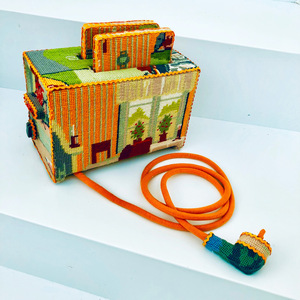
All manner of domestic items and appliances tightly wrapped in cross-stitched designs by Swiss-based artist Ulla Stina-Wikander: bringing symbolic functionality to a pastime traditionally regarded as (her words) kitsch and worthless.

colossal

Broadsheet.ie