



From top: National broadband consortium leader David McCourt, former Minister for Communications Denis Naughten; Pat Leahy, of The Irish Times, and Mary Regan, of RTÉ News
A fortnight ago, leaks concerning the then pending review by auditor Peter Smyth into the National Broadband Plan procurement process were given to selected journalists.
Mr Smyth was tasked with examining the interactions between the former Minister for Communications Denis Naughten and businessman David McCourt, founder and chairman of Granahan McCourt – the last remaining consortium bidding for the National Broadband Plan.
The purpose of the review was to see if their interactions undermined the integrity of the procurement process.
The leaks gave the impression that Mr Smyth found that the procurement process was wholly untainted by the meetings, with RTÉ reporting:
“RTÉ News understands that a review of the procurement process for the National Broadband Plan will state that it was not undermined by contacts between the former Communications Minister Denis Naughten and the businessman [David McCourt]…”
But Mr Smyth actually found:
“…the fact that the former Minister met with Mr McCourt (or representatives of the other bidders) outside of the process is not in and of itself a basis for finding that the procurement process has been tainted.”
He also said that, as he has to take Mr Naughten and Mr McCourt’s word for what was discussed at two one-to-one meetings and one telephone call:
“I cannot unequivocally state that the State-led intervention under the NBP was not discussed at the meetings between the former minister and Mr McCourt outside of the procurement process.”
On Tuesday, November 20, 2018.Taoiseach Leo Varadkar confirmed to the Dáil that the review by Peter Smyth into the National Broadband Plan procurement process had been received by the Government.
He also confirmed it had gone to the Attorney General and that anyone named in the report may be be sent a copy of the report, to give them a chance to respond to the report’s findings.
However, he ultimately anticipated the review would be published in a matter of days.
During that same day, RTÉ’s Business Editor Will Goodbody reported this and added that the review had not been discussed at that morning’s Cabinet meeting.
Later that evening, on the Six One News, Mr Goodbody reported:
“As for what it [the review] says, well everyone is remaining tight-lipped in Government circles about that today. Certainly though, it’s contents will determine the future of this plan, as it stands at the moment and it will certainly have a big impact on how soon it is that people around the country, who are still waiting for high-speed broadband service, will get it.”
A few hours later, on RTÉ’s Nine News, Mary Regan, formerly of the Sunday Business Post but now with RTÉ’s political staff, reported to presenter Eileen Dunne about the contents of the review based on speaking to “a number of Government sources”.
Ms Dunne introduced the news item saying:
“RTÉ News understands that a review of the procurement process for the National Broadband Plan will state that it was not undermined by contacts between the former Communications Minister Denis Naughten and the businessman leading the only remaining consortium for the plan.”
Ms Regan then told presenter Eileen Dunne:
“I understand, from speaking to a number of Government sources this evening that it does not find that those contacts undermined the process in any way. So essentially what it means is that the Government can proceed with the normal evaluation process that would take place for any tendering process which the Government has previously said would happen by Christmas.
“There had been some fear that this report might stop the procurement process in its tracks but that now doesn’t seem to be the case and that report is expected to be published in the coming days.”
Similarly, the following morning, on Wednesday, November 21, 2018, on RTÉ’s Morning Ireland, Ms Regan reported the same to presenter Bryan Dobson.
Mr Dobson, in a similar fashion to Ms Dunne the night before, introduced the item saying:
“A review ordered by the Taoiseach last month, into the integrity of the National Broadband [Plan] process will state that it was not undermined by contacts between the former Communications Minister Denis Naughten and the businessman leading the only remaining consortium for the plan.”
During her report, Ms Regan then told Mr Dobson:
“I understand, speaking to a number of sources in Government, that he [Smyth] does not have any findings to indicate that this process was undermined by the meetings that took place. And what Government sources are interpreting this as meaning, is that the procurement process and the assessment of it can go ahead.
“So, essentially, that means a legal assessment that would normally be taking place is now proceeding and the Government has previously said it wants that process to be finished by Christmas.”
“…My understanding, speaking to a number of sources is that this particular issue is not cause for halting the process.”
“…The Government will be hoping that this stumbling block, at least, is out of the way in terms of proceeding ahead with this plan.”
That same morning, on Wednesday, November 21, 2018, Pat Leahy, in The Irish Times also reported on the review based on his contacts with “high-level sources” and “sources in Government”.
Mr Leahy’s article was published on page six of the newspaper but was also flagged on the front page of that morning’s edition.
He reported that the review “is expected to find that the process has not been fatally damaged by meetings between the sole remaining bidder and the former minister for communications Denis Naughten, high-level sources say”.

The Shoos – Christmas Time
A festive single from Dublin’s The Shoos with special guest Lorna Kennedy providing vocals.
Video by Andrew Jordan


From top: poster for the Fireman’s Polka (1903) dedicated to Captain Boyle, of the Dublin Fire Brigade, above right, at the WhiteHorse Yard, Dublin in 1890
Captain John Boyle of the Dublin Fire Brigade.
He was the gift that kept giving.
Historical Dubliner writes:
Captain John Boyle served as chief of the Dublin Fire Brigade between 1882 and 1892. On his retirement from office, the Freeman’s Journal wrote of him:
“The lives saved and the property preserved by his coolness, skill and daring, are the best testimony to his deserts. No general in active service in the field discharged duties more onerous or more dangerous.”
His greatest success was partially saving the South City Markets in Clarendon Street from destruction in 1892. Dublin kids, however, preferred to refer to him as “Captain Santa Claus”.
Pics via The National Library of Ireland and South Dublin Libraries


This morning.
The Central Statistics Office announces:
Ireland exported €123 billion of goods in 2017 and imported €79 billion. We exported €17 billion more to the USA than we imported in 2017.
The UK was our largest import partner in 2017 at €18.8 billion and was also our largest partner for both exports (€4.6 bn) and imports (€3.7bn) of food and drinks.
In total, Ireland exported €12.3 billion and imported €7.7 billion of food and drinks in 2017.
We imported 20kg of bananas, 13kg of apples, 10kg of onions and 7kg of carrots for every person in Ireland.
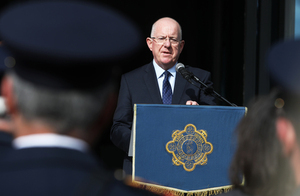
Minister for Justice Charlie Flanagan
Further to the incident in Longford last night.
Last month, Social Democrats co-leader Catherine Murphy asked the Minister for Justice Charlie Flanagan:
‘What the level of firearm training provided to armed Garda personnel in each of the years 2016, 2017 and to date in 2018; the number of gardaí by grade or rank with firearms training; the type of weapon they are trained to carry and or use; the company engaged to provide training; the cost of training on an annual basis; and if he will make a statement on the matter.’
In a written reply, Mr Flanagan said:
The Deputy will appreciate that the Garda Commissioner is responsible for managing and controlling generally the administration and business of An Garda Síochána, including by arranging for the training of its members and civilian staff and I, as Minister, have no direct role in the matter.
Training is provided by Firearms Instructors attached to the Garda College and the Emergency Response Unit under the control of the Director of Training, Garda College.
Following a recent audit conducted at the Garda College figures show there are approximately 2700 personnel that are currently authorised to carry firearms.
This can increase to approx. 3500 depending on operational requirements. This caters for all ranks of Gardaí who carry firearms.
Members attached to regular units and Detective units are trained in handguns only, namely Smith & Wesson revolver, Sig Sauer & Walther semi-automatic pistol.
Specialist Units such as Emergency Response Unit and the Armed Support Unit are trained in Sig Pistol, H&K MP7 Sub-machine gun, Taser and 40mm direct impact munitions (Less Lethal options).
For the Deputy’s information listed below are figures for attendance at firearms training in each of the years 2016, 2017 and to 31st August 2018.
2016 – 7851
2017 – 10555
2018 – 6891 as of 31st August 2018The increase in 2017 is as a result of the increase in ASU (Armed Support Unit). Each member attends more than one training course each year.
Earlier: Meanwhile, In Longford

Free Saturday?
A concert commemorating the life of John Lennon in aid of the Simon Community at Tullamore Food Fayre, Kilcruttin Business Park, Tullamore, County Offaly at 12-2pm.
Johnny Keenan, of ‘Broadsheet on the Telly‘ fame, writes:
‘Another Offaly Good Vibration – Give Peace A Chance’ will take place next Saturday 8th December in Tullamore Food Fayre, Kilcruttin Business Park, Tullamore.
An array of Offaly talented singers and poets will come together to perform original compositions and pay tribute to John Lennon on the 38th anniversary of his death.
This is positive vibe for all the family and is run to raise much needed funds for Midlands Simon Community.
Hot Keels
at


Behold: the Damen Game Changer Expedition Yacht – a 69m polar explorer with a fully equipped deep diver centre, onboard C-researcher U-boat submarine, a Saab falcon remote vehicle, a helipad for a custom Airbus H130 helicopter and space for multiple tenders.
Powered by four 3,000hp MTU 16V4000 M63L diesel engines, Game Changer has a top speed of 20 knots and a maximum cruising range of 4,500 nautical miles at 16 knots.
Currently available for seasonal charter from €189,000 to €220,000.


From top: Irish Fiscal Advisory Council Chairperson Seamus Coffey (left), Chief Economist and Head of Secretariat Mr Eddie Casey (centre) and Mr Michael G Tutty speaking to the media at the launch of the The Fiscal Assessment Report last week; Michael Taft
The Irish Fiscal Advisory Council has provided the Left an open goal. If we shoot, we score. But first we have to get on the pitch. And right now the Left has not even put on their jerseys.
In their latest Fiscal Assessment Report, the Fiscal Council got more than a bit tetchy with the Government’s handling of the public finances.
They used some undiplomatic language:
‘ . . . the medium-term budgetary plans are not credible . . . ‘
Ouch. The Fiscal Council’s critique of the Government’s fiscal policy boils down to (a) failing to drive a budgetary surplus in the good times; (b) leaving the debt at an elevated level; (c) stimulating an economy to the point of over-heating; and (d) failing to factor in the downsides in future projections.
All of this is leaving us badly exposed of the inevitable slowing down of the economy, never mind the damage Brexit, changes international taxation and trade wars could do.
In short, Fine Gael is squandering the recovery. Put this together with Fianna Fáil’s reckless pre-crash policies (never mind the equally reckless austerity measures both parties pursued) and the Left has a good starting narrative: you can’t trust the Right to manage our public finances.
This doesn’t mean people will automatically trust the Left, which to date has had little to say about the issues of debt, over-heating, deficits, etc.
This allows the Taoiseach to get away with deflecting the debate away from the Fiscal Council’s criticism:
‘[The Taoiseach] insisted the Government’s spending was modest compared to the constant demands of the left-wing Opposition for increased spending . . . if people listened to that kind of left-wing rhetoric the economy would plummet very quickly.’
The Left’s silence allows our opponents to monopolise the issue and distort its position. So let’s start engaging the debate.
Here are some ideas. These are not comprehensive or necessarily authoritative. But hopefully it will get things started.
1. Stick with the Fiscal Rules.
Never thought I’d write that but for now the Fiscal Rules are a practical defence against more orthodox policies. Sticking with the Rules’ deficit target will allow us more space than Government spending projections. We can still critique the Rules’ faults, though: the treatment of investment, the inapplicability of the Rules’ methodology to a small, open economy; their deflationary bias, etc.
2. Strengthen Automatic Stabilisers
There are two key stabilisers: Unemployment Benefit: In the event of a slowdown higher unemployment benefits will help maintain domestic demand. In our EU peer group, unemployment benefit is far stronger – over €300 and €400 a week; in Ireland, it is only €193. Increase unemployment benefit with a small increase in Employers’ social insurance.
Employment Subsidy: It is important to maintain employment in downturns. Therefore, rather than job losses, employers would reduce workers’ hours with the state subsidising workers’ income to prevent loss in take-home pay. This programme was pursued by Germany during the last downturn with considerable success. This would be less costly than growing the dole queues.
3. Underpin the Productive Economy
There are three main areas: Introduce cost-rental housing to substantially reduce rent levels. This would increase spending on goods and services and reduce unnecessary upward pressure on wages.
A new financial model for childcare: current policies are not working (last year, the Government handed over €1,000 in cash subsidies to childcare providers– and fees still increased). Reducing fees would, again, allow for higher expenditure on goods and services, and reduce entry costs into the labour market.
Human capital, education, and innovation capacity: to see us through the medium and long-term, increase resources into education, innovation, and basic and applied research (Ireland compares poorly to other EU countries), switch away from tax credits to grants for SMEs, increase links between state, universities and progressive enterprises, etc.
4. Collective Bargaining Rights for Workers
Optimising our response to any downturn requires employees to be part of the solution, part of the decision-making process at firm-level. Further, sectoral committees should be set up in those sectors most at risk of Brexit or other-related slowdowns with full employee participation.
Collective bargaining has two significant benefits:It tends to favour those on low and average incomes – the groups that have a higher propensity to spend during a downturn
It tends to reduce precarious contracts which currently exclude people from fully participating in the consumer economy (that is, they are forced to save during those weeks they have less work or no work at all).
5. Keep Public Banks Public
Notably, AIB. Banks are notoriously counter-cyclical; when the economy goes into downturn banks withhold lending. A public bank can act differently since it is not beholden to short-term shareholder interests. It can continue to support viable companies, which might not otherwise be able to access credit.
6. Engage in Real Public Services Reform
We need to ensure efficiency and productivity in our public services. So why not bring in the actual producers of public services; namely, the employees. Employee-driven innovation is a feature in many other EU countries. It is employees who are best placed to know why something isn’t working and how it can be put right.
7. Unleash Public Enterprise
Public enterprises are essentially investment-driven businesses. This will be all the more needed in the rough periods ahead. During the last recession, public enterprises maintained investment. Currently, the top six public enterprises invest the equivalent of 40 percent of the state’s capital budget.
* * *
It might seem curious this hasn’t focused on tax issues. Budgets, however, merely reflect the state of the economy so we must first look to economic policies.
You will increase revenue if you raise the wage floor, end precarious contracts, drive investment, strengthen stabilisers, reduce rents and childcare fees, and support innovation.
Measures that put the economy on a more sustainable footing can then be complemented by tax measures – in particular, taxation on property, assets and passive income.
Two short-term measures would be to introduce a net assets (wealth) tax and substantially increase inheritance tax. And, of course, stop Fine Gael from introducing its €3 billion tax cut bonanza.
However, the debate involves, whatever other and better measures are proposed, the key thing is to resolve in the New Year to enter the fiscal debate. Let’s put on our jerseys and get on the pitch.
An open goal awaits us.
Michael Taft is a researcher for SIPTU and author of the political economy blog, Notes on the Front.

The European Court of Justice in Luxemburg may endorse an anti-Brexit opinion
As Brexit turns into a curse
And Britain goes from bad to worse
Now there’s good news in sight
As it seems they’ve the right
To go suddenly into reverse
John Moynes
Pic: Getty