Last night: Broadsheet Trailer Park: Solo: A Star Wars Story
thisisnthappiness/thedorkreview



From top: 3d rendering of humanoid robots working with headsets and monitors; Michael Taft
Will the age of automation, AI (artificial intelligence), and robots produce a utopian or dystopian future; or, which is more likely, a bit of both.
This discussion will continue for a long time. However, we must start debating how we will deal with these inevitable changes even if we can’t accurately predict their future impact. And do so without falling into the twin-traps of over optimism and apocalyptic pessimism.
An example of the latter was this study that produced a mini-panic – suggesting that nearly 50 percent of all US employment was at risk of automation (that was the headline panic; the report’s details are more nuanced). Nonetheless:
…Our model predicts that most workers in transportation and logistics occupations, together with the bulk of office and administrative support workers, and labour in production occupations, are at risk.
More surprisingly, we find that a substantial share of employment in service occupations, where most US job growth has occurred over the past decades, are highly susceptible to computerisation.
This was quickly countered by a McKinsey Report which stated that only 5 percent of employment would be lost. The difference lay in how they measured the impact – will it fully replace a workers’ job, or most of it, or part of it?
The difference between fully or partially replacing a particular job is crucial to understanding the impact.
The McKinsey Report produced a useful projection based on assessing the automation potential in particular sectors.
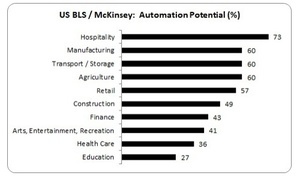
The sectors with the highest automation potential, according to McKinsey, are hospitality, manufacturing, transportation, agriculture and retail. Those with the lowest are education, health, information and management.
According to this summary:
‘Almost every occupation that McKinsey looked at had some aspect that could be automated. Even 25% of tasks inside of a CEO job, the analysis found, could be automated. But very few jobs could be entirely automated. McKinsey’s conclusion was not that machines will take all of these jobs, but rather, “more occupations will change than will be automated away.”
So our jobs may not be fully eliminated, but they may be significantly changed.
Some proposals have been put forward to deal with the oncoming Robot invasion. A Robot tax has been mooted, with revenue going to a fund to be distributed to households. Yanis Varoufakis suggests that such a tax wouldn’t be workable. In any event, is it a good idea to tax an investment that can result in greater efficiency and higher productivity?
Others have proposed a Basic Income. There may be a number of good arguments for Basic Income (and there are) but dealing with technological change is not one of them. This could result in fewer people at work having to fund more people not in formal work, with less demand contributing to economic growth.
Still others put great store by education and re-skilling. This is something we should be doing in any event. But this assumes that there will be a growth in employment arising from automation. If there isn’t, what are we training people for – except to increase competition for employment which could drive down wages?
These observations aren’t the last word, merely the first. There are many who would argue that radical technological change is nothing new, that we have lived through these periods before.
They further argue that the reduction in costs will lead to a higher volume of demand for other goods and services, and that the increased productivity will increase net wages. There is much that is potentially true here. The problem is we can’t predict a future that is coming so fast at us.
Here are three proposals that could also help inform the debate.
First, reduce working hours. I have discussed this here. We should be considering this regardless of automation. This is a work/life balance issue which can be negotiated along with wages. If there are fewer hours needed to work due to robots increasing productivity, why not share that benefit out – especially in those sectors most exposed to automation.
Second, future public policy should raise the proportion of employment in health and education – areas where governments have considerable influence through the public sector. There is a long-time rise in such employment.

Prior to the crash, nearly one-in-five in the EU-15 were employed in the health and education sectors. In Ireland it was less but in both instances, there have been substantial increases since 1970.
We know that health employment will rise given the aging demographic. And if we want to invest in education and re-skilling, there will be a need for education employment. These two sectors are the least susceptible to automation.
Third, with the potential of jobs being lost, or downsized and down-skilled, or being transformed into precarious work practices, we should ask: where is the worker’s voice in all this?
If we let ‘market forces’ do their business, with governments trying to play catch-up and plug social holes, we could be in for a debilitating time. That is why the law should vindicate workers’ rights to collective bargaining in order to negotiate the introduction of these changes – whether reduced working hours, higher wages and/or social benefits, or re-training programmes.
Since people will be most affected, they should have equal say in how this is all done.
There are any number of strategies to be canvassed, discussed and argued over. And they all beg more questions. For instance, a policy of increasing education and health employment through the public sector would require that a greater amount of the value uplift of robots be captured by the state. Is this best done through higher corporation tax or equity in those high-tech companies receiving the inevitable public subsidies?
But at least let’s start that discussion now. The last thing we need is to leave the resolution of the problem until after the problem has collapsed the economy – just like what happened in the years leading up to the property boom crash.
Because next time the robots may not be able to put the pieces back together.
Michael Taft is economic analyst and author of the political economy blog, Notes on the Front.
Top pic: Getty
https://twitter.com/BBCTwo/status/960437866860957696
In case you missed it.
From BBC2’s The Mash Report this week
(H/T: Judith Goldberger)

A television screen on the floor of the New York Stock Exchange yesterday
If you sneak a quick peek at the Dow
It won’t take you long to see how
All the prices are down
But there’s no need to frown
As you’ll pick up some great bargains now
John Moynes
Pic: AP





MORE to follow.



An unashamed pie-in-the-sky homage to the 1934 Bugatti Type 57 Atlantic (top pic) by designer Arthur B. Nustas, who calls this elongated Cruella deVil style roadster concept the Type 57T.
Nustas has sixteen years to talk his way into the Bugatti boardroom before the centenary of the Type 57.
It could happen.
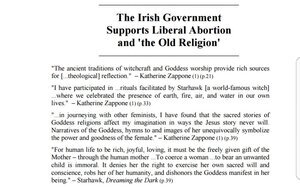
Will the media challenge @KZapponeTD about her involvement in Witchcraft as she described in her 1991 book and its connection to her support for the extreme #repealthe8th agenda of abortion on demand up to birth? @IrishTimes @irishexaminer @broadsheet_ie https://t.co/66szdpyD0U pic.twitter.com/LKPtM7a8yu
— Emma Murphy (@EmmaMurphy12150) February 5, 2018

Oh.
This afternoon.
Pro-life activists highlight Minister for Children Katherine Zappone’s apparent interest in witchcraft and the teachings of ‘Starhawk’ drawn from Ms Zappone’s 1991 book The Hope For Wholeness.
Anyone?
Maybe it was just for a spell.
Spell.
Suit yourselves.
Previously: Fly, My Pretties
Images via Emma Murphy

What you may need to know.
1. The internet is moving at light speed currently, as illustrated by last night’s surprise SuperBowl “drop” of producer JJ Abrams’ latest entry into the Cloverfield franchise, in its entirety, on Netflix before anyone had even seen a trailer or a single still from it.
2. It was so quick, in fact, that while everyone was processing this information and mulling over it as a new media experiment in anti-marketing or audience sleight-of-hand (something Abrams has lots of form in), the first reviews came in to reveal that The Cloverfield Paradox is mostly garbage, and the surprise release was more than anything an emergency exit for an unmarketable mess of a film.
3. Amid the other mostly forgettable blockbuster previews rumbling out on SuperBowl night, the world finally gets to see a teaser for Solo: A Star Wars Story, Disney and LucasFilm’s latest entry into the Star Wars universe.
4. It’s been a troubled production, with original directors Phil Lord and Christopher Miller unceremoniously sacked near the END of filming last year, due to “creative differences” with LucasFilm boss Kathleen Kennedy. (“Ace Ventura in Space” was one insider’s description of what the duo were apparently shooting for. As great as that sounds, perhaps not the best route for an origin story of one of cinema’s most iconic and beloved heroes).
5. Journeyman director and old friend of LucasFilm Ron Howard, was drafted in to take the reins, and now we finally get to see a preview of what’s to come this May.
6. Plenty more of those Star Wars itches are being scratched in Solo. It revolves around young Han Solo (Alden Ehrenreich) and frenemy Lando Calrissian (Donald Glover). Young Chewbacca is in there too of course (could he reasonably be called a puppiee in this?), while Game of Thrones’ Emilia Clarke and everyone’s best bud Woody Harrelson round out the cast.
7. Little is known about the plot, but this trailer has something of a Noir-ish feel, in contrast to Rogue One’s WW2 flavour. All eyes will be on Ehrenreich’s performance as Solo, who exhibited great comic timing in Hail Caesar! (2016) There’s a dash of the character’s brashness here for sure, but do people want to see something different, or a straight up Harrison Ford impersonation? Just as long as there isn’t some conspicuous reference to the infamous) “Han shoots first” scene.
8. Last week there was mostly apathy surrounding the movie, due to the controversy, plus the fact that it’s out so soon after divisive The Last Jedi (2017). I may be buying into the hype, but from this first look, it appears Ron Howard might have saved the day after all.
9. If Lord & Miller wanted to make ‘Ace Ventura in Space’ happen on their own time though, that would be just fine.
Verdict: Great, kid. Don’t get cocky.
Release: May 25