




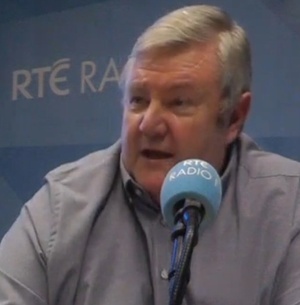
From top: Catherine Corless with Ray D’Arcy yesterday;; Terry Prone, of the Communications Clinic, on the Late Late Show in October
Yesterday.
Historian Catherine Corless was interviewed on RTE Radio One’s Ray D’Arcy Show.
During the interview, Ms Corless – who discovered there are no burial records for 796 babies and toddlers who were recorded as having died at the home – said she rejected an apology made by the chair of the Communications Clinic Terry Prone on the Late Late Show in October.
Ms Prone made the apology because of an email she wrote to French journalist Saskia Weber after the Irish Daily Mail first published a story about the possibility of a mass grave at the former Bon Secours Mother and Baby Home in Tuam, Co Galway in 2014.

In her email, Ms Prone – who was taking media queries on behalf of the Bon Secours nuns – told Ms Weber:
“If you come here, you’ll find no mass grave, no evidence that children were ever so buried, and a local police force casting their eyes to heaven and saying “Yeah, a few bones were found – but this was an area where Famine victims were buried. So?”
Ms Prone also told Ms Weber:
“If you’d like me to point you at a few reputable historians who might be good, I’ll certainly do that.”
Ms Corless’s interview on the Ray D’Arcy Show followed Minister for Children Katherine Zappone, on December 12, publishing a report from the Expert Technical Group which has been investigating the former Bon Secours mother and baby home in Tuam, Co Galway.
In that report, the group outlined five options for the site of the former Bon Secours mother and baby home in Tuam, Co Galway.
Readers should note the group’s full 232-page report also contains the line:
“The potential to identify individuals interred in Tuam is one that poses many challenges as has been identified in this report. It is an issue that has the potential to cause upset and potential damage to relations between the public, the Church and the Government.”
Ms Corless spoke about this line during her interview with Mr D’Arcy.
She also called for the number of skulls to be counted at the Tuam site to see if there are 796 skulls.
She said if there are fewer than 796, this may indicate that death certs were falsified to allow for illegal adoptions to take place – with children most likely sent to America.
From the interview…
Ray D’Arcy: “When you were in the last time with us, I think it was February 2015, I read to you the letter that Terry Prone had written on behalf of the Bon Secours nuns to a French documentary…”
Catherine Corless: “That’s right, that’s right.”
D’Arcy: “And it sort of poo-pooed the whole thing.
Corless: “Terry Prone did, she just really, she just made a mock of all the survivors and everything that I had brought out into the open. And it was very, very unprofessional of her at the time, I thought. And I just couldn’t believe it. It was very hurtful, it’s all I can say, to survivors.”
D’Arcy: “She did say, on the Late Late Show, when Ryan Tubridy put…”
Corless: “Well because she was put to the…a gun was put to her head, yeah.”
D’Arcy: “She said, ‘most shockingly, I should have contacted Catherine and said I’m really sorry. I believed, based on the evidence I had, that it was famine burials. And then, without looking to camera, but I think she was addressing you, ‘you were right and you were right to fight it through’. Has she rang you since?”
Corless: “Absolutely not, Ray. No I don’t take that as an apology at all because it was just a very curt, kind of her hands in the air again. It was almost the same, ‘so, I was wrong’. That’s the way I took it.”
D’Arcy: “Was that before or after you were on the Late Late?”
Corless: “It was after, oh it was yeah.”
D’Arcy: “Would you like her to ring you?”
Corless: “Absolutely, absolutely, just to see how she really feels about it: are they taking this seriously at all? Does she realise the impact it has on survivors, so many survivors. I think that’s the one thing Ray. Nobody’s taken, still, to this day, taken much notice of them, or listened to them. They don’t know the hurt they’re going through. And it’s impacting on their own families. And they don’t realise there’s so many of them.”
Later
D’Arcy: “So that report from the Expert Technical Group. In it they say, because there was a lot more to it than just the five proposals as to how to treat the site. In it they say it’s ‘an issue that has the potential to cause upset and potential damage to relations between the public, the Church and the Government’.”
Corless: “That’s right, Ray. I would question, I would question the people who wrote that, what is that about? Are they telling us we can’t be going? We can’t be upsetting the Church again? Or the State? Or the Government? I would like a, I would like an explanation of that.”
D’Arcy: “I’ll have to read it again for them again, Catherine.”
Corless: “Do please.”
D’Arcy: “‘It’s an an issue that has the potential to cause upset and potential damage to relations between the public, the Church and the Government’. Now they’re not saying ‘don’t do it because..’, they’re just pointing out…”
Corless: “I know…that’s what I mean. When you read the five suggestions again. The words they’re using. ‘Disruptive’ and they’re using words that they shouldn’t use. They’re more or less, I have said, it’s bordering on propaganda, the way that, those five issues are pointed out.”
D’Arcy: “Because they’re sort of leading…”
Corless: “Leading, leading the witness, you could say. Absolutely. And of course the money is there upfront and the first column of all the suggestions and maybe €3m-€5m sounds terrible to people and I know what Galway County Council will be saying, ‘it’s taxpayers’ money, this, that and the other’, ‘we don’t need this’, ‘there’s hospitals…’, they’ll bring in all this…”
Listen back here in full
Read the Expert Technical Group’s full report here
Previously: Reputable History
Soz
at
In the apology RTÉ acknowledged that it made mistakes and failed to comply with its statutory duty under the Broadcasting Act during the programme broadcast on 24 October 2011.
It acknowledged that it should have verified the origin of the tweet [go to 5 min 15 seconds above], and the tweet should not have been erroneously attributed to another candidate’s Twitter account.
RTÉ also acknowledged that it should not have broadcast the tweet and when it became apparent that it was false, it should have immediately corrected the fact that the provenance of the tweet was mistaken.
….[Paul] Tweed [Sean Gallagher’s solicitorsaid RTÉ’s apology had been supported by the payment of “substantial damages” although he said the terms of the settlement were confidential.
G’wan the licence fee!
RTÉ apologises and pays Gallagher settlement over tweet (RTÉ)
Rollingnews
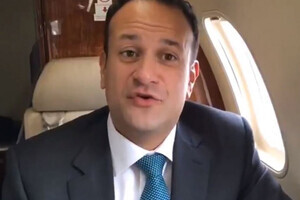
From top: Taoiseach Leo Vardkar in a video from the Government jet in October; Derek Mooney
Though it would probably be more accurate to call it an idiom than a word, “fake news” is now 2017’s new word of the year. Not just in English. Norway’s Language Council pronounced ‘fake news’ (falske nyheter) as the new Norwegian word of the year saying:
“The word is not completely new, but its use has exploded over the last year… It is a word that has set the agenda and was given a lot of attention during the 2016 US election, and that attention has continued.”
Though they probably said it in Norwegian.
Though idiom has its origins in last year’s US Presidential slug fest, it has come to be the hallmark of Trump’s presidency. A few months back we saw President Trump bizarrely claim, in an interview with fellow Republican nut job Mike Huckabee that was so soft (and full of crap) that it could have been sponsored by Cushelle toilet rolls, that he invented the word “fake”.
It is not only the charge Trump levels at established news organisations who put out stories or commentaries he does not like, it is also the tactic that Trump’s surrogates use to deflect criticism.
It is our “whataboutery” times a thousand, but where our “whataboutery” is intended to just shut the other side up for a while, the intention of “fake news” is to erode any public trust and faith in the truth.
“Fake news” is not new, back in the 1930s the Nazis had another name for it: lügenpresse – the lying press. It is just the means of delivery that has changed.
As we have seen in the Brexit referendum, plus in elections in Germany and France, “fake news” is not confined to one country or continent. How could it? Its modern means of delivery is global, social media.
But here we should stress that the two are not synonymous. Social Media is just the tracks on which this runaway train is rolling, it is the train we need to stop, there is no public benefit in ripping up the tracks.
It would naïve in the extreme to imagine that dear little, sweet little Ireland will be immune from the phenomenon. Just because we have not yet been the sights of an “Alt-Right” “fake news” factory somewhere in Moscow so far, it doesn’t mean we might never be.
Neither should we be so green as to imagine that others with differing motivations and political inclinations would not be happy to use these tactics to further their own agenda.
Last week’s initiative by Fianna Fáil’s Science and Technology spokesperson, James Lawless aimed to address some of these concerns. His Online Advertising and Social Media (Transparency) Bill 2017 was debated in the Dáil last week, and was passed at Second Stage. At this point I should declare that James is an old friend of mine and discussed the Bill with me some weeks ago.
Lawless’s Bill proposes to address the difficulties with online authentication and identification and thus close off the opportunities currently available for, in his own words: “more advanced actors to game the system in the technological space and to pretend to be other than who they are, operate multiple fake accounts or run sponsored advertising”.
A laudable ambition which most would applaud, you would think… but no. Though Lawless’s Bill was supported by his own Fianna Fáil party, as well as Sinn Féin, Labour, the Greens, the Social Democrats and several independents, it was opposed by Fine Gael, govt supporting Inds and their newly found BFFs in PBP.
Though the Government indicated its broad support in principle for the Bill’s aims and intentions, it then said it was opposing it. Rather than looking to amend any flaws or anomalies at committee and report stages in the Dáil and Seanad, which is, afterall, the purpose of our complex ten stage legislative scrutiny process, it sought to kill it off.
But, the two sole Fine Gael speeches in last week’s Dáil second stage debate give the game away. They were concerned that the Bill, which seeks to heighten transparency in online political advertising, might stymie the operations of their Strategic Communications Unit (SCU).
Passing James Lawless’s Bill might mean no more videos of Leo addressing us from the inside Government Jet or the teaspoon slot of the dishwasher. Well actually no, it would not mean no more videos, just no more of them being pushed and promoted on the State credit card.
Fortunately, the Dáil saw the difference and Lawless’s Bill was passed last week and it now proceeds for its Committee Stage sometime in 2018.
All’s well that ends well, says you. Eh, not quite.
Having lost the vote and having failed to stop the Bill that it fears may frustrate its SCU it then suddenly finds a similar initiative of its own that it can share with the media over the weekend.
On Sunday night the online edition of the Irish Independent was able to report on a letter sent by the Minister of State for Older People urging the EU Commission:
“…to consider a new policy that will require multinationals, such as Facebook, to introduce new and stronger methods of authenticating accounts created on their platforms”
This was barely four days after they had tried, and failed, to defeat James Lawless’s Online Advertising and Social Media (Transparency) Bill 2017.
Curious, how there was no mention of this initiative from the government side in the Second Stage debate last Tuesday?
Even more curious when you consider that Minister Daly told the Irish Independent that he is on a cross-departmental group led by Minister for Communications and includes Ministers for Justice and for Children. Only one of those Ministers contributed to last week’s Dáil debate and he never mentioned it.
You would have thought someone in Leo’s joined-up government would have thought to mention this important cross-departmental group in a Dáil debate on the issue of online transparency? Surely the group didn’t just suddenly pop out of mid air after the debate, or even late on Sunday night?
Looks like Leo’s government has found a new way of operating: denounce one thing today and then hail it as your own idea the next. I have given previous examples of this approach here, here and here.
All they need now is a new word that describes it. Who knows, it may even become the 2018 word of the year?
Derek Mooney is a communications and public affairs consultant. He previously served as a Ministerial Adviser to the Fianna Fáil-led government 2004 – 2010. His column appears here every Tuesday morning. Follow Derek on Twitter: @dsmooney
Saddle Creek
at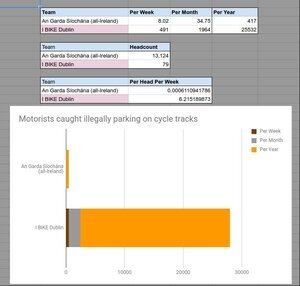
I BIKE Dublin tweetz:
So we took An Garda Siochana’s yearly performance for issuing fines for parking illegally in cycling lanes over a full year (in the full country) and our community worked to beat that figure in one week on their daily commutes. Above are the provisional results. #freethecyclelanes
Earlier: Dangerous Curves
Right So
at
Yesterday.
Chicago, Illinois, USA
Thanks Áine McGillycuddy


Clockwise from top left: Lorraine McCabe, Sgt Maurice McCabe, former Minister for Justice Frances Fitzgerald, and former Garda Commissioner Noirin O’Sullivan
Yesterday evening.
The Disclosures Tribunal released details of who will appear before Judge Peter Charleton for the first 10 days of sittings, after it resumes on January 8.
These witnesses will be asked questions in relation to the tribunal’s term of reference ‘e’.
Specifically, this term of reference is:
“To investigate whether the false allegations of sexual abuse or any other unjustified grounds were inappropriately relied upon by Commissioner O’Sullivan to discredit Sergeant Maurice McCabe at the Commission of Investigation into Certain Matters in the Cavan/Monaghan district under the Chairmanship of Mr Justice Kevin O’Higgins.”
Readers will recall how claims made about Sgt McCabe at the outset of the privately held commission in 2015 were proven to be untrue but the claims and fall-out of the same were never recorded in Justice O’Higgins’ final report.
When the tribunal resumes on Monday, January 8, the first witness will be the Head of Legal Affairs at An Garda Siochana Ken Ruane.
Also appearing on the first day will be Anne Marie Ryan, who was a solicitor with the Chief State Solicitor’s office during the O’Higgins Commission of Investigation.
On the afternoon of Tuesday, January 9, the former Garda Commissioner Noirin O’Sullivan will appear.
Ms O’Sullivan may also appear on the morning of Wednesday, January 10.
Colm Smyth, SC, who represented Ms O’Sullivan and other gardai at the O’Higgins Commission of Investigation, will also appear on Wednesday, January 10.
Mr Smyth will be followed by Gareth Byrne, BL, and Michael MacNamee, BL, who were also part of the legal team representing Ms O’Sullivan and other gardai.
The guards whom Mr Smyth, Mr Byrne, Mr MacNamee and Ms Ryan represented at the O’Higgins Commission of Investigation included former Garda Commissioner Noirin O’Sullivan, her predecessor Martin Callinan, retired Chief Supt Colm Rooney, Chief Supt Michael Clancy, retired Assistant Commissioner Kieran Kenny, retired Chief Supt Jim Sheridan and Supt Noel Cunningham.
On Thursday, January 11, head of HR at An Garda Siochana John Barrett will give evidence.
Readers will recall how it has been previously reported that the Disclosures Tribunal has already been told that – before the beginning of the O’Higgins Commission of Investigation – a member of Garda management told Mr Barrett “we are going after Maurice at the commission”.
It’s expected that Mr Barrett will give evidence in relation to this claim.
Mr Barrett will be followed by the former Chief Administration Officer Cyril Dunne.
On Friday, January 12, Richard Barrett, of the Attorney General’s office, will appear, followed by Michael Flahive, of the Department of Justice.
Readers may recall Mr Barrett and Mr Flahive’s involvement in the now infamous email that led to calls for former Tanaiste Frances Fitzgerald to resign several weeks ago.
This was an email sent by Mr Flahive to Department of Justice officials, including former Minister for Justice Frances Fitzgerald’s private secretary Christopher Quattrociocchi, on May 15, 2015.
In it, Mr Flahive said he received a call from Mr Barrett and that, according to Mr Barrett, a row had taken place at the O’Higgins Commission of Investigation between the legal counsel for Sgt Maurice McCabe and the former Garda Commissioner Noirin O’Sullivan.
In the email, Mr Flahive wrote that Mr Barrett told him the row occurred because the counsel for Ms O’Sullivan wanted to introduce a complaint that the 2006 investigation into Ms D’s ‘dry humping’ allegation against Sgt McCabe wasn’t investigated properly.
Mr Flahive outlined that Michael McDowell, SC for Sgt McCabe, objected to this being raised and asked if Ms O’Sullivan had authorised the argument that this claim was relevant to Sgt McCabe’s motivation.
Mr Flahive explained that Mr Barrett said Ms O’Sullivan had authorised this approach.
Mr Quattrociocchi forwarded this email to to three people, including Ms Fitzgerald.
The other two people were Ms Fitzgerald’s special advisors William Lavelle, a Fine Gael councillor, and Marion Mannion.
After the email emerged, readers may recall, Sgt McCabe told Taoiseach Leo Varadkar the alleged events outlined in this email never happened.
Former General Secretary of the Department of Justice Noel Waters will appear on Monday, January 15.
Readers will recall Mr Waters resigned with immediate effect on November 28 – within hours of Ms Fitzgerald resigning.
On Tuesday, January 16, Mr Quattrociocchi will give evidence, followed by the former Tanaiste Frances Fitzgerald.
On Wednesday, Fine Gael councillor Mr Lavelle will appear.
On Thursday, January 18, Sgt Maurice McCabe will give evidence.
Read the schedule for this term of reference here
Previously: Absence Of Malice
Pics: Rollingnews

The HMS Queen Elizabeth, Britain’s new aircraft carrier, is leaking
There’s been quite a panicky scene
On a ship that’s named after the queen
It seems one shaft seal
Wasn’t quite the real deal
Which caused leaking that was unforeseen.
John Moynes
Pic: Getty
Get Out Now
at
https://www.youtube.com/watch?v=5ScJK2z3DkY
Gulp.
Meanwhile…
Scoffing aside for a while, the RDS isn’t cheap. Whos bankrolling this? pic.twitter.com/P7RsCPrZYm
— Gerard Cunningham (@faduda) December 18, 2017
Anyone?