

Splutter!
This morning.
Mucky Muiris.
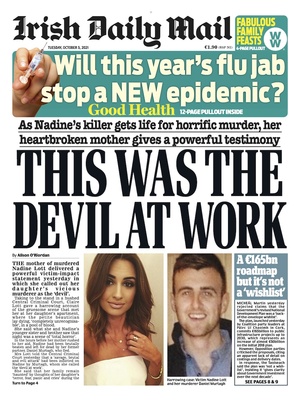
Are orgasms good for your health? (Muiris Houston, Irish Times)



Splutter!
This morning.
Mucky Muiris.
Are orgasms good for your health? (Muiris Houston, Irish Times)

Facebook Chief Executive Officer and founder Mark Zuckerberg in Dublin in 2019
This morning.
Via Mashable:
In an oddly short update on its engineering blog, Facebook explained the root cause of the outage that saw half the world suddenly post memes on Twitter, and the other half realize WhatsApp (another Facebook service that was down) isn’t a good backup for Messenger.
“Our engineering teams have learned that configuration changes on the backbone routers that coordinate network traffic between our data centers caused issues that interrupted this communication. This disruption to network traffic had a cascading effect on the way our data centers communicate, bringing our services to a halt,” the post said.
The outage also had an effect on the company’s internal systems, which is why it took so long to fix it, Facebook said.
Meanwhile..
The timing of the outage was somewhat suspicious, given that it happened right after a whistleblower went public with damning info on how Facebook handles misinformation on its platform. However, Facebook is adamant that the root cause of the outage is the misconfiguration issue detailed above.
Finally, Facebook said it has no evidence that user data was compromised as a result of this downtime.
Facebook apologizes for that massive outage, says no user data was compromised (Mashable)
After an average period of three to four months, fully vaccinated people were found to be 73% protected against infection and 90% protected against hospitalisation https://t.co/4QdrGtpdpb
— RTÉ News (@rtenews) October 5, 2021
This morning.
Pfizer vaccine prevents severe Covid for at least 6 months – study (RTÉ)
Meanwhile…

Last night.
Project Veritas released the fourth part of an investigations into the Covid vaccine.
Three Pfizer scientists told undercover journalists that natural antibodies are a better protection against Covid than the vaccine, with one saying:
“When somebody is naturally immune — like they got COVID — they probably have more antibodies against the virus…When you actually get the virus, you’re going to start producing antibodies against multiple pieces of the virus…So, your antibodies are probably better at that point than the [COVID] vaccination.”
Pfizer Scientist: ‘Your Antibodies are Probably Better than the Vaccination’ (Project Veritas)

Actor William Shatner – Captain Kirk in ‘Star Trek’ (above) – hopes, at 90, to become the oldest person to reach space
A wonderful trip is in store
For an actor that we all adore
As Shatner will grace
The near edge of space
Where quite a few have gone before
Getty













MORE to follow.


Behold: the Bandit9 Supermarine – a first production model from a former Saigon-based custom shop.
Built from the ground up, the lightweight 7075 aluminium alloy frame has a 900cc or 1200cc Triumph Twin engine (capable of 210km/h) and a choice of suspension setups and ABS brakes. The wind tunnel-sculpted bodywork comes in race spec ABS plastic, high-strength resin or carbon fibre.
Each bike is made to order, so price on application.


The Fall (1956) by Albert Camus (top) is a crucial text for lawyers, argues David Langwallner (above)
Now, I have written about Camus before for Broadsheet. But this is in a different tone. The readers of Broadsheet have asked for a clinical piece, so here it is: clinical and theoretical.
The crucial text for all lawyers, in my view, is the French novelist Camus’s The Fall. The crucial man of reason. From his involvement in the French resistance to his controversial comments about the Algerian War, this was not a disengaged man of letters. He, unlike his protagonist in The Fall (1956), was not a hypocrite unlike his erstwhile friends De Beauvoir and Sartre.
Now, the longer political tracts on suicide The Myth of Sisyphus (1942), and the classic expression of his anti-authoritarian resistance mentality and his distrust of bloodletting and extremism The Rebel (1951), say multitudes in his classic French prose style and are crucial to our age. But it is the novels where the legacy rests.
The Plague (1947), of course, has brought Camus right back into focus and I have written about it hitherto, in Counsel magazine, and all it says about our present awful coronavirus times and The Outsider/Étranger (1942) has never been unfashionable and hotly debated by multiculturalists which I have also written about in Cassandra Voices.
Thus, the last published novel The Fall (1956) often gets overlooked, not least in that it is, in a way, monothematic unlike the other texts but that is its force, and it is about a lawyer, so hence clinical practice, and it is masterpiece. I would go so far as to say the greatest short novella of the 20th century; a secular version of St Augustine’s Confessions without the same atonement.
At the outset, to preface the book, Camus quotes Lermontov who said of his own epic A Hero of Our Time (1840) where the Byronic hero Parchorin is a superfluous nihilistic figure.
“It is in fact a portrait, not of an individual; it is the aggregate of the vices of our whole generation in their fullest expression.”
That I think is also what Camus is doing: etching a portrait, far from the flattering, of his generation. Perhaps through a lens darkly of many generations, including ours.
Short, crisp, and precise, the book is a detailed exposition on the lawyer as a professional hypocrite. In the Mexico City bar in Amsterdam, that city of half measures, compromises and ambiguity, both beautiful and repulsive, at once, the home of The Night Watch, the Van Gogh Museum and the drug trade and the red-light district. Thus, Jean Baptiste Clamence regales the assembled multitudes as a self-styled judge penitent and the book concerns one such dialogue, or should it be monologue, to a silent presumably willing listener.
Well, Gambon and John Hurt read Beckett’s Krapp’s Last Tape beautifully. And that is what it is like, a monologue. Maybe Gambon could be persuaded!
We, the readers, are the passive recipients. Just as to any client in the bar, he introduces himself unctuously at the outset of the book:
‘Monsieur, may I offer my services without running the risk of intruding.’
One is reminded of Uriah Heep and his incantation to be humble as a mask of self-deception.
Or later he describes himself as:
‘A charming Janus and a play actor so very much important in an advocate.’
His view of human society is venal, using the example of the piranha fish. It is, in effect, always a question of who will clean up or eat the other, or worse, or better, still depending on your view, comparing the holocaust to vacuum cleaning and admiring, on a purely professional level, the technique and the diligence. The relevance to our deregulated virus times should not go unnoticed.
The view of human nature in short is not benign. As a Parisian lawyer, the book in the classic, confessional French style highlights his own professional hypocrisy.
Often taking charitable cases to make himself look good. He had, he mulishly self-justifies to the reader, rightness of tone, appropriate emotion, persuasion, and warmth. Restrained indignation. The self-esteem of the putative righteous. F For Fake (1973) as the Welles film, set in the world of art forgery, shows. The art of illusion and fakery. And the book is very much one of Lost Illusions of a fake or a busted flush to use an American vernacular expression.
His representation of the innocent threads through the book, though he ambiguously notes that even those innocent of a crime accused have committed others, a dangerous line of argument often pursued by extremists of a religious or fundamentalist nature. The confusion of sin and criminality.
Clemence (Camus) is caustic about religious maniacs and, in a line, I must remember he argues that their moralising makes their Satanism virtuous. Or at least to them it does. It is a common failing of excessively religious people that they do not see the evil in themselves. I am reminded of several members of The Irish judiciary in that respect.
Clemence at least turns the lenses unsparingly on himself. The book, in an indirect way, reminds me of a recent book by a prosecutor of the Southern District of New York Doing Justice: A Prosecutor’s Thoughts on Crime, Punishment and The Rule of Law which, in the cosmos, I suppose has the moral significance of a Diary of a Nobody by Grossmith, but, no matter, also shows the effect of religious moralism in lawyer-dom with references in abundance to an entity called God.
The book argues that it is not enough that the convicted or soon-to-be convicted criminal be reformed and rehabilitated. It is not enough to admit what we already know. Freedom and absolution require more. You must confess all your sins. Well, that is certainly what Clamence is doing. To all and sundry, without restraint. Perhaps he should be reminded of the right to silence but perhaps not… I am sedulously of the view, at this stage, that the prosecutor mentality, evident also in Valjeart chasing Jean Valgena for the theft of a loaf of bread, is unsuitable for any position of institutional authority.
Jean Baptiste, of course, in his professional career began to look at himself as a delusion ally as a superman but is acutely conscious in hindsight of his own middle-class hypocrisy. In the text, he intimates he did not have, or rather has, no longer friends but accomplices and though he represented the innocent, and they were grateful, it was vanity.
Well, we should all be so reflexive. The reason we are kind to the dead, he argues, is that we owe them no obligation. Well, that is true and an Irish trait that it is the living we should care about which we are not.
The book has remarkably interesting things to say in our post-truth universe about how power determines truth. We are right because we are the powerful and we win.
Thus, our victory determines what is true or not, a dangerous vista in the fascist authoritarian creep that is now evident.
In fact, the protagonist, like the present author, does not like the police. Well, no defence lawyer really does. Clemence, in fact, in an ironic sense, starts to write An Ode to the Police.
The expression of how human society is structured on slavery is also pertinent, albeit slavery with a smile, perhaps a variation of service with a smile, our new corporate feudalism.
Also relevant to our present times, he draws the precise relationship between politics and gangsterism, save that politicians are the gangsters who win. And now it is, of course, corporate and political gangsterdom that rules our universe.
As a self-styled judge penitent, he, of course, now realises and argues that to judge one must first become a penitent. The kind of self-abnegation in the Tridentine and religious maniacs who adorn the Irish profession and trek off to churches in Rome and the Santiago De La Compost walk.
He also elaborates on how judging and condemnation involves crucifixion of a secular and perhaps quasi-religious form. All crucified, all judged. The sea change or the epiphany that leads to self-imposed exile in Amsterdam is his failure to assist a suicide victim who throws herself into the Seine.
Thus, this act of cowardice shows what he is genuinely like, to himself, and not a Good Samaritan and thus off to exile but not before decline. Months of orgy and excess lead to a slippage in the standard of his speeches.
The reference, purely verbal, that I often made to God in my speeches before the court awakened mistrust in my clients. They probably feared that heaven could not represent their interests as well as a lawyer
Though sometimes, it should be said, in a closing speech, God works. Marshall Hall QC at the end of a famous peroration in The Seddon case (1912) representing an old prostitute said:
“God did not give her a chance, why do not you?”
And it worked. It often works in Ireland. In God We Trust Inc. But a Hail Mary should not be relied upon at the expense of the scientific and forensic dismantling of the evidence.
Jean Baptiste himself fears, though, the judgment of men not God and regards religion as a huge laundering in the soap sense or indeed money-laundering exercise so evident in mafiosa Catholic countries like Ireland and Italy.
We thus have the lawyer as monster, posing and preening, loquacious and fawning, with avowed but hypocritical good intentions and ostensible and indeed ostentatious charity but, self-serving. It says much for our time and the book concludes with a line worthy of Beckett:
“It’s too late now. It always will be too late. Unfortunately.”
Though Beckett, it should be said, might have said, fortunately. Thus, in 90-odd pages, the lawyer as demon is captured perfectly and the deep-seated hypocrisy of the profession exposed.
There is a certain family resemblance to elements of the Irish profession and the transgression of professional boundaries which allows and permits and endorses public servant barristers to do corporate nixers to serve the agenda of non-public service.
Thus, we should be self-reflexive, but it would be wrong to transliterate this to Mr Camus. He was the opposite. A just man.
But, in our present universe, are we more Jeans Baptise than Camus. That is the problem which Camus fully understood relevant then and now. Thus shallowness, ambition and fraudulence are matters that all lawyers should take account of and turn the lenses on themselves. Many prosecutors are peculiarly incapable of this.
Standards have fallen of the cliff. Worldwide and the narrow sliver that holds the platinum chip standard of justice, the English profession visibly creaking at the edges with the Jean Baptistes worldwide in the ascendant.
David Langwallner is a barrister specialising in public law, immigration, housing and criminal defence including miscarriages of justice. He is emeritus director of the Irish innocence project and was Irish lawyer of the year at the 2015 Irish law awards. His column appears here every Tuesday and Friday. Follow David on Twitter @DLangwallner
Delighted to see the extensive work of the SciComm Collective Ireland recognised as best practice in COVID-19 communications in latest ECDC report – https://t.co/zIV9c3VbS0 . 13 young science communicators working with @roinnslainte for the last 6 months tackling misinformation pic.twitter.com/7MBu5dlRB0
— Stephen Donnelly (@DonnellyStephen) October 4, 2021
No one likes a snitch.
Meanwhile…
…are we hot?
Amongst the media companies reported by the HSE to social media companies for distributing “harmful misinformation”: the Hill, Politico, the Jerusalem Post, Gript, Fox, ABC, the New York Post, Reuters, the New York Times, the British Medical Journal, and a TV station in Iowa.
— John McGuirk (@john_mcguirk) October 4, 2021
We are not.


This afternoon.
Leinster House, Dublin 2.
Sinn Féin spokesperson on Children, Kathleen Funchion (top) and the party’s spokesperson on Social Protection, Claire Kerrane launch the party’s Alternative Budget 2022 for ‘building back better’ social protection.
Ms Kerrane said:
My proposals include a €10 increase across working age social welfare payments. This is a first step to linking all social welfare rates to the Minimum Essential Standard of Living.
“Another key proposal I am outlining today is the right to a state pension at 65; restoring the State Pension (Transition) and increasing State Pension payments by €5 per week. People have worked hard all their lives and should be able to retire at the age of 65, if they choose to do so.
“I am also outlining Sinn Féin’s commitment to recognise Carers by increasing the annual Carer Support Grant to €2,000, increasing income thresholds for Carers Allowance and proposing a Long-term Carers Pension in line with our State Pension measures. This recognises the incredible and vital role which carers have and which is not recognised enough.”
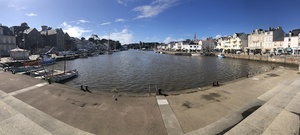
This afternoon.
Pornic, France.
Carlosfandango writes:
Jaysus, ‘tis lovely all the same.
Where are your dogs?
Harrumph.