Yesterday evening.
Spotted in Dublin Airport.
Thanks Bernie Tansey



Yesterday evening.
Spotted in Dublin Airport.
Thanks Bernie Tansey

Zinc – debut album from Galway trio
What you may need to know…
01. Galway post-rock/electronica trio Zinc have brought those bordering-on-arrogant grooves you ordered.
02. Forming in 2014, the trio quickly set about jamming out melodies and textures in equal measure, and empowered by a Galway City Council grant last year, put down their first full-length this year, with production from Solar Bears’ Rian Trench.
03. Streaming above is the band’s eponymous debut album, available now for download via Bandcamp.
04. Having launched the long-player with gigs at Galway Jazz Festival and the An Áit Eile weekender this past week, more dates are to be announced shortly.
Verdict: Sparse soundscaping meets unnecessarily fat bass and some seriously cocky percussion. Possibly one of the year’s low-key highlights.

Samsung’s fire-prone Galaxy Note 7 smartphone
At Samsung, the newspapers tell,
That things really aren’t going well
The Galaxy Seven,
A phone lover’s heaven,
Looks more like the red flames of hell.
John Moynes
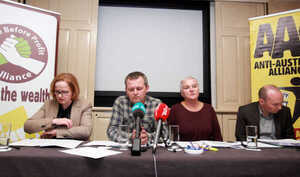

From top: Anti Austerity Alliance/People Before Profit press conference yesterday with from left: Ruth Coppinger, Richard Boyd Barrett, Brid Smith and Paul Murphy; Paul Murphy
Today’s budget debate will largely be a charade.
Paul Murphy writes:
‘Fiscal space’ – it is a trick of misdirection worthy of Houdini. What one issue stood out most in this year’s pre-budget discussion? A debate about whether pensioners or people with disabilities or carers deserve a €5 increase more.
This is the fiscal space and neo-liberal economics in action – artificially creating scarcity and pitting people against each other to fight over who gets what.
It has served to focus discussion on how to share out the relative crumbs of €1.2 billion instead of the total cake of over €230 billion of economic output or a discussion on what kind of economy or society we want.
Years of austerity and regressive budgets have driven inequality to a point where the richest 10% of the population now control 54% net wealth, leaving just 5% for the bottom 50% of the population. Workers’ wages remain lower than in 2008 and have fallen as a percentage of GDP from 53% in 2008 to a projected 40.1% next year.
At the same time, corporate profits rose from €35bn in 2009 to €51bn in 2014 and €75bn in 2015. That is austerity in action – shifting wealth from wages to profits. The fiscal space straitjacket is designed to ensure that continues.
The consequence is a cost of living crisis for workers who are faced with low wages, soaring rents and underfunded public services resulting in unaffordable prices for necessities like childcare.
On the other hand, corporations with soaring profits are guaranteed by Michael Noonan that their tax rate on profits “never has been and never will be up for discussion.”
The starting point of the AAA-PBP budget statement Close the Tax Haven, Redistribute the Wealth, Transform Society was to break out of the fiscal space straitjacket and to end Ireland’s status as a tax haven.
Instead of tinkering at the edges, we set out to outline how vast resources and wealth exist in this country and could be used to transform Ireland from a fiscal paradise for corporations into a socialist green economy that could work for all.
The centre-piece is the need for a break with the capitalist developmental model based on attracting foreign multinationals with low or non-existent corporation tax, low regulation and wages.
That failure is clear when nearly 60 years after attracting foreign capital with tax breaks was presented as a temporary measure to give the economy a boost,
Michael Noonan is still talking about FDI as the “seed potatoes” of economic development. It has resulted in a weak domestic private sector and a basket case economy – where growth figures have no relationship to the reality of the economy or people’s lives.
While the government and Fianna Fail fought over how to spend €1.2 billion, we proposed raising an additional €25 billion in tax and spending an additional €24 billion.
We targeted the raising of at least an additional €4 billion from corporations through a combination of closing tax loopholes like the ‘Double Irish’ and the ‘Knowledge Development Box’ and increasing corporation tax rates.
Although it has largely fallen out of public debate, the question of odious unjust debt and the need to burn the bondholders hasn’t gone away.
The state continue to spend €1 in ever €10 in tax raised on debt servicing – for debt that largely arises from the banking crisis and is not ours. We put forward a strategy of debt repudiation, which would conservatively save at least €3.22 billion.
To fund the scrapping of austerity taxes for working people – water charges, property and the USC, we put forward a series of other taxation measures.
These include the introduction of a Millionaire’s Tax of 2% on net assets exceeding €1 million, which would raise €2.92 billion, a Landlord’s Tax on non family homes, which would raise €450 million and a High-Income Social Charge and new rates of marginal tax on high levels of income to replace the Universal Social Charge and raise €2.33 billion.
In addition, we pointed to the almost €9 billion available in NAMA and the Irish Strategic Investment Fund. These are funds that are not allowed to be invested because of the ‘Expenditure Benchmark’ Fiscal Rule.
That rule must be broken and those funds used to fund major capital programmes – in housing, renewable energy, water, health and childcare.
While the government continues to treat the housing and homeless crisis as a market problem that needs a market solution, planning to bring in a new first time buyers grant, we took a completely different approach. The state should simply use €4.5 billion of those resources to build 20,000 and acquire 30,000 vacant units and use them as public homes to tackle the housing crisis.
Instead of treating our two-tier health service as an inevitability, we advocated spending an additional €3 billion on health in 2017, as part of developing a National Health Service in Ireland.
That would fund an additional 1,000 acute beds, 5,000 additional healthcare workers, the abolition of prescription charges and the allocation of an additional €200 million to mental health, alongside many other measures.
Instead of subsidising private childcare, we argued for €2 billion investment in the building of a public childcare service, free at the point of access. In addition, we called for additional investment of more than €1 billion into education, providing genuinely free education at all levels, with free school books, an end to voluntary contributions and all third level fees.
In addition, we budgeted €2.19 billion for an end to pay inequality in the public sector between older and more recent entrants and an immediate restoration of pay to 2008 levels.
Finally, as a crucial part of a strategy of transforming the economy along environmentally sustainable socialist lines, based on public ownership, we argue for investment of €3 billion directly by the state in renewable energy, water infrastructure, forestry and green agri-food.
All of this can seen a bit fantastical and undoubtedly will be portrayed as such by the media, if they bother to look outside the fiscal space. It is designed to provoke – to push the boundaries of debate out of the fiscal space and to illustrate the immense wealth that does exist.
The central point is that the obstacle to resolving the many social crises in Ireland is not an absence of resources – it is the fact that their ownership is concentrated in the hands of the big corporations and the super-rich.
The financial resources that could be raised through the taxation measures mentioned are only a small fraction of the resources that could be utilised by a left government with socialist policies to transform people’s lives. For example, using the banking system as a democratic public utility could mean a transformation in terms of public investment.
Public ownership of the key sectors of the economy would enable a paradigm shift to an economy based on renewable energy and sustainable growth – a socialist green economy.
Today’s budget debate will largely be a charade. Fine Gael and Fianna Fáil both invited Ireland’s very own Donald Trump, Michael O’Leary, to give them anti-worker, pro-big business addresses.
They will pass a budget that serves his interests. Labour will feign opposition to the very approach it was implementing one year ago. Sinn Féin will oppose much of the budet, but its acceptance of the parameters of fiscal space and the rules of capitalism means they cannot offer a radical alternative.
The outlines of such an alternative is offered in the AAA-PBP budget statement. It requires a mass movement of the left in Ireland to make a left government with radical socialist politics a real possibility.
Paul Murphy is a TD Anti Austerity Alliance. Follow Paul on Twitter: @paulmurphy/AAA
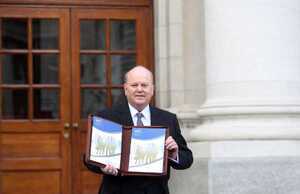

From top: Michael Noonan presents Budget 2016; Michael Taft
Overall high spending may not tell us much about the efficiency of a public service, but low spending can tell us a lot about why our public services compare so poorly with other countries.
Michael Taft writes:
Budget day and everyone will be looking for the favourite detail (tax cut, pension increase) while the Government attempts to mould the good news angle.
And throughout all this the media will be forced, through time and news cycle constraints, to report headline numbers and instant commentary. Deeper analysis will come later and by then we will all have moved on.
One of my favourite budget details is the general level of expenditure on public services, or government consumption.In the past government ministers have expressed the aspiration to have first class public services – everything from health to education to police and fire services and all the rest.
However, we are so under-funded compared to other countries, it is hard to see how this will be achieved anytime soon.
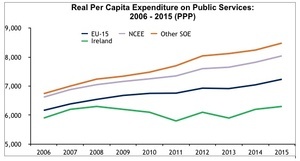
We trail behind the mean averages of EU-15 countries and our two peer groups: Northern and Central European economies, or NCEE (this excludes the poorer Mediterranean countries) and other small open economies (Other SOE – Austria, Belgium, Denmark, Finland and Sweden).
To show how far behind we are, this is how much we would have to increase spending on public services:
To reach the EU-15 average: €4.9 billion
To reach the average of Northern and Central European economies: €9.1 billion
To reach the average of other small open economies: €11.4 billion
A €9 billion increase just to reach average of Northern and Central European economies – that is a big, big number. Even with a government determined to provide the range and quality of public services enjoyed in countries on the continent, it would take a long time to realise that.
So what should we expect today?
We will get a lot of piecemeal announcements (x amount for health, y amount for education and so forth) and a few ‘sweeties’. But you will have to go towards the bottom of the budgetary outlook document, past pages of tables and numbers, to find the expenditure on public services.
But here’s one bottom line: spending on public services would have to increase by €450 million just to keep pace with inflation. Even if spending exceeds that, it may only be enough to keep pace with inflation plus demographic pressures (rising elderly and school-going population).
It will be tight – with tax cuts, increases in social protection (both in rates and increased pensioner numbers) and investment to be financed out of the same relatively small pot.
There is the legitimate complaint that spending levels is no guarantee of quality. Inefficient spending can waste a lot of outlay.
For instance, the Netherlands has experienced a substantial long-term increase in health expenditure due to the extra costs from privatising their health insurance system. This was the model that our last Government sought and failed to introduce, thankfully.
In Ireland, there is a lot of data to suggest we spend more on health than most other EU countries even though we benefit from a much lower elderly demographic (this will change over the next decade).
We spend one percent more than the average of Northern and Central European economies; we should be spending less – though the claim that we over-spend is sometimes greatly exaggerated.
Are there inefficiencies in the health system? Yes. Is it due to the high level of private profit in our public health system?
Our spending on hospital services is low but spending on outpatient services is very high – this might suggest perverse private incentives. Is it because of our geographical density which requires more spending on physical structures and staff than more highly dense countries? Is it due to weak management structures? We need a more sophisticated evidence-based debate on this issue.
One thing is certain – overall high spending may not tell us much about the efficiency of a public service, but low spending can tell us a lot about why our public services compare so poorly with other countries.
While we shouldn’t expect any big increases in public services today given the fiscal constraints and the demand on other expenditure, we should expect that the Government will announce that it intends to close the gap with the European average over the next 5/7/10 years; that is determined to provide the same quality and range of public services that our fellow European citizens enjoy.
Or is that expecting too much?
Michael Taft is Research Officer with Unite the Union. His column appears here every Tuesday. He is author of the political economy blog, Unite’s Notes on the Front. Follow Michael on Twitter: @notesonthefront

An especially challenging downhill MTB course designed by professional racing cyclist Dan Atherton and showcased – in all its bone-jolting, sphincter-tightening glory – by way of Atherton’s helmetcam.

Photofunia founder Alexy Ivanov’s Retro Wave Text Generator – the three words of your choice rendered in ‘futuristic’ graphics, 1980s style.
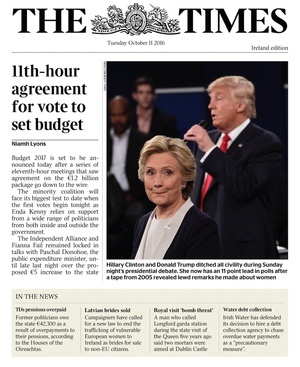





MORE to folly