
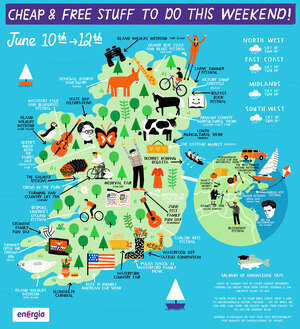
Your inexpensive weekend mapped by Ross O’Mullane and Fuchsia Macaree for Energia. Full details at link below.



Your inexpensive weekend mapped by Ross O’Mullane and Fuchsia Macaree for Energia. Full details at link below.

Last night.
On RTÉ’s Prime Time, presenter David McCullagh spoke to Gerry Edwards, of Termination for Medical Reasons Ireland, and Tracy Harkin, of Every Life Counts, about the UN’s criticism of Ireland’s abortion laws.
From last night’s discussion:
Tracy Harkin: “I think, myself, as a mother, who has a daughter who has been diagnosed with a life-limiting disability, I find this report from the United Nations disturbing for a number of reasons. Firstly, I suppose what’s deeply distressing for many parents involved in our support network, and other charities that work with families that have lost babies to these conditions is the language the United Nations has chosen to use.”
“Terms like ‘fatal foetal abnormality’, ‘incompatible with life’, they’re such harsh sounding, dehumanising terms. And I think for parents like myself and for the many parents throughout Ireland who have lost their little ones to these conditions, that’s not how they see their children at all.”
“Their experiences have not been heard by in this report which is deeply disturbing; parents have been speaking out, for example, in our organisation, Every Life Counts, for the last few years, calling for better support and services to be rolled out in maternity hospitals throughout Ireland to help them make the most of the time to parent their child, to love their child, to hug their child, to, you know, smell their child as any mother wants to.”
“And this is so important, such an important pathway to healing for these mothers and I think it’s alarming that the only option, or solution that the United Nations is fixated on is abortion. You know, these are children, human beings with severe disabilities and there’s not an agreed list, neither will be, and I think for us parents, for myself, before I had my little daughter Kathleen Rose, who’s now 9 years of age, you know she’s such a wonderful little character, she’s brought such joy to my life. Many of our parents didn’t have that time with their little ones and maybe only had minutes or days but they all said that that time was so important to healing. And there’s more and more research coming out to show that, in contrast, abortion increases despair and depression among mothers because they don’t have that closure.”
David McCullagh: “Tracy Harkin, sorry to cut across you, you talk about having services available to allow parents to spend time with their children, however short that time unfortunately may be. And I don’t think anybody’s suggesting that people shouldn’t be able to make that choice. But simply that others, who feel differently, shouldn’t be deprived of their choice, for what is best for their family.”
Harkin: “Well, I think the main thing here is accurate information and I think what’s missing from this whole conversation is also to look at what’s happened in other countries. What has the impact been of legislation in other countries. You look at the UK for example, over 90% of children with any disability whatsoever are aborted right up to birth. I mean most of us have their children with Down syndrome, Spina Bifida, in our communities, we love them, we fundraise for them. There’s a chilling effect to legislation here which the United Nations has chosen to ignore, time and time again. And it’s also important to mention that this case was brought forward by the Centre for Reproductive Rights which are a large, wealthy organisation with many millions at their disposal and their only focus, worldwide, is to promote abortion…”
Later
Gerry Edwards: “I think it’s very important, again in the interest of language, that we are quite clear that there is a difference between disabilities and life-limiting conditions and fatal foetal anomalies which are conditions which are not capable of sustaining independent life outside the womb.”
“Our son had a condition called severe anencephaly. Most of his skull was missing and his brain was missing. He could not sustain independent life, there was no question whatsoever of him surviving for any length of time. And that was confirmed to us by five different medical professionals in three hospitals in two jurisdictions.”
“My wife would have been forced to continue with that pregnancy for five more months in this country, not able to bear the social contact with other people, working with the people that she worked with, being stopped by people on the streets, in the full knowledge that our son would not die, or would not live, I beg your pardon. And this was the situation which was absolute torture for us and we made a decision which was in our best interest and in the best interest of our family.”
“And that decision required us to leave our carers, leave our family and travel to another state. We did spend time with our son, he was delivered naturally, he had an induced labour, we got to spend time with him but we would have got to spend more time with him had we been able to go through that process here in Ireland.”
“Our family members would have gotten to meet him, we would have had the dignity of having a funeral and a community to stand with us and support us in our loss. Instead we got a jiffy envelope, delivered by a courier a couple of weeks later. That’s unacceptable.”
Later
Edwards: “It’s the responsibility of our legislators to legislate. They also have an obligation to uphold international human rights law. This isn’t imposed upon Ireland. This is something that Ireland signed up to. There was a discussion earlier on in the programme about upholding the law and Ireland is one of those countries that has pledged to uphold international human rights law and we’ll find out very soon whether our Government is going to honour that commitment it made and actually take steps to change our legal environment soon.”
Watch Prime Time back in full here
Meanwhile,

On TV3’s Tonight With Vincent Browne last night…
During the newspaper review, the panel – Senator Lynn Ruane, Breda O’Brien, of the Iona Institute; Sinéad O’Carroll, of The Journal.ie and Ger Colleran,former editor of the Irish Daily Star – also discussed the UN’s criticism.
From the discussion…
Mick Clifford: “Breda, ‘Cabinet to defy UN on abortion reforms’ [the main headline on today’s Irish Examiner]. This is not going to go away and some people would say all roads to a referendum one way or the other.”
Breda O’Brien: “Well I’m absolutely delighted if that’s an accurate headline in the Irish Examiner because this committee is part of a huge push that there is to kind of, in a sense, the UN treaty say ‘do not give any right to abortion’ but these committees have been pushing this agenda for years. And they’re stuffed with people who share a point of view which is that the baby in the womb does not have equal rights with the mother. And of course they’re going to find that something is cruel and inhumane and degrading, but I had the privilege of accompanying a friend of mine when she had a baby with a life-limiting condition and..”
Clifford: “But there’s stories like that but there’s also the other side…”
Sinead O’Carroll: “Fatal foetal abnormality is different to life-limiting…”
O’Brien: “No, life-limiting condition is the term used by hospice, it’s the term used by…”
O’Carroll: “Fatal foetal abnormality is the term used by doctors when they give diagnoses to women with fatal foetal abnormality…”
O’Brien: “But also, people, I think fatal foetal abnormality is one that people who have had babies with life-limiting conditions have asked to have it removed because it is so offensive. Your child is not a fatal foetal abnormality, no more than somebody with leukaemia is a cancer.”
Ger Colleran: “It’s the condition, not the child…”
O’Brien: “But that’s what, people have actually said in the media, they’ve said things like, ‘the fatal foetal abnormality’ as if that were, it’s a child who has a life-limiting condition…”
Clifford: “Breda, do you believe there’ll be a referendum?”
O’Brien: “I hope that there will be good sense and that people will see that this is a matter of equal rights and that they should leave it as it is.”
Lynne Ruane: “There will be.”
Clifford: “Ok, well, we’re going to have to leave it for that because that’s it now, we’ve run out of time..”
Watch back in full here
Previously: ‘The Ashes Were Unexpectedly Delivered To Her Three Weeks Later By Courier’
Italy-born André writes:
The company I work for is growing, there are a few open roles indeed… I’m Italian and I got in Dublin when they hired me two years ago. I can say that has been best decision of my life.
Beside the work, I love Ireland, bought the book about strange things that look like Ireland because I want to be able to recognize my new home as easily as I could recognise Italy.
So,for immigrants the change is for good. I don’t know if you do this, but would other people who have come to live and work in this country like to share their best reason to be in Ireland, to be in Dublin or to move here? (or not to, if you don’t like)…
Anyone?

‘sup?
This morning.
In Kildare.
Dave O’Sullivan writes:
Bird Strike: The day the pigeons flew into my office window….
Meanwhile…

Sue Kirk writes:
Same! Live in the sky, die* in a window. *Spoiler: he didn’t die…

Seems legit.
This week’s Galway Advertiser
Thanks Louise

Meltybrains? – rearranging the national anthem as part of Rising Against Homelessness
What you may need to know…
01. Dublin post-rock/experimental five-piece Meltybrains? have been garnering serious momentum in recent times.
02. The masked marauders’ journey has taken them around the world and back, including appearances at SXSW and Electric Picnic. Following 2013 EP, Attention! Now That We Have Your Attention, the band turned heads with last year’s Donegal/IV double a-side. Naturally, the next step was a mad tropical tune (and accompanying dance!) called The Vine, which has broken out en masse at subsequent live outings.
03. Streaming above is the band’s take on Amhrán na BhFiann, recorded for the Rising Against Homelessness fundraiser compilation. A bold move to say the very least, the band builds a longform, experimental piece around the anthem’s lyrics. CD available at (evil-empire record shops) and (corporate coffee) around the country.
04. Proud inheritors of the question-mark-suffix tradition in great Irish alternative music, also.
Verdict: One of the country’s most forward-thinking and fearless outfits. Capable equally of breathtaking sonics and moments of unbridled derangement.

Every week, we give away a voucher worth €25 to spend at any of the 13 Golden Discs stores nationwide.
All we ask from YOU is to request a song we can play at 1pm TODAY.
This week’s theme: Stirring anthems.
To enter, just complete this sentence.
‘Please play the tearfully inspirational ____________by _____________ for the players and fans heading off to France for Euro 2016’
Lines MUST close at 12.45pm


From top: Minister for Foreign Affairs Charlie Flanagan at a Brexit conference last month; Dr Kieran Allen
Why Britain – and then Ireland – should vote to leave the European Union.
Dr Kieran Allen writes:
If you’re Irish, you should vote Remain in the upcoming British referendum. This is the message that Enda Kenny and the political elite are pushing.
The Ryanair boss, Michael O’Leary, is spending €25,000 on persuading the British to stay. The ‘ heavy hitters’ of the ESRI, the Irish Exporters Association, the ICTU and the mainstream parties are warning about a calamity if there is a British exit.
It is all about putting on the green jersey to stop discussion on the nature of the EU itself but it rests on dubious assumptions.
There is a prediction that if Britain leaves the EU a new set of border controls will separate the North and South. However, a common travel area has existed between Ireland and Britain long before either country joined the EU.
It is also claimed that trade between Ireland and Britain would be in danger. Yet an Anglo-Irish Free Trade Agreement has been in place since 1965. And as both governments are ardent advocates of free trade, there is no reason to believe this will change.
If Britain votes to leave the EU, there should be a vote in southern Ireland to exit.
Supporters of Remain appear to have forgotten the role that the EU played in the economic crash of 2008.
Last year, the Finance Minister, Michael Noonan, told the Banking Inquiry that he was warned by the President of the European Central Bank that if he burned bondholders that a ‘bomb would go off’ in Dublin. A ‘bomb’ meant a financial explosion rather than an incendiary device.
The EU prefers to use financial methods rather than military intervention to change the policies of elected governments. When the left wing Syriza party was elected to government in Greece, the EU simply changed the rules so that its bank reserves ratios were reduced.
The result was a run on Greek banks and a turning of the financial screw until the Syriza government eventually capitulated.
The former President of the German Bundesbank Karl Otto Pöhl explained the ECB’s wider strategy:
“It was about protecting German banks, but especially the French banks, from debt write offs. On the day that the rescue package [with Greece] was agreed on, shares of French banks rose by up to 24 percent. Looking at that, you can see what this was really about – namely, rescuing the banks and the rich Greeks.”
As a result of these policies Ireland paid 42% of the total cost of the European banking crisis, at a cost of close to €9,000 per person.
The EU is a fundamentally undemocratic institution where an unelected EU Commission initiates legislation and ‘directives’. Complex, shadowy structures known as ‘trilogue committees’ then hammer out deals with members of the EU parliament.
This structure gives huge scope for the estimated 30,000 lobbyists who mainly represent corporate interests.
The secret negotiations over TTIP show exactly how it operates. Even elected members of the EU parliament are denied access to these trade negotiations.
Yet the EU Commission held 597 closed door meetings with lobbyists, with 87% coming from the corporate sector.
Budgets are no longer solely determined by national governments but are restricted by an ‘Annual Growth Survey’ that is promoted by the EU Commission.
Since the crash of 2008, the EU Commission has used its influence to increase the retirement age to 68 and to promote ‘labour activation’ policies to conscript youth into low paid schemes. It also supports increased ‘user fees’ such as water charges.
Governments are also prevented from borrowing to fund public services if their budget deficit is more than 3 percent of their GDP. Ireland is currently suffering from a huge housing crisis but EU rules prevent the state borrowing enough money to fund a major council house building programme.
National central banks have become agents for the European Central Bank and both are immune to any democratic pressure.
The Irish parliament, for example, recently passed a motion to reduce mortgage charges but were promptly told by the ’independent’ central bank that it would make no difference.
The EU Directorate General of Competition cracks down on state aid and promotes privatisation. Any public service defined as a ‘service of general economic interest’ must be opened up to market competition.
This whole undemocratic edifice provides a shelter for the political elites to tell their electorate that they have ‘no choice’ but to impose unpopular policies. Listen to Enda Kenny talk about water charges and you get the idea.
But what about the EU’s ‘progressive role’ on human rights?
Many of the advocates of Brexit are racists who imagine that the National Health Service could be run with migrant workers. Their insular fanaticism makes anyone look progressive.
However, the EU’s own rhetoric about refugees has helped to legitimise fears about migrants. It has taken in only a tiny number of Syrian refugees.
The UN human rights chief, Zeid Ra’ad Al Hussein, has been forthright in his condemnation, claiming that the EU could easily take in one million migrants, a number that would represent barely 0.2 percent of its population.
In comparison, up to 26 percent of Lebanon’s population is made up of Syrian and Palestinian refugees.
One only has to look at the number of refugees who have drowned in the Mediterranean—now dubbed ‘the world’s most lethal graveyard’—to see how hollow is the EU’s rhetoric of human rights.
Instead of a false debate about ‘Ireland’s national interest’, it is best to acknowledge that some Irish people gain from the EU’s influence over our affairs. The majority do not.
That is why I would encourage a vote to leave.
Kieran Allen is a sociology lecturer at University College Dublin. He is a member of People Before Profit.


From top: This morning’s Northern Territory News; ‘F**k It and Apples
‘sup?
The animals’ owner Greg Dick said tourists were often taken aback at the sight of the kangaroo — named “F**k It” — mounting Apples the pig by the side of the road.
But he says he’s powerless to intervene in the outback love affair.
“It’s quite an unusual thing,” he said.
“I tried to take the pig away the other day and the kangaroo nearly tore the fence down.”
Oink.
Kangaroo and pig strike up special romantic relationship in Aileron (NT)
Thanks Mark Geary


Sir John Rogerson’s Quay, Dublin 2,
Barry H writes:
U2 are flogging their former offices down in the docklands; I passed by this week and took a few snaps (above) but when I looked closer I think they’ve left an Emmy Award….Possibly the 2011 Sports Emmy. Typical. Careless rock stars.