

Lord Wilmore writes:
All the bins, both sides of [the Dublin] docklands, covered up
Anyone?



Lord Wilmore writes:
All the bins, both sides of [the Dublin] docklands, covered up
Anyone?
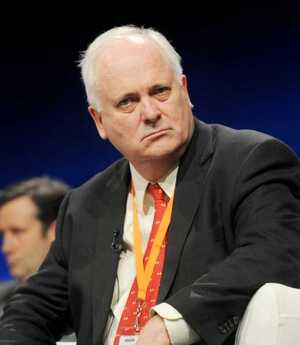

John Bruton (top) at last year’s Fine Gael Ard Fheis and (above) Tim Pat Coogan
Home truths?
Or revisionism of the most odious kind?
You must decide.
Former Taoiseach John Bruton appeared on RTÉ R1’s Today with Sean O’Rourke [presented by Keelin Shanley] this morning to clarify his position on the usefulness of the 1916 Rising and the War of Independence. They were later joined by author and historian Tim Pat Coogan.
Keelin Shanley: “Former Taoiseach John Bruton has called on the Government to commemorate the centenary of the Home Rule Bill coming into law on the 18th September 1914 rather than focus on what he describes as a completely unnecessary Easter Rising and War of Independence… can you lay out our basic argument here, can you say why you think that we’re focusing too much on 1916?”
John Bruton: “Well, the first point is that I think it is important that we commemorate in September, that is next month, the 100th anniversary of the passing into law of the Home Rule Bill, an achievement of the Irish Parliamentary Party, something that Parnell didn’t achieve, something that Butt didn’t achieve, something that O’Connell didn’t achieve John Redmond and John Dillon did achieve and it happened one hundred years ago last month and I think it is very important that we celebrate and commemorate this achievement of parliamentary, peaceful, non violent politics. It wasn’t easy, there was huge opposition to Home Rule, there was a lot of anti-Catholic prejudice in both parties in Britain, the House of Lords had a veto on legislation and that veto had to be removed, which it was, thanks to the pressure of John Redmond and John Dillon…”
Shanley: “But wasn’t it also the fact that [Then UK Prime Minister] Asquith needed them?”
Bruton: “Yes. and that’s exactly what the lesson is, that you use your opportunities. Asquith needed them to avoid a general election and John Redmond and John Dillon played a very tough game and they forced the Liberal Party, which had abandoned the Home Rule policy under Rosebery, and didn’t implement it when it could have done so in 1906 under Asquith, it forced the Liberal Party to reinstate Home Rule as its policy, not only that but to remove the veto of the House of Lords and to run the risk of General Election, and even, the Irish Party even succeeded in forcing the King to say he would appoint a large number of members of House of Lords to change the majority of the House of Lords to overcome or to remove the veto, all that was done by Irish politicians without firing a shot, simply by using democratic parliamentary leadership, and I think that commemorations should be about lessons that are relevant to today, the relevance of parliamentary tactics, the ability to achieve things democratically without threat or use of force, that’s what’s relevant, and we must not miss the opportunity of having a commemoration on the 18th of September and I think I’d like to see the Taoiseach involved, for example, and the Tanaiste…”
Shanley: “But going back to John Redmond and Dillon’s achievements there, but what guarantee, Asquith, as you say yourself, he was formally opposed to Home Rule, he was only doing this because he was under political pressure, he was about to embark on World War One, what guarantee did anyone have at the time that he would deliver on his commitment to Home Rule, isn’t that the kind of key issue here?”
Bruton: “Well I think John Redmond probably could have actually got Home Rule into operation earlier before the War broke out if he had not been holding out for a United Ireland, well as you know we have not got a United Ireland now by other methods, they didn’t achieve more than his peaceful methods achieved and we could perhaps have got Home Rule for even 28 counties into force before the War, and I think it is regrettable that that didn’t happen and I think that if if we had got that we would have eventually ended up with dominion status and ultimately complete independence like Canada, India and all the other…”
Shanley: “Without the violence.”
Bruton: “Without the violence. Violence was not used to achieve Indian independence, Gandhi’s policy was the right one…”
Shanley: “He could have done that if he had been willing for instance to let Northern Ireland go but, going back to that, what guarantee did he have that Asquith would give him or whoever was leader of Britain after World War One?”
Bruton: “Well I think, in the paper I have submitted to the Taoiseach, I gave two very concrete examples of the evidence that Home Rule was going to come into effect anyway. In the Coalition Manifesto of Lloyd George, the Conservative/Liberal Coalition Manifesto in the December of 1918 election they said explicitly, Home Rule is on the Statute Book, in other words they weren’t going back on it. In that same election, the Labour and the Asquith Liberal Party were in favour of Dominion status for Ireland as was the Irish parliamentarian John Dillon at that time. Furthermore Andrew Bonar Law, who was the most resolute conservative opponent of Home Rule, said well, once there’s a possibility of any Ulster county being able, if they wish, to opt out of Home Rule he wouldn’t object any further and that’s quoted in a booklet that I’ve read recently so I think that Home Rule would have come into effect and if Home Rule had come into effect and if some Ulster counties had been excluded, maybe four, maybe six, they would have been under direct rule, there would have been no Stormont administration, so in other words there wouldn’t have been a possibility of the sort of deeply discriminatory policies that were subsequently introduced when the Stormont administration came about and furthermore under Home Rule there would have been continuing representation from the South of Ireland in the House of Commons, reduced representation but continuing representation, so any attempt to introduce any anti-Nationalist or anti-Catholic measure in whatever part of Ulster that was excluded from Home Rule, there would have been a means of stopping that, which unfortunately wasn’t possible afterwards when, in fact, I’m afraid, the South of Ireland turned its back on Northern Nationalists for a long period.“
Shanley: “So can I ask you, John Bruton, do you then think, I suppose many people have the view of Redmond and Dillon as having been a little ineffectual, you know, when they asked Irish people to consider going to fight for the British in the War, that we need to rewrite history, that would be your view?”
Bruton: “Well we always need to rewrite history and I have no doubt people will be rewriting what I’m saying today and what I did but that’s the fascination of history. John Redmond at Woodenbridge urged people for the first time to actually join the army two days after Home Rule went on the Statute Book, it was a direct response to fact that Britain at last, after 80 years of agitation had finally agreed that Ireland would have legislative independence, it was in that context and in the hope that by saying we are on the same side as the Ulster Unionists he could have persuaded them to come in under Home Rule too, now I don’t think he would have succeeded in that but that was his goal and his intention and nothing that anyone else has tried since including violence has changed the mind of Ulster Unionists.”
Shanley: “If you look back on the role that Redmond played and maybe reassess it what would you say about role of the people who were the heroes of the 1916 rising had to play, how would you assess their role in Irish history”
Bruton: Well first of all I don’t question for one moment their sincerity or self-sacrifice…”
Shanley: “Were they misguided in your view?”
Bruton: “I think they made a mistake.What they did when they occupied the GPO and other strongpoints in Dublin and they set themselves a Proclamation, they were aligning themselves with the Kaiser, with the Kaiser’s Germany, with the Ottoman Empire and with the Austrian empire against the French Republic and against the United Kingdom in whose armies many other Irish people including perhaps brothers of those who were going out in 1916 were actually fighting, now taking sides in that war meant Ireland wasn’t neutral, it was taking sides, I think they needn’t have done that.”
Shanley: “Okay well on that note let me bring in Tim Pat Coogan, author and historian. Tim Pat Coogan, you’ve been listening to what John Bruton has had to say there, what is your overall take on this?”
Tim Pat Coogan: “Well, I don’t think there was a hope in hell of Home Rule ever coming into operation, I mean it was only a paper thing, they passed it into law but it was never going to be actually acted on.”
Shanley: ”Why do you think this? On what basis?”
Coogan: “Well, because of the course of events at the time. Randolph Churchill coined the phrase ‘Ulster will fight and Ulster will be right’ when Gladstone first introduced Home Rule in 1886 and that that phrase is why the Six Counties are no longer part of Ireland, that is acknowledged in Churchill’s biography…”
Shanley: “What about the notion of Home Rule without Ulster, that could have gone ahead?”
Coogan: “Well honestly, really, this kind of thing is on a par with, saving your presence, saying if one were gifted with male appendages my aunt would be my uncle. The fact is that the British army mutinied with the support of the British Navy and said that they would not allow Home Rule to be introduced to Ulster and it was because of that, that on the eve of the war they couldn’t go ahead with it, and, talking about Germany’s involvement, there was a very strong feeling in Germany and it was one of the causative factors in the Kaiser’s decision to go to war, that Britain was so tied up with Ulster that they wouldn’t be able to fight and there was a lot of talk about the Kaiser’s Irish friends, by whom they meant the Unionists, not the nationalists, the question of independence was paramount in their minds and the 1916 leaders by their deaths and by their sacrifice… there were three factors, one was the different treatment that Home Rulers got and the Nationalists got to the Unionists who ran in guns under the nose of the police and the British navy and were regarded as heroes for doing it, with the connivance of every form of authority in England, which was pure fascism,
The second thing was of course the executions and the third thing was Redmond’s misguided effort in sending all these young men off to the War. By the time the khaki election was held Sinn Fein had arisen and they had aborted the effort to introduce conscription, people forget that people really voted for Sinn Fein in the first place certainly out of sentiment but also out of gratitude for peace, for keeping them out of the war and that really copper-fastened the division between the two sides of the island.
Just to give you one indication of the absolute impossibility of Home Rule coming in before the War broke out, Lloyd George sent a letter to Carson to show to Craig saying we must ensure that Ulster will not come into a United Ireland whether she wills it or not, yours sincerely, at the same time they’re telling poor Redmond you’ll get a united Ireland and so on. Even his close friend who was the Chief Secretary for Ireland Augustine Birrell, when he wrote his very affectionate obituary of Redmond in the Times in the London Times said he had misjudged the moment and it was wrong of him to do as he did at the time and advocate the Irish joining up.”
Shanley: “Let me ask John Bruton to respond to some of your points there. First of all the idea that the army mutinied on the basis that it would not allow Home Rule…”
Bruton: “That’s true and it indicated what a great achievement it was to get Home Rule onto the Statute Book while the War was already on and despite what had happened in the mutiny in the Curragh, which was a disgraceful event, I mean the idea that General Sir Henry Wilson in the British Army was conniving with the Opposition to undermine the policy of the then Liberal Government was something which wouldn’t be permissible in any democracy.”
Shanley: “It shows the strength of resistance to Home Rule…”
Bruton: “Indeed it does and that is why the achievement which needs to be commemorated on the 18th September was so great because it overcame all of that.”
Shanley: “It was just a commitment to it, it wasn’t Home Rule…”
Bruton: “Indeed it was. That legislation had been passed three times in the House of Commons and was finally signed into law having been put through the House of Lords…”
Shanley: “Signed into law but not enacted
Bruton: “Yes, enacted but not put into implementation because the War was already on and they felt, I think, mistakenly that they should hold out for bringing into being a united Ireland…”
Coogan: “If the British government had decided not to enact it I don’t think there was anything the Irish Parliamentary Party could have done to enforce it.”
Bruton: “Yes, there was nothing Redmond and others could have done to bring into force a united Ireland the IRA tried to enforce a United Ireland, the IRA tried to invade the North in 1922, people have been trying to coerce Ulster for a long time, it’s not going to work and I think we should realize that John Redmond tried persuasion, he didn’t succeed, the IRA and others tried coercive methods and they didn’t succeed…”
Coogan: “…. the leader of the Conservative party in the period you’re talking about was standing before thousands of Unionists in Balmoral and he was telling them there was no length to which they could go to which they would not be supported by the British government and the British people…”
Shanley: “Tim Pat Coogan, could I ask you about that point that John Bruton made there, that had John Redmond gone ahead or had, you know, we all trusted, if you like, that Home Rule would be enacted after the War, that much of the violence that Ireland has gone through could potentially have been avoided with pretty much the same outcome?”
Coogan: “Well it’s a ‘what if’, this was a question at the time, the famous Yeats poem, ‘what if England had kept faith’ [Easter 1916 ‘England May Keep Faith], but, as he went on to say, this is all irrelevant after 1916, and it wasn’t just a tradition of invading the North they left us with but violence, I mean the country was like an armed camp with 30,000 British soldiers, all the Ulster guns they had, the armed police force, the Irish Citizen Army and so on, so the idea that the gun was introduced by 1916 into Irish politics is ludicrous, they left us with some very good ideals, the lengths to which our country has fallen from them is what’s given us the banking crisis and suicide and emigration and debt, when they said that their aim was to cherish all the children of the nation equally, and it’s the extent of our retreat from those ideals that is the measure of our present day problems, and they were just disgusted and the people at the time who supported them, and remember that John was talking about parliamentarianism and I agree with him with a lot of what he was saying, the value of Parliament and so on remember that the people voted for Sinn Fein…”
Shanley: “OK, we have had a lot of response on this, listeners getting in touch with us…. another question here for you, John Bruton, ‘Bruton wants us to celebrate a second-rate sort of Vichy Ireland and Home Rule was an insult to an independent nation’”
Bruton: “Ireland had been fighting for Home Rule for the previous eighty years and it wasn’t enacted into law by anybody other than John Dillon and John Redmond on the 18th September 1914 and it needs to be celebrated. I think we should also put in the balance on the other side the lives that were lost, 253 soldiers were killed in British army uniforms in 1916 of whom 52 were Irish, 253 civilians most of whom did not volunteer to be killed, were killed in 1916 they deserve to be remembered, during the War of Independence 1200 people were killed many of them civilians who did not volunteer to fight, they deserve to be remembered, likewise up to 4000 people were killed in the Civil War, a civil war that was inspired in part by the intransigence that 1916 created, the people felt that they had to go all the way for a 32-county Ireland and that anything less than that would be betraying the dead and that, I think, cult of the dead and the intransigence that it brings about is something which has caused damage to Ireland and made compromise, which is the way forward, more difficult.”
Shanley: “Now you’re asking for this to be remembered do you believe that it will be remembered you’re talking about September 18th which is very close, why so late, if you will?”
Bruton: “Well the first question I ever asked in the Dail in 1969 was a question of the then Taoiseach Jack Lynch asking him to remember John Dillon, Joe Devlin and John Redmond so I’ve been at this for a while, but I’d like to see the Taoiseach lay a wreath on the grave of John Redmond in Wexford, I would like to see that Tanaiste lay a wreath on the grave of John Dillon I would like to see a commemoration of those who lived for Ireland, lived their lives peacefully for Ireland so that we can then celebrate other people in a proper context and with a proper balance.”
Shanley: “Celebrate it in its entirety, I suppose. Tim Pat Coogan, your reaction to that?”
Coogan: “Yes. Two separate things. John would like to see Dillon and Redmond commemorated. I see no objection, these are honourable and good men, I see no objection to commemorating them, but Home Rule was a non-event, the Irish people had voted for it in some of the elections, by the time it came it was shelved and aborted, if it’s on the shelf, it’s not a law. During the period after the introduction of the Home Rule thing, from 1886 to 1916 there were several general elections. In some of these elections Home Rule was voted for by a majority of 5 to 1, 5 to 1 and it was aborted by the combined pressure of the Conservatives who were using the Unionists as very willing tools, there was no hope with that opposition, the opposition of the Services, the opposition of all the younger sons of Protestant families in Ireland who were in the navy, the army, and certainly the fox-hunting gentry, the landowners, there wasn’t a snowball’s chance of them allowing Home Rule to come in at all…”
Shanley: “But, Tim Pat Coogan, would you support John Bruton in his basic request here that these people should be marked…?”
Coogan: “John has a particular affection for Redmond and for aspects of the British aristocracy, I mean he had a portrait of Redmond in his office and I remember he was saying too, John, when Prince Charles came to Ireland, that it was the happiest day of your life…”
Bruton: “No I did not say that, I had my wife sitting beside me and I wouldn’t possibly have dreamt of saying that, the happiest day of my life was the day I got married, what I said was that that time, that visit marked the best point in Anglo-Irish relations in my lifetime which is true but I’m glad to say that Anglo-Irish relations are much better now than they were even then thanks to the work of others including Bertie Ahern…”
Coogan: “With Martin McGuinness sitting down…”
Bruton: “Yes, all those people. I didn’t say that. My wife is listening and I want to say that I didn’t say that, that it was the happiest day of my life… It was a happy day, it was a happy day and it was good to have Prince Charles in Ireland…”
Shanley: “Well we’ll have to leave it there but thank you very much, both of you, for joining us this morning, John Bruton and Tim Pat Coogan.”
FIGHT!
Listen here
Pic via irish Central

RAF Fighter Jet from RAF Coningsby escorts a Qatar Airways flight into Manchester this lunchtime after a bomb threat pic.twitter.com/5ep9lipi3r
— Matt McNulty (@MattMc_7) August 5, 2014
Update:

A man pulled from the QR23 flight at Manchester Airport has been arrested on suspicion of making a hoax bomb threat, a spokesman for Greater Manchester Police said.

Panti Bliss gave Amnesty’s annual pride lecture in Belfast at the weekend. She also wrote that, before she dies, she’d like to get married in Belfast during the festival
Patrick Corrigan writes:
But how long will she have to wait [to get married in Belfast]? Northern Ireland looks set to become an equality backwater for the LGBTI community as equal marriage for same-sex couples is introduced in the rest of the UK and Ireland (if passed in the constitutional referendum next Spring), but not in NI, as the Stormont’s biggest party, the DUP, continues to block moves to introduce legislation.
Previously: Miss Panti And The Kindness Of Strangers

Anne Cody and the ‘Noreship Enterprise’ on the Nore River at Kilkenny
A novice activist, Anne Cody took to ‘saving Kilkenny’ like a duck to water.
Anne writes:
Take a leisurely stroll through the streets of Kilkenny. Where else would you see so many buildings of historical and archaeological beauty in so short a distance?
Kilkenny Castle and parklands, St Mary’s Church and graveyard, The Kilkenny Design Centre and craft workshops, The Hole in the Wall, Rothe House and walled gardens, St Canice’s Cathedral and Round Tower, The Black Abbey, The Butterslip, Market slip, The Old Jail and Courthouse, The Shee Alms House etc.
I don’t know the dates for these streets and buildings but I do know that Kilkenny is the most beautiful, walkable city in Ireland and while I was not born here and I do not live within its walls it is my city and I am very proud of it.
At first I didn’t believe it when I heard that ‘they’ were planning to build an extremely wide concrete bridge over the River Nore in the shadow of St Canice’s Cathedral, near to Green’s Bridge.
I would state exactly how wide this bridge will be but specific information relating to the bridge seems to be very difficult to get from the County Council I understand however that the proposed structure will be wider than the one built to take the traffic on the ring road.
I became quite angry when I realised that the building of this bridge was imminent.
I began to wonder if the end of the city near Green’s Bridge was not valued as much as the area around the Castle.
I could see that the council’s acquisition of the extensive river side Diagio site including the historic St Francis’s Abbey , provided a wonderful opportunity for creating an imaginative urban space that would attract tourists, enhance the life of Kilkenny people, support local businesses and protect the ambiance of the medieval city.
It might include a riverside park, a jetty for small boats, or maybe an intergenerational college of law, empowerment and civic responsibility where innovative and creative thinking and action are positively encouraged. At this point my imagination runs dry but that doesn’t matter because within the residential and business community of Kilkenny City and County I am sure there are many excellent, innovative ideas. I get quite excited and passionate when I think of the possibilities.
A dirty, great, big, concrete bridge would, be a serious impediment to the creation of such a space. It makes much more sense to have a comprehensive development plan for the area and if a bridge is needed then build one that is sensitive to the medieval heritage of the city.
Of course, if the proposed bridge in all its splendid ugliness were to improve the flow of traffic in the city then this would be a significant point in its favour.
Now at this point I am really struggling for words. Despite asking questions and listening to many different people I do not know where this bridge will join the streets of Kilkenny. Will it be Vicar Street, Dean Street, near the car park at Dunnes Stores or will it just stop dead on the side of the river? Will it encourage extra traffic onto the city centre streets or will it sit quietly empty until such time as the Diagio site is developed?
Anger gave way to hope when I realised just how many people of all ages and backgrounds felt the same way as I did and were prepared to do something about it . In fact when I learned that many people had been working tirelessly for years trying to get their voices heard, to prevent this folly I was ashamed that I hadn’t spoken out sooner and worked with them but now I was determined to get involved and be one more voice calling for a review of the project and increased public consultation.
Going to the protest for the first time was not particularly easy. Would I be welcome? Would I be expected to stand in front of a moving truck? Was I going to be arrested? Would I get a criminal record? What strain would this put on my relationship with my husband who did not understand what I was doing and seemed to be even more anxious than I was?
I decided just to go and see what happened, one step at a time. I arrived, said ‘Hello’ picked up a placard and started to walk. I soon realised that I had not joined an army, this was a protest of individuals. I could come and go as I pleased, I could confront the trucks or police or I could walk away. While everyone welcomed me no one had expectations of me. I felt good , on my own terms I was able to stand up and be counted for something I believed in.
Along with the many people who man the protest points 24/7 I learned that there were many others working in different ways from making posters, contacting the media, checking out legal options etc.. Not forgetting the support of drivers who beep as they pass by. Though on this point we now need to ask drivers to stop beeping because the extra noise is very difficult for local residents to live with and the intention is to run a peaceful and respectful protest.
That was three weeks ago and since then life has been an emotional roller coaster. I have made new friends and got to know old ones better. At times I have been bitterly disappointed When I heard that the pile driver, escorted by police in the middle of the night, had got into the site I wondered if I would have been able to make a difference if I had been there. Would I have had the courage to keep walking? What would I have done? I was angry when I saw the photograph of a council executive who seemed to be sneering at the people who were protesting.
Every time I heard someone say ‘This bridge is going ahead. There is nothing you can do about it’ I became more determined not to give in. I wondered about my courage and commitment until that Thursday morning when I saw the pile driver move towards the river and I knew that the only way to stop it was to get into the water. A strong swimmer I had no fear of the water and I quickly joined the other swimmers.
Thankfully the day was hot so the water was a very pleasant place to be and it seemed to be clean enough to swim in. I wasn’t particularly concerned that I would come to any physical harm but I was quite worried when the guards arrived on the opposite bank and I was very worried that this would be reported in the media and my husband would see a picture of me in the river sitting a few inches from the pile as it was being driven into the river bed.
I was delighted when, for safety reasons after two hours in the water the pile was removed. It felt such an achievement that a few bodies in the water had caused the pile to be removed and the pile driver to be taken back to the yard. It was even better when there was an agreement that work would stop altogether until after the Saturday Council Meeting. Small victories can energise and encourage everyone to keep going.
Along with many others I was, mistakenly, hopeful that the Saturday County Council meeting would call a temporary halt to the work until a review of the project had taken place. When this did not happen I knew that work on the site would begin again on Monday morning it was another very disappointing day.
Then in the early hours of Monday morning The Noreship Enterprise’ arrived on the river. Small and compact but sturdy and safe it was an important addition to the cause. For me it also provided an oasis of calm in the middle of all the activity. Much as I love to work, be active, have a cause and a purpose I also need quiet time alone. I need calm and stillness. I need just to be. On Tuesday I was delighted to have the opportunity to spend the night alone, on the raft. The raft has its own anchor but it was also securely tied with ropes onto each bank. I felt safe.
After all the emotion, excitement, noise, chat , busyness I was alone floating in the middle of the river. All was still and quiet. Mentally blocking out the noise of passing traffic I listened to the fish jump and saw the birds flash by skimming the water as they went. The most noticeable being the bright blue Kingfisher.
As daylight faded the city lights turned on and were reflected in the shimmering river. I couldn’t believe my good fortune, surely this was the most desirable location in the city and it was all mine.
Looking ahead I could see Kilkenny Castle towering above the river and surrounding buildings and to the right I could see the magnificent St Canices Cathedral and Round Tower. Rafting between John’s bridge and Green’s bridge I reflected that if the new bridge had been sensitively designed to fit in with the existing cityscape as part of an overall traffic plan it would have been welcomed and I would not have had my night on the river. Every cloud does have a silver lining!
.
As I write this I swell with pride that Kilkenny is my city and I am doing all I can to preserve its beauty for myself and for others. Stopping the bridge is just the beginning, we then have to take, claim, demand, insist on the opportunity for our ideas, vision and wisdom as citizens to be at the heart of the future development of Kilkenny. This is our right and our responsibility.
I am no longer walking on eggshells at home. My picture has been seen, a conversation is taking place. I am on the receiving end of some good natured teasing. Today my husband is making a placard, tomorrow he is going to see what is happening at Greens Bridge. I wonder if I can persuade him to spend a night on ‘The Noreship Enterprise’ with me. Now that would be very nice!
Anne Cody
Previously: Taking It To The River
Thanks Padraig O’Ceallaigh

Thursday, August 7 -Sunday, August 10: The Summer Social @ The Grand Social, Lower Liffey Street, Dublin
Nialler9 writes;
“Over four days, under The Summer Social banner, the Grand Social will be hosting an eclectic mix of artists including Caoimhin Ó Raghallaigh, Cora Venus Lunny, Lasertom, Sleep Thieves, Punch Face Champions and Bats. There’ll be DJ sets from Burnin’ Up disco club’s 1st birthday, Get Down Edits, Shotgun playing ’60s music, Indietronic and more. Some events are free, some are ticketed. You can win an all-weekend pass to The Summer Social in this week’s Nialler9 gig guide [link below].”

Rachel McCormack – Stand Up And Be Counted
The first of four videos – to be shown on broadsheet this week- by Gavin Douglas and Ciara Murphy starring Dublin Singers/bands and showcasing lovely parts of de capital.
Tomorrow: The Liberties.

Spotted this morning in Breathnach’s Discount Store, Tallaght, Dublin.
Thanks Ronan Kelly


A true story, elegantly retold.
Words by Darrin O’Toole, pictures by Barry Keegan, letters/colours by Dee Cunniffe, who say:
To be a hero, visit simon.ie or pmvtrust.ie or just give a cup of coffee, some change, or your ear.
READ ON: We Can Be Heroes (Scribd)
(Thanks Dee Cunniffe)
