
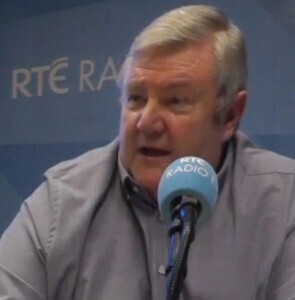
 From top: Taoiseach Micheál Martin; Derek Mooney
Fear not. This is not yet another Covid 19 article written by someone without an ounce of expertise. While I have a view on whether to move to level 4 or 5 or stick with level 3, it is not sufficiently informed as to risk inflicting it on you.
It is not that I haven’t attempted to inform my view. I have. I try to find and read analysis from a wide range of experts. This week that included checking out the website mention in that controversial full-page advert in Thursday’s Irish Times.
That was not a good move. While the Great Barrington Declaration appears at first glance to be endorsed by experts, delve deeper and you find that many of the endorsements are not what they seem.
How could anyone take any declaration seriously that claims to have the backing of: Dr Harold Shipman, Dr Coroh Nahvirus, Herr Dee Münitie, and consultant eye specialist, Dr Bernard Castle.
To be fair, the website was the exception. Most of what I have been reading has been informative, confusingly so. This stuff is not light reading, not least the articles on testing, from the widely used PCR (Polymerase chain reaction) tests, to LAMP (Loop-mediated Isothermal Amplification) tests to antigen test kits to antibody ones.
After a few hours reading about tests and how some produce false positives or negatives it is hard for the lay person, like me, not to wonder if the problem with the current public debate has less to do with false positives and a lot more to do with false binaries and false dichotomies?
Though it is also attributable to the fractious nature of the social media environment in which a lot of this is being played out, I find that the discussion on Level 3 versus Level 5 has turned into a poisonous and polarised “ussuns” versus “themmuns”. A false dichotomy/false binary of government versus NPHET.
Debate descends into mindless gainsaying and sloganeering that would not sound out of place on the terraces of an old firm derby. It is just as vacuous to claim that NPHET’s decisions are based on panic as it is to say that ministers only care about protecting business.
Slight diversion. As bad as things are here, they have still not plumbed the depths to which DUP minister, Edwin Poots has dragged it in the North. Over the past few days he has been asserting that Covid rates can be broken down along sectarian lines. He reckons the rate of infection in nationalist areas is six times higher than in unionist ones. Might it have something to do with the fibres used in GAA county tops?
While it is reasonable for the public to be angry about Sinn Féin’s handling of the Bobby Storey funeral, that does not give folks a licence to sectarianise Covid-19.
Apart from anti-masker morons, almost no one has spoken as recklessly or irresponsibly on this part of the island. Nonetheless, dare to suggest on social media that you have qualms or concerns about the social and economic impact of moving to Stage 5 and you get accused of being anti science and pro coronavirus. Go the other route, say you back a full lockdown now and you get an equal and opposite outrage from the other side.
The choice is not, as one tweeter incongruously put it during the week, a zero-sum game of either being in favour of supressing the virus or of letting it rip through the country.
Saying that we need to learn how to live with the virus is not the same as saying that we should ignore infection and allow it to find its own level.
Not favouring a move to Level 5 and being against increasing restrictions is not arguing for allowing Covid 19 to spread, it is arguing that better enforcement of the existing rules may achieve greater compliance than introducing new ones.
Tightening the rules without first ensuring that you are fully and adequately enforcing the existing rules means further constraining those keeping to the existing ones, at best. At worst, it risks alienating some who feel they have played their part to date.
Without doubt there are groups, individuals and businesses ignoring and flouting the existing rules. Irish Twitter is daily agog with all sorts of examples of this, including (if accurate) the egregious case of a hotel in south west Dublin.
But recalcitrant rule breakers do not stop just because the rules get tougher, they stop because they get caught or fear getting caught.
But what percentage of the increasing number of cases are down to deliberate rule breakers? I have no idea, but I would be surprised if it were higher than the percentage due to inadvertent or negligent contact. Actually, I’d be absolutely shocked if it came anywhere next or near it.
Scan the provincial newspapers or local radio shows and you will find local GPs attributing or connecting increasing rates in their townland or county with funerals, matches, first communions and even schools.
Their claims are far from scientific just anecdotal, but they suggest that simply reducing the permitted size of gatherings is not sufficient by itself.
You need the added carrot and stick of greater public information and increased enforcement to thwart complacency, improve compliance and thereby reduce the opportunity for further outbreaks.
Writing in the Irish Times on Friday, Dr Jack Lambert said: “As we see Covid surge in Ireland, there continues to be an absence of a strong face mask message”. (In the interests of balance I should point out that NPHET’s Prof Nolan took to Twitter afterwards to peevishly decry Dr Lambert)
But Dr Lambert is right. We can see that for ourselves. There has been nowhere near sufficient highlighting of the importance of mask wearing (and I mean proper wearing, not the “off the nose” look favoured by some) or on social distancing or the importance of hand washing.
As Dr Lambert says, watch CNN any night and you will see a PSA on one of these three topics during every ad break. Are we seeing that here?
Nearer to home, the Scottish government has been praised for its direct public service advertising campaign, including this one on protecting elders.
Word of mouth “advertising” works just as well. As I mentioned here before, my mother lives in Spain. Fortunately, it is in a part in the south of Valencia which continues to have a low rate of Covid19. She reports that virtually no one ventures out of their homes without a mask. Having visited her there, I can attest to that.
Most people living there can relate a story about someone found not wearing a mask by the Guardia Civil or Policia local and being made to go with them to an ATM to draw out cash to pay the on the spot fine.
The stories varies a bit when it comes to the size of the fine. Some claim it was €75, some say €120 while others reckon it was €250. The variations increase when it comes to the identity of the miscreant.
While no one telling the story knows the culprit firsthand, they do know it that was definitely a man… or maybe a woman… from an urbanisation or community over here… or over there… who had only gone outdoors briefly to put out the bins/collect the post/walk the dog/visit a neighbour.
The point is this. When people believe there is a good chance of getting caught and fined, they do not take the risk. That is not the case here. It may have been in March, April and May. It is not the case now.
I have no doubt that both NPHET and the government – and by government I mean the entire apparatus, not just the political apex – are both doing their very best, based the best data and analysis available to them. They are both making mistakes and fumbling the communications, but these are errors based on good intent.
The reality is that everyone is learning how to respond to this pandemic, including the experts on the hoof. It is a steep learning curve and, as the Financial Times suggests in this very useful compendium of global data, has many paradoxes. Science never speaks with a single voice.
That the government and NPHET have both allowed and permitted competing narratives is still a major failing.
Varadkar’s Claire Byrne Show attack on NPHET was ill-judged, small wonder he seemed uneasy delivering it. Simon Harris’s constant commentary is not helping either, though it could also be argued that Harris only has the space as his successor’s communications have been less than stellar.
On the other side we have those NPHET sources willing to chat to the media and opine on the attitudes of those they are there to advise. These probably low-level folks should recall the warning cited by the West Wing’s Toby Ziegler (Season 3; episode 5):
“Those who speak, don’t know; and those who know, don’t speak.”
While their bosses should note that delivering advice via the media is not the way to ensure that future advice is heeded.
While governments in normal times are happy to have a few days of contrived “will they or won’t they” media speculation, it is usually where they want to keep the focus on themselves or want the public to feel relieved that they rejected the least favoured option.
These are not normal times, and this is not a contrived choice. A major decision that will impact the lives and livelihoods of many thousands of our fellow citizens must not be played out as a battle of wills between NPHET and the government.
We are all in this together – and that starts with the government and NPHET.
Derek Mooney is a communications and public affairs consultant. He previously served as a Ministerial Adviser to the Fianna Fáil-led government 2004 – 2010. His column appears here every Monday.Follow Derek on Twitter: @dsmooney
Rollingnews









![]]](http://cf.broadsheet.ie/wp-content/uploads/2020/10/9798-Covid-19.jpg)