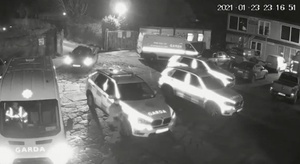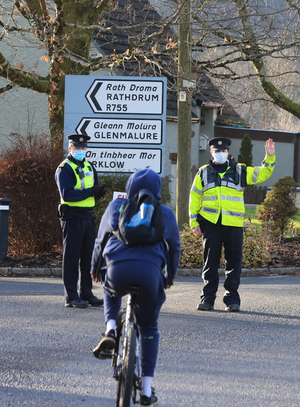



From top: Anti-Lockdown protest on Grafton Street, Dublin 2 last Saturday week; Debenhams Workers on a picket outside the Debenhams shop on Henry Street were moved on by An Garda Siochana last May
“The Garda Síochána will succeed, not by force of arms or numbers, but by their moral authority as servants of the people”
Michael Joseph Staines, First Garda Commissioner
Peter Keating writes:
The above statement is, in my opinion, a good founding principle for any Police Service in a free democracy. What is meant by “moral authority”? Wikipedia defines it as “authority premised on principles, or fundamental truths, which are independent of written, or positive, laws.”
Under its current leadership, An Garda Síochána has become increasingly politicised by this government and its predecessor. This undermines the moral authority which Michael Staines rightly recognised as being so vital to its success as a Police Service.
The Gardaí should indeed be servants of the people, not private political and ideological enforcers. Unfortunately, we are seeing policing in Ireland increasingly take its cue from the double standards of its political masters.
Last April, Gardaí broke up a demonstration by ordinary citizens protesting the loss of their jobs at Debenhams. Ironically, in light of recent events, the Debenhams protests were endorsed by prominent figures from the Irish Left.
Last June, a five thousand-strong Black Lives Matters protest marched through Dublin with hardly a Garda in sight. This demonstration, supposedly in the middle of a deadly pandemic, drew no condemnation from the political establishment – quite the contrary.
Last December, there was a virtual media blackout and no arrests made after violence in Blanchardstown. This is in stark contrast to the political, media, and Garda reaction to the anti-lockdown demonstration in Dublin a week ago last Saturday.
Protestors were met by a phalanx of Gardaí (both mounted and on foot) who were suited and booted with dogs and batons at the ready long before the lobbing of a firework by an individual who may have had nothing to do with the protest.
There have also been double standards applied to funerals under government restrictions and, of course responses to other incidents such as, Golfgate, Alan Kelly maskless on the Luas, the RTÉ party and the party at the Garda station, has been inconsistent.
The behaviour of Gardaí at evictions has also been called into question. The role of An Garda Síochána at an eviction is quite clear: They are there to prevent a breach of the peace and to ensure the safety of all concerned. If they witness a breach of the peace or any other offence, then they are duty-bound to act.
It really is that simple. With respect to the assertion in the Irish Independent article referenced above that “An Garda Síochána is a learning organisation” and the request for an urgent external report so that the organisation can “learn lessons” – isn’t that exactly the purpose of the expensive two-year training course which Garda recruits undergo?
There have been other incidences of the organisation and its members acting inappropriately and outside of its remit in the furtherance of various agendas unrelated to policing, such as the organisation’s promotion of vaccines on social media.
Then there’s the TikTok dancing, supposedly to “Lift the Nation’s Spirits”. The participation of An Garda Síochána in an inane (but undoubtedly very expensive) dance production at a time when livelihoods and lives are being lost as a result of the government restrictions which they are enforcing was completely inappropriate. At best, it was in bad taste. It was unnerving and slightly sinister, like a bully wanting to be your friend. Notably, the Defence Forces and The Coast Guard wisely chose not to follow their example.
There is no doubt that the relationship between a politicised Garda Síochána and the ordinary citizen is changing – particularly under the current government restrictions – and not for the better. Policing by consent is being replaced by coercion.
The image of a gaggle of dancing Gardaí does not juxtapose well with the image of a cohort of Gardaí detailed to arrest and remove a woman from her place of business for exercising her Constitutional right to earn a living and provide for her family. Ordinary people are being criminalised for just trying to live their lives.
In a force (and An Garda Síochána can certainly be described once more as a force) comprising in excess of fourteen and a half thousand members, it is not unreasonable to believe that there are many who have their doubts about the direction policing has taken both generally, and specifically in relation to current government restrictions. Many have families themselves who are also suffering They can see the damage wrought by these restrictions to the people they are supposed to serve.
So where are the Garda whistleblowers now? All members have made a “Solemn Declaration” (albeit watered down from the original Sworn Oath) to uphold the Constitution – which is superior to all positive law – and hence to defend the rights and freedoms of all citizens which Bunreacht na hÉireann asserts and guarantees.
Is there really nobody prepared to raise their head above the parapet? Remember, five thousand members found it within themselves to take (forbidden) action over their pay in 1998 via the “Blue Flu”.
Meanwhile on Merseyside in the UK, there was a scene somewhat reminiscent of a relatively recent Garda photoshoot, but far less subtle: four officers from Merseyside Police – one wielding a large stick – posing in front of an advertising van bedecked with a rainbow-coloured billboard bearing the large slogan “BEING OFFENSIVE IS AN OFFENCE”.
The ill-advised stunt proved to be a step too far, however, and the resultant public backlash forced Merseyside Police into an embarrassing apology, a Superintendent being required to clarify that “being offensive” is, of course, not in itself an offence.
Although having occurred in another jurisdiction, such “woke” (and legally incorrect) virtue-signalling should also ring alarm bells here, particularly in the context of the impending enactment of identity politics-based “Hate Crime” legislation.
The Merriam-Webster dictionary defines “Identity Politics” as “Politics in which groups of people having a particular racial, religious, ethnic, social, or cultural identity tend to promote their own specific interests or concerns without regard to the interests or concerns of any larger political group”.
Identity politics is by definition inherently divisive and inequitable. Legislation (and obviously enforcement) based upon it is not a good fit for a Republic that purports to assert the equality of all citizens before the law.
The drive to enact such legislation, supposedly in the midst of a deadly pandemic, is pure opportunism, an effort to make ideological hay while the political skies are clear. In truth, one would now be hard-pressed to separate the government parties ideologically, and the oxymoronic “Opposition” lie even further to the Left.
The covid-19 narrative continues to provide fruitful opportunities for the government parties to achieve long-held political and ideological aims.
Many of those who have championed this legislation, and who seek desperately to discover a fascist bogeyman to help justify it, are the same people who have spent the last 11 months steadily eroding the fundamental rights and freedoms of Irish citizens. The irony appears lost on them, but the fact remains that these are the people dictating the policing agenda.
An Garda Síochána must return to the first principles advocated by Michael Staines. They must repudiate the service of political agendas and return to their role as servants of the people. Politicisation and poor leadership is undermining the moral authority of An Garda Síochána.
Care should be taken to ensure that it is not lost, or the loss of the support, trust, and consent of the people will surely follow.
Peter Keating is a ‘part-time writer and artist’ based in Munster.