

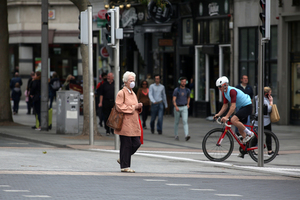


This afternoon.
Mask-wearing elderly in Dublin city centre.
Lockdown Day 148.
Day 54 of Phase Three.



This afternoon.
Mask-wearing elderly in Dublin city centre.
Lockdown Day 148.
Day 54 of Phase Three.

Former Fine Gael leader Alan Dukes
This morning.
On RTE’s Today with Sarah McInerney, former Fine Gael leader Alan Dukes said Fine Gael’s EU Commissioner Phil Hogan and Fine Gael supporter, Supreme Court judge Seamus Woulfe should not resign.
Yet he said it was “absolutely inevitable” and correct that Dara Calleary and Jerry Buttimer resigned.
He said:
“They are people with significant political offices who should have been giving an example to everybody else.”
But in respect of Mr Hogan and Justice Woulfe, he said:
“Government officers should certainly resign. I don’t think there’s a case for Phil Hogan to resign. It’s an egregiously stupid thing for him to have done and similarily for Seamus Woulfe. But I don’t think that, in any way, they’re in the same position in relation to public opinion and the public action we need to take in this country to deal with this.”
Ms McInerney pointed out that Justice Woulfe broke the health guidelines.
Mr Duke replied:
“I’m sorry I don’t think that this event, in any way, calls into question his judgment as a Supreme Court judge. The case for Dara Calleary and Jerry Buttimer is completely different.”
In addition, at one point, Ms McInerney, who is presenting her final Today show today, told listeners:
“It wasn’t just Phil Hogan, it wasn’t just Seamus Woulfe, former broadcaster Sean O’Rourke was there as well and others. And we’d be happy to hear from any of them and if they would like to come on the show before 12 o’clock, we will make space to speak to them.”
Earlier: Resigned
Meanwhile…
I enjoyed that little exasperated "jaysis" from Sarah McInerney there! #golfgate pic.twitter.com/SMSk7hLAOq
— Peter Branigan (@PeterBranigan) August 21, 2020


The Workman’s Club (alternative live music venue) Wellington Quay, Temple Bar, Dublin 8 has had enough.
And who would blame them?
Apart from CIan.
Earlier: I’m Not Confused, You’re Confused

Taoiseach Michaél Martin
This afternoon.
Responding to Sinn Féin’s finance spokesperson Pearse Doherty’s comment that there is a ‘dysfunction and chaos’ in Government that is undermining public confidence….
‘..Micheál Martin insisted “the overall message is very, very clear.”
He said the measures announced by the Government on Tuesday are aimed at ensuring there is a balance of keeping people at work and keeping community transmission as low as possible.
Yesterday, the Green Party leader and Minister for Transport Eamon Ryan acknowledged that there are contradictions in the advice relating to limits on indoor gatherings compared with schools having indoor classes of 20-30 pupils.
However, the Taoiseach said “there is no confusion about the fundamental issue” of trying to protect lives and livelihoods and stop the increase in cases of the virus…The numbers have gone up substantially in the last two weeks compared to a month earlier. That’s it. The numbers have gone up. We have to respond,.”
Taoiseach rejects claim of confusion over Covid-19 messaging (RTÉ)


The new norm – teacher will sit behind Perspex at Nagle Community College in Cork when school returns @MichealMartinTD getting a tour pic.twitter.com/iJC50wGHEf
— Ciara Phelan (@ciaraphelan_) August 20, 2020
Ah.
Here.
This morning.
Nagle Community College, Cork City.
Really?
REALLY!?
Meanwhile…
More hellish delusions. pic.twitter.com/ARnPRwsn4c
— Justin Hart (@justin_hart) August 20, 2020
Utah, USA.
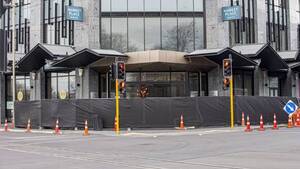
Crowne Plaza Hotel in Christchurch, New Zealand is now an isolation facility with fencing separating the building from the public.
Meanwhile, in New Zealand
Jordan Schachtel writes:
Military has been deployed to make sure people don’t leave their quarantine camps, which are mandatory for COVID-19 positive individuals and their families.
From what I understand, police are prohibiting the press from taking photos and videos of the current situation in the facility, citing privacy concerns. Still, it would be nice to know what the heck is going on there.
Found a couple testimonials from the mandatory quarantine facilities. Military checks in “constantly on our well being but also our adherence to the rules.”
The first person in the conversation had a sore throat and was sent to the quarantine camp as a precaution.
Of course, the families are left out of the decision making process, but don’t worry, the state knows what’s best for them!
A lot of the rebuttals from the Kiwis point out the fact that they are being quarantined at nice hotels, as if that justified the incarceration of citizens without any due process.
What starts as a nice, contained arrangement ends up a very different situation when the virus inevitably surges through the population. What happens when they start running out of rooms? White collar prison-style incarceration quickly goes south.
What happens when you run out of nice hotels to put COVID infected people in them? The not-so-nice makeshift “hotels” prop up in your local neighborhood which require a different policing structure to ensure compliance.
Unfortunately, this represents the mainstream viewpoint here. They have bought into the pseudoscientific delusion that they can fully eliminate the virus. So of course, forced incarceration is on the table. It will not end well when the bubble bursts….
Time to look at our quarantine hotel contingency plan (newsroom.co.nz)
Pic: Stuff.co.nz

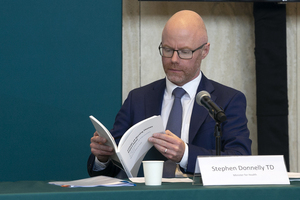
Minister for Health Stephen Donnelly at the publication launch of the COVID-19 Nursing Homes Expert Panel Report.
This afternoon.
The COVID-19 Nursing Homes Expert Panel Report has been published.
As of July 14, 79% of all notified deaths from COVID-19 occurred in the over 75 age group and deaths in nursing homes (985 cases) represented 56% of total deaths (1,748 cases) in Ireland.
From the report:
‘The COVID-19 public health emergency has shown some of the many strengths of Irish society. It has also shown some weaknesses.
We have a two-tier healthcare system and a two-tier siloed approach to the long-term support and care of older people which favours referral to long-term care settings as opposed to promoting a wider range of home care options. We owe it to our older population and ourselves to do better.’
Also:
During the crisis, leadership and timely decision-making became overwhelmed due to a vacuum of clear guidance, mixed messaging, a lack of access to clinical expertise and resources (oxygen, infusion pumps, PPE).
A submission from academic nursing who took part in the ‘call to arms’ felt that for the vast majority of nursing homes there was no direct clinical governance; GPs’ mainly focused on managing their individual patients either in person or virtually. COVID-19 very quickly exhausted existing governance and escalation pathways.
Read here
More as we read it.
Previously: Left To Die: Nursing Home Timeline

new restrictions explained pic.twitter.com/h1XIBHhin1
— Killian Sundermann (@killersundymann) August 19, 2020
Ah now.
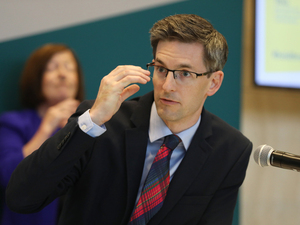
Dr Ronan Glynn, Acting Chief Medical Officer, Department of Health
You can have a read of the advice from Acting Chief Medical Officer,, Dr Ronan Glynn, to me that formed the basis of new public health measures announced yesterday https://t.co/CHr1FDxsKj
— Stephen Donnelly (@DonnellyStephen) August 19, 2020


“the average number of close contacts per case was 5 and the median was 3”
Does this not indicate that people are continuing to keep their contact circles pretty small – and/or are maintaining social distancing – without any Garda powers?
Anyone?
Earlier:“Is There A Magic Number For Schools, Pubs Or Anywhere Else? There Isn’t”
Meanwhile…
This is a classic diversion.
People criticise the government.
Government: Don't attack NPHET. https://t.co/6ozwz6X4Go
— Paul Murphy (@paulmurphy_TD) August 19, 2020
Um.

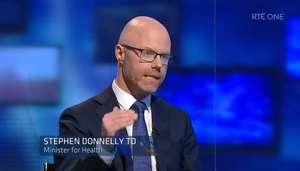
Last night.
RTÉ One’s Prime TIme.
Minister for Health Stephen Donnelly interviewed by Mark Coughlan (top right) attempted to explain the logic behind the the new Covid measures.
Stephen Donnelly: “If you look around Europe and if you look at the amount of cases per population, we’re exactly mid-table. Unfortunately we have one of the highest growth rates of the virus anywhere in Europe. And so what we’re doing is we’re saying ‘let’s act now…let’s act before we’re closer to the top of that table and before we need to make much more serious restrictions’.”
Mark Coughlan: “So what’s gone wrong? How did we get here?”
Donnelly: “I don’t think it’s a question of what’s gone wrong. We’re dealing with a vicious, deadly and highly contagious virus. And what’s happening here is happening all over the world. In Europe but further afield, we’re seeing it in South Korea, in New Zealand and in other places. The broad pattern is: there was a surge here and other places, very harsh and restrictive measures were used, they worked…”
Coughlan: “They were supposed to give us time to implement a system that would allow us to control the virus…”
Donnelly: “Yeah, I think that’s fair…”
Coughlan: “And we had that time, did we not?”
Donnelly: “Yeah, yes, and I think this is that. So controlling the virus is rapid testing and tracing. We had about 52,000 tests last week. We’ve a massive upswing in testing now so we’re doing testing right around the country for meat processing plants, for direct provision, for nursing homes. I’m meeting the HSE tomorrow to see how we can get quicker and quicker. We’re increasing enforcement powers. The Minister for Justice and myself are working on that.
“And what we’re doing now is that we’re going to take very targeted measures, not the broad and very severe measures that were taken in the past, we’ve learnt about this. We’re moving quickly. In order to make sure we get the schools up, in order to make sure we get health services open. In order to save lives and in order to protect jobs because we all know that if we end up in a second serious national lockdown then the consequences, personally, for our communities and for our economy would be very, very serious.”
Coughlan: “You spoke about testing and tracing now. Why are we still trying to speed that process up? Surely that should have been properly in place by now?”
Donnelly: “Well, I don’t think we’ll ever stop trying to speed it up. Our testing…”
Coughlan: “But we were talking about 24-hour turnarounds back in, I think, May and we’re still looking at 72/three-day turnaround times. Why aren’t we at a 24-turnaround?”
Donnelly: “So we are, from test, from someone getting a swab to getting a result. Has there been something of a lag when we saw an awful lot of cases appear very quickly, there has and the HSE has been working very hard on that.”
Coughlan: “That was supposed to be the capacity?”
Donnelly: “The capacity is there, the capacity is there for 100,000.”
Coughlan: “Yet we saw a slowdown.”
Donnelly: “We did, so the capacity is there for 100,000 – that’s what means we can respond and say ‘we’re doing all meat processing plants’, ‘all direct provision’, ‘all nursing homes’. What we did see was a very low level for about a month, about 20 cases a day. In a matter of days, that shot up to many, many times that. We didn’t have the resources in place to instantly respond to that. It did take two or three days longer.”
Coughlan: “But you knew factories were a risk at the time? For the last few months, we’ve known factories were at risk. The whole system was supposed to be agile and robust to respond to incidents like this. And yet, you just said yourself, it didn’t.”
Donnelly: “Well it did, the system is agile, the system is robust.”
Coughlan: “But it slowed down.”
Donnelly: “It did slow down and we’re looking at making sure that doesn’t happen. But if you compare us to some other countries. Take New Zealand, New Zealand is held up as a paragon of success in all of this. New Zealand’s target time is five days. Our target time is three days and we’re looking at reducing that. The HSE has done amazing work. One of the things that happened was with a very quick upswing. There weren’t some of the clinicians in place to make the calls as quickly as we would have liked. Why? Because they’re clinicians who were pulled from their own frontline work. They were rightly redeployed. However, the HSE is working on a more permanent system that doesn’t require pulling other clinicians in.”
Coughlan: “When will that be in place?
Donnelly: “We’re working on it right now. I’m meeting them tomorrow and they’re already making improvements to it so…”
Coughlan: “So if there’s another surge in the next week, will it be ready? Or is it a month-long thing or?”
Donnelly: “No it’s happening already. So there’s a whole team in UCD has been stepped up. There’s a team in UCC who’s being stepped up at the moment so that capacity is being put in place very quickly. Would we have loved to have seen no lags when we saw the outbreaks in some of the Midlands? Sure. But as with every other country, we are learning as we go. And I think the HSE made a very reasonable decision to redeploy clinicians to their day jobs when the cases were low and they pulled them back in quite quickly when the cases shot up.”
Later (in relation to new powers being provided to the gardai and after Mr Donnelly said he had been working with the Minister for Justice Helen McEntee on these new powers)
Donnelly: “What we want to do is we want to say, look, it’s clearly no longer enough to say ‘we need everyone to follow the guidelines’. We all know that there are more and more house parties happening. And unfortunately nobody wants to be the guy that says ‘stop the house parties’ but unfortunately, the data that the public health doctors have is unambiguous and that it is causing a spread.
And whilst maybe the people at these parties are not at risk themselves, although they could well be, it’s entirely possible that they’re then carrying the virus to people who are at risk. So the decision we’ve taken is to say in cases like this or in cases where we have bars that are clearly just not obeying the same guidelines that the vast majority of the country obey, we are moving from recommendation and guidelines to enforcement powers and I think that’s the right thing to do and I think the public want to see that. Because we are asking everybody to make sacrifices again and again and again. We can’t have a situation where a very small group of people say ‘you know what…'”
Coughlan: “So that’s going to take legislation is it not? That’s going to take legislation which, as I understand it, won’t be enacted until the Dail returns which is September the 15th and yet these measures will be finished by September the 13th, no?”
Donnelly: “We will take a look. Primary legislation obviously takes a bit of time and we will be looking for the co-operation obviously across the political spectrum. The timing on that hasn’t been worked out but the message we’re sending out is this: is that while the vast majority of people are complying which is why we’re still mid-table in Europe and not in a worse situation, we can’t have situation where a small number of people essentially thumb their nose at everybody else. And we’re saying, ‘look, from now on, we are, as quickly as we can, we’re gonna bring in enforcement powers and that does require primary legislation’.”
Coughlan: “So all this is to try and bring the incidence rate down essentially, isn’t it, in the country? So it takes a while for all the cases to process through the system, several weeks. Yet in two weeks time we’re sending everybody back to school or to college. Is there not a contrast there or a difficulty in all that?”
Donnelly: “No, I think this is exactly why we’re acting now. So the measures that we, the State, take now, and that we, the people, take now are to reduce community transmission and the single best protection for the schools, by going back, which is still on track and a core government priority is reduced community transmission. That also, by the way, is the best protection for people in nursing homes, for people who may have underlying health conditions who are living at home. This is all about reducing community transmission and the prevalence in the community as low as possible.”
Coughlan: “And that’s what the local lockdowns in Laois, Kildare and Offaly were supposed to do too and seeing as we are where we are today, that obviously didn’t have the effect you were hoping it would have. Is there any situation in two weeks’ time, you’ll reconsider opening the schools?”
Donnelly: “Well, first of all…”
Coughlan: “Is there an incidence rate, is there a kind of a high bar or anything like that, that the Government has even discussed or considered or is it schools will reopen, whatever happens?”
Donnelly: “So, first of all, just on the three counties, it is not the case that the measures haven’t had the desired effect. The measures are having the desired effect thanks to the work that the people in those three counties are doing. So, a bit like the measures we brought in now, had we not acted when we did with those three counties, the situation would be much worse. If we didn’t act now in terms of the measures we’re bringing in today the situation in two weeks or two months would be much worse and we would be looking at a national lockdown.
“In terms of, is there a magic number for schools or for pubs or for anything else, there isn’t. So the public health team, they look at a lot of different things, they look at the cases, they look at whether the cases are going up or down, they look at where the clusters are, they look at how much community transmission is going on and a lot of other factors so that’s why we have the public health emergency team and the expert advisory group so they can look at a lot of really complex information and then come up with the recommendations.”
Coughlan: “Briefly, there was a lot of discussion earlier today about over 70s and new measures to be brought in, from my reading of it, the new measures are essentially, you know, limit your contacts, stay indoors as much as possible, is there anything that’s actually new in it that they should be thinking about or considering?”
Donnelly: “Yeah, there was reporting today which was simply incorrect and scared a lot of people. A lot of elderly people, I was talking to colleagues, Oireachtas colleagues, they said, they were getting a lot of phone calls from a lot of very worried and very angry people over the age of 70 saying ‘are we about to be locked into our homes?’, that is absolutely not the case, it was not the recommendation from NPHET and it was not considered by government.
“Let me try and paraphrase the Chief Medical Officer when he was asked exactly this because what you’re asking is public health advice. Essentially, what he was saying is people who are vulnerable to this virus, be it based on age or an underlying condition need to exercise very careful judgment over the next 26 days. The prevalence rate is higher than we want. We had it down to about 3 per 100,000. It’s now up, I think, at 26 per 100,000. That is a rate that causes serious risk for people. It is in the community more than it was and so the advice to people over 70, the advice to people who are more vulnerable to this is: exercise caution.
“So, for example, if you are planning on going on a holiday, on a staycation and you’re over 70 with an underlying condition, there’s no issue with that whatsoever so long as you’re limiting your social interactions…and to be honest, everything I have seen shows that those who are more vulnerable to this have been very seriously following the guidelines. Really, it’s a reiteration of that: to be very, very careful while the rate is where it is.”
Watch back here
Earlier: A Limerick A Day
