Tag Archives: Housing

Minister for Housing, Planning and Local Government, Eoghan Murphy

This morning/afternoon.

The Social Democrats will  bring a motion of no confidence in the Minister for Housing, Planning and Local Government, Eoghan Murphy to the floor of the Dáil next week.

It comes, according to RTE, amid speculation that Fine Gael TD Dara Murphy is set’ to resign his seat in the Dáil to take up a job in the European Commission’.

Catherine Murphy , co-leader of the Social Democrats, said:

“Our housing situation has gone beyond a crisis and has been an emergency for a long time. This Minister and this Government have abjectly failed Irish families, our communities and our economy in not getting to grips with the chronic lack of housing that is affordable to buy or rent.

“The Minister’s trots out his plan – Rebuilding Ireland – but he can’t even meet the tame targets set in that plan. It is failure upon failure. And the consequences for real people are appalling.”

Roisín Shortall, Ms Murphy’s fellow co-leader, added:

On almost every door in the by-elections, our candidates in Cork North Central, Dublin Mid West and Dublin Fingal hear the same story of an emergency in housing.”

Meanwhile

A spokesperson for Minister Murphy said the motion is an “election stunt” ahead of the by-elections on Friday.

“This is pathetic and the Social Democrats would be better using their time seeking support for a constructive solution rather than a stunt that will not pass,” the spokesperson said.

Social Democrats to table no-confidence motion in Murphy (RTÉ)

Rollingnews

Housing Minister Eoghan Murphy (second from right) turning the sod on an upgrade to the Lee Road Water Treatment in Cork City

This afternoon.

Eoin English, in The Irish Examiner, reports that the Housing Minister Eoghan Murphy responded to criticism of the Government’s response to the housing crisis by Fr Peter McVerry.

Mr English reported:

Eoghan Murphy warned that the State can’t just “throw up houses” overnight and must consider how to build communities too.

…“When we build a home today, we want it to last for 100-years,” he said.

“So we have to think, are we building it in the right place, to the right standards and specifications?”

Housing Minister defends the government’s Rebuilding Ireland plan during Cork visit (Eoin English, The Irish Examiner)

Pic: Cork City Council


O’Devaney Gardens site in Dublin 7; letter from Bartra Capital Property Group CEO Michael Flannery to Dublin City Council dated October 31, 2019

Further to a post yesterday about Dublin City Council’s controversial vote on a fresh €7million deal with Bartra Capital for the regeneration of O’Devaney Gardens in Dublin…

Journalist Lois Kapila, in Dublin Inquirer, has written a detailed account of that meeting on Monday night.

In her report, she refers to a letter sent from Bartra Capital Property Group CEO Michael Flannery to Dublin City Council dated October 31, 2019 (pictured above).

Ms Kapila reports:

The big change from last month, when councillors delayed voting and said they’d seek a better deal, and this month, when they voted to back the deal, was the offer of “affordable” rental housing on the site.

The deal on the table last month included 248 social homes, 165 “affordable” homes for sale, and 411 market-rate private homes.

After that, though, Bartra Capital Property CEO Michael Flannery said the company would be willing to enter into an “option arrangement” with the council, or its nominee, which would give the council the right to buy some or all of the 411 private “at the average prices per unit type” set out in Bartra’s final tender.

This could help, for example, the council or an AHB [approved housing body] get another 30 percent of the total units to use as an affordable or cost-rental scheme, the letter says.

To give Bartra certainty, the council and the Department of Housing would need to tell Bartra whether, and to what extent, it wants to exercise that option “within a reasonable timeframe” of signing the development agreement, Flannery’s letter says.

…. Independent Councillor Anthony Flynn said the agreement around the affordable rental was still smoke, mirrors, and promises – with nothing legal yet. “There’s no commitments,” he said. (Bartra’s letter isn’t legally binding.)

…Whether the Department of Housing will agree to help fund the affordable rental or cost-rental homes is unclear. Its press office hasn’t yet responded to queries about that, sent on Tuesday morning.

Meanwhile…

Olivia Kelly, in The Irish Times, also refers to the letter.

In an analysis piece, Ms Kelly reports:

Bartra said it is willing to sell “some or all of the private units” to the council or its nominee.

Well of course. Why wouldn’t it be willing to get these guaranteed sales, particularly when, as it said in a letter to Mr Kenny, it would be at a “price to be determined by the preferred tenderer”.

Bartra said the price would be in line with what it is in its tender documents.

But it is not clear if this relates to the price of affordable homes, which was in the region of €420,000 before State subsidies are applied, or the private costs, which would see prices top €500,000.

Councillors Vote Through Deal to Redevelop O’Devaney Gardens After Fraught Debate (Lois Kapila, Dublin Inquirer)

O’Devaney Gardens gets the go-ahead, but questions remain (Olivia Kelly, The Irish Times)

Yesterday: Passed Under Garda Protection

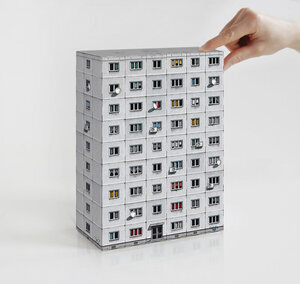
Fancy building your own socialist prefab panel block while learning about the history of prefabricated construction systems commonly used behind the Iron Curtain?

Look no further.

Plattenbau, Panelák, Wielka Płyta, Panelky, Panelház or Панельки: Prefabricated panel blocks go by different names around the former Eastern Bloc, but no matter where they were built, their goal was always the same: to provide homes for expanding city populations after World War II.

‘Panelki’ by Zupagrafika (€22 + P&P)

thisisnthappiness

Sandymount Strand in Dublin; Green Party MEP Ciaran Cuffe; David Browne, president of the Royal Institute of the Architects of Ireland

Building on Dublin’s Sandymount Strand and the Tolka Estuary could provide enough homes for 150,000 people, the president of the Royal Institute of the Architects of Ireland (RIAI) has said.

David Browne, a director of RKD Architects, said the beach and estuary lands should be reclaimed from the sea for dense, sustainable apartment neighbourhoods, which would provide affordable homes over the next 50 years.

Reclaim Sandymount Strand for apartments, says architect (Olivia Kelly, The Irish Times)

Abercrombie’s new town plan for Dublin (Olivia Kelly, The Irish Times)

Dublin MEP Ciaran Cuffe thinks it could be damaging to the environment.

“I think it’s very controversial,” said Mr Cuffe. “Personally, I don’t think it’s viable. It involves building in the Dublin Bay biosphere which was a Unesco designation a few years ago.”

Green MEP says building homes on reclaimed land in Dublin Bay is not viable (Irish Examiner)

Save Poolbeg

Previously: Derelict Dublin


Minister for Housing Eoghan Murphy

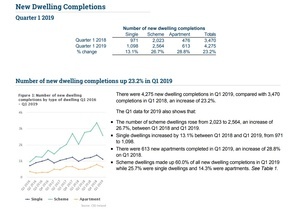
Summary of new report on ‘new dwelling completions’ from the Central Statistics Office; tweet from Taoiseach Leo Varadkar

This morning.

New figures from the Central Statistics Office state there were 4,275 “new dwelling completions” in the first quarter of this year.

According to the CSO the figure “is based on the number of domestic dwellings connected by the ESB Network to the electricity supply and may not accord precisely with Local Authority or Eircode Routing Key boundaries”.

Over the same period last year, there were 3,470 such completions.

Meanwhile…

And…

Daft.ie’s report from earlier this week on the first quarter of this year and the rental market stated:

“…the level of supply needed for rents to not change is about 13,000 per quarter, or 1,000 per week. Currently, the Dublin market is getting half that – about 500 per week.

“To close that gap, Dublin needs to build tens of thousands more rental homes. How many depends on how frequently these change tenants.

“Suppose the average tenancy last three years, which is somewhat shorter than is currently the case (and thus lowering the total number of homes needed).

“In that case, Dublin would need build an extra 500 rental homes to come on the market each week for those full three years, to close the gap between the 500 that are coming on and the 500 that are needed.

“That’s almost 80,000 rental homes that Dublin needs to build, as soon as possible.”

Read the CSO report in full here

Minister for Housing Eoghan Murphy

This afternoon on RTÉ Radio One’s News At One.

Housing Minister Eoghan Murphy was interviewed by reporter Louise Byrne about the latest Daft.ie quarterly report which shows just 2,700 properties were available to rent nationwide on the website on May 1, while the average rent nationwide is €1,366.

Mr Murphy told Ms Byrne rent inflation is low.

The Daft.ie report did refer to the national annual rate of inflation at 8.3%, in the first quarter of 2019, being the lowest in five years as a “crumb of comfort” in the report.

Ms Byrne put it to Mr Murphy: “Are rent increases of 6.8% in Dublin year-on-year slow?

He said:

“It’s the slowest rate of increase that we’ve seen since 2013. We know that rents have run away in the capital because of the lack of the supply that we have had with homes to buy and homes to rent.

“And that’s why with Rebuilding Ireland, we’re dramatically increasing the number of homes to buy, but we’re also bringing in these reforms to protect renters which is so important. We know we have more work to do.

“We’re halfway through Rebuilding Ireland but it is showing signs of progress in some key areas like supply. But there’s more to do and that’s exactly what we’re going to be doing over the rest of the year.”

Asked when 80,000 homes will be built in Dublin – given that this is the figure Daft.ie claims is required and only 18,000 were built across the country last year, Mr Murphy said:

“What we saw last year was the 25% increase in the number of homes built over the previous year, it’s going to increase again this year. Each year, under our plans we’re committing more money to building more homes for social and affordable housing, we’re also seeing on the private side more housing being built as well.

“The key thing we need to see in places like Dublin is more apartments, but it’s not just Dublin where we need to see more apartments being built, it’s in each of the cities in the large towns that we have in the country. And that’s why we talk about our vision beyond Rebuilding Ireland.

“We’re talking about growing the population outside of Dublin, taking the pressure off Dublin, not just for homes but for jobs as well.”

Mr Murphy also told Ms Byrne that the rent caps “that have been working” have been extended to 2021 “at the earliest”.

Listen back in full here

Earlier: Daft Figures

Rollingnews

From top: Dublin Housing Action Committee (DHAC) publication entitled ‘Crisis’, 1969; DHAC founding members, from left: Sean Dunne, Mairin deBurca and Eamonn Farrell  in Liberty Hall in Dublin on May Day

The following is a talk given by photojournalist Eamonn Farrell, Director of Rollingnews and former Dublin Housing Action Committee [DHAC] activist, on May Day to launch a photographic exhibition at Liberty Hall focusing on the housing crises in the 20th century and 21st century Dublin.

‘Ironically in today’s newspapers and on the air you could get all the latest stats on the housing crisis. Not pleasant reading. I am not going to bamboozle you with further figures.

But if you will allow me I will try and paint a picture of my experiences as a housing activist in 1960s Ireland

Like many people in the sixties, I moved to England. Not just in search of work. I already had a job as a junior barman. In those days to be licensed to pull pints of the black stuff you had to serve three years as an apprentice and then two as a junior barman.

Ireland then was still in the grip of a conservative Catholic Church. No divorce. No Contraception. Gay sex was illegal. Women had to give up work when they married. Young mothers were being sent to work in laundries and forced to give up their children born outside of marriage. Priests demanded the right to question and interfere in the nature of your activities in the marriage bedroom.

Yes, that was the Ireland in which the tyranny of British occupation was replaced by the tyranny of a church exercising the moral oppression of the population with the compliance of an independent, but supine state.

I had worked in Kirwan House, a pub right beside what was then UCD in Earlsfort Terrace. It was frequented by students who were starting to get the whiff of new philosophies from the European mainland and were reading works not only by Sartre but by Marx and Lenin as well.

Bob Dylan was strumming, Luke Kelly was singing and O’Donoghues pub was only around the corner. For a teenager from Finglas it was heady stuff. But not quite heady enough.

In London I bumped into one of the students I befriended in Dublin and he invited me to come along to meetings of the Irish Workers Group (IWG), headed by Gerry Lawless.

Lawless had ensured himself a place in legal history by being the first person to take a case to the European Court of Human Rights. The IWG would have been described as a Trotskyist group, which meant little to me at the time.

The IWG held meetings every Sunday at Speakers Corner in Hyde Park And on a particular Sunday, I was delegated to speak. Of course I was nervous and nearly vomiting into my tea in the nearby Lyons Cafe, but it was nothing to how sick I was when I discovered the speaker before me was a young curly-haired radical by the name of Eamon McCann!

Now if any of you have heard Eamon speak you will know his mouth cannot keep up with the speed at which his brain is shoveling words onto his whiplash tongue. Needless to say I was a disappointment to myself and my comrades. Always meant to check with Eamon were those curls natural or the result of a perm.

My first task after that miserable performance was to go to a certain hotel where there was an international conference taking place, and at night cut down both the American and Soviet flags.

I duly arrived Stanly knife in hand and shimmied up the pole to cut down the American flag first. As I cut through, which was not easy, as once up the pole, my legs were wrapped around it like a pole dancer, I had only a split second to allow both hands free to cut the rope.

Suddenly blood was squirting from my hand, the flag was still in place, and I dropped to the ground like a fireman on an emergency call.

Continue reading →

From top: A young Eamonn Farrell being arrested during a sit-down housing protest, College Green, Dublin in 1969; Mr. Farrell claimed that the garda inspector who is about to be tripped by him, had moments earlier punched him in the stomach; Eamonn today

Eamon Farrell, Editor of RollingNews.ie and former Secretary of the Dublin Housing Action Committee DHAC,is launching a photographic exhibition on the housing crisis, tonight at 7.30pm in Liberty Hall.

Eamonn will also be speaking on his experience as an activist with the DHAC, including sit down protests and occupation of vacant properties, and as a journalist covering last year’s housing protests in Dublin.

The exhibition is a part of the 2019 May Fest events which starts of with the traditional May Day Parade from Parnell Square at 7.00pm to Liberty Hall.

Eamonn was a founding member of the Socialist Party of Ireland (SPI), Socialists Against Nationalism and the Divorce Action Group (DAG).

He ceased his political activities with the demise of the SPI and entered journalism, becoming picture editor of the Sunday Tribune and Editor of RollingNews.ie photo agency.

The Dublin Housing Uprising exhibition (Facebook)

Rollingnews