Tag Archives: Ireland

On Thursday.

Ireland will play Russia at the Kobe Misaki Stadium in Kobe City, Japan, in the Rugby World Cup with kick-off taking place at 11.15am Irish time.

Further to this…

CEO of Vodafone Anne O’Leary tweetz:

On Thursday [Ireland’s rugby team] take on Russia during office hours. Vodafone employees are getting 2 hours off to watch it. Canterbury of New Zealand, Aer Lingus & Diageo Ireland, I challenge you to do the same and nominate 3 other businesses. Here’s a note from Joe [above] to help!

*Pass it on*.

UPDATE:

Oh.

Ireland V Russia

Carlow Weather tweetz:

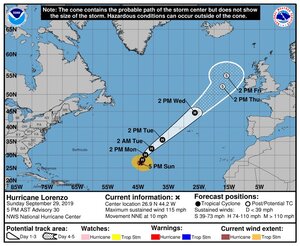
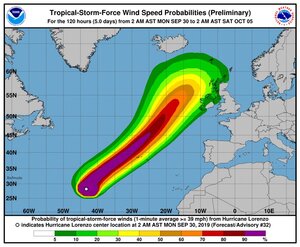
“Latest [Hurricane Lorenzo] update: The National Hurricane Center track forecast has been adjusted a little to the left to come into better agreement with the latest consensus aids. Although the spread in the models is not as large as it was yesterday, the forecast beyond 48 hours is still of low confidence.”

Met Éireann ‘closely monitoring’ Hurricane Lorenzo (RTE)

Top pic: National Hurricane Center

UPDATE:

Data Protection Commissioner Helen Dixon; Labour TD Alan Kelly

This morning.

The Data Protection Commissioner Helen Dixon is fielding many questions about the Public Services Card at a meeting of the Public Accounts Committee.

But separate to the Public Services Card, and in response to a question from Labour TD Alan Kelly, Ms Dixon told the committee that, in terms of the supervision and enforcement of data protection law, Irish taxpayers will incur costs for having multi-nationals headquartered in Ireland.

Ms Dixon said:

“Once the Irish DPC [Data Protection Commissioner] starts administering fines and sanctions on companies, there has been a debate about whether all of that goes to the Irish Exchequer and whether that isn’t shared across the EU member states.

“At the moment, it’s our understanding that it goes to the Irish Exchequer.

“So, already, there’s an opposite debate to the question you’re opening up which is that: well is that fair? If Ireland supervises most of these big tech companies and there are infringements and fines, does Ireland get to keep the fines? So that’s an open question that’s ben raised a number of times.

“In relation to the costs, I think it’s well possible that the Irish taxpayer will end up, by virtue of these companies being headquartered here, incurring costs.

“The Irish taxpayer has incurred costs already in relation to the case that you referenced that’s before the Court of Justice at the European Union on transfers of data because it arose from a complaint by Max Schrems against Facebook Ireland.

“Facebook Ireland being located here means that we are responsible.

“However, under this Co-operation and Consistency Mechanism that operates around the one-stop shop in the EU now, if there’s a dispute in relation to the findings that I make – so I’ve to circulate a draft decision in relation to any of these cases that concern multi-nationals to my fellow EU Data Protection authorities.

“And if ultimately they have a different view, that I can’t reconcile into my findings, I institute a dispute resolution mechanism before the European Data Protection Board and it may take over the decision making. And if a company affected by that decision disagrees with it, it takes an annulment action to the Court of Justice of the European Union.

“So, there will be a certain number of cases that may end up being taken out of Ireland’s hands because of disagreement between data protection authorities and the European Data Protection Board will then have to bear the cost for defending those cases before the CJU.

“But, undoubtedly, the effect of having the multi-nationals headquartered in Ireland is going to give rise to costs for Ireland in terms of the supervision and enforcement of data protection law.”

Watch the proceedings live here

Irish New York Times’ journalist Declan Walsh; New York Times

This morning.

Publisher of the New York Times, reports:

“The current [US] administration, however, has retreated from our country’s historical role as a defender of the free press. Seeing that, other countries are targeting journalists with a growing sense of impunity.

… let me tell you a story I’ve never shared publicly before. Two years ago, we got a call from a United States government official warning us of the imminent arrest of a New York Times reporter based in Egypt named Declan Walsh.

…this particular call took a surprising and distressing turn. We learned the official was passing along this warning without the knowledge or permission of the Trump administration.

Rather than trying to stop the Egyptian government or assist the reporter, the official believed, the Trump administration intended to sit on the information and let the arrest be carried out. The official feared being punished for even alerting us to the danger.

Unable to count on our own government to prevent the arrest or help free Declan if he were imprisoned, we turned to his native country, Ireland, for help.

Within an hour, Irish diplomats traveled to his house and safely escorted him to the airport before Egyptian forces could detain him.”

The Growing Threat to Journalism Around the World (AG Sulzberger, The New York Times)

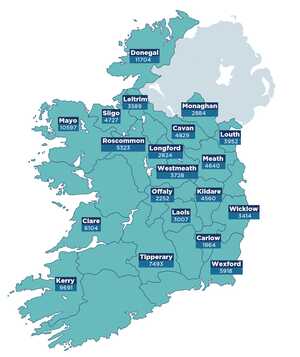
From top: Graphic showing number of empty homes in rural Ireland; figures from Peter McVerry Trust report on rural homelessness

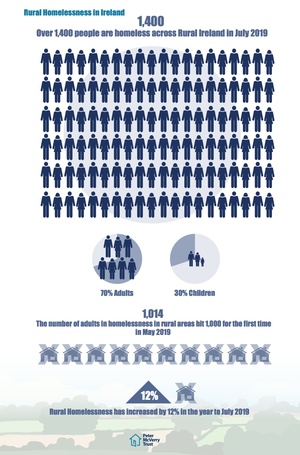
Homeless charity Peter McVerry Trust has launched a new report on rural homelessness.

From the report:

As of April 2019, there were 40,234 mortgages across Ireland in long-term mortgage arrears (two years or more).

According to information published each year by the Central Bank, rural counties have the highest percentage of mortgages in arrears as a percentage of all mortgages.

This has the potential to impact heavily on rural homelessness given the rates of mortgage distress and repossession

In 2018 financial institutions across Ireland repossessed 1,284 homes.

Peter McVerry Trust tweetz:

Homelessness is impacting small towns across Ireland – not just larger urban areas.

Peter McVerry Trust publishes new report on rural homelessness (Peter McVery Trust)

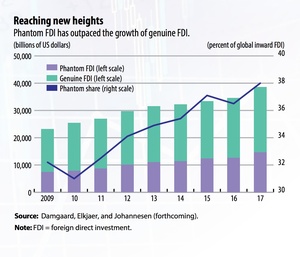
Graph on ‘phantom’ Foreign Direct Investment created by researchers Jannick Damgaard, Thomas Elkjaer, and Niels Johannesen from the University of Copenhagen

A large proportion of the world’s stock of foreign direct investment is “phantom” capital, designed to minimise companies’ tax liabilities rather than financing productive activity, according to research.

Nearly 40 per cent of worldwide FDI – worth a total of $15tn – “passes through empty corporate shells” with “no real business activities”, the study by the IMF and the University of Copenhagen found.

Instead they are a vehicle for financial engineering, “often to minimise multinationals’ global tax bill”, said researchers Jannick Damgaard, Thomas Elkjaer, and Niels Johannesen, who carried out the study.

Nearly two-thirds of Ireland’s inward investment is “phantom”, the IMF study found.

Almost two-thirds of Irish FDI is ‘phantom’ – IMF study (The Irish Times)

For your consideration.

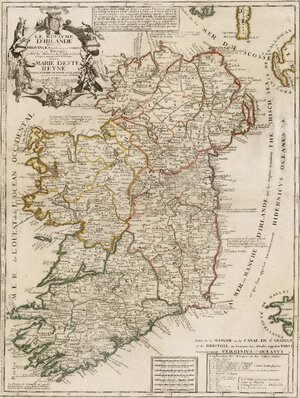
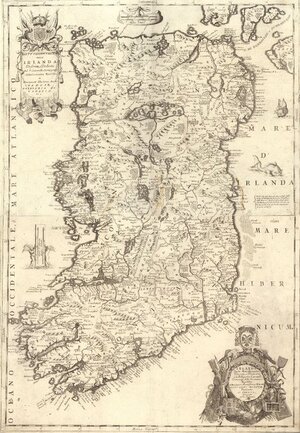
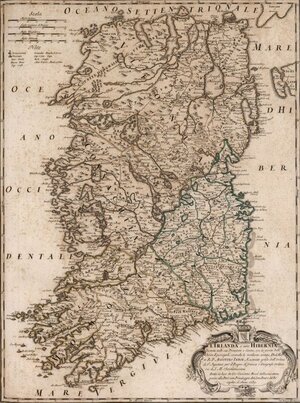
Seventeenth Century Irish/Hibernian map porn.

Via HeritageMaps:

Four maps depicting Ireland in very different shapes – all from the 1690s – by, from top:  Visscher, Nolin, Coronelli and Rossi and published in Amsterdam, Paris, Venetia and Roma.

The Nicolaes Visscher map’s short title is ‘Regnum Hiberniae’ and appears courtesy of [David] Rumsey Maps – hi-res available here.

The Vincenzo Coronelli map’s title is ‘Composite: Parte settentrionale dell’Irlanda. Parte settentrionale dell’Irlanda’. Via Rumsey. Full res here.

The 1690 Jean-Baptiste Nolin map is called ‘Le Royaume D’Irlande Divise en Provinces subivisees en Compte et en Baronies selon les Memoires du Sr. Petty . . . ‘ and appears courtesy of Raremaps. Full version here.

And 1699’s Giovanni Giacomo de Rossi map is called ‘L’Irlanda o vero Hibernia’ in short. Also via Rumsey. Hi-res version here.

HeritageMaps

MAX in Stockholm, Sweden; burger and chips from MAX

This morning.

It was reported that the Minister for Agriculture Michael Creed spoke to representatives of the meat industry, farming associations and Government agencies at 2am, by phone, amid talks aimed at resolving a dispute over beef prices.

The talks are expected to reconvene on Thursday or Monday next.

This morning, economist Jim Power, who is carrying out research on the Irish beef sector for the Irish Farmers’ Association, told RTÉ’s Morning Ireland listeners that there are approximately 70,000 specialised beef farmers in Ireland,

These are farmers who are dependent on beef as their primary product.

He said 90 per cent of the beef produced in Ireland is exported by meat processors and that between January 2010 and July 2019, price compression led to the average price of beef sold in Irish shops falling by about 3.4 per cent.

He said this drop in price was largely due to the competition amongst retailers and pointed out that, in 2010, discount stores Aldi and Lidl accounted for around 9.5 per cent of grocery market in Ireland whereas now they account for more than 24 per cent.

Further to this…

Kieran Hennigan writes:

The meat-free revolution is much, much closer than you think.

Last week I travelled to Sweden and met an old friend for a drink who now resides in downtown Stockholm.

As is common place after a couple of pints, we developed a hunger and my eyes fell upon the golden arches of a McDonalds.

As a BigMac connoisseur, I suggested aloud that it was high time for a burger. Taken aback, my acclimatised friend audibly scoffed: “Swedish people don’t eat McDonalds, they eat MAX.”

We left the bar and passed an all but empty McDonalds save for a few foreign tourists. What is MAX? I asked. ‘It’s like McDonalds, but better in every way.’

She was right of course.

We approached the bustling Scandianavian burger franchise. Being unfamiliar with the line-up and the language, I randomly tapped the touch screen menu and was happily munching through my quarter pounder within a few minutes.

The burger was delicious as expected.

Herein is the point, it was absolutely like a normal beef burger. The meaty bounce in the texture was there, the translucent grease oozed out when squeezed, the slight red blood colouring was there in the middle, even little white fatty tendons flexed and snapped as they struggled to hold the patty together.

The taste was like any other greasy, salty fast food burger I’ve ever enjoyed after a few pints. This is of course despite the burger being made of entirely 100% plant-based ingredients.

I put it down to fluke and taste buds dulled by strong Nordic beer, and so I went back the following day to put it to the test in the cold light of day.

I needn’t have bothered: it was a beef burger in everything but origin.

Insatiated, I ordered the ‘no-chicken’ chicken burger. The breaded ‘breast’ fillet with mayonnaise and ice-burg lettuce was as good as any I have tried, and I’ve tried more than my fair share.

Vegetarian burgers are not necessarily a new invention, nor are poor meat substitutes, but the new Swedish MAX burger is a revolution in food technology.

Their latest self-developed range, made from soya extracts enhanced with protein enzymes, only went on sale less than three months ago but already accounts for a whopping 40% of their burger sales.

They expect it to surpass 50% by 2022, and the future of the chain is looking meat free.

MAX’s sales already outperform McDonalds and Burger King in Sweden, and have recently opened branches in Norway, Denmark and the UAE.

The accountants standing over empty shop floors at rival fast food joints are sure to have noticed this trend and if they don’t join them soon, they are sure to be beaten by them.

The bottom line is that this breakthrough in ‘non-meat’ technology can easily fool lifelong meat lovers like myself, and do so at a cheaper price than their meaty alternative.

Add to this the fact that they will inevitably ease the carbon conscious and ethical guilt of consumers and we have the perfect recipe for a fake burger takeover.

This most recent of Scandinavian innovations may not yet threaten the high-end steak market that grass-fed Irish farmers pride themselves on, but sure as the rise of cheap synthetic fabrics devastated the cotton industry leaving cities like Manchester high and dry, the meat industry seems destined to have the feet pulled out from under it.

When the mass market demand for beef declines globally, there will only be room for a small number of niche high-end producers to fulfill local market demands.

Whether we like it or not, this seems inevitable not just in the long term, but potentially within the next decade.

Whilst we fret and worry about losing one beef market due to Brexit, the Swedes are quietly ensuring that the rest of the global beef market is being sent to the slaughter.

And who can blame them?

The steaks are just too high.

Pics: MAX

Listen back to Morning Ireland report in full here

Um.

In the last few years, Dublin has become one of the world’s 10 most expensive places to rent, ahead of cities like Tokyo, Sydney and Singapore.

Deutsche Bank reported in May that typical rent for a midrange, two-bedroom apartment in Dublin was $2,018 a month, 23 percent more than in 2014 — the biggest increase of any city in the top tier.

…“You have a generation being locked out of the Irish social contract,” said Rory Hearne, a lecturer in the sociology of housing at Maynooth University.

“A lot of young people are now realizing they will never own their own home, and that is a particularly terrible outlook when you live in a country where a house is usually your main asset for retirement.”

…The Irish division of Savills, an international property company, predicts that rents will increase an additional 17 percent over the next three years.

…It now costs far more to rent than to pay off a mortgage. The property website daft.ie recently reported that the monthly mortgage payment on a two-bedroom house in the city of Cork would be about $700, but the same house would cost almost $1,300 to rent.

Home prices have rebounded since the recession, but homeownership has not, in part because people paying high rents often cannot save for down payments.

To curb dangerous lending and borrowing, the Central Bank of Ireland in 2015 capped mortgage loans at about 3.5 times the buyer’s annual income, but the median price is about 5.6 times earnings.

Housing Crisis Grips Ireland a Decade After Property Bubble Burst (New York Times)

Rollingnews