Tag Archives: RTE

This afternoon.

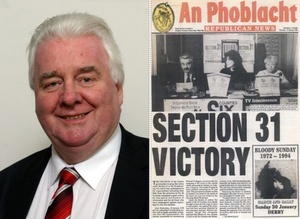
Sinn Féin councillor for Artane-Whitehall in Dublin City Council Larry O’Toole (above) tweetz:

“The breakthrough. My successful challenge to State Censorship (Section 31) in the early nineties. Took a case because RTÉ wouldn’t broadcast my interviews during the Gateaux strike. I’m afraid that censorship mentality still exists in RTÉ.”

Meanwhile…

FIGHT!

Any excuse.

Section 31

Larry O’Toole?

Related: A trade unionist who took RTE to court (Irish Times, Catherine Cleary, May 18, 1998)

Earlier: Rallying Cry

This afternoon.

“After 15 years working in the Sunday Independent, I’m delighted to be joining the weekends on RTÉ Radio 1.

The weekend is a time to pause, take a breath and review the week, and it’s also a time when people like a different, more reflective kind of radio, maybe even a bit of fun.”

Marian’s legacy will inspire us to continue to explore, challenge and debate the issues that truly matter to Irish people.”

Brendan O’Connor.

Um.

*cough*

*cough*

*cough*

*cough*

Brendan O’Connor gets weekend mid-morning slot on RTÉ Radio 1 (RTÉ)

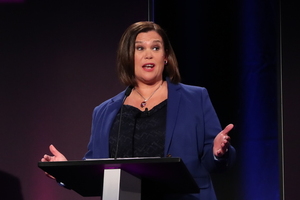
From left Fianna Fáil leader Micheál Martin, Fine Gael leader Leo Varadkar and Sinn Fein President Mary Lou during the leaders’ debate on RTÉ One’s Prime Time

This afternoon

RTÉ Radio One’s Ray D’Arcy has told his listeners he counted how many times the word “change” was used times during last night’s Prime Time leaders’ debate.

How much change, Ray?

The word was used by the three candidates a total of 357 times.

Three hundred and fifty seven.

Earlier: How Was It For You? [Updated]

Rollingnews

This evening.

“RTÉ is very mindful it has a duty to the public to reflect events as they unfold.

During the course of the campaign and over recent days RTÉ has taken into consideration the notable change in the dynamic of the campaign on the ground, and representation and statements by political parties.

The dynamic has also been consistently reflected in all opinion polls since the campaign commenced.

We now consider it necessary to amend our original approach, respond to the changes in the campaign, and continue to put the audience first in the making of Tuesday night’s programme.”

RTÉ statement this evening.

Mary Lou McDonald to take part in leaders’ debate (RTÉ)

Earlier…

David McCullagh and Miriam O’Callaghan of RTÉ’s Prime Time; Sinn Fein leader Mary Lou McDonald, during the seven way RTE leaders debate

On January 14 last, Taoiseach Leo Varadkar announced that the election would take place on Saturday, February 8, 2020.

The following day, January 15, RTÉ released a press statement announcing details of its TV election debates. It noted:

In the final days of the campaign The Prime Time Leaders Debate will see the party leaders from the two largest political parties invited to take part in a live head-to-head studio debate.”

“In approaching election coverage the RTÉ Election Steering Group has regard to objective and impartial criteria, such as the results of the last comparable election (in this instance, the General Election 2016) and the results of intervening elections, such as the 2019 Local and European elections. Other factors are also considered in RTÉ coverage of the campaign.”

This morning.

RTÉ’s Political Correspondent Paul Cunningham reports:

“RTÉ’s General Election steering committee will meet at 11am to consider representations from Sinn Féin for Mary Lou McDonald to participate in the Prime Time leaders’ debate tomorrow night.

“Under the existing plan, the debate will be between the Fine Gael leader Leo Varadkar and the Fianna Fáil leader Micheál Martin.

“Sinn Féin’s Pearse Doherty, who made the request to RTÉ in person yesterday, has argued that recent opinion polls prove that the criteria used to exclude Ms McDonald are redundant.”

More as we get it.

Meanwhile

Prime Time presenter Miriam O Callaghan with, from left: Micheál Martin of Fianna Fáil, Enda Kenny of Fine Gael and Eamon Gilmore of The Labour Party before a three-way leaders’ debate during the 2011 General Election

From the book Electoral Management: Institutions and Practices in an Established Democracy: The Case of Ireland by Fiona Buckley and Theresa Reidy…

In a chapter by Kevin Rafter:

Televised leaders’ debates have been a feature of Dáil elections since February 1982 with the sole exception of the 1989 election when agreement was not reached to organise a debate.

The seven debates between February 1982 and May 2007 shared several common features. In the first instance, participation was confined to the leaders of Fianna Fáil and Fine Gael, the two largest parties, which in effect turned the encounters into ‘Prime Ministerial debates’ as holder of the office of Taoiseach (Prime Minister) have been drawn from these two parties.

In addition, there was always only one televised debate per campaign, and all these debates were hosted by RTÉ.

The nature of the leaders’s debate changed in the 2011 general election. The number of debates increased to four while the number of host broadcasters increased to three with the involvement of TV3 and the publicly owned Irish language service, TG4.

The debate on TG4 took place in the Irish language (all earlier debates were in the English language).

Finally, and undoubtedly the most important change in 2011 was an increase in the number of participating party leaders.

The leader of the Labour Party, traditionally the third largest party participated in all four debates while one of the debates was a five-way encounter involving all parties with a minimum representation in the outgoing Dáil.

Since 1988, the organisation of presidential debates in the USA has been overseen by an independent commission although they are still defined by ‘behind-the-scenes arguments about everything from the format of the questioners to the length of the response time, the placement of cameras, the height of podiums, and the location of water glasses’.

In an Irish context, these ‘debates about the debates’ involves private interaction between the main political parties and broadcasters. At the 2011 general election, each of the three broadcasters ultimately involved in broadcasting debates (RTÉ, TV3 and TG4) negotiated separately with the five main political parties. This was a different approach to the UK experience where the broadcasters ‘communicated and agree a concerted approach’.

RTÉ’s hosting of two leader debates in 2011 was preceded by eight months of informal conversations, email communication and formal face-to-face meetings.

In a post-election review, one RTÉ executive offered advice for colleagues involved in future debate negotiations:

“…avoid getting drawn into lengthy discussions on formats or rules and regulations – we make the TV, they provide the candidates – and at no stage did we get drawn into the sorts of intricate rules which were a feature of the UK debates.”

...The importance of being impartial and fair, and being seen to be so, was a central feature of RTÉ’s approach to election coverage in 2011.

Indeed, at the final internal SC [steering committee] meeting before polling day it was noted ‘with satisfaction that RTÉ’s coverage hadn’t featured as an election story and this was very welcome as an indication that we were providing extensive, accurate and fair coverage’.

There you go now.

RTÉ committee to meet over Sinn Féin participation in election debate (RTÉ)

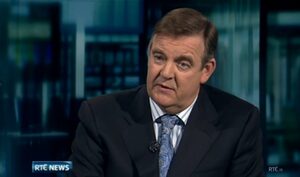
RTÉ broadcaster Bryan Dobson

Just now.

Áine Lawlor told RTÉ’s News At One listeners that Bryan Dobson will interview Taoiseach and Fine Gael leader Leo Varadkar tomorrow evening at 7pm on RTÉ One.

She said it will be the first of a series of one-to-one interviews that Mr Dobson will hold with party leaders.

More as we get it.

Earlier: Buzzin’

Previously: [We] ‘Alienated A Section Of The Public Who Rightly Or Wrongly Perceived RTÉ As Biased’


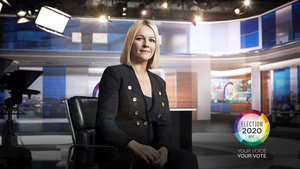
RTÉ’s Claire Byrne

Next Monday night.

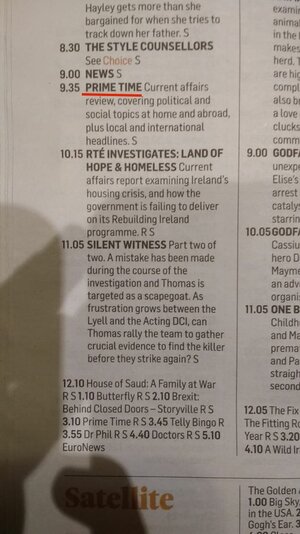
On RTÉ One, at 9.35pm.

Claire Byrne Live Leaders’ Debate.

Laura Fitzgerald writes:

“Next Monday night (27th January) Claire Byrne will host the biggest Election 2020 leaders debate of the campaign so far.

“For the very first time RTÉ will broadcast a special leaders’ debate live from Galway.

“The seven political parties leaders joining Claire on stage for the major two-hour live debate will be: Mary Lou McDonald (Sinn Féin), Leo Varadkar (Fine Gael), Brendan Howlin (Labour), Micheál Martin (Fianna Fáil), Richard Boyd Barrett (Solidarity/People Before Profit), Eamon Ryan (Green Party) and Roísín Shortall (Social Democrats).

“The leaders will also face questions from an audience of over 300 people independently selected by RED C Research polling company.”

Two HOURS?

Thanks Laura

Screenshot from Taoiseach Leo Varadkar’s election campaign video which he launched on Twitter; the video was subsequently deleted

Yesterday.

Taoiseach Leo Varadkar posted a video about himself – which included RTÉ footage of himself – to launch his general election campaign.

It following his announcement that the election will take place on Saturday, February 8.

The clip also confirmed that the party’s slogan is A Future To Look Forward To.

However.

Last night.

Cormac McQuinn, on Independent.ie, reported the video was removed from his Twitter profile because it contained RTÉ News footage without permission.

Mr McQuinn reported:

…It opened with international news broadcasters saying his name and a caption that claims he “secured a deal to protect Ireland’s interests” in the Brexit talks.

It also included RTÉ News footage featuring news reader Eileen Dunne which was posted without the broadcaster’s permission.

….A Fine Gael spokesman said the issue was as a result of a “technical oversight”.

He added: “Our production company previously attempted to contact RTE several times regarding use of this footage.

“The two second clip has been re-edited,” he added.

Yikes.

‘Clip has been re-edited’ – Varadkar removes election video that used RTÉ News footage without permission (Cormac McQuinn, Independent.ie)

Taoiseach Leo Varadkar being interviewed in RTÉ on Sunday; *Sam, a five-year-old homeless boy who was photographed eating from a piece of cardboard in Dublin last October

This afternoon.

Further to Taoiseach Leo Varadkar’s interview on RTÉ’s This Week at the weekend, in which he was asked about the picture of the homeless five-year-old boy Sam (not real name) who was photographed eating from a sheet of cardboard on a street by volunteer group The Homeless Street Café…

And the Fine Gael leader replying:

“…we tried to find out who that child was, because we wanted to make sure that he was looked after, that perhaps he could be moved into a family hub or perhaps we could make sure there were no child protection issues. We still haven’t been able to find that child unfortunately…

Saoirse McGarrigle, in The Irish Mirror, reports that Denise Carroll, from the Homeless Street Cafe, has said the boy is “very easy to find”.

Further to this…

Independents 4 Change general election candidate Seánie O’Shea, from Wexford, tweetz:

Varadkar to @rtenews This Week: “…shocking, shocking photograph and one I found very upsetting. We still haven’t been able to find that child, unfortunately”

Homeless Street Cafe: “We speak to his mother and him every week.. They also have our contact details and we have hers”

Homeless Street Cafe: “The majority of the soup run would know who this family are … Claire Byrne did a piece and she was in town and he was in the film so he is very easy to find.”

Also Varadkar on his “attempts” to find the child known as Sam: “perhaps we could make sure there were no child protection issues” The children of this country need to be protected from the lies and inhumanity of this Government.

Also, where is the follow up from RTE News or David McCullagh after being blatantly misled?”

Leo Varadkar could’ve found homeless boy Sam, 5, activist insists (Saoirse McGarrigle, The Irish Mirror)

Previously: You Had Nine Years

Sam