

Something new, strange and high octane from Derrynane Robot Club, to wit:
Terrence returns from the festival…
Previously: Fatuous



Something new, strange and high octane from Derrynane Robot Club, to wit:
Terrence returns from the festival…
Previously: Fatuous


On the 18th of August, 1994, Martin Cahill (aka ‘The General’) was assassinated in Dublin [at the junction of Oxford Road and Charelston Road, Ranelagh].
Cahill was apparently shot by the Provisional IRA, less than a fortnight before the historic ceasefire.
Future Broadsheet photographer Oisín Kane happened to be in Ranelagh with his SLR when he came upon the scene. The above images (published for the first time in 2012) were taken about 20 minutes after the shooting.
Watch the RTÉ News report here.

49 seconds of awkwardness from Mark Baldwin.
We’ve all been there, in fairness.
Silly Beggar
Previously: Judgement Day

Mount Trenchard Direct Provision Centre in Co. Limerick – where up to 50 asylum seekers are believed to currently reside
You may recall a post from last Thursday about how three asylum seeker men living in the Mount Trenchard Direct Provision Centre, near Foynes in Limerick, started a hunger strike because of the long delays in the asylum system. They have all been waiting at least ten years for their applications to be processed.
A subsequent post last Friday detailed how representatives of the NGO Doras Luimní helped to negotiate talks between the residents and the owner of the centre. Minutes after the Doras Luimní representatives left – and after a later date for further talks was set – two residents, who were acting as spokespersons for those protesting, were transferred out of the centre by the Reception Integration Agency under Garda supervision, while another asylum seeker reportedly also left.
It’s understood four residents are now on hunger strike.
This morning, Brian O’Connell spoke to Seán O’Rourke about the situation and, during his segment, he played several interviews with those involved.
One of the interviews was with one of the men transferred out of the centre, Patrick, to a direct provision centre in Cork city.
Patrick told Mr O’Connell about what happened after they spoke to management and gave his feelings about the direct provision system.
“Ten minutes later, me and Ahmed, my friend from Sudan, we got transfer letters because we were the ones asked to speak…we were escorted by squad cars, they had guns with them, they were escorting us as if we were terrorists.”
“It’s [the direct provision system] very tough, it’s very tough to be honest. People are being treated inhumanely. The way we sleep in our rooms, sometimes ten people in one room.”
Mr O’Connell also spoke to another resident of the centre, Jamhal, who was also moved to Cork on Thursday. Mr O’Connell explained that it is not yet clear whether Jamhal’s transfer was voluntary or forced.
Speaking to Mr O’Connell:
Jamhal: “We are getting sick, you know, some people are, they harm themselves, some people, they kill themselves cause of this system. Like myself, I hurt myself many time, you know, you can see here.”
Brian O’Connell: “On the right hand side of your hand there are three large scars – that is as a result of…”
Jamhal: “It is a result of the system like. Holding a man for ten years who has all these ambitions and dreams and become all dark and nightmare. It’s like a nightmare, I’m living a nightmare in this system. We want to be heard by the Irish people, just when you protest about something, they just write letter from RIA and then they transfer you to another place. Just to break you and they break me.”
Meanwhile, solicitor John Gerard Cullen, who represents some of the residents in Mount Trenchard, also joined the show.
Mr Cullen told how he witnessed a ‘frightening’ incident at Mount Trenchard yesterday.
John Gerard Cullen: “Yesterday evening I called down to see a number of clients in the hostel and, in the course of one consultation, there was a very repetitive crashing sound and it was dismissed by other persons in the dining room, as simply a person fighting, it would seem, which appears to them to be quite normal. But it continued and then reports came in that somebody had broken the computer in the main hallway and then somebody broke the flat screen television and a gentleman appeared at the door of the dining room with a baseball bat. He battered the counter where food is dispensed and then he proceeded to deal with the windows, it was sort of an annex to a Georgian building and he broke pane after pane, window after window, about four windows at that stage. And then I saw some of the persons removing their cars and I said, well, you know, I really need a windscreen and so forth, so I sort of removed my car. I intended to go back but I was told that it was not really safe to go back by some of my clients who had moved up to the rooms. And I was told that up to 18 windows have been broken since, I think the gardaí eventually arrived and restrained the alleged offender. So that’s just one incident. But it was, he seemed to be, the individual seemed quite disturbed.”
Sean O’Rourke: “Well this would appear, Gerard, to bear out what we’ve been hearing from Brian, just about mental health issue at this centre.”
Cullen: “Yes it would appear that a number of persons suffer from mental health problems and, of course, that impacts very considerably on others at the centre as well because what one describes as the overcrowding and I mean I know, for example, in rooms 1 and 2, that there are apparently 12 beds. Well my instructions date from really June 2014, I was told at that stage that there were 8 persons living in those, in each of those two rooms. And so the persons who are living in those conditions, which lack privacy are obviously exposed to the kind of attacks that I’ve just described. And they told me that they can’t sleep until 3 or 4 o’clock in the morning, and that fighting is going on, and disturbances of one kind or another.”
O’Rourke: “Behaviour of that kind would obviously be very upsetting and frightening for people. What other issues have been brought to your attention at the centre?”
Cullen: “Well I suppose the transport issue is regarded as one of the major problems. Again I’m told that there are two taxis per day, that ferry people to Foynes and back which is about three miles from Mount Trenchard but those taxis can only accommodate four persons at a time so there were, in June, there were 64 persons in the hostel. So they feel themselves marooned and very geographically remote and socially remote. There’s nothing to do. There’s no intellectual stimulation, there’s no training, there’s no work, and there is this exposure to violence.”
Previously: Meanwhile In Limerick

This morning.
Ronan writes:
“Disabled parking at Aldi East Wall road [Dublin]….no disabled badge on dashboard and very able bodied walking into the shop….

Neigh.
A prison inmate whose ex became pregnant by another man got pals to throw a horse’s head through his love rival’s window. His cronies blasted the horse with a shotgun – then sawed off its head to use in the sickening attack in Dublin, The Star [not available online] can reveal.
That’s mafia, Ted.

Via Gumtree.ie:
“Man in the Moon’ Baby Cot/Crib/Bed, made for a dreamer or future astronaut, pilot, or just a star gazer. makes me wish i was small again! Solidly built from old wineboxes and heartwood, using timber dowel to eliminate the look of ugly screws and nails. The moon can sit solidly on the floor with no rocking movement, or the moon can sit on a stand which gently rocks the whole moon from side to side (not front to back as you’d imagine the moon to do!), looks beautiful when in action you just want to crawl into it yourself and catch a few Zzzzzs!
Linda writes:
“Buying for new babies is hard enough – but ‘built from old wineboxes’ – how can you resist?”

It’s STILL August.
Brown Thomas, Grafton Street, Dublin this morning.
Thanks Wayne F
Too early for Santa suits @Benefit_IRE no? pic.twitter.com/CnPjGEwxae
— JoBurger (@JoburgerDublin) August 18, 2014
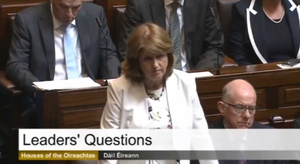

Deputy Catherine Murphy asked the Tánaiste Joan Burton a number of topical questions on the final sitting of the Dáil before the summer recess (July 17) in light of the UN HRC hearings in Geneva.
The Labour Party leader firmly ruled out any hope of new legislation for victims of rape and incest and those seeking terminations for medical reasons (TFMR).
Deputy Catherine Murphy: “This week’s damning review of our human rights practices by the United Nations Human Rights Committee makes for grim reading but it is hardly surprising. Our failure in regard to the Magdalen laundries survivors, the symphysiotomy survivors, those who spent time in mother and baby homes and those who were victims of clerical child abuse is shameful. However, we stand to repeat the mistakes of the past if we do not act to address the grossly discriminatory laws that govern abortion. The UN committee confirmed that we are in breach of the International Covenant on Civil and Political Rights by denying women the option to avail of abortion in certain circumstances, namely, rape, incest, fatal foetal abnormalities and where a woman’s health is in danger. I would argue that we are not only in breach of the covenant but also in breach of basic humanity in denying an abortion to a woman who has been raped, is a victim of incest or has to endure carrying to full term a pregnancy when there is no prospect of delivering a live baby. I found it profoundly chilling to listen to the remarks of the principal officer of the Department of Health who told the committee that denying these women the right to abortion was the will of the people. I question what people are meant. The eighth amendment to the Constitution was inserted more than 30 years ago and attitudes have changed significantly since then, as recent polls have shown.
The Labour Party is a socially progressive party. The Tánaiste is the leader of that party as well as the deputy leader of this country, and she is also one of the few women in a decision-making role in this Government. Is she going to use her powerful position to bring about change in this area and, if so, how is she going to do that?”
Tánaiste: “In regard to the issues arising around fatal foetal abnormalities, the Deputy will be aware that some time ago the Government legislated successfully in regard to the X case. That is reflected in our legislation and is an issue that both parties in Government have addressed. In regard to fatal foetal abnormalities, I am on record as stating that I would like to see a situation where it is possible to address them. As of yet we do not have agreement on that in the programme for Government. It is a personal position and I have been on public record in this regard over a long period.”
Deputy Catherine Murphy: “I know we have legacy issues and it is very uncomfortable to consider past failures in hindsight. We are asking how we allowed such things to happen and who was in power at the time, but will the pattern be repeated by people in power now, and will we have the same conversations in 30 years?”
Deputy John Halligan: “Exactly.”
Deputy Catherine Murphy: “The same committee might then be reviewing how the country dealt with issues like fatal foetal abnormalities, for example, or people who have been raped or subject to incest and who have been denied their human rights. The Tánaiste indicated her personal views are on the record but I ask her as Tánaiste – deputy leader of the country – and the leader of the Labour Party for her position on the issue.
I went to Liverpool Women’s Hospital with people who were part of a study group on fatal foetal abnormalities. People were put through a tortuous process where, for example, they would have had to retrieve the remains of a baby they wanted by way of something like DHL delivery, which is absolutely appalling. It is inhumane and we cannot rely on a 31 year old referendum decision, presuming that people have not moved on when so many events have taken place in this country. We need a referendum, as the Tánaiste knows, if we are to change that position. Does the Tánaiste accept we need a referendum and will she commit to working towards such a referendum?”
Tánaiste: “There has been an extensive process with the Constitutional Convention, which considered various issues and reported findings. As I pointed out, the Government and the Dáil has dealt with issues arising from the X case. Those had been unresolved over a very long period of years. We want a position in Ireland where every baby is a wanted baby. The Deputy spoke about cases and the people she accompanied in Liverpool, and those are tragic circumstances as the babies are wanted but their life outcomes were in doubt because of medical issues.
It was referenced in Geneva that on a previous occasion, the Irish people gave a view – as was their entitlement – on what they wanted reflected in the Constitution. I did not share the view at the time and my party and others like me recommended voting against the amendment to the Constitution. As a democrat, the Deputy must recognise that the people voted for the eighth amendment to the Constitution. The Government has legislated for and dealt with issues surrounding the X case, which has been a difficult issue in this country over a very long period. That is what was agreed in the programme for Government.”
Deputy John Halligan: “So the Tánaiste will not agree to a new referendum.”
Leaders’ Questions July 17 2014
Previously: Violation Once Again
