
Yearly Archives: 2016

Screen Shot 2016-06-27 at 14.26.44

Dublin-Seven-Website-Only

From top: RTÉ documentary The Guards; Frankie Gaffney’s book Dublin Seven

The uncompromising reticence to discuss the matter of Garda corruption is incredibly sinister.

Frankie Gaffney writes:

A recent RTÉ fly-on-the-wall documentary, The Guards, was advertised with an emotive montage of individual Gardaí speaking to camera, intimately relating various bad experiences they’d endured during duty: “I’ve been called names”, “I’ve been headbutted”, “I’ve been kicked”, and so on.

I can identify with their trauma. Living in the inner-city, I’ve been verbally abused, threatened, punched, kicked, had my home smashed up, and had money and personal belongings stolen from me.

But I didn’t feel safe calling the police. Why? Because all these actions were carried out by members of An Garda Síochána on operational duty. And it all happened before I was eighteen.

I was six years old the first time I was strip-searched.

Our national broadcaster chose to air this documentary at the height of a policing crisis. The programme provided a lengthy forum for Gardaí to boast unchallenged of the prowess their new initiatives. “New” intiatives which include a continuation and escalation of their futile war on drugs.

As Noam Chomsky has pointed out, it is not actually a war on drugs, or on people who take drugs, it is instead a war only against poor people who take drugs.

If ever a policy was designed to inflict misery on the weak and vulnerable it is this idiotic and evil folly.

It would have more useful, if instead of this programme, sympathetic to our newly discredited police force to the point of sycophancy, we had a documentary about the assaults Gardaí perpetrate on working-class young people and vulnerable addicts.

Or perhaps an investigation into some of the suspicious deaths of those under arrest. Deaths like that of 20-year-old Terence Wheelock, a young man with no history of self-harm who police assert hung himself in custody.

Or Brian Rossiter who was only 14 years of age when he died from brain injuries in a police cell. His parents were told by Gardaí that disciplinary proceedings arising from incident were “none of their business”.

As Fr Peter McVerry put it, speaking of how young people in the inner-city relate to the police, “neither group has any respect for each other, but it is up to the Gardaí to show some respect for the people they have power over”.

It is the Gardaí, remember, who, acting freely as adults, swear an oath, don a uniform, and are paid money to uphold the law. In my experience, this means nothing to them.

RTÉ’s The Guards continues a long tradition throughout Ireland’s media of unquestioningly accepting any narrative offered by Gardaí, and relating stories from only their perspective.

Our media is beholden to An Garda Síochana, not least because members of the force continue to feed journalists stories at their individual discretion, without anything approaching due process. The most obvious exemplar of this is the country’s highest profile (and highest-paid) crime correspondent, Paul Williams.

In perhaps the most egregious example of the power Williams wields, he went on the Late Late Show one week before the election, and explicitly warned viewers not to vote for Sinn Féin – because a vote for them would endanger lives.

He contended his antipathy for this political party was due to their intention, if elected, to abolish the Special Criminal Court. This is a proposal backed by both the Irish Council for Civil Liberties and Amnesty International.

The Special Criminal Court was established in 1972, purely to deal with the escalation of IRA violence at the time. The court was always intended as a temporary measure, to be abolished when the Troubles ended. There is no jury.

According to Williams it’s only the gangsters and drug-dealers “smirking on Francis St” (did he see this?) that want this extraordinarily draconian “Star-Chamber” style court abolished. Yet ironically, the court has used its full set of powers to prosecute anti-drug activists in the past (with convicted heroin dealers appearing as witnesses for the State).

Williams, who also receives 24-hour protection from the police (paid for by the taxpayer), has little or nothing to say on the subject of Garda corruption other than to deny its existence. Throughout his career, he has backed up An Garda Síochána to the hilt.

The fanciful depiction of the Gardaí as the perpetual good-guys continues into fiction. Also from RTÉ, the phenomenally succesful Love/Hate fed audiences hungry for an insight into Dublin’s underworld.

I admit to a love/hate relationship with this drama.

The writing, the directing, the acting, the storytelling as a whole – at times all were fantastic. The show displayed serious Irish talent, and made incredibly compelling viewing. It deserved its success. Like most Dubs, I was excited all week for the next episode. But the “Guards = good”, “gangsters = bad” narrative is just not real life. Not even close.

The recent epidemic of corruption in an Garda Siochana was just the tip of the iceberg. Prior cases in Donegal and ongoing revelations from Leitrim demonstrate this clearly.

Yet any concessions from the establishment that there may be the remotest hint of corruption within the force have to be bitterly fought for. The reticence to even discuss the subject, the bitter resentment and persecution displayed towards those who raise it, and the silence on the potential for deeper problems, is incredibly sinister.

For example, anyone with the remotest concern for policing standards should have been screaming from the rooftops the moment the now faithfully departed Commissioner Callinan denied (prior to any inquiry) that there was corruption in an Garda Siochana.

All organisations the size of An Garda Siochana (approaching 13,000 members) will, as a matter of course, have some corruption. Callinan was claiming nothing short of omnipotence. This disgraceful – despicable – assertion from that blustering buffoon should have seen him sacked on the spot. Yet it went largely under the radar.

This thundering disgrace masquerading as a public servant went on to refer to the courageous whistleblowers, who stood up to bullying and smear tactics in pursuit of the truth, as “disgusting”. The whole squalid episode was shameful, exposing for all to see the rotten core of this state.

Yet now, after some cosmetic changes, some optics, a few soundbites and some window dressing, the situation has been remedied in the goverment’s eyes. You may proceed.

Last month Jim McGowan was promoted to the position of chief superintendent, an appointment which came – coincidentally – just two weeks before responsibility for promotions was to be handed over to an independent authority.

Jim McGowan also happens to have been the officer in charge of a a Garda unit specifically established to prosecute (or persecute?) political activists.

The same unit that designated 20 Gardaí in Tallaght to evidence gathering duty over a single protest in Jobstown – a protest at which nobody was even injured.

The same unit that sent 10 Gardaí in three cars to bang on a family’s front-door at 7am, to arrest a 16-year-old water protestor before he went to school. This, apparently, is what makes you rise in the ranks of An Garda Síochána.

Jim McGowan also happens to be Noirin O’Sullivan’s husband.

The commissioner’s attention certainly doesn’t seem to be focused on ending nepotism, or the unhealthy influence of party political interests on policing. Or, for that matter, on tackling corruption.

Nope, business as usual.

Nobody seems to be asking what part such frivolous and petty diversions of resources (or indeed potential high-level corruption) might play in allowing the gangs to operate as smoothly and effectively as they do.

The financial crisis that was used as an excuse for a massive transfer of wealth from the poor to the rich (and gargantuan cuts in health spending) was, in this country, brought about by recklessness, poor regulation and criminality in the banking and financial sectors.

To prevent this happening again, the Office of the Director of Corporate Enforcement (ODCE) was established. It was recommended that a dedicated team of forensic accountants be set up to target “white-collar crime”.

One accountant was assigned to this task. I say “was”, because this accountant has subsequently been transferred to other duties. For the past six months no accountants have been employed in this task.

While the media have been focused on gossip and speculation about the personalities involved in a petty “gangland” feud, in Ireland today a white-collar is carte blanche to commit crime. The type of crime that crippled this economy, consigned thousands to emigration, and has led this country to a situation where 10 people every week commit suicide.

And Paul Williams proclaims it is a vote for a party that wants to end this status quo that would endanger lives?

I see muscle bound men driving SUV’s with tinted windows, wearing balaclavas, carrying automatic weapons. These are the Gardaí.

If the children of the north inner-city Dublin are scared, what are they seeing that is scaring them?

“We need to demilitarise our police departments so they don’t look and act like invading armies,” said US presidential hopeful Bernie Sanders.

Creator of The Wire, David Simon, said Baltimore police treated people the same way “an Israeli patrol would treat Gaza, or the Afrikaners would have treated Soweto back in the day . . . they’re an army of occupation”.

Any of these comments could be applied to inner-city Dublin today.

Unlike our newspapers, unlike our documentaries, unlike our dramas, Simon’s magesterial American TV series The Wire did show the back-story behind their characters. It showed the reasons people fall into cycles of crime and addiction, what it is that causes poor and vulnerable people to to enter an inescapable spiral of criminality – a cycle that damages themselves as much as anyone else.

It showed how social conditions, inequality and deprivation, compel people to criminality. It also showed that corruption and profiteering from drugs and “gangland” extends right the way throughout our society, throughout our institutions, throughout the police force.

All the way to the top of the political ladder. Our writers, our journalists, our newspapers, our broadcasters, need to take note – and start telling the full story too. Anything less is a lie.

Frankie Gaffney is the author of Dublin Seven
Cl3-WGcWgAArzQP

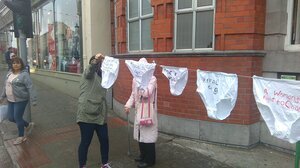
Yesterday.

In Sligo town.

A repeal the 8th demonstration organised by Repeal the 8th Sligo and Speaking of IMELDA (Speaking of Ireland Making England the Legal Destination for Abortion).

Pro-choice activists ‘knicker bomb’ Sligo (Sligo Today)

Previously: Knickers To The Eighth

Earlier: Publish And Be Damned

Pic: Repeal the 8th Sligo

Meanwhile…

e03e073eb8bc4fdab68170ea5a9da401_18

They called it wrong again.

‘sheet poll number cruncher Shane Heneghan writes

Firstly, in the interests of full disclosure let me just say that I was spectacularly wrong about this. I predicted a remain vote of about 52%. The voters gave me the exact opposite result.

When the dust settles, the fact that this was the second major failure in a row of the British polling industry, a country where the polls are traditionally remarkably reliable, should be dealt with but at the moment that is way down our list of considerations.

Let’s just take a step back for a minute and look at what happened.

This situation we are in now is unprecedented and no one can seriously tell you what will happen next. Anyone who says they can is a liar and probably has a very specific agenda.

But for the sake of argument ‘ll go through some of the hypothetical models of Britain’s future that have been going through my head in the past while:

The Norwegian-Icelandic Model
This involves joining the European Economic Area and would leave the UK in a close economic relationship with the EU while giving them an emergency break on freedom of movement and removing them from the jurisdiction of the European Court of Justice. The UK would also lose it’s right to appoint a commissioner, elect MEPs and send ministers to the Council of the European Union and still have to pay handsomely into the EU budget while receiving little or no benefit.

The Swiss Model
Much the same as the above only in this case the relationship would be governed by a series of bi-lateral treaties. I think this is the most likely outcome as it gives the UK much more flexibility.

(It is important to note that the above two options involve membership of the Schengen passport free zone which I am assuming Britain will continue to avoid like the plague.)

The Singapore model
In short, this involves the UK being treated as if it were a third country completely detached from Europe. It implies that tariffs and customs inspections would again applied to goods traded between the rest of Europe and the UK. This is by far the most radical option and in many ways the least likely given the close nature of the vote.

There are a few other things to keep in mind in the next few days.

1)
Corbyn has got to go
A man who leads his party in a referendum and fails to convince great swathes of his electoral base of his position will probably have to do the honourable thing sooner or later. A leadership election will almost certainly be triggered by the Parliamentary Labour party in the next few days. The shadow cabinet is already in disarray and the departure of Hilary Benn does not help.

2) This vote is not binding.
The British Parliament is literally the beginning and the end of UK democracy. Referendums have no legal status and if the House of Commons votes to ignore this referendum in the morning then it’s dead in the water. Of course, even if this is entirely legally plausible, it is more or less politically impossible and would probably lead to UKIP forming an armed militia within about six months.

A slightly more likely prospect would be if a new moderate Labour party leader won an election before the exit negotiations concluded on a platform of maintaining full membership. That may sound unlikely but there is a solid 48% voters that feel hard done by and a sliver of the winning side with buyers remorse who may back them and when you factor in that the Conservative party is almost certainly going to lurch towards the right after Cameron leaves them it just might make this scenario a runner.

3) A northern Irish border poll really is a non starter.
We have already seen how the Democratic Unionist Party have moved heaven and earth to stop gay marriage being introduced to Northern Ireland- imagine the effort they would mount to stop a vote on Irish unity. Sinn Féin can hardly be blamed for raising the idea- what else are they for? But the relative silence of the SDLP is also telling. This issue simply is not on the table at the moment despite the North’s difference of opinion with mainland Britain. Things may change if Scotland votes for independence.

4) Britain may drift ideologically into the Atlantic
Future right wing governments in Britain may not be bound by EU social legislation and may slash “red tape” such as maternity leave, paid holidays, anti discrimination rules and other such nonsense dreamed up by water cooler dictators in Brussels. In terms of foreign policy in general they will be even more dependant on the so called “special relationship” with the Americans- how reciprocal that relationship is anyone’s guess.

Finally, I don’t like historical hypotheticals but I can’t help but speculate that John Major should have held a referendum on the Maastricht treaty in 1991.

Presumably, he could have won and used it to silence “the bastards” in his party while nipping the rising tide of Euroscepticism in the bud. This would have probably solidified his premiership more so than his eventual “Back me or sack me” leadership contest.

He didn’t and UKIP was founded in 1994.

Shane Heneghan is a Brussels-based election and poll watcher. Follow Shane on Twitter

Cl9Dbd_WQAAJtWYScreen Shot 2016-06-27 at 12.49.23

Graphs in the Higher Education Authority’s National Review of Gender Equality in Irish Higher Education Institution, published today

An expert group commissioned by the Higher Education Authority – and chaired by Máire Geoghegan-Quinn – reviewed gender equality, or lack thereof, within Ireland’s third-level institutions.

Publishing its report today, the group states it recommends that:

– Each higher education institution introduce mandatory quotas for academic promotion, based on the flexible cascade model where the proportion of women and men to be promoted/recruited is based on the proportion of each gender at the grade immediately below.

– Gender equality is identified as a national priority and key system objective in the Higher Education System Performance Framework.

– Agreed targets and indicators of success are included in higher education institutions’ compacts with the HEA. Funding will, therefore, be linked to institutions’ performance, and will be withheld if they fail to meet agreed targets.

– In so far as possible, the final pool of candidates at the final selection step in the appointment process for new presidents of higher education institutions will be comprised equally of women and men.

– All candidates for presidential appointments at higher education institutions will have demonstrable experience of leadership in advancing gender equality, and this will be included in the recruitment criteria.

– Each institution will appoint a vice-president for equality, who will be a full academic member of the executive management team and who will report directly to the president.

– Key decision-making bodies (concerned with resource allocation, appointments and promotions) in higher education institutions will consist of at least 40% women and at least 40% men.

– The recruitment and promotion procedures currently used by higher education institutions will be reviewed to ensure they are gender-sensitive.

– Higher education institutions will apply for and achieve an Athena SWAN institutional award within three years. Within seven years, research-funding agencies will require institutions to have attained an Athena SWAN silver institutional award to be eligible for funding. (Athena SWAN is a system of awards – granted at bronze, silver and gold levels – to recognise institutions and departments for progress in addressing gender inequality).

– The HEA will establish a comprehensive database of staff in higher education institutions to provide an evidence base for monitoring progress in addressing gender inequality.

– A national committee to support gender equality in higher education will be established by the HEA, in partnership with the Irish University Association and Institutes of Technology Ireland.

The report can be read in full here

Previously: Trinity College: A Woman’s Place

Sexism And Trinity

Screen Shot 2016-06-26 at 21.04.12 qoqafgb7yfakuyw3jsda

Behold: Blackbird -a  battery-powered automotive rig created by London based visual effects company The Mill.

A fully-adjustable wheelbase, track width, and suspension allows filmmakers to shoot car commercials without actual cars. The product chassis, in whatever required variant, colour or configuration, is superimposed over the Blackbird in post production via CGI.

jalopnik

Screen Shot 2016-06-27 at 12.06.36

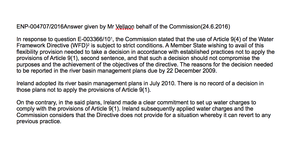
Written response to a question put forward by Independent MEP Marian Harkin seeking confirmation about the Water Framework Directive and water charges in Ireland

RTÉ reports:

The European Commission has confirmed that it does not believe Ireland has a derogation from water charges under a key European Union directive.

The Commission has said that it considers the application of water charges as qualifying as Ireland’s so-called “established practice” under the Water Framework Directive.

The clarification by the Commission increases the likelihood that it could take action against the Irish Government if it abandons water charges.

In a written statement to Irish MEP Marian Harkin, the Commission says that Ireland cannot “revert to any previous practice” as to how it complies with the Water Framework Directive.

The Commission’s response confirms a report broadcast by RTÉ News on 31 May.

Meanwhile…

No derogation from water charges, Commission says (RTÉ)

Previously: ‘I’m Saying That RTÉ’s Report Is Not Balanced’

Screen Shot 2016-06-27 at 11.52.22

Joe Collins writes:

We all know they tweak with fares but its worthwhile seeing it in action now and again. Aer Lingus prices to Paris for this coming Sunday, the day Ireland ‘might’ have played had they won. Before and after yesterday’s game. The 13:40 flight was €414.99 before KO and down to €167.99 after the Boys in Green’s adventure was ended.

Anyone?