






Author Archives: Chompsky

Space Hoodie
at
Behold: the double-shelled Eskimo Nebula (also known as the Clownface Nebula or Caldwell 39).
Some say it looks like a human head in a furry parka hood. But not astronomer William Herschel, who discovered it in 1787. For him, it was named NGC 2392 WH IV-45. To wit:
More recently, the Hubble Space Telescope imaged the nebula in visible light, while the nebula was also imaged in X-rays by the Chandra X-ray Observatory. The featured combined visible-X ray image, shows X-rays emitted by central hot gas in pink. The nebula displays gas clouds so complex they are not fully understood. NGC 2392 is a double-shelled planetary nebula, with the more distant gas having composed the outer layers of a Sun-like star only 10,000 years ago. The outer shell contains unusual light-year long orange filaments. The inner filaments visible are being ejected by strong wind of particles from the central star. The NGC 2392 Nebula spans about 1/3 of a light year and lies in our Milky Way Galaxy, about 3,000 light years distant, toward the constellation of the Twins (Gemini).
(Image: NASA, ESA, Hubble, Chandra; Processing & License: Judy Schmidt)
Hot Wheels
at


 Behold: the 1988 Italdesign Aztec Coupe – not to be confused with that other infamous Aztec, Walter White’s Pontiac.
Based on Giorgetto Giugiaro’s 1988 Turin Motor Show prototype and slated for an initial production run of 50, only 18 were ever made – each fitted with external key-code diagnostics and service area access, powered by a turbocharged Audi 2.2-litre inline-five engine and married to a Lancia all-wheel-drive system.
Say what you like about the Captain Scarlet styling, the Aztec’s twin-bubble, split cockpit is – at the very least – ideal for dysfunctional couples.
Yours for €69,000+.

A short – inspired by (and rendered on) Herman Melville’s classic tale by French animator Marie Paccou – with a twist. To wit:
For obvious budget restrictions, the Pequod has been turned into a kind of launch boat and you have to imagine all the crew hidden in the hold.
Water Levels
at


Behold: NGC 3372, aka The Great Carina Nebula – 300 light years across – one of the largest star-forming regions in the Milky Way. To wit:
Like the smaller, more northerly Great Orion Nebula, the Carina Nebula is easily visible to the unaided eye, though at a distance of 7,500 light-years it is some 5 times further away. This gorgeous telescopic close-up reveals remarkable details of the region’s central glowing filaments of interstellar gas and obscuring cosmic dust clouds in a field of view nearly 20 light-years across. The Carina Nebula is home to young, extremely massive stars, including the still enigmatic and violently variable Eta Carinae, a star system with well over 100 times the mass of the Sun. In the processed composite of space and ground-based image data, a dusty, two-lobed Homunculus Nebula appears to surround Eta Carinae itself just below and left of center. While Eta Carinae is likely on the verge of a supernova explosion, X-ray images indicate that the Great Carina Nebula has been a veritable supernova factory.
(Image: NASA, ESA, Hubble, ESO, Amateur Data; Processing & Copyright: Robert Gendler & Roberto Colombari)
Meatier
at

Earth gets pelted by tiny rocks all the time, but every so often, a real whopper hoves into view (and hopefully glides past).
To put all this into context, here’s a terrifying new size comparison from masters of same, MetaBall Studios.
Previously: It’s What You Do With It That Counts
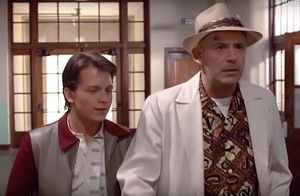
An impressive deepfake ‘recasting’ of Back To The Future with Tom Holland and Robert Downey Jr in the roles of Marty and Doc Brown by Ezyryderx47.


The best Portuguese-English phrasebook of 1884, by Jose Carolino.
Just Stoned
at


The pleasing ephemeral stone arrangements of land artist Jon Foreman on the Pembrokeshire coast of Wales.
Each piece takes about four hours to construct, with minimal planning, much to the delight of beach goers who find them before they’re ultimately consumed and erased by the tide.