
Spotted this afternoon (location unspecified).
Nullzero writes:
Another fine day’s work from NCPS.



Dr Martin McCaffrey, a Professor of Pediatrics at University of North Carolina and a neonatologist
Yesterday.
On The Pat Kenny Show on Newstalk.
Mr Kenny interviewed an American doctor called Martin McCaffrey.
At the outset of the programme, as Mr Kenny outlined who he would be speaking to on his show, he mentioned that he would be speaking to “The US doctor who wants us to change our treatment of babies with inevitably chromosome disorders”.
Then, just before the interview took place – in the second part of the show – Mr Kenny introduced the doctor by saying this:
“A professor of neonatal perinatal medicine is urging medical professions and politicians here to reconsider how we treat babies with chromosomal abnormalities. Dr Martin McCaffrey is a neonatologist visiting from the University of North Carolina to address Stormont about the issue and he’s with us in studio. Dr Martin McCaffrey you’re welcome to the programme.”
During the interview…
Pat Kenny: “What kind of outcomes? If a baby is diagnosed with these conditions in the womb, is termination often the outcome?”
Martin McCaffrey: “Correct, so what has been seen is that if you have a pre-natal diagnosis, before birth diagnosis, and if you have a post-natal diagnosis, the children who are diagnosed pre-natally are often given a message from providers, for a variety of reasons I believe, that is fairly hopeless and fairly dismal and many of those pregnancies will end in termination. Some will not, but many will. After birth, if a baby is undiagnosed but not diagnosed until after the delivery what will happen is that five or six or seven days of age a baby is diagnosed. A baby has already had resuscitation procedures, support procedures initiated. So that diagnosis may be given, it is still a challenging diagnosis for families. But families have seen that their child is actually alive and living and actually that is the case with most of these children when they’re born. They do not die at birth and they will survive, we know now, for fairly significant periods.”
Later
McCaffrey: “I think, typically now, for a variety of reasons, Pat, I was trained and until 2009, I will mark that as my epiphany, I was trained that these children didn’t survive and they all died. In 2009, I went to a meeting where I met a number of parents of these children, I didn’t realise any of them survived. And it was news to me and I started looking at the literature and the literature is clear over the years that maybe as many as 20 or 30% of these children, or 40%, survive to a year.
That 20/30% can survive to five years. And I was absolutely puzzled by this. That this was not how I was trained. I think for a variety of reasons we, as medical providers across the board have been a little bit reluctant to accept that these children can live. Not because they can’t live physiologically but because they have severe developmental handicaps and I think it’s really more of an issue of us not being willing to embrace the vulnerability and the opportunity, the virtue of dependence, that really exists with these children. We all, Pat, are going to leave this life at some point. We are all lethal, we are all temporarily abled and, at some point, we are all going to leave, and I think these children, if we would open up our eyes as providers, we would be able to find the love to support them, it would build a community that would flourish.”
Further to this…
Máire writes:
“Yesterday Newstalk’s Pat Kenny interviewed an American doctor [Dr Martin McCaffrey] on the subject of chronosomal disorders, particularly 13 and 18. To listen to him, you would think that trisomies were nothing to be worrying about, instead of extreme life-limiting conditions.”
“It turns out this doctor is a pro-life lobbyist with a Catholic group called Be Not Afraid. This affiliation was not made clear in the broadcast. The doctor was merely introduced as neonatologist, Martin McCaffrey – no mention of his pro-life affiliation whatsoever. The doctor was presented as a neutral authority on the matter.”
“This broadcast was brought to my attention by someone listening to the show who lost her 9-week-old baby daughter to Trisomy 18 and was extremely upset by this.”
Listen back to the interview in full here
Update:
‘Thank you for getting in touch with Newstalk. We greatly value you as a listener to The Pat Kenny show.
I would like to assure you that we have given your complaint much consideration.
We feature items involving the pro – life and pro – choice positions regularly. We do not necessarily feature both sides on the same day.Dr McCafferty made it clear that he was taking part in the programme in his capacity as a neonatologist, and Clinical Professor in Neonatal-Perinatal Medicine at University of North Carolina Chapel Hill and as a board member of the International Trisomy Alliance.
In the course of the interview Pat did suggest that Dr McCaffery’s position was merely delaying the inevitable and went so far as to say that his position was “ putting parents through ten years of heart break and suffering”
Pat also challenged Dr McCaffery on weather his personal opinion is informing his medical opinion.Pat read many texts throughout the programme putting the pro – choice position to the audience.
Again we greatly appreciate you getting in touch with the programme and we hope that you continue to listen to Newstalk.’
Email from The Pat Kenny Show to a Newstalk listening ‘sheet reader this afternoon.

This morning.
Unspecified location.
Thanks Nullzero
Meanwhile…

This morning.
Oranmore, Co Galway
Thanks Damien McCoy

Heather writes:
Saw this considerate mondo-car taking up two spots in Brown Thomas Car Park on Sunday. Driver had the reverse lights on, car in idle, was smoking and doing makeup for aaaages.

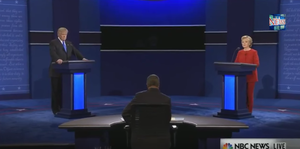
Donald Trump and Hillary Clinton ahead of last night’s US Presidential Debate
I stayed up late into the night
To see a magnificent sight
Each of the pair
Had incredible hair
And one spoke incredible shite.
John Moynes
Pic: Associated Press
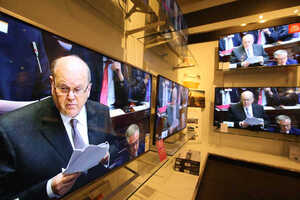

From top: Minister for Finance Michael Noonan delivering his bidget speech last year; Michael Taft
Business in Ireland is too important to be left exclusively to Irish business
Michael Taft writes:
I mentioned previously that the run-up to the budget is my favourite time. We get all manner of sloganeering and mantras. Take this one: a pro-business budget. This usually refers to more tax reliefs, more grant handouts and income tax-cuts to lessen upward wage demands.
Throw in scrapping the odd regulation (always referred to as ‘red tape’) and voila: a pro-business budget.
This isn’t really a pro-business budget – just a string of fiscal gestures that allows the Government to claim it is doing something
. Yes, these are the demands of business organisations but as Sean Lemass pointed out:
‘Nobody nowadays regards the operation of an important industrial undertaking as being the exclusive private concern of its owners . . . The social consequences of fluctuations in the level of business activity are matters of public debate.’
In short, business in Ireland is too important to be left exclusively to Irish business. It is a social activity involving a range of stakeholders. So what would a real pro-business budget look like, one that takes into account social consequences?
In the first instance, it would recognise three principles:
The fortunes of business are inextricably intertwined with the fortunes of society. A prosperous, confident, creative society is likely to create a business sector in its image. If you don’t think so, imagine the opposite: high-levels of poverty, educational inequality, crumbling infrastructure, impoverished public services, etc. What kind of business sector will that produce?
Second, business is not homogenous. Export-focussed firms are not that interested in domestic demand – but they are keenly interested in the demand in other countries. Businesses focussed on the domestic sector, on the other hand, would have an interest in domestic income levels.
Thirdly, businesses need protection from each other. For instance, the original rationale for Joint Labour Committees was not only to protect workers in low-paid sectors; it was also intended to end the situation whereby: ‘ . . . the good employer is undercut by the bad, and the bad employer is undercut by the worst.’
Thus grounded in these principles, here are some ideas for a pro-business budget.
1. Reduce income Inequality: concentration of income at the top of the income pyramid is bad for business. Higher income groups have a higher propensity to save and their spending is more import-dense. If the goal is to induce higher consumer spending, especially if Brexit unsettles confidence, then redistribute to lower income groups.
This would mean no tax cuts for high-income groups (they’re getting pay rises anyway – the CSO shows managers and professionals have seen incomes rise by 7 percent in the last four years compared to losses in other groups). Instead, redirect resources towards raising social protection rates – which spend almost all their income.
2. Increase Investment: essentially, investment ‘buys assets’ that either generate future income or reduce future costs. Investment into advanced broadband can generate new business opportunities; investment in water and waste reduces costs associated with leaks and maintenance; investment into renewables and green energy reduces import and environmental costs. All these come with not only higher business activity (it takes people and materials to produce these assets), but crowds-in additional private investment.
3. Increase Government funded R&D: Ireland is a bottom-dweller in the EU-15 when it comes to support research and design. We would have to increase R&D – in telecommunications, energy, environment, health, transport, etc. – by over 40 percent to reach the average of our peer group, other Northern and Central European economies.
4. Education, Education, Education: this is a key driver, not only in enterprise ability but in reducing inequality. I charted Ireland’s performance on education expenditure here. We would have to increase spending by €1.2 billion to reach other peer group average in Europe.
5. Reduce Living Costs: what is one of the biggest drains on the productive economy (besides debt)? Requiring people to pay market prices for public goods. For instance, health is a public good – yet so many have to purchase it on the private market.
Reducing the costs of childcare, the costs of rents (through public or voluntary cost-rental models), the cost of public transport by having a proper subvention regime – these would reduce unnecessary upward pressure on wages and free up money to spend . . . in the private market. Businesses get a win-win on this.
6. Expand Public Enterprise: business is business – whether it’s public, private, non-profit, capital-owned or labour-owned. So bring together all the public companies and work out a strategy to expand: new start-ups, joint ventures with private companies, expansion, and procurement strategies to facilitate the SME sector.
7. Face Reality: Apple is only the beginning. The momentum in Europe is towards EU-wide initiatives to tackle multi-national avoidance through transparent country-by-country reporting laws, greater transparency in transfer-price fixing, the common corporate consolidated tax base and an EU-wide withdrawal tax. We can either
(a) Hide our head in the sands and hope the world doesn’t notice us,
(b) Line up with the most right-wing forces in Europe (and the richest, tax-avoiding multinationals) to block these initiatives, or
(c) Face up to reality and begin devising a post-Apple foreign direct investment policy. An evidence-based debate is necessary in order to achieve a new consensus. And to achieve that consensus will require the input of all the stakeholders – employees, employers, civil society groups, etc. The Government should announce that it will start this process the day after the budget.
There’s a lot more things we could start doing in Budget 2017 and most of this could not be achieved in one year. But a pro-business budget is one that looks to the long-term, eschewing short-term gesture measures; one that comes with a realisable road-map.
Being ever the optimist, I can’t wait for October 11.
Michael Taft is Research Officer with Unite the Union. His column appears here every Tuesday. He is author of the political economy blog, Unite’s Notes on the Front. Follow Michael on Twitter: @notesonthefront

Anne writes:
At the till in Dundrum, Co. Down.
Have you been surprised by an unseasonal Yuletide display? Write in confidence (supplying pictorial evidence) to broadsheet@broadsheet.ie, marking your submission ‘Ah here, It’s barely October’.
https://www.youtube.com/watch?v=ZjErCdGtJ_A
And so it begins.
FIGHT!
Previously: Face Off
Derek Mooney writes:
Here are some random, even disconnected, thoughts on tonight’s US Presidential Debate, posting at approx 5:30 am (Irish Time).
The first is just how shockingly poor Trump’s performance really was. While many pundits were predicting that he would do badly, especially as news emerged of how little debate prep he was doing, I hadn’t imagined it would be THAT bad.
Trump is a guy who should be most comfortable in front of the TV cameras. He has spent years as a reality TV star, surely he had learned some understanding of how the medium works. Yet, as we saw from his constant interruptions, his snorting and sniffling and his awful reaction shots in the split screen segments, he seemed the least comfortable of the two in that environment.
To be fair to Trump, he did have a moderately good opening segment. He made it clear from the outset that he was set not only to bring the fight to Hillary Clinton, but to paint her as the ultimate political insider, but he never developed his narrative beyond that opening twenty minutes.He fared best when he offered solutions, the problem is that he spent most of the debate just reciting the problems.
As the debate went on it was soon clear that he had not prepared and that he was just recycling his standard Trump Rally material. His strategy, in so much as he appeared to have one, seemed to be to just play to his own existing voter base and ignore swing voters.
That is not a winning strategy when the race seems to be so close – well, close in terms of national vote, not quite so close in terms of the electoral college – but especially so when the candidate seems so prepared to rise to Clinton’s bait each and every time.
Hillary’s attack lines were so obvious that he and his team must have anticipated them and devised key responses and arguments that would allow him to pivot the debate back to her obvious weaknesses – yet they never came.
The best he could come up with was a crude bait-and-switch, but for most of the time he not only accepted the premise of Hillary’s remarks – on his taxes, his attitude to race issues and his comments on women – he then repeated and expanded on them.
While Hillary helped him implode, most of the credit goes to him. He had too made unforced errors… such as he denial that stop and frisk had been declared unconstitutional – even contradicting the moderator when he stated clearly that it was… or his lethal throwaway “That’s because I’m smart” comment when Hillary wondered if he had paid no federal taxes.
He has made his temperament and his credibility, real election issues, in a way that the Clinton had failed to do before tonight.
While Clinton clearly had a good night and did win the debate, she did not say or do enough to deal with her big unfavourables.
She still lacked passion and never really addressed the accusation that she is a Washington insider, an establishment figure disconnected from the real America which feels disillusioned and ignored – something I explored here on Broadsheet.ie.
The question is whether her winning the debate will move the poll numbers for her. In the past the winner of the first debate has managed to secure a small post debate bounce . In all likelihood she will do so now, which begs the question can she secure that bounce and hold on to it.
I suspect, as the campaign progresses that she will gradually edge more swing voters to her cause, though they will probably go to her more to stop Trump that to push Clinton – but a win is a win, even when it is your opponent who secured it for you.
A win is a win, even when your opponent secures it for you (Derek Mooney)









MORE to follow.
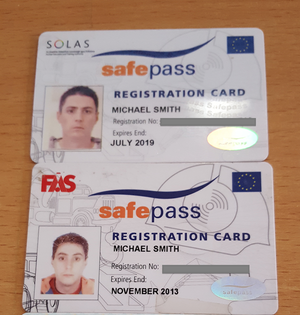
Barry writes:
I found three cards belonging to a Michael Smith dumped in a bush outside my office on Grantham Street [Dublin 8]. I’d say he’d be chuffed to get them back as they are all to do with his work.


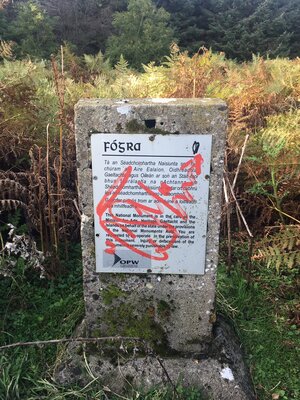
Jack Reynor tweetz:
This is at Glen Ding in Blessington [Co. Wicklow]. Can people please not do this kind of sh1t in the few beautiful areas we have left in the county please…