Category Archives: Misc

Screen Shot 2016-05-10 at 12.06.51

Newly appointed Minister for Health Simon Harris

“Voltaire once commented that “the most important thing in life is to speak your mind”. That’s exactly what I did last week. At a private meeting amongst colleagues, I raised concerns about legislating for abortion in Ireland, adding that should such a scenario arise, I would have grave difficulty supporting it. The next day I read about my comments in the media.

… I have a strongly held view on this and I need to stand by that belief. I will not throw insults at others of opposing views, in the way others threw insults at me last week. In a liberal, open society which so many people talk of, guaranteeing people their right to hold a view, to make that view known and to stand by their principles is not an optional extra. Liberalism, tolerance and openness require each of us to respect the rights of others to differ with you, to have thoughts and beliefs with which you may not concur.”

Simon Harris: It’s not bigoted to have a view on abortion (Sunday Independent, July 22, 2012)

Fine Gael TD Simon Harris also sent an anxious e-mail in the final week of the campaign assuring PLC [Pro Life Campaign] that: “I am happy and proud to assure you I am pro-life.”

Mr Harris added the nervous plea of: “Please be assured of my support. I need No1 votes on Friday so I can be in a position to support these positions in Dail Eireann.”

Creighton faces ejection with vow to ‘follow conscience’ on abortion (Sunday Independent, July 7, 2013)

Fine Gael junior minister Simon Harris has said he wants the right to an abortion extended to women whose babies have fatal foetal abnormalities, describing their situation as “appalling”.

In an interview with The Sunday Times, the minister of state in the Department of Finance said he believed a referendum on the eighth amendment, which gives an equal right to life to the mother and unborn, will probably be required to widen the grounds for abortion to these cases.

Minister calls for vote on 8th amendment (The Sunday Times, Sarah McInerney, December 27, 2015)

Úna Nic Gearilt writes:

Given his role new role and the push for an referendum on repealling the 8th Amendment it would be nice for Simon Harris to pick a side and stick with it…

FIGHT!

Rollingnews

CHILD RACKET - DARLING copy

Alan O’Regan asks:

Anyone know what car insurance has gone up so much since last year? Between 30 and 50%! The best answer I could get when I rang around is “that’s the nature of the game”. 2002 car that I use as a run round. Passes its NCT every year. 7 years no claims. No points. Some of the quotes I got made my eyes water…

Anyone?

If you have a problem, if no one else can help, and if you can withstand mild, sociopathic ribbing….maybe you can ask a Broadsheet reader.

(Queries to: broadsheet@broadsheet.ie)

IrishWater_Mark_Colour_borderimage


Further to reports that Irish Water spent €16million on extending its lease – by 10 years – at its Colville House, Talbot Street, Dublin 1 HQ.

Three days after the general election.

Niamh Brennan, the Michael MacCormac professor of management and academic director of the UCD Centre for Corporate Governance, writes in today’s Irish Times:

As it is, the governance of Irish Water is unusual, in that it is structured as a wholly owned subsidiary of another State body, Ervia (formerly Bord Gáis Éireann).

Initially, the board of Irish Water comprised 14 directors, of whom 10 were independent non-executive directors (ie, they did not work in Irish Water on a day-to-day basis) and four were executive directors.

Then, the minister for the environment at that time, Alan Kelly announced he would be putting in place a new unitary board, combining Irish Water and parent company Ervia.

…By the end of November 2014, all the non-executive directors were gone, leaving Irish Water with a solely executive board, comprising (according to the 2014 financial statements) Michael McNicholas, chief executive of the parent company, Ervia; John Tierney, managing director of Irish Water; Brendan Murphy, Ervia group finance director; and Michael O’Sullivan, Ervia group commercial regulatory director.

Thus, there is currently no direct non-executive oversight of these four executive directors on the board of Irish Water. Instead, Irish Water is subject to the control and oversight by the board of Ervia, its parent company.

The position of chairman of Ervia is currently vacant, following Rose Hynes’s resignation in October 2015. How can the board of Ervia be operating effectively without a chairman?

In November 2015, Irish Water announced that John Tierney would be stepping down as managing director at the end of April 2016.

Who is Irish Water’s managing director now? Does Irish Water currently have a managing director?

There is a large section on Ervia’s website on transparency, including web pages for Ervia and Irish Water board meeting minutes. These web pages are empty. Transparency indeed.

Lifting lid on Irish Water reveals unusual governance (Niamh Brennan, Irish Times)

Related: Irish Water extended HQ lease by 10 years in €16m deal (Fiachra Ó Cionnaith, Irish Examiner)

Nicky-Byrne-Eurovision-2016-mainglobearena

From top: Nicky Byne, Irish entrant with ‘Sunlight’; Globe Arena

The first Eurovision 2016 semi finals begins tonight from the Globe Arena, Stockholm, Sweden.

But what songs are worth backing?

And is Ireland’s entry among them?

FluffyBiscuits, ‘sheet Eurvision analyst, writes:

Every bookie and fan appears to think that Russia will be the leader of the pack this year.

Russia has entered 33 year-old singer Sergei Lazarev with his Greek Russian penned hit “You are the only one”.

The song is a club style hit with a larger than life performance. Lazarev has a slick production behind him with the Russians desperately wanting to win (distracts from the anti gay laws in part).

Following closely on his heels (!) is the Ukranian singer Jamala with ‘1944’ . 1944 tells the story of the deportation of the Crimean Tatars from the then USSR. and subsequent ethnic cleansing. It’s an emotionally charged R&B ballad with an ethnic edge that seeks to tell the story (and in the process annoy the Russians).

Third favourites are France, the song of which is an annoyingly catchy ear worm titled ‘J’ai cherche’ .

France sent young singer Amir who has the looks and the song that could take down mother Russia and restore French glory which has been missing from the contest for years.

Other favourites this year are Malta (think of drum n” bass mixed with pop – my personal favourite), Armenia (some young one screeching with ethnic instruments), Bulgaria (slice of upbeat pop), Czech Republic (strong ballad about domestic violence co-written by Irishman Aidan O Connor) and Australia with one of their stars Dami Im singing “Sound of Silence”.

Most fascinatingly of all, the one song (if you can call it that) that is really getting chins-wagging is Serhat from San Marino with ‘I didn’t know’.

Serhat is a Turkish TV presenter who is 60+. Originally the song was a dreary ballad that was destined to finish last until San Marino TV for the pure craic  lashed a disco track over it and painted him as a crooner. What ensues is three minutes of a song that is cheesier than an unwashed nun’s inner thigh.

San Marino are about 70/1 to win but the public do have a say this year in how the winner is decided alongside the juries.

As for the other bits around Eurovision – it is all drama.

– We have had the flag list incident where the competition organisers (the EBU) released a list of flags to be banned (it backfired spectacularly, listing the Kosovo flag alongside the ISIS flag was not a bright idea).

– Germany’s original choice of singer was withdrawn after homophobia allegations.

– Bosnia’s group got into a fight amongs themselves.

– The Israeli contestant Hovi Star (think pound shop Boy George) accused Russian immigration of homophobia and subsequently had a bitch off with the Dutch contingent.

– Romania kicked out for not paying participation fees.

As mentioned earlier Ireland are sending Nicky Byrne with the song ‘Sunlight’. A pop rock entry that tries so hard to be likeable but falls between the cracks as being too generic. It’s catchy and the lyrics nice and lovey dovey but that is all.

Let’s be honest here with ourselves, Nicky in my book was never really a singer, he is a showman who puts on a good performance and sings a nice song but its instantly forgettable and his voice is at best average (and he does have an album coming out soon and is married to Bertie Aherns daughter but that is just coincidence) . RTÉ missed the boat with this year’s Eurovision,

No point whinging anymore. I still love it, always will!

Betting tips – back Ukraine each way, Cyprus to qualify from the semi and maybe Germany finishing last. Above all enjoy it for what it is – a kitsch campy entertainment show with a dash of seriously good song writing in between.

FIGHT!

Pics: Eurovision

Screen-Shot-2014-05-20-at-09.44.521-1024x616

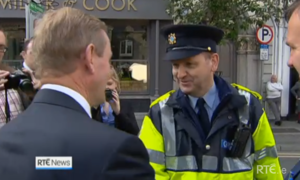
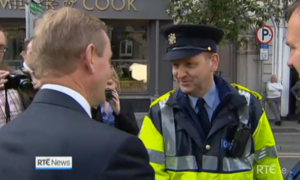
Garda whistleblower Sgt Maurice McCabe on duty in Mullingar, Co. Westmeath, when he met Enda Kenny while the Taoiseach was canvassing in the town ahead of the local and European elections in May 2014

You’ll recall how High Court Judge Kevin O’Higgins was appointed in 2015 to chair a Commission of Investigation into complaints of Garda malpractice in the Cavan-Monaghan area made by Sgt Maurice McCabe.

The Commission of Investigation was launched on the advice of Sean Guerin SC who initially looked into Sgt McCabe’s complaints.

The O’Higgins report has not been published but it was handed to the Minister for Justice Frances Fitzgerald on April 25.

Since then, there has been a drip feed of articles about the contents of the report.

Last night, after having secured a copy of the report, RTÉ journalist Philip Boucher Hayes said the following on RTÉ One’s Drivetime:

It’s a bit of a Late Late Show report – there’s something for everyone in it. It’s the kind of document that doesn’t make a clear determination one way or another so much as it criticises and it exonerates everybody in equal measure. If you were of the view that Maurice McCabe blaguarded his colleagues and exaggerated cases in order to pursue his own agenda, you’d find some substantiation for that in what Justice O’Higgins has to say.

McCabe was “prone to exaggeration at times”. Some of his complaints against his fellow gardaí were “over stated”. Some were described in the report as “unfounded”. And, as evidence of McCabe’s ingenuity, his detractors will point to the allegations which were “withdrawn”.

A picture emerges of McCabe on this reading, as somebody who cried wolf, who dragged the reputations of his colleagues and the entire force through the mud needlessly but that’s a selective reading of what Justice O’Higgins has to say.

He also says of the whistleblower sergeant that he is a person “who acted out of genuine legitimate concern”, that he “was never less than truthful in his evidence”.

The judge says he, “unreservedly accepts his bona fides” and that he had shown “courage and performed a genuine public service at considerable personal cost. For this he is due the gratitude of not only the general public but An Garda Síochána”.”

Those who were previously persuaded that Maurice McCabe wasn’t the victim of discrimination will find evidence in the support this belief. McCabe said he “had reason to believe that he was being set up and wrongly implicated” in some of the cases of which he had complained. Attempts were being made to point the finger of blame right back at McCabe where he had cried malpractice.”

The judge said that such a belief was “unproven” so McCabe wasn’t being persecuted for coming forward on this reading. Yes, except the report also says that there are five instances where there were attempts by the force to “blame Mr McCabe for malpractice or poor policing”. And, in each of these cases, the judge decided that “the sergeant was being wrongly blamed”.

So, simultaneously, Maurice McCabe wasn’t being persecuted for blowing the whistle but was being wrongly blamed by fellow gardaí for doing things that he didn’t do.

Another headline Maurice McCabe’s detractors point to is his allegation of corruption made against Former Garda Commissioner Martin Callinan. Mr Callinan is “entitled to have his reputation vindicated” and that allegations made against him by Maurice McCabe “were unfounded and deeply hurtful” says the judge. Proof again that McCabe was pointing an unjustified finger of blame.

But in the same paragraph, where this appears, it’s also made clear that McCabe never accused Callinan of corruption – “He had not intended to make allegations of criminal conduct against the Commissioner but rather of an abuse of power only.”

Frustrated that he was being ignored by Garda management, Maurice McCabe had found a device that would ensure his complaints which, the judge affirms, would get a hearing.

“The complaint was in part a device to make sure that it came before the minister. At that time a complaint against the Commissioner had to be referred to the minister.”

Again the judge offers something for all sides to say they had been unfairly maligned and simultaneously vindicated.

Anyone reading the accounts of the report that Maurice McCabe withdrew his allegations could reasonably infer that he knew he was on shaky ground in some of the things that he was saying.

On the contrary though it emerges in the transcripts of the commission that Sgt McCabe withdrew one complaint against an officer whom he felt should have been more critical of the shortcomings of a junior officer.

When he was presented with the testimony of the senior criticising his junior, McCabe withdrew the complaint saying that this “was the first time I’ve seen this”.

Justice O’Higgins had to plot his way through a great deal of, he said, she said. But what was at the root of all of this was McCabe’s allegations of Garda incompetence or malpractice. Here, he finds repeatedly that the Gardai didn’t do their jobs properly.

He says, of Lorraine Brown, and her allegation of assault that she “under went a harrowing experience and was entitled to have the matter dealt with competently and professionally by the gardaí. Unfortunately, as is evident from the findings of the commission, her legitimate expectations in this regard were not met.”

Of Maurice McCabe’s claim that gardai were failing to prosecute motoring offences and impose penalty points, the judge finds that “there was a clear pattern of members of the public being stopped for having no insurance or some other deficit in their documentation. In a number of those offences, the member of the public recorded as having admitted the offence. However, the examined print outs reveal a failure to prosecute in many instances.”

Of the investigation into the assault at the Lakeside Manor Hotel, the judge says “the investigation of this incident was characterised by delay and error. Sgt McCabe correctly identified the deficiencies in the investigation and the steps necessary to rectify them”.

And of the most tragic of all of the cases, highlighted by Maurice McCabe, the murder of Sylvia Roche Kelly, by Jerry McGrath, the judge concludes that McGrath shouldn’t have been out on bail and wouldn’t have been were it not for a failure on the part of gardaí in Cavan.

He says that there can be no excuse for “a misclassification of that assault and a failure to communicate effectively within AGS [An Garda Siochána] to ensure accurate and relevant information was shared.

Any report this long is going to lend itself to being read from in a way that supports one narrative over another. Even more so in the case of this report which offers something for everyone to support their case.

But so too does it support many of the allegations of incompetence, poor practice, malpractice and failure to serve the public that were at the heart of what Maurice McCabe first alleged.

Listen back in full here

Previously: Lest We Forget

Fennelly Report: The Digested Read

greyday

‘sup?

From David Tully, the Brayhead basketball hoop guy.

A video comprising elephant love making, sky diving and an existential Golden Lab.

David writes:

Woke up to this bland (irish) day – two weeks ago  in Easkey, Sligo. Anyways liked the tree, the wind. Thought the branch’s at the top  looked like horse’s heads.  So wiped this up yesterday. Adding daft, slightly surreal elements. After Effects & Mocha, then scoured youtube looking for things to chop up. There’s a whole world of “animals mating. That dog – i shot on Bray waterfront – where i lived.  liked its bored expression – just waiting – looking slightly morose

90286109Michael-Taft

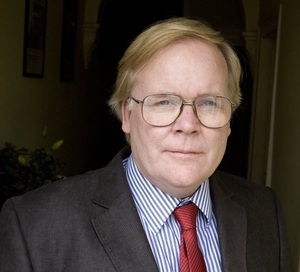
From top: Social welfare office, Thomas Street, Dublin; Michael Taft

No one group has suffered more.

So why is no one talking about restoring the cuts to social protection?

Michael Taft writes`;

Why isn’t this on the agenda? Why are so few talking about it (one exception is Unite the Union, there are other civil society groups in this conversation, too)?

We hear a lot about repairing the social damage, paying back those who made sacrifices during the recession. So why is no one talking about restoring the cuts to social protection?

In 2010 and 2011 basic social protection payments were cut by 8 percent – from a basic rate of €204.30 to the current €188. In addition, inflation has taken its toll, so the loss in real terms is higher. But in the last two budgets taxes were cut while basic social protection payments were left untouched.

If you’re looking for people who suffered during the recession you’ll find most of them reliant upon social protection payments.

taft1

Over half of unemployed, single parents and those unable to work due to illness or disability suffer multiple deprivation experiences.

For single parents reliant on social protection payments, the figure is probably higher than 59 percent as this category would also include single parents in the workforce, many of whom would not suffer deprivation.

Yes, we must get the unemployed back into work but even by 2021, the Government expects unemployment to be 6 percent.

Yes, we must devise programmes to get many of those suffering from disability into the workforce as well but we have a long ways to go – Ireland has the lowest level of employment among this group (bar Bulgaria and Hungary).

And we need to help single parents back into the workforce (a national network of affordable childcare would help in this regard).

We must be doing all these things – but in the meantime, we shouldn’t be consigning a huge swathe of the population to poverty and deprivation.

How much would it take to reverse the costs? In January of this year, the Social Protection Minister puts some numbers on this. Based on this, it would cost close to €800 million to restore social protection payments to their nominal 2009 level (including restoring the cuts to youth Jobseekers’ Allowance).

It would cost approximately €1.2 billion to restore these payments in real terms (factoring in inflation).

If this seems like a lot, remember – this is only about restoring the 2009 status quo. It would still mean stagnation since then.

Is this affordable?

The new Government intends to spend €3.5 billion on tax cuts up to 2021. There is an additional €€2 billion tucked away under the fiscal space radar for ‘tax indexation’; that is, tax cuts.

So there is some money about if you think that trying to lift people some ways out of poverty and deprivation is important.

Yes, poverty is about more than just cash transfers. There’s work and personal skills, access to public services, education and health status. But it’s also about income.

It’s not as if this money will go down some black hole. By and large it will be returned back to the economy through higher consumer spending which means more money in the tills and cash registers of businesses throughout the country (low-income groups have low propensities to save).

If this doesn’t sound too unfeeling, people on low-incomes are demand-conduits; what goes into one pocket, goes out of the other into businesses and their workforce. This is all the more the case given that low-income groups’ consumption is less import-dense – they spend less abroad, or on new cars, champagne or other imported items than the rest of the population.

But at the end of the day, you prioritise according to your political values (economics is not science, it’s politics).

If you believe that poverty and deprivation is a stigma on society, a social obscenity, and an avoidable outcome, you will prioritise those who are having trouble making ends meet.

This includes those reliant on social protection, those on waiting lists (housing, health), the homeless, the elderly living in isolation, those mired in arrears, the child in need of special education, the carer in need of help with their disabled relative.

The list is not endless but it is substantial. We can fashion our economic (political) and social priorities in a way that helps, assists, supports.

And if we do that, we will find that we are all better off.

We are not self-aggrandising units of consumption. We live in society, participating in a dense network of social relations. When some of those relations are mired in poverty and deprivation, it degrades all of us.

So let’s start – even if it is a small start – to build a better society. Let’s start restoring social protection payments.

Michael Taft is Research Officer with Unite the Union. His column appears here every Tuesday. He is author of the political economy blog, Unite’s Notes on the Front. Follow Michael on Twitter: @notesonthefront

Rollingnews