

Um.
Colm writes:
Fairly decent job if fake. Scared if not.
Anyone?

Bants. In fairness.



Um.
Colm writes:
Fairly decent job if fake. Scared if not.
Anyone?
Bants. In fairness.
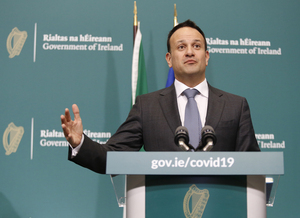
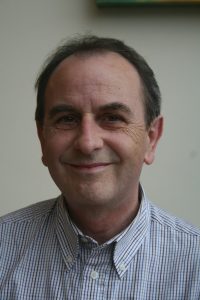 From top: Taoiseach Leo Varadkar claimed people asked to be laid off so they could claim the €350 Covid-19 payment; Eamonn Kelly
Leo Varadkar told a press conference the other day that he had heard stories of people asking employers to lay them off to take advantage of the €350 coronavirus welfare payment.
He presented no evidence for this and simply used his platform as acting taoiseach to denigrate workers who, it was implied, were looking to turn the coronavirus crisis to their own financial advantage.
There were any number of anecdotes the acting taoiseach might have told to raise a giggle at people angling for an extra buck during a crisis.
Like retailers boosting prices on goods during the coronavirus crisis; or AIB deducting bank charges direct from the accounts of people who had just been laid off due to that crisis; or the plentiful anecdotes of private landlords over-charging tenants during the housing crisis in a private rental market made attractive by a neo-liberal government determined not to provide social housing. Ireland is rife with system-gamers exploiting crises, and we have the social casualties to prove it.
However, minister Varadkar chose to target low-paid workers for his derision, as is his form.
And the manner in which he told the anecdote, that slow grin, as if he had never heard of such cheek, revealed that same old ingrained prejudice against poor people that this privileged man has enforced time and again through social policy and sly insinuation.
The allegation is of course totally anecdotal. But Mr Varadkar, currently acting taoiseach, should really back this public statement up with names of employers and workers who, he claims, were attempting to game the system. In the interests of transparency.
He owes it to those workers who have been working around the clock providing basic services to all during the crisis, to at least identify those among their number who, he claims, were attempting to skive off work under false pretenses and claim the coronavirus welfare payment.
A payment, incidentally, which is striking in its generosity, with the minister declaring that the standard jobseeker’s allowance of €203 just isn’t enough to live on. That’s news.
That the payment is being divvied out by a politician who lost their seat in the last election, but is still somehow the minster for social protection, might cause a cynic to suspect a motive behind such generosity. An upcoming election might favour the politician behind such a generous gesture. A lost seat might be won back. Bought back, even.
The Culprits
There is a clue in Leo Varadkar’s statement as to the identity of the workers and employers at the root of the anecdote. It lies in his reference to 20 hours and an extra €11.
This can only be a Community Employment (CE) scheme, or something similar, and the employer in question can only be a CE supervisor, who work closely with the DEASP.
So the anecdote most likely has its roots in a CE scheme, with a CE worker, who may or may not have been joking, putting this proposition to a CE supervisor who, apparently, reported it back to the DEASP, from where it was likely passed to Mr Varadkar’s PR representatives, who appear to have used the story in the hope of gaining some political capital by denigrating a target group; this time “lazy” low-paid workers on the make in a crisis.
In this attempt to gain political capital we see once again the familiar Varadkar ploy of targeting a weak group, incapable of political response, in an attempt to turn the anger of their peers upon the target group.
The bottom line being, as in the now infamous welfare cheats campaign, to create division and suspicion among those sections of society most adversely affected by austerity, low wages, premium accommodation costs, a financially crippled health service, and all the other familiar inequalities that are a consequence of the neo-liberal policies pursued by Fine Gael.
But Mr Varadkar lacks the courage of his convictions, holding back from going all the way with his scapegoating.
Rather than leaving those alleged system gamers in quiet community employment anonymity as the subjects of an amusing anecdote for comfortable socialites, he ought to, if he wants to be seen to be following through consistently on his charges, expose the individual culprits fully to public shaming. It’s clear that this is his intent in bringing up the subject. So let him go all the way.
Maybe set the culprits up on a scaffold in Smithfield and have over-worked staff of essential services fling rotten fruit at them. If you’re going to scapegoat, at least do it with a bit of pizzazz and give the public a show. All else is just unverifiable spin with a mean-minded twist and an intent to target the defenceless to gain political capital.
Such a mean-minded attack might even be construed as a deliberate and calculated act of relational aggression. An underhanded mode of behaviour that is not only beneath the office of taoiseach, but is beneath the standards of any decent person.
New Understandings
But we can take it by now that Fine Gael don’t just toss out ideas like this in an idle fashion. There is something behind it. Could it be an attempt to sow divisiveness between workers? Heroes vs lazybones? But why?
The clue might be found in Mr Varadkar’s own manifesto of 2017 when he was hungering after the Fine Gael leadership and the prize of becoming taoiseach by the back door.
In that manifesto was a proposal, based on a Tory template, to prevent workers of certain defined occupations from striking. Such occupations would first be defined as “essential services”, and the proposal would be to ban them from striking, because such strikes would be deemed too damaging to the public good.
Such a ban would of course curtail workers’ options in challenging disreputable employers seeking to exploit them.
Now the coronavirus restrictions have given Fine Gael and their right-wing associates an opportunity to clearly define “essential services”, and the payoff for the right might well be a ban on strikes by those workers they are currently characterising as “heroes”.
Beware the compliments of a flatterer, so said Machiavelli to the Prince.
Such a move would put essential workers at the mercy of government and employers in terms of pay and benefits, with no recourse to protest on their own behalf without breaking the law. To say no to employer exploitation would be a criminal act.
In the future, the only bonuses essential workers might be seeing may be the occasional public round of applause. Like artists and musicians, they may well find themselves expected to work for the experience and the “exposure”, and because they “love what they do”.
Gaming the System
An argument was made in the Irish Times a week or so ago that Fine Gael ministers have governing skills that new ministers might not have, and since we are in the midst of a crisis, it might be best to leave Fine Gael personnel installed in their previous government positions, despite the election results.
That sounds reasonable enough given the circumstances. Though when you consider that the government in question is the same one that ran down the health service in a privatisation drive, among other neo-liberal strategies undermining social equality, the situation doesn’t seem quite as rosy.
A clear picture emerges of a fox smiling in a hen-house and saying, Sure, I’ll take care of everything. You relax. Don’t bother your pretty little heads about anything.
There was also the suspicion that the article in question was one of those fake articles from the Fine Gael spin unit, placed as a genuine article in a reputable newspaper, to help the cause of remaining in power even when some of their ministers have lost their seats.
Writing your own news and op-eds; leaving ministers in place to divvy out generous amounts of public funds; devising new strategies to divide and disempower workers, while cleverly attempting to suspend parliament under the guise of public health concerns.
Now that, is gaming the system.
Eamonn Kelly is a freelance Writer and Playwright.
Friday: Tested Negative And Petty
Previously: Eamonn Kelly on Broadsheet

Kungstradgarden, Stockholm, Sweden yesterday
in Sweden, there are no enforced lockdowns, the economy remains open, and citizens are free to travel and enjoy the attractions..
However, it’s not business as usual, as Philip O’Connor, in Stockholm, Sweden, writes (full column at link below):
Sweden’s decision not to lock down its society has put it in the global spotlight.
Commentators and journalists are asking, not unreasonably, what the Swedes know that virtually every other country doesn’t, but to describe the situation in the Scandinavian nation of ten million as “business as usual” is not accurate; Sweden’s lockdown is imposed not on the state level, but at the individual, and the effect has been felt on every aspect of life.
While Norway and Denmark closed schools and in some cases closed borders, and insisted on quarantining those who had been abroad, Sweden took a much more low-key approach.
First, gatherings of over 500 people were banned, binning the possibility of ice hockey playoffs or starting the sports leagues that were due to get under way in the spring.
Workers who could were instructed to work from home, and those who don’t enjoy that luxury were told to stay at home if they displayed any symptoms whatsoever.
As the disease gradually spreads and the death toll rises, so too do the demands for individual responsibility; the size of gatherings has been cut from 500 to 50 and commuters have been asked not to use public transport at peak times.
Table service in bars has become the norm, and fast-food restaurants have taken to taping off seats and tables so that people do not sit too close together. S
hops have been told to restrict the numbers on their premises and that queues should be controlled to enable people to keep their distance.
But still some activities go on. In Vasaparken, not far from the Spice Of India Restaurant, the winter ice is long gone, and swarms of kids of all ages play football on the artificial turf at lunchtime, watched by teachers and youth workers in fluorescent vests….(more below)
Genius Or Gamble? Inside Sweden’s Covid-19 Crisis (Philip O’Connor, Our Man In Sweden)
Getty


Yesterday.
Professor Martin Cormican, National Lead for Infection Control and Antimicrobial Resistance, HSE, displaying some of the PPE equipment sourced from China, at a HSE briefing in Dublin.
With Just 10 per cent of the total €200 million order having arrived. Professor Cormican stated that only 65 per cent of the first batch has met the required standard.
Good times.
Meanwhile.
This morning
A shipment of five million pieces of personal protection equipment (PPE) is believed to have been delivered to Northern Ireland, according to the NI secretary.
Brandon Lewis said the PPE consignment should have arrived at approximately 07:00 BST on Monday morning.
He said it would be delivered to the health services “in the course of the day”.
It would help ensure sure staff had the “protection they need”, he added.
Coronavirus: Millions of PPE items ‘arrive in Northern Ireland’ (BBC)


An award winning 2016 short by Russian animator and director Dina Velikovskaya in which a determinedly ambitious mother bird, obsessed with reaching the sun, finds herself distracted at the arrival of her similarly attired, newly hatched chick.

Rollers.
A short documentary by photographer and filmmaker Donal Moloney, who writes:
A couple of years back I come up with a notion to document a few interviews with some older ladies who still enjoy the weekly ritual of having their hair put in rollers. There’s something wonderfully decadent about it but sadly it’s on the wane.
I had a few hairdressers earmarked around Dublin. My first port of call was one in Fairview to test the water. For various work commitments I put the project on hold. Last week I was going through an old hardrive and found this (above)…

Spotted last week in New York by Olivia G. Caldwell. Artist unknown.
And on that note, a recent mural by Andreas Welin in Copenhagen..


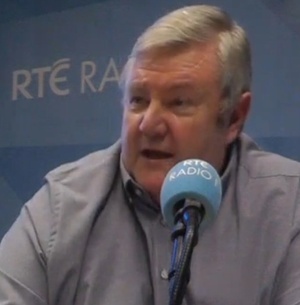 From top: Taoiseach Leo Varadkar (right) and Fianna Fáil leader Micheál Martin during the party leader’s General Election 2020 debate on RTÉ One; Derek Mooney
According to the headline in last Friday’s Irish Times: Fianna Fáil and Fine Gael are close to agreeing a coalition framework document.
I am sure they are.
Comments from the two party leaders confirms this. The Taoiseach has said the document should be ready within a week or two. Mr Martin said it could act as a “catalyst” for other parties to join such a government.
Yes, the parties have made some progress, but there is still a long way to go before there will be a government in place.
The optimism exuding from Fianna Fáil sources last week that a new government could in place before the end of April with Martin as Taoiseach, was… to put it at its mildest… a bit premature.
Let’s look at the facts. Together Fianna Fáil and Fine Gael have 72 Dáil seats. If everyone votes, 80 is a bare majority.
Realpolitik – something Micheál Martin was talking about a few weeks back – dictates that any government hoping to last a full term have a majority that is northwards of 80, preferably in the mid 80s. That or a confidence and supply agreement with another big party, but let’s not go back there, just yet.
To get to 80 or above the two parties need the Greens, or the Labour Party, or the Labour Party and Social Democrats, or the Labour party and Labour aligned independents, or some permutation or combination of the above to be part of the deal.
There are also several independents in play, including (though not limited) to those who backed both Varadkar and Martin on the February vote for Taoiseach.
To put it crudely, agreeing the joint Fianna Fáil/Fine Gael coalition framework document is the equivalent of plucking the low hanging fruit. There is a lot more reaching, stretching, climbing and grappling to be done to get the rest. And there is no guarantee that the efforts will pay off.
It is 57 days since we voted in the General Election and 45 days since the 33rd Dáil attempted to elect a new Taoiseach and put a government in place.
Under normal conditions, and we are clearly not in normal conditions now, when the Dáil is serially deadlocked and incapable of selecting a Taoiseach, the default option, one could even call it a backstop, is another election.
The possibility of another election contributes to the government formation process by setting an endpoint. The prospect of a continuing deadlock leading to an election can help concentrate the minds of the parties and individual TDs.
So, what happens in a situation where there cannot be an election and the Dáil cannot agree a new Taoiseach?
Well… nothing happens. The status quo remains the status quo and the outgoing government remains in place.
That’s what we have now. It is also what we will have for the foreseeable future. We are in a situation where that backstop… that impetus… that threat of a second election is not imminent.
Coronavirus means it is highly unlikely there could be an election any time before September or October, and even that timeline may be a tad optimistic.
To his credit, Martin and his supporters are saying in public what they are saying in private. It is not absolutely everything they are saying in private, but most of it is.
Martin may sincerely believe that a government with 85 (or more) seats, comprising Fianna Fáil/Fine Gael and another main party/parties (along the lines mentioned above) and friendly independents can be speedily put in place.
From what I hear the framework document is drafted in such a way as to give the Greens/Labour/Social Democrats most of what the FF/FG negotiating teams think they might want and need.
So committed is Martin and his inner circle to this end that they are ready to bet all their futures on it. Indeed, in the minds of many in Fianna Fáil (and that includes yours truly) they are ready to gamble the future viability of Fianna Fáil as a significant political force on it.
The always ultra-cautious, risk averse, Martin is set to go “all-in” in a game where he holds few of the cards and the other player has a number of hands from which to choose.
But Fianna Fáil and Fine Gael close to agreeing a coalition framework document was not the only political headline appearing in the Irish Times last week.
On Friday, the headline “Second general election is now a real possibility”appeared above a column by venerable political commentator Stephen Collins.
Collins said the unwillingness of the Greens, Social Democrats or Labour to join with Fianna Fáil and Fine Gael made the prospect of a second election real possibility.
He was not the only one. The Irish Independent’s Kevin Doyle did the same on Saturday, though he put it stronger. He didn’t describe it as a possibility, he hailed it as a necessity saying that the Ireland of today and tomorrow is “a very different place” from the one that voted two months ago.
He is right on this last point. The manifesto promises made last February anticipated a very difficult world and a much stronger economy.
While it is easy to dismiss this talk of second elections as speculation, perhaps even brinkmanship – I am willing to wager that it is speculation based on more than a few informed discussions, discussions with sources not far removed from the Fine Gael leadership.
So, while the option Martin talks about publicly is the same one he works on privately, that is not the case for Fine Gael. This is not to say another election is Fine Gael’s preferred option, but it would be foolhardy not to recognise that the possibility exists.
Fine Gael has choices. It has options. It has these not because it has been busy out manoeuvering Fianna Fáil, but because Martin and his lieutenants have managed to somehow under manoeuvre themselves.
Many inside his party firmly believe his decision to rule out any meaningful exploration of the national unity government option was a mistake. I am one of them and, as Éamon Ó Cuív tweeted yesterday, we are many.
Rather than exploring the unity government idea and teasing out its duration or agenda and then allowing other parties to decide whether it was for them or not, Martin moved to shut down debate inside or outside his party.
He chose to steer his party into a position where it is committed to one route only. His supporters may hail it as noble and politically courageous, the act of a principled leader. They may be right, but it is not the action of a masterful strategist.
Micheál Martin the political leader, the man who would be Taoiseach, may see his suggested coalition as the one way forward, but there is another Martin, Martin the historian, who might see some feint echoes of 1948 in today’s attempts to pull all parties, bar one, together into coalition to keep that one party out.
Today it is Sinn Féin. In 1948 it was Fianna Fáil.
I have not changed my views on Sinn Féin, no more than Micheál Martin has. My problems with Sinn Féin appears as point one in the seven principles for government formation I drafted in early February and set out here five weeks ago.
I want a government without Sinn Féin, but I also want to be able to go to the pub tonight or to grab a bus into city centre tomorrow to meet friends. There are times we do not get our first wish, or even our second.
I am not filled with glee at the prospect of Sinn Féin entering government, but I grasp that these are unique times.
At this moment and for the next year or so, or until there is a viable and widely available Coronavirus vaccine, we need all the talents and political skills that are ready and willing to serve together in a unity government, serving in one.
No bans, vetos or exclusions. We have enough of those to cope with right now.
Derek Mooney is a communications and public affairs consultant. He previously served as a Ministerial Adviser to the Fianna Fáil-led government 2004 – 2010. His column appears here every Monday.Follow Derek on Twitter: @dsmooney

The only car on the northbound side of the M50 at 11am this morning. These are strange times @broadsheet_ie pic.twitter.com/n99si7U5D0
— Simon Judge (@simonjuj) April 5, 2020
Yesterday.
