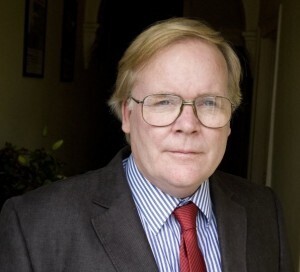
From top: IBEC Ceo Danny McCoy; Michael Taft
According to Danny McCoy, director general of employers’ lobby group, Ibec:
‘The public sector is too small for the size of the private sector, and that is really something for Ibec to say. The lack of doctors, the lack of guards etc. You can feel it.
We agree there needs to be an allocation of resources towards issues that affect people’s everyday lives, like housing.’
He went on to say the Government must deliver a surging demand for public infrastructure and public services with more investment in public sector jobs and subsidised child care. Yes, that’s something coming from employers.
But common-sensical, too. High costs – whether measured in childcare fees, private rents, A&E over-crowding and health waiting lists – degrade the productive economy and put costs on both households and businesses.
So it makes good ‘business sense’ to call for investment in public services.
And this social investment will require higher levels of public sector employment. You can’t consume a service that hasn’t been produced by women and men.
The problem is that over the long-term, the proportion of public sector jobs has declined relative to total employment.

In the early 1980s nearly one-in-five worked in the public sector. This has fallen to less than 15 percent. If we were to return to 1980 levels, we would have to employ 100,000 more in the public sector.
Ireland’s level of public sector employment is quite low compared to our peer group in the EU.

If Irish levels reached the average of our EU peer group, we’d have to employ another 150,000. To reach Swedish and Danish levels, we’d have to nearly double the number of public sector workers (i.e. another 300,000 employees). Note: Germany and the Netherlands are excluded as employment data doesn’t include public health employees.
Some might wince at these levels of public sector employment though they are pretty mainstream on the continent. But public sector employment there has a radically different structure.
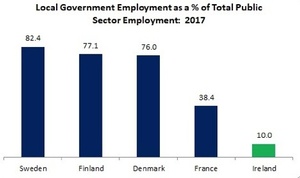
Countries with high levels of public sector employment are also countries with a high level of decentralisation; where local government plays a more substantial role.
It is difficult to make these comparisons across Europe as many countries have a federal structure, where there are local and regional tiers.
But in those countries with an Irish-style central/local tier structure, local government accounts for the greater part of public sector employment.
To drive Irish public sector employment we should look to empowering local government to take over more functions that are currently reserved for central government. This, of course, is a long-term reform given the highly-centralised nature of Irish government and the complexities involved in decentralisation.
This process could involve a regional structure with a local tier. For instance, a Greater Dublin Council could be created, amalgamating the four local authorities with provision for smaller councils (e.g. Tallaght, Donnybrook, Inner City, Blanchardstown, Clondalkin, etc.).
This would build scale and localise at the same time.
There would also be benefit to the political culture from this process. Eurobarometer shows a higher level of trust regarding local authorities:
61 percent tend to trust local authorities (as opposed to 34 percent who don’t)
Only 42 percent tend to trust the national government (as opposed to 51 percent who don’t)
Moving from a ‘too small’ public sector (as IBEC puts it) to a European-style balance between public and private sectors will be a truly radical reform. This is one of many issues that didn’t arise during the election. But it will be an issue facing the incoming government, regardless of ideological hue.
Satisfying the demand for enhanced public services could well determine the popularity of any new government. And employing more people will be necessary in meeting that demand.
Radically decentralising government may be the best way to achieve all that.
Michael Taft is a researcher for SIPTU and author of the political economy blog, Notes on the Front. His column appears here every Tuesday.
Rollingnews