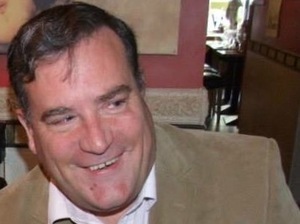

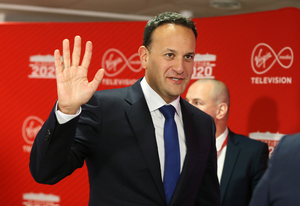
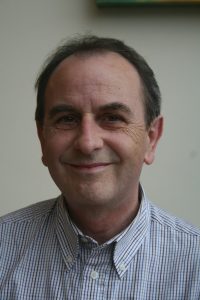
From top: Micheál Martin and Leo Varadkar arriving at Virgin Media One HQ last night and in studio with Pat Kenny (centre); Eamonn Kelly

In social employment schemes you work a half a week and another person works the other half of the same week.

This idea has been brought over to government now, with FG’s week finished and Fianna Fáil looking to fill the warm seat.

The Great Debate at least confirmed that sad little fact. That should the voting fall a certain way that FG would be prepared to take the secondary role in a confidence and supply arrangement, with Micheál at the helm.

However, unlike a social employment scheme, this arrangement can be cheated a little and the same person might continue, claiming the whole job at the expense of the other.

This is what election 2020 is about, to decide who wins the work scheme, Leo or Micheál.

And since both parties are agreed to never go into government with Sinn Féin, the other 20+something party according to some polls, it’s clear they can only go into government with each other, with maybe a few Greens to balance their diets.

Which meant that this wasn’t really a debate as such, it was more like theatre, and might well have been considered for an IFTA nomination if it hadn’t been so lacking in drama.

This was not a debate in the accepted sense of the word. That is, two opposing views presenting opposite sides of a clearly discernible difference of opinion in a classical thesis, anti-thesis, synthesis type of way.

This was more like two right shoes deciding on how they might go for walk without looking too awkward. Or two negative charges deciding which of them will adopt the role of positive charge for the sake of appearances.

I’ve heard better debates in the pub, because at least there were honest opposing views, even if both sides were a little bit pissed. Maybe even because both sides were a little bit pissed.

Here the debate was centred on tweaking something that was already taken for granted, namely a centre right position on the spectrum, with accompanying conservative world-view. With both sides shadow-boxing on an agreeing to disagree basis.

Because no matter what happens, both will still either be chief or chief in waiting, and both positions have their perks.

But both are the same sides of the same coin, two horses of the same colour, two peas in the same pod, two flies in the same ointment. And debate as they might they will only ever produce the same thing: an overwhelming neutral.

At best maybe two neutrals of the same neutral collapsing into a singularity, with a great big politician’s smile.

There was no difference between them because there was no representation of even one idea from the centre left side of the political spectrum, the very ingredient that Sinn Féin might have brought to the dead party, to put a little zest in the political sauce.

It was like a house party without the in-laws. All you could do to energise proceedings was talk about them in their absence.

This meeting of same minds was so safely conservative that it’s a surprise that they didn’t manage to nullify one another in some kind of cosmic mutual cancellation, both vanishing into thin air with a loud pop, leaving Pat Kenny alone with only a pair of large contact lenses show-horned into his haggard eyes to afford us a vision of the future.

This was an event so lacking in necessary fundamental oppositions that it was flat stale coming out of the oven, if not dead on delivery, lacking as it was in the complimentary chemical compounds necessary for the animation of even the most basic cellular life forms found on Planet Earth.

As a debate it was a one-legged man, a one-balled dictator, two clones of a clone affecting individuality but determined to remain identical.

Two safe conservative twins glued forever to their centre right positions, singing the same tune, not even in harmony, but in deadly, toneless, monotonous unison.

Eamonn Kelly is a freelance Writer and Playwright.

Previously: Eamonn Kelly on Broadsheet

Rollingnews

Earlier:Dan Boyle: All Talk

Buzzin’

A very impressive remote control scale replica of a 1962 Oldsmobile Dynamic 88 Fiesta station wagon complete with built in chassis squeaks and engine noises, lights and an Arduino controlled active suspension that can raise and lower the car, allowing it to react to weight shifts and drift impressively.

awesomer

From top: then Fine Gael Leader Enda Kenny and then Taoiseach and Leader of Fianna Fail Bertie Ahern in the RTÉ Prime Time studio for the General Election 2007 TV Debate, May 18, 2007; Dan Boyle

Head to head debates during election campaigns rarely have the consequences they are portrayed as having. The format is unsuitable for the collective short term attention span we have evolved in having.

The winning is in perception, often informed by the superficial, and when it is by anything said it is by the glib soundbite than by any profound truth spoken.

The Kennedy/Nixon debate in 1960 launched the template of modern political intercourse, a template that has barely altered since.

Kennedy was deemed to have won the debate by virtue of appearing younger and more vibrant. Those who listened to the debate on radio, where greater consideration could be given to tone and content, marked the debate a draw.

Since then most set pieces seem to have become reduced to an incessant search for a zinger. The telling phrase, as short as possible and easily remembered.

Even when achieved they often have little effect on the eventual outcome.

When Lloyd Bentsen put down the embarrassingly ineffectual Dan Quayle in 1988, it didn’t stop George Bush Snr. becoming US President, nor Quayle his Vice President.

If the format has varied very little and its effect has been largely oversold, there have been examples when changing numbers taking part in a debate has had some effect.

In the US in 1992 and the UK in 2010 the introduction of third candidates did seem to affect voter behaviour.

Ross Perot and Nick Clegg took advantage of their participation in debates to gain greater support for their political platforms.

What third candidate participation achieved after these debates was not the breakthrough of a competing ideology, rather it identified a receptacle for the plague on both your houses vote.

While both Perot and Clegg achieved significant votes, because of the electoral college in the US, and first past the post in the UK, neither achieved an impact their votes would have had under a more proportionate system.

The history of head to head candidate debates in Ireland has hardly been littered with stellar moments. Because of that it can’t be claimed that such debates have been campaign defining or changing.

The last such significant debate was held between Bertie Ahern and Enda Kenny in the general election campaign of 2007. Neither had ever had been thought of as skilled debaters. Those expectations were met.

Modern politics has ‘developed’ to such an extent that, through an army of consultants and advisors, image has become paramount; content a potential trip zone.

If the main protagonists look the same, sound the same, behave the same and largely believe in the same things; how are they meant to be differentiated?

In the Ahern/Kenny 2007 debate Ahern was perceived to have had won because he was thought to be the more competent manager. Managing to keep a smooth running economy perform to expectation. That was what it was thought the electorate wanted.

Ironic I know.

We learn little from these debates. At best they confirm whether momemtum exists and can be sustained.

Despite protestations during every election campaign that many voters have yet to make up their minds up, most have. It is thought that on election day of those who vote, eighty per cent of those voters vote as they would do on day one of an election campaign.

Except under our system it is how votes subsequently transfer that determines the third, fourth and fifth seats in most constituencies. That is well worth continuing to argue over.

Dan Boyle is a former Green Party TD and Senator and serves as a Green Party councillor on Cork City Council. His column appears here every Thursday. Follow Dan on Twitter: @sendboyle

Rollingnews

Stress speeds up the hair greying process, scientists have confirmed

Some boffins at Harvard now say
That the stresses I face every day
Are the reasons why
I’d need to use dye
Or admit that my hair is all grey

John Moynes

Pic: Runstudio

Last night.

Virgin Media One.

Taoiseach Leo Varadkar and Fianna Fáil leader Michaél Martin are asked about ‘illegal drug’ use during their one-to-one General Election 2020 debate hosted by Pat Kenny.

Wait for it.

Watch in Full Here

A Magdalene laundry in the 1950s; a tweet from Irish Examiner journalist Conall Ó Fátharta in response to a tweet from Taoiseach Leo Varadkar in December 2018

This evening.

A coalition of institutional abuse survivors and supporters has called on all election candidates to commit to setting up a National Archive of Historical Institutional and Care-Related Records.

The Justice for Magdalenes Research group writes:

“Survivors, academics and practitioners call on every election candidate and political party to commit to a National Archive of Historical Institutional and Care-Related Records.

A coalition of institutional abuse survivors and those affected by adoption, along with academic and practising archivists, historians, psychologists, sociologists and lawyers, have called on all election candidates and political parties to commit to establishing a National Archive of historical institutional and care-related records.

The group says that this should be a cross-party commitment, which is urgently acted upon in 2020.

The group has called for the creation of an independent national archive, as an Annex to the existing National Archives, which would provide at a minimum:

  • Access to full personal files for institutional abuse survivors and those affected by adoption, including women whose children were unlawfully taken from them;
  • Access for family members of those who died while in custody or care to information about their relative’s fate and whereabouts;
  • An opportunity for survivors and others to deposit testimony and other information for public access now or in the future;
  • Public access to the administrative records of the systems of institutionalisation and adoption in 20th century Ireland, whether currently held by private or State bodies; and
  • The extra staffing, training and records management infrastructure (physical and digital) required at the National Archives or appointed body in order to achieve the above.

This call to politicians builds on advocacy work by all members of the coalition over the past months and years.

This work includes: resisting the current Government’s proposed Retention of Records Bill, questioning the secrecy imposed by the ongoing Commission of Investigation into Mother and Baby Homes, and highlighting to national and international human rights bodies the failure of accountability for Ireland’s ‘historical’ institutional and adoption-related abuses (such as: the refusal to give survivors access to evidence held by the State and Church authorities, the absence of criminal prosecutions, and procedural barriers to survivors accessing the civil courts).

Read the group’s call to action in full here

Previously: ‘Based On The Findings Of The McAleese Report’

“The State Simply Doesn’t Get It”

“It’s Time For Magdalene Survivors’ Testimony To Be Accepted As ‘Evidence’”

‘It’s Difficult To Understand Why Nothing Was Done’

Open The Files

The Magdalene Report: A Conclusion

This morning/afternoon.

Parnell Square, Dublin 1

Sinn Féin spokesperson on Finance Pearse Doherty talking to the media as he published Sinn Féin’s proposals to ‘put money back in the pockets of workers and families’ including a €1.2bn pledge to exempt anyone earning under €30,000 from paying Universal Social Charge.

Via The Irish Independent:

The party is also proposing to reduce the retirement age from 66 to 65 and increase the State pension by €20.

Combined these two measures will cost over €1.1bn. Sinn Féin is also again pledging to abolish the local property tax in this general election at a cost of nearly €500m.

“That shows the quantum of money that we’re talking about putting back into people’s pockets, but there’s other measures as well,” he said.

Mr Doherty also highlighted Sinn Féiin’s plan to abolish levies on non-life insurance policies at a cost of €630m per year. The party claims this will reduce premiums by around 5pc….

‘It’s up to them to do that’ – Sinn Féin won’t ask retiring TDs to give back some of their pension pots (Independent.ie)

Leah Farrell/Rollingnews

Broadsheet.ie