



Irish New York Times’ journalist Declan Walsh; New York Times
This morning.
Publisher of the New York Times, reports:
“The current [US] administration, however, has retreated from our country’s historical role as a defender of the free press. Seeing that, other countries are targeting journalists with a growing sense of impunity.
… let me tell you a story I’ve never shared publicly before. Two years ago, we got a call from a United States government official warning us of the imminent arrest of a New York Times reporter based in Egypt named Declan Walsh.
…this particular call took a surprising and distressing turn. We learned the official was passing along this warning without the knowledge or permission of the Trump administration.
Rather than trying to stop the Egyptian government or assist the reporter, the official believed, the Trump administration intended to sit on the information and let the arrest be carried out. The official feared being punished for even alerting us to the danger.
Unable to count on our own government to prevent the arrest or help free Declan if he were imprisoned, we turned to his native country, Ireland, for help.
Within an hour, Irish diplomats traveled to his house and safely escorted him to the airport before Egyptian forces could detain him.”
The Growing Threat to Journalism Around the World (AG Sulzberger, The New York Times)


This morning.
At Buswells Hotel in Dublin 2.
Solidarity TD Ruth Coppinger is holding a press conference to raise awareness about sexual exploitation in Dublin’s rental sector.
It follows Ms Coppinger telling the Dáil last week about a woman who was offered free rent by her landlord if they could “agree something”.
Previously: ‘Sex In Return For Reduced Rent’
Pics: Aisling Kenny, and Aine McMahon

 From top: Taoiseach Leo Varadkar and Minister for Social Protection and Employment Affairs Regina Doherty
Twenty years ago (last Sunday) the first ever episode of The West Wing premiered on US TV.
Though anyone who has ever served in government can confirm that The Thick of It or Yes, Minister are more realistic portrayals of life along the corridors of power, The West Wing still represents the ideal, the way we would like to think it is.
This is due, in part, to the excellent characterisations, but it is mainly down to the quality of writing. The dialogue not only fizzed, it was informed by actual policy debates.
There were prescient. Much of it is still cogent despite all that has happened in the intervening two decades.
Take this Sam Seaborn discourse from Episode 9 of Season 1. The President’s aides are discussing the views of possible contenders for a Supreme Court vacancy when Sam says:
“It’s not just about abortion, it’s about the next 20 years. In the ’20s and ’30s it was the role of government. ’50s and ’60s it was civil rights. The next two decades are going to be privacy. I’m talking about the Internet. I’m talking about cell phones. I’m talking about health records and who’s gay and who’s not. And moreover, in a country born on the will to be free, what could be more fundamental than this?”
Two decades later and privacy is still a critical political issue. We don’t always refer to it as privacy, sometimes we call it data privacy or protection, but it is the same thing.
Use the word “information” in place of “data” and you realise how fundamental it is to life in this ever more digitalised world.
Two statistics highlight the vital importance of Data Privacy/Data Protection to Ireland.
The first is that 40% of all of the EU’s personal data is stored here.
Think about that. We account for 1% of the EU’s population, but we store 40% of its personal data.
That makes data a critical economic issue for Ireland – one that is set to increase post Brexit. A hard Brexit would dramatically limit data transfers between the EU and UK (UK would be outside the scope of the EU’s data protection regime).
Data is not just an issue for the big tech giants or social media platforms. Data processing and transfers are commonplace and essential to all businesses, large and small. The digital revolution has transformed all our lives.
Yet a series of serious, glaring, unforced errors by this government show that the folks around the Cabinet table have not yet grasped the critical national importance of data protection.
(Though not as serious as the examples to follow, let me also refer you back to my story about the mess made in 2014 of the appointment of a Junior Minister for Data Protection)
This is not just an issue that the EU can deal with and leave us alone. This is an issue and a moment where we must stop being the slowest mover.
The ongoing saga of the Personal Services Card is a case in point. I have no issue with the State having social welfare ID cards. It makes sense and works efficiently for most who use it.
But one of the core principles of data protection is that personal data is only used for the express purposes for which consent was given. Data expressly given to Welfare is for the use of Welfare. It is black letter law.
It is the rule we insist is applied to private companies who hold our data and the standard must not be lower for the State or any of its agencies.
The Taoiseach’s glib response to the negative report on the PSC from the State’s Data Protection Commission, saying that he will just change the law is not just infuriating, it is idiotic.
To quote from the Data Protection Commission’s statement:
A total of eight findings are made in the report. Three of those relate to the legal basis issue; the remaining five relate to issues around transparency. S
even of the eight findings are adverse to positions advanced by the Department, insofar as the DPC has found that there is, or has been, non-compliance with the applicable provisions of data protection law.
So, in seven out of the eight areas examined, the DPC found that the State had breached its own laws.
It is not good enough for the Taoiseach to come back and say… meh, I will change those laws.
We cannot allow the message to be sent to the rest of the EU, never mind the world, that the Irish State has a laissez-faire attitude to the protection and integrity of personal data.
The message we should be sending is that we have rules, strong rules and that we are ready to enforce them equally against all entities, public or private.
It is this area, implementation and enforcement, that brings me to the second key data statistic I wish to discuss.
Earlier I mentioned that 40% of the EU’s personal data is stored here. That makes us an increasing cyber target. Last year Ireland was the sixth most cyber-attacked country in the EU.
According to the European Parliamentary Research Service every day more than 6 million data records are stolen or lost worldwide and over 4,000 ransomware attacks are launched.
These attacks cost the European economy hundreds of billions of euros. They not only affect corporations and private entities, they affect critical infrastructure, such as hospitals, transport and information systems.
And what is Ireland’s response to this incresaing threat to a sector that is growing daily in its strategic importance? Almost nothing.
As a senior IT security specialist remarked some months back, we leave the protection of critical economic resources infrastructure to a few private militias. Facebook, Google etc. spend hundreds of millions on their data security systems while the State struggles to put even the barest protections in place.
The National Cyber Security Strategy is now over two years out of date. It should have been updated in 2017. Work only started early this year and, according to the Department’s website:
“An updated National Cyber Security Strategy will be published later in 2019”
We have no central cyber agency or national security agency. Our Defence Forces are the experts at national defence and should have the central role in national cybersecurity, but they are being pushed aside instead.
Under the civil/military co-operation process set out in the above mentioned 2015 national cybersecurity plan, there is an SLA (service level agreement) in place for Defence Forces support, but the Junior Defence Minister Paul Kehoe has rendered this meaningless, telling Jack Chambers TD in the Dáil that:
“The Defence Forces provide seconded specialists to assist with the work of CSIRT-IE when resources allow.”
We know from the Comptroller and Auditor General’s report that the cyberunit in the Department of Communications, Climate Action and Environment is not fit for purpose and the Defence Forces cannot fulfil its SLA obligations due to the depletion of qualified defence force staffs across this and many other specialist areas.
Cybersecurity and Cyber resilience are areas where Ireland can and must be to the fore, but instead the government is making us a backmarker. More The Thick of It than the West Wing.
Derek Mooney is a communications and public affairs consultant. He previously served as a Ministerial Adviser to the Fianna Fáil-led government 2004 – 2010. Follow Derek on Twitter: @dsmooney

Gospel?
Or myth?
Jimmy The Mink writes:
Found in a drawer…Maybe your learned contributors could tell me if there is any truth in any of it?
Anyone?

 From top: Climate change strike in Dublin city centre last Friday: Michael Taft
Amidst all the commentary on the millions-across-the-globe Friday climate change strike, one remark was striking: we should be very afraid. Certainly, failure to contain the rise in global heating will wreak devastation. And the United in Science report makes for unnerving reading.
However, fear may not be the best way to mobilise people into action. A better way is to show how climate repair will actually make life better and improve our living standards beyond just avoiding global meltdown.
In other words, the policies to address the climate emergency will actually result in a more prosperous society.
Take a carbon tax: if this were increased without a robust compensation mechanism, it will further degrade the living standards of low and average income households. However, if it is accompanied by a Carbon Dividend – or a ‘climate income’ – things change.
Low and average income groups are likely winners and income inequality is reduced. In that context, the carbon tax could then do what it is supposed to: reprice carbon to remove externalities (i.e. remove the massive subsidy fossil fuel extractors receive from a failed market) and provide environmentally-sound incentives to investors and innovators.
So what climate repair policies can actually make things better? Here is a small list – no doubt there are other and better examples.
Free Public Transport
Public transport is key to reducing emissions and congestion. So why not make it free? This could induce more people out of their vehicles, provided there is capacity and access. Looking at the experience of other European cities, free public transport can have a transformative impact on mobility and life quality. And it would especially benefit low and average income groups given that a month’s pass in Dublin costs €140.
Car-Free City Centres
Ban or limit private cars into city centres. Again, this could induce people to use public transport, while recapturing the city streets for people . Cities throughout Europe are taking initiatives, from outright bans to bans on weekends to extending pedestrian zones.
Free Retrofitting
Well, free up front. One of the problems with the current grant system is that only those with enough money can take advantage of the grant. So why not make the retrofit free upfront with repayments linked to income or ability to pay. The full cost can be recovered when the house is sold or disposed. This could be funded by a National Housing Bank (similar to the bank Fine Gael proposed under their NewEra proposals) and include solar panel installation and fuel pumps. Further steps would be to require retrofitting when a house is sold or transferred.
Electric Cars
Similar to retrofitting, grants and tax breaks for electric cars benefit higher income groups who can afford such vehicles. So why don’t we substantially subsidise the purchase of electric cars with repayments based on income and the balance cleared upon disposal of the car? In the first instance, we could initially target this programme at rural dwellers, since they will be disproportionately impacted by a carbon tax. This would have to be done alongside a rollout of a recharging infrastructure.
Green Our Cities
Greening urban areas has a multiple of beneficial effects – from health to climate change to improving the overall liveability of our neighbourhoods. This is where community democracy can play a driving role – neighbourhood councils established to draw up local plans for greening, design and planting. This should come with sufficient resources to realise these plans (e.g. Munich local government provides grants to households to dig up hard surfacing and replant their gardens).
Make Just Transition Truly Just
The Green Party has proposed a Just Transition Commission in their Just Transition (Worker and Community Environmental Rights) Bill. This would be a significant step forward. But we can go further.
There will be job losses across a range of sectors. A fund could be established to ensure that anyone who loses their job due to decarbonisation would be entitled to their full wage for a an extended period to facilitate re-training, new employment opportunities, or moving to a new job – a Green Guaranteed Income.
This would not only provide security for workers, it would maintain their spending power which would help protect employment in other sectors (e.g. retail).
Another new feature would be a Green Examinership – a process by which a failing company (due to decarbonisation) is given legal protection to allow its workforce to come up with proposals to convert production to renewable or sustainable goods and services.
Let a 1000 Ideas Bloom
When we think about climate repair we tend to think of either government policy or individual action. We have to bring the productive economy into this debate.
Every business with more than 50 employees (this threshold could be lower) should produce an annual joint environmental audit between management and employees, emphasising environmental innovation in new processes and / or products. The Strategic Investment Fund could be re-orientated towards green innovation to assist in this. Let people in and let a thousand ideas flourish.
* * * *
The advantage of these policies is that they would be good in and of themselves. That they can help in pursuing climate justice and repair makes them win-win. There are more policies that could be introduced to achieve this beneficial impact:
To shore up low incomes we could consider a partial Basic Income, the Living Wage and collective bargaining – all of which can boost living standards.
Considering that some things may get more expensive (e.g. food), we should be reducing costs in other areas such as housing with cost-rental and cost-purchase housing.
Reduction in working hours (the 30-hour working week) can contribute to climate repair through a reduction of our carbon footprint (the fewer hours worked, the better).
Of course, the first question in response is how much will it cost?
The problem is we have no baseline for the cost in the scenario where we do nothing or very little. Therefore, we can’t make comparisons. So let’s just work out costs based on where we are now.
Many of the above have few cost implications: guaranteeing people’s income in the case of climate-related job loss (a 0.2 percent increase in social insurance), car-free city centres, etc. Some of the proposals could actually raise revenue by driving productivity (the 1000 ideas, green examinershp), while subsidising retrofitting and electric cars would be debt-financed by households over the long-term.
Even so, a truly Just Transition will have significant costs. For instance, free public transport would cost over €600 million – and this doesn’t count the cost of increased demand and capacity (thanks to @Sean_Fearon for pointing out this PQ).
The Government should conduct a thorough analysis of what the CSO describes as ‘potentially environmentally damaging subsidies.’
In 2016, through direct spending subsidies and indirect tax reductions, we spent over €4 billion in 2016 on such subsidies. It should be noted that these are potentially damaging, and many of the subsidies are social supports (fuel and gas allowances, subsidies to disabled drivers, etc.).
This means that it is far from a simple matter of ending the subsidies and redirecting the money towards green investment. However, in the first instance, the Government should identify which subsidies are definitely damaging.
Warmer houses at lower cost, living city centres, retrofitting and electric cars accessible to everyone, green towns and cities, income guarantees and employee-driven innovation – the transition to the new energy, production and consumption regime needed to combat climate change will contain many challenges.
But in so many areas we can show that the transition can be Just, spreading real benefits to everyone.
This is a programme capable of mobilising society around a new and progressive consensus.
Michael Taft is a researcher for SIPTU and author of the political economy blog, Notes on the Front. His column appears here every Tuesday.

This is like a clip from a special episode of The Office where everyone dies from climate change pic.twitter.com/Q0aAxXmrDn
— James Felton (@JimMFelton) September 23, 2019
Meanwhile…
Trump shrugs off talks of impeachment over Ukraine at the #UNGA. Climate activist @GretaThunberg watched him arrive https://t.co/Rx1nH4hRQi pic.twitter.com/EaH7mKCP09
— Reuters Top News (@Reuters) September 23, 2019
What Greta Thunberg told the UN: full speech (The Irish Times)


Move over, Danny MacAskill, there’s a new trials rider tyro in town.
Behold: the twistin’, flippin’, jumpin’ urban shennanigans of Austrian dandyhorseman Fabio Wibmer.

Donald Tusk tweetz:
Standing together with [Irish] PM Leo Varadkar in New York. We continue looking for how to avoid a disorderly Brexit.
Meanwhile…
No breakthrough. No breakdown. No time to lose. #Brexit pic.twitter.com/nUhqUilVXq
— Donald Tusk (@eucopresident) September 23, 2019
All A Blur
at
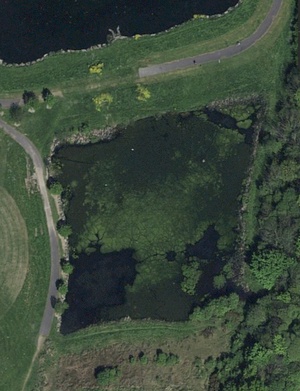
From top: Google Maps image of Tallaght wetlands; Apple Maps image of Tallaght wetlands.
Um.
Liam writes:
Someone (South Dublin County Council?) has requested Google to blur the aerial image of part of the wetlands affected by the recent controversy.
When was this requested and by whom and why was it granted, was it before or after the event? The second picture is from Apple maps and shows what the image should look like.
Anyone?
Yesterday: ‘Like The Surface Of The Moon’