Garda Commissioner Drew Harris addressing the conference of the Association of Garda Sergeants and Inspectors in Cavan yesterday

This morning.

RTÉ’s Morning Ireland broadcast an interview its crime correspondent Paul Reynolds carried out with the Garda Commissioner Drew Harris at the AGSI conference in Cavan.

It followed Mr Reynolds reporting that one of An Garda Síochána’s members is being investigated by the National Bureau of Criminal Investigations for allegedly engaging in “outside security work”, which is not permitted.

Mr Reynolds previously reported that false alarms were allegedly set off at a business and these were responded to by gardaí, in patrol cars, and these false alarms were then reported on the Garda PULSE system.

Mr Harris said he couldn’t speak of the specifics of the case as the matter is being investigated.

Mr Reynolds put it to Mr Harris:

“But you are known and have taken a very strong stand on discipline. I mean, and there has been criticisms of your stance at this conference [AGSI] of the fact that even though allegations have been levelled against individuals, that have not been proven, you have prevented people from being promoted.”

Mr Harris said each case is examined on its merits and he’s examined a number of cases and people have been promoted.

He said others have been delayed until he has received more facts.

Meanwhile, separately…

Anyone?

Listen back in full here

Yesterday: Malingering Odours

Previously: “False Alarms”

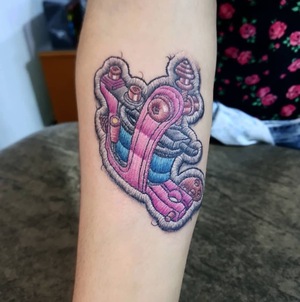
The work of Brazilian tattoo artist Duda ‘Tattoo You’ Lozano: inked-on tatts like sewn-on embroidered patches.

Or you could just sew on actual embroidered patches.

Or just leave it and don’t be at yourself.

laughingsquid

The publication this morning of a report into burial arrangements at Mother and Baby Homes includes a chapter on the transfer of the remains of children and adults who died at the institutions to medical schools for “anatomical study”.

The commission found evidence that children’s remains were studied in Dublin and Galway medical schools but not Cork medical schools.

The report explains that it was legal, under the Anatomy Act 1832, for unclaimed remains to be used in this way, at this time.

But it noted:

“The burials of the anatomical subjects used by the Dublin Medical Schools are properly recorded in Glasnevin Cemetery.

“It has not been possible to establish anything about the burials of the child anatomical subjects used in the Galway Medical School as their names are not known.”

Between January 1920 and October 1977, the bodies of more than 950 children who died in the Dublin Union, and associated institutions, including Pellestown, were sent to medical schools in UCD, Trinity College Dublin and the Royal College of Surgeons in Ireland.

All but 18 of the 950-plus children were “illegitimate” children and aged between 10 minutes and 15 years at the time of their death, while 27 additional stillborn infants were also sent to the Dublin Medical Schools.

The report found:

“Not all deserted or abandoned children who died in Dublin Union institutions were sent for anatomical studies. There is no information available about the criteria (if any) used to choose which children’s bodies were sent.”

The remains of the children examined in the Dublin schools were later buried in the Poor Ground section of Glasnevin Cemetery.

The commission found:

“They were buried in individual burial plots that were located next to those used for ordinary child and adult burials. The usual practice in Glasnevin Cemetery was for the remains of a number of anatomical subjects to be collectively buried in the same plot on the same day.”

It disturbingly adds:

“It is unknown if the remains of individual bodies used for anatomical studies were placed in separate coffins for burial in Glasnevin. A meeting of the Dublin Board of Guardians in 1907 heard accusations that in the medical schools, coffins were not being used for one body alone, but that the practice was simply to fill up a coffin with various body parts from various individuals who had been dissected.”

The commission’s report states that, under the Dublin Cemeteries Act 1964 and bye-laws under that act, if the remains of more than one person were to be put in a coffin, an application had to be made.

The Glasnevin Trust told the commission: “There are no annotations within the burial registers showing that permission was granted…to allow more than one set of remains per coffin.”

However the commission later notes:

“The Glasnevin Trust told the Commission that, while each burial was required to be witnessed by a designated member of staff, the staff did not inspect coffins internally.”

In Galway, the commission found that the Galway Medical School Anatomical Register records that, between 1909 and 1997, the remains of around 690 adults were transferred to the School of Anatomy, Galway Medical School, for anatomical study.

They were transferred from South Dublin Union, Ballinasloe Mental Asylum, Castlebar Mental Hospital, Ennis Mental Hospital and Galway Central Hospital/ Galway Regional Hospital.

The register contains no mention of any children’s remains of having been transferred but the commission states: “evidence exists that children’s bodies were sent to the medical school”.

Of the evidence that shows children’s remains were sent, the commission found:

“In every instance, the body or bodies were supplied by a porter at the Central Hospital/Regional Hospital Galway. In every instance the infant remains were received by the head of the School of Medicine and Anatomy Department, University College Galway.

He paid the porter 10/- for every infant body received. It appears that between April 1949 and November 1964, he received and paid for 35 infant anatomical subjects. None of these infants is recorded in the Galway Anatomical Register.

Unfortunately, no records survive which name the children whose bodies were sold. It is
possible that some of the bodies were stillbirths which, at the time, could not have been registered.”

The report explains that, under the Anatomy Act 1832, a person with “lawful possession” of a dead person could allow for an anatomical examination to take place – unless the person had expressly stated, while alive, that they did not wish this to happen.

This had to be expressed in writing or orally in the presence of at least two witnesses, and bodies could not be sent to schools until at least 48 hours after death.

The report notes:

“In the case of deserted or abandoned children who died in these institutions, there was no one with the legal capacity to object to the bodies being sent for anatomical studies.

“The bodies of “illegitimate” children that were unclaimed by the mother or any other relative, could similarly be used for anatomical studies.

“It is not known, but it seems unlikely, that the mothers concerned were made aware of the existence or requirements of the Anatomy Act at any stage during their stay in any of the institutions being investigated.”

Under the act, the medical schools were legally obliged to ensure that the remains of people used in these studies were “decently interred in consecrated ground” and that a certificate of interment be given to the inspector of the district within six weeks of receiving the remains.

The schools were also legally obliged to maintain registers of bodies received.

However, the commission found that the 48-hour rule and six-week limit “were not implemented in practice”.

It found:

“The Commission has since established that a number of children were transferred for anatomical studies from Dublin Union institutions before the 48 hour period for claiming the body was over. In general, burial took place two to three years after the death.”

The commission also recalls a letter written by the Chief Medical Office of Galway County [not named] to the Department of Health in January 1961, complaining about the size and cost of burial spaces for the remains of those whose bodies were studied.

The office wrote:

“A problem has arisen regarding the interment of such remains of bodies following their use for anatomical dissection.

“According to the Rules applicable to burial grounds for every person over 12 years of
age a burial space of 9ft. x 4 ft. must be provided.

“This would mean that if the remnants of ten cadavers were to be interred, ten graves should be provided, ten graves which would prove very costly and indeed wasteful of graveyard space.

“The remains of a cadaver after dissection consists of dismembered bones, perhaps some
entrails and muscles which could be easily accommodated in a coffin 3’ x 12” x 9”, and if placed vertically in the grave four such coffins could be accommodated in the space above prescribed.

“Markers, of course, would be placed over each coffin.

“There would be no intermixing of corpses. I understand that this procedure is adopted for other anatomical schools. I request a direction if the procedure suggested above would be allowed and approved of by your Department.”

The suggestion was rejected, the commission found.

But, it noted:

“…a civil servant’s note on the file states that ‘… it might be said that these rules are not always (or even usually) strictly observed throughout the country’.”

The report can be read in full here

Earlier: Bessborough: ‘There Are 900 Bodies After Going Missing’

Death In Tuam

Grainne Griffin, Ailbhe Smyth and Orla O’Connor by Ruth Negga (Time)

Behold: curious formations and bizarre textures visible in the vicinity of the Cone Nebula, 2,700 light years from Earth.

Well, this is how it would have been in 681BC, when – who can forget – an assassin brought the 24 year reign of Assyrian king Sennacherib to an untimely end (that’s what you get for sacking Babylon).

Anyhoo – what’s this? Some kind of interstellar dust cloud? To wit:

The unusual shapes originate from fine interstellar dust reacting in complex ways with the energetic light and hot gas being expelled by the young stars. The brightest star on the right of the featured picture is S Mon, while the region just below it has been nicknamed the Fox Fur Nebula for its color and structure. The blue glow directly surrounding S Mon results from reflection, where neighboring dust reflects light from the bright star. The red glow that encompasses the whole region results not only from dust reflection but also emission from hydrogen gas ionized by starlight. S Mon is part of a young open cluster of stars named NGC 2264, located about 2500 light years away toward the constellation of the Unicorn (Monoceros). Even though it points right at S Mon, details of the origin of the mysterious geometric Cone Nebula, visible on the far left, remain a mystery.

(Image: Chilescope; Processing & Copyright: Utkarsh Mishra)

apod

Sara Ryan & Steo Wall – ‘Rise Up’

A remarkable collaboration between Newbridge, County Kildare-born, Cork-based chanteuse Sara Ryan (top right) and Dublin singer/songwriter Steo Wall (left) ‘Rise Up’ unapologetically tackles the hot topic of our time – our collective response to the international refugee crisis.

The single is taken from Sara’s forthcoming album ‘Breathe’, released in the autumn.

Steo, meanwhile, has a fan in kindred spirit Damien Dempsey, who invited him to be the opening act for his shows in Vicar St. Dempsey also joins Davey Spillane and Luka Bloom as special guest collaborators on Wall’s debut album ‘Where I’m From’.

Nick says: The contrast between Ryan’s silky smooth tones and Wall’s take-no-prisoners rap is striking – a steel fist in a velvet glove.

Steo Wall
Sara Ryan

From top: scenes from a protest yesterday outside Leinster House by Supervisors and Assistant Supervisors of Community Employment (CE) schemes ; Bethany Langham

In 2008, the Labour Court in Ireland recommended that it is the responsibility of the Government to provide pensions for the Supervisors and Assistant Supervisors of Community Employment (CE) schemes in Ireland.

Eleven years later, the Government continues to ignore this ruling on the basis that they are not the employers of CE Supervisors.

CE schemes are designed to help those in long-term unemployment gain the confidence and skills necessary to re-enter the workforce.

There are approximately 22,500 participants on 1250 CE schemes in different communities around the country each with a Supervisor who takes care of the day-to-day management of the scheme.

In some cases where there are more than 26 participants on a scheme, there may be an Assistant Supervisor as well. Each CE scheme has a sponsor or multiple sponsor groups who help to oversee the scheme on a voluntary basis.

The Department of Employment Affairs and Social Protection (DEASP) oversees CE schemes. They provide financial support (including supervisors’ wages and employer PRSI) and have final say on the approval of new schemes.

A third party, non-profit, subsidiary company is set up to govern each scheme. The DEASP lodges money for wages, training and materials grants into the bank account of this subsidiary company. The voluntary sponsor of the scheme then transfers this funding out of this bank account and into the relevant locations.

The Government is the sole funder of these schemes and these subsidiary companies are essentially used as an extra layer of bank accounts.

Conor Mahon, who is a CE Supervisor in County Galway, describes the DEASP as his “shadow employer”.

He says the DEASP dictate…

“…how much holidays we get, how much sick leave we get… we’re audited by them. Every aspect of [CE] is micromanaged at every level”.

According to Mr. Mahon, even a small donation made by a member of the community who values the work of CE, results in a “hoopla with the department questioning it [demanding a] letter of explanation”.

Ahead of a planned strike in February 2019, a letter was sent to the sponsors of each scheme from Nora Durcan, Principle Officer in the DEASP.

In this letter, Ms. Durcan instructed how the sponsors should manage the schemes during the strike, reminding them that the DEASP will review funding allocated for the scheme “having regard to the industrial action taken”.

At a Dáil debate on January 29, 2019, Taoiseach Leo Varadkar claimed:

“It would be very unusual for a Government to reject a Labour Court recommendation… I am not sure I have ever seen Government bodies doing it”.

Fianna Fáil TD, John Brassil, reminded the Taoiseach of the 2008 Labour Court Recommendation (LRC) advising that the Government provide CE Supervisors and Assistant Supervisors with pensions.

He also referred to a Private Members’ Bill from 2018 which received a two thirds majority to implement this LCR.

The Taoiseach replied:

“In that case, the State is not the employer… but instead funds, or is the major funder of the body that employs the people.”

The Government’s stance on this matter is that the employer of the CE Supervisors should make provisions for a pension for them. Yet, the DEASP pays employer PRSI for CE Supervisors and Assistant Supervisors.

The Taoiseach is also manipulating the facts.

The subsidiary companies who govern each CE scheme are solely funded by the Government. Unless the Government makes provisions for extra funding for pension schemes, this matter will remain unresolved.

Minister for Public Expenditure, Paschal Donohoe, expressed his admiration for the Labour Court at a Dáil debate in March 2017.

He claimed that the Labour Court and Workplace Relations Commission handle thousands of issues each year and consequently “In order to ensure their continued role in matters of deep importance, it is crucial that the Government supports them”.

His opinion seems to differ in this case. Minister Donohoe claims that if the Government was to honour LCR 19293, the incurred costs due to other groups requesting the same rights, would be in the region of €400 million.

According to Mr Mahon, this scoping document includes…

“…every person or entity that gets funding from the Government [or] that does something beneficial for the community.”

Mr. Mahon adds:

“We have the LCR that none of the rest of them have”. These scare-tactics of Minister Donohoe are based on ‘the worst-case risk scenario’.”

In 2008 when CE schemes were governed by FÁS, a statutory body, €10 million was set aside to fund the provision of a pension scheme for CE Supervisors and Assistant Supervisors.

With the economic downturn, it was agreed on their behalf that this money would be rerouted into other areas of the country that needed the funds more urgently at the time. Since then, a change in Government saw that this money was never returned.

In 2015, Brendan Howlin, the then Minister for Public Expenditure and Reform, agreed to negotiate on this issue. However, according to Eddie Mullins, the SIPTU Sector Organiser for this case, “this [current] Government has basically back-tracked on it”.

When asked if he had ever seen the Government treat a group of people the way they are treating CE Supervisors and Assistant Supervisors, he said:

“No, it’s most unusual that they would treat a Labour Court recommendation the way they’re treating it”.

He regards the behaviour of the Government as “absolutely despicable” .

In 2015, at the Lansdowne Road Agreement, it was agreed that a High-Level Forum would be set up to deal with this issue.

On April 24, 2018, three years later, a Dáil debate was held on the subject of CE pension schemes during which Deputy Willie O’Dea of Fianna Fáil described the Forum:

“It’s members must be very high-level and busy because it has only had 5 meetings since its inception”

On that day, CE Supervisors and Assistant Supervisors from around the country made their way to Dublin for the debate which proved to be a further display of indifference by Government.

As stated by Deputy O’Dea:

“these people have been insulted by the Government tonight… because the Ministers responsible, in particular the Minister for Employment Affairs and Social Protection, did not have the gumption to come in here and read out the miserable script… for not providing them with their justified claim”

Economically, CE Supervisors are suffering. Equal to this is the emotional drain as a result of fighting for their rights and being ignored by the Government for so many years.

Celia Killeney has been a CE Supervisor in Galway for 21 years.Despite being on the same wage for the last 11 years, due to inflation and the rising costs of living, Celia claims she is financially worse-off than she was in 2008.

When asked how being ignored and used by the State has made her feel, she replied “devalued, worthless” and that she feels “it is absolutely disgraceful for a human being to be treated like this”.

A rally organised by SIPTU and FORSA took place outside Leinster House yesterday. Hundreds of CE Supervisors, Assistant Supervisors and supporters took part.

At a press briefing before the rally, it was announced that CE Supervisors and Assistant Supervisors will engage in five consecutive days of industrial action commencing on the 13th of May 2019.

Bethany Langham is a Galway-born, Dublin-based video and broadcast producer. She is currently doing a part-time masters in journalism and media communications.

Rollingnews

Bessborough Mother and Baby Home; the ‘Little Angels’ plot on the grounds of Bessborough House in Blackrock, Cork

The publication this morning of a report into burial arrangements at Mother and Baby homes includes a section on the former Bessborough Mother and Baby Home in Cork which was opened in 1922 and owned and run by the Congregation of the Sacred Hearts of Jesus and Mary.

More than 900 children who were born in, or admitted to, Bessborough died in infancy or early childhood.

The report states it had been “assumed by former residents and advocacy groups” that the children who died in the home were buried in a small burial ground on the grounds of Bessborough.

But, the commission said, from “an early stage”, the commission believed this was unlikely – as the area wasn’t big enough and because it was unlikely the children would be buried in the same burial ground as the congregation.

It has since only been able to establish that just one child was buried in the congregation’s burial ground.

After examining burial records of separate burial grounds in Cork city, the commission also established that, between 1922 and 1929, 54 children who died in Bessborough were buried in St Joseph’s Cemetery on the Tory Top Road in Cork; two infants who lived in Bessborough were buried in St Michael’s Cemetery in Blackrock, Cork in 1958 and 1986; at least one child was buried in Cork District Cemeteray, Carr’s Hill; and four children who had an association with Bessborough were buried in St Finbarr’s Cemetery in Cork.

This morning, on RTÉ’s Today with Seán O’Rourke, Paul Redmond, of the Coalition of Mother and Baby Homes, said:

“The really big headline report here is the fact that the entire Bessborough angels’ plot seems to have gone missing. What we’ve always thought of as the angels’ plot and there is a marker there for it – a little memorial mentioning the babies – the report is basically saying ‘there are no babies buried there’ or there might be one or two.

“But they don’t know where they are. Literally there are 900 bodies after going missing because of this report. It’s quite stunning.”

This morning’s report also found that, between 1927 and 1985, 12 adult women, who were former residents of Bessborough and whose deaths were not childbirth related, were buried in St Joseph’s Cemetery.

One of these women entered Bessborough in 1922 at the age of 20 and remained there until she died in 1984. Another of the women started living in Bessborough, aged 21, in 1924 and remained there until her death in 1985.

The commission also identified the deaths of 14 mothers who lived in Bessborough – nine of whom died of pregnancy or childbirth-related reasons. However the commission was unable to established the burial place of these 14 women.

The commission asked the Congregation of the Sacred Hearts of Jesus and Mary about the burial arrangements but the congregation “said it had very little information as the records compiled in the institution were held by the Child and Family Agency (TUSLA) and it did not have access to these records”.

However the commission explained there is “no information about burials in these records”.

It found:

“A number of members of the congregation provided affidavits and/or oral evidence to the Commission. They were able to provide remarkably little evidence about burial arrangements.

“The congregation told the Commission that the burial ground in Bessborough was opened in 1956 for deceased members of the congregation and the congregation does not know where the vast majority of the children who died in Bessborough are buried.

“The Commission has not seen any evidence that the approval of the Minister for Local Government for the opening of this burial ground was sought or granted as required by the Local Government (Sanitary Services) Act 1948.

“A member of the congregation who was in Bessborough for most of the period 1948-1998 told the Commission that she did not remember any child deaths during her time there but she implied that the children who did die there were buried in the congregation burial ground.

“In the years 1950-1960 (inclusive), 31 children died in Bessborough so it is rather surprising that she does not remember any deaths.

“Another congregation member who was in Bessborough from 1978-1985 told the Commission that one baby died during her time there. She said that the manager of the maternity hospital (who was also a member of the congregation) “took over the arrangements for the burial”.

“She “vaguely remembered” that the mother wanted the baby buried in St Michael’s Cemetery but she did not know where the baby was actually buried.

“The Commission has established that there is no record of this baby in St Michael’s burial records. She did not remember if the mother’s family was involved in the burial arrangements but she was clear that the congregation had bought the coffin for the baby.

“In evidence to the Commission, a member of the congregation who was there in the 1980s said that there were two children buried in the burial ground during her time there and a third was disinterred elsewhere and reinterred in this ground.

“Another member of the congregation who was in Bessborough for a period in 1971 and again between 1975 and 1981 swore an affidavit in which she said that she remembered one child who died and was buried in the congregation’s plot in the grounds.

“The recollections of these two congregation members seem to be incorrect In fact, it would appear that there is only one child buried in the congregation’s burial ground and that burial took place in 1994.

“The burial ground has some individual memorials to other children who died in Bessborough but it is unlikely that they are buried in this plot.

“It is possible that children who died in Bessborough were buried within the grounds. However, to date, the Commission has found no physical or documentary evidence which indicates that this occurred.”

In relation to the commission’s efforts to establish if there are other burial grounds on the Bessborough site, the report found:

“The Commission engaged forensic archaeologists to carry out a cartographic and landscape assessment of possible unrecorded burial arrangements in the Bessborough grounds.

“As already stated, the grounds measure approximately 60 acres. It is also possible that burials took place in the grounds that no longer form part of the Bessborough estate, that is, a total area of 200 acres.

“The forensic archaeologists and the Commission’s researchers reviewed all available cartographic sources and aerial images in order to identify possible burials within the
grounds of Bessborough. A site survey was also conducted.

“It is clear that there are a number of locations within the grounds where burials could have taken place. However, there is no significant surface evidence of systematic burial anywhere except for the congregation burial ground.”

The report also examined aerial photography taken in 1951. It states:

“The Commission examined vertical aerial photography taken by the Irish Air Corps in 1951. This series includes high resolution aerial photography of the Bessborough Estate.

“The majority of child deaths at Bessborough occurred before 1951 (over 700 and it would be reasonable to expect that, if there were burials there, an aerial photograph taken in February 1951 would show up some ground disturbance, or anomaly on the landscape.

“If over 700 children were buried on the Bessborough Estate before 1951 the aerial photograph would be expected to give some indication of where the remains are located.

“The aerial photographs of the Bessborough site were examined by forensic archaeologists who determined that no visible features on the Bessborough landscape were indicative of any obvious site hosting the remains of such a large number of children.”

It later states:

“…as no physical evidence of possible locations was found, the Commission did not consider it feasible to excavate 60 acres not to mention the rest of the former 200 acre estate.”

The report states that records of admissions, births, discharges and deaths were compiled by the congregation and given to the HSE in 2011 who subsequently gave them to TUSLA in 2013.

Read the 96-page report in full here

Earlier: Death In Tuam

Burials As Late As 1990

Broadsheet.ie