STOP!

Do Not Attempt To Move This Post!

Congratulations to veteran Broadsheet commenter Clampers Outside who got married at the weekend.

Clampers, best known for his loathing of identity politics, has been a constant, loyal and entertaining presence on the ‘sheet since 2010.

We wish him and his new bride our warmest regards.

What God has joined together let no one disengage with a bolt-cutter.

From top: the MV Celine at Dublin Port last Friday; Derek Mooney

Up to last Friday it was difficult to find a good visual representation for Brexit in Ireland. Yes, there were maps showing the six counties in one colour and the 26 in another, but apart from those or some grainy photos of border posts and black coated customs men standing behind old tin signs emblazoned “Stad”, there were few clear, defining symbols for Brexit in an Irish context.

That all changed last Friday.

The change came in the form of a ship. But not just any ship. This one, christened the MV Celine by the Taoiseach and assorted other lesser celebrities, is the world’s largest short sea, roll-on roll-off cargo vessel. It will directly connect Ireland to the European continent via Rotterdam and Zeebrugge, by-passing the UK entirely.

As images go, it is an impressive one. But the image-makers real triumph lay in finding an appropriate nickname for the newly named ship.

While “Celine” may be the official name that adorns the ship’s champagne drenched hull, the spinners on the quayside were intent that the media – and by extension we – call it by their chosen soubriquet: “the Brexit Buster”.

What a coupling, a damned big ship with an on-message nickname. It is a neat piece of messaging, conveying the impression that Ireland is ready and prepared for the worst that Brexit can throw at us.

The MV Celine’s statistics are striking. At 234m in length, the Celine is, in terms of capacity, twice the size of any other ferry currently operating out of Dublin Port. It can hold 580 standard truck trailers along 8km of parking lanes.

But size isn’t everything.

The real significance of the MV Celine is that it points to our post Brexit trading future. A future where Ireland’s EU27 imports and exports no longer must go via the UK and suffer the hassle, time delay and cost of having to going through not one, but two, sets of customs and border patrols as they enter and then exit the UK.

This is important as around 80% of Irish road freight, destined for the rest of the EU, goes across the UK. This is what some call our land bridge to EU, though it is hardly much of a land bridge when you must take a ferry at each end.

If you want a sense of the scale and extent of the delay and inconvenience we will may face in the worst post Brexit scenarios, then consider this simple fact: goods going through Dover from outside the EU take 15 times longer to process compared to those coming from within the EU (45 minutes from outside versus 3 minutes from inside).

Can you imagine the accumulated tail backs there will be at British ports? Now, multiply all those delays by two as Irish goods going to or from the EU across the UK will have to face those potential delays twice: once as they enter the UK and once as they leave it.

In the absence of some alternative direct routes, the UK’s national customs computer system will be handling both the inward declarations of Irish exports to the UK and the transit of Irish goods travelling through the UK and on to mainland Europe.

But, the UK’s national customs computer system is due to be replaced, with the new Customs Declaration Service (CDS) system due to launch in January 2019, two months before the UK brexits. As if that were not worrying enough, a UK National Audit Office 2017 review of the UK customs computer system’s readiness for Brexit found that

“…there is still a significant amount of work to complete, and there is a risk that HMRC (Her Majesty’s Revenue and Customs) will not have the full functionality and scope of CDS in place by March 2019…”

So, assuming the British government does what it currently says it will and exits both the Customs Union and the Single Market as well as the EU, then it is essential that Ireland to look for better routes to send our good to and from the rest of Europe.

These routes are vital for us as an island nation as seaborne freight accounts for 84% of Ireland’s trade in terms of volume and 62% in terms of its value. It is also highly focused on one location with 46% of all seaborne trade (by volume) passing through Dublin Port.

But, impressive as the MV Celine may be, one ship is not going to be the solution to our problems. Neither will two or three such vessels.

The real value and importance of the MV Celine right now is not the number of trucks she can carry every 38 hours to Belgium or Holland, but rather in the policy course she sets.

Should we now be looking at developing new direct shipping routes with mainland Europe, particularly with France, Belgium and the Netherlands?

But that question begets another one, are we right to assume that all these new routes should have Dublin port as their Irish hub? Should we not now be seriously evaluating our infrastructure capacity and looking to develop other Irish ports to serve these new shipping routes?

Some 60% of the trade at Dublin Port involves the UK – would it not make more sense, especially as they are investing in new customs and border facilities at the port, to make Dublin the key point of entry for our UK only good traffic, along with Drogheda and some other ports along the eastern seaboard?

Might this be a way of freeing up some extremely valuable land in and around Dublin Port for much needed high-density development in the centre of the city?

Might Brexit planning provide an opportunity for dusting off the PD’s 2006 New Quarter proposal, though this time with a more sensible and scaled down version that does not see the whole of Dublin Port shut down and shipped Northwards.

We should be considering expanding Rosslare and/or developing a new purpose-built port along the South East or Southern coasts to serve the new fast EU shipping routes.

One of the potential attraction of Rosslare, as Irish Rail was keen to tell the Seanad Special Select Committee on Brexit, is that Irish Rail is the port authority for Rosslare-Europort and so investment plans could be put in place that do not impact on the debt levels of Irish semi-state-owned ports.

Not only that but including Irish ports in the trans-European transport policy (TEN-T) could mean EU infrastructural funding for the “necessary modifications to Irish ports”.

Modification is an understatement. Increased direct shipping volumes with mainland Europe would require major infrastructural investment to provide modern facilities that provide for the speedy and high-tech loading of these faster roll-on/roll off vessels.

Perhaps the image of the ship is all the government wants just for now and so it sees its job as done, for now. Hopefully this is not the case, though it often seems to be this government’s modus operandi.

Hopefully there are contingency plans sitting on a desk somewhere while Ministers and officials wait to see if Theresa May eventually opts, when all other avenues are hopefully closed off, to take the avenue of keeping the UK in either “a” or “the” Customs Union and “a” or “the” Single Market.

If she doesn’t, then we will have very little time to act. So, now is a good time to start the feasibility planning and commence talking to a variety of international experts who know how to build, equip and run these modern ports.

Maybe that way we can turn the floating impression that Ireland is ready and prepared for Brexit into a more anchored reality.

Derek Mooney is a communications and public affairs consultant. He previously served as a Ministerial Adviser to the Fianna Fáil-led government 2004 – 2010. His column appears here every Tuesday Follow Derek on Twitter: @dsmooney

Rollingnews

Daleo Lama writes:

I’m all for #repealthe8th, I always have been… *cough*

Kudos to @repeal_shield for breaking new secret censorship ground.

Unfortunately they caved in to the anti-censors since I made this video.

But … VERY interesting seeds were planted.

Kind Regards
Your Leader
Daleo Lama


Thanks Conor Magahy

At the weekend.

In Youghal, Co Cork.

Clean Coasts Ballynamona tweetz:

From our beach clean in Redbarn on Saturday. So let’s try and see if we are dating this bottle correctly. Would it be late 1960s maybe? Seeing as the currency changed in Ireland in 1971?

Anyone?

Meanwhile…

Clean Coasts Ballynamona adds:

This KP packet of Alien Invaders has a best before date of 11th Jan 1986. This was 31 years old when it was cleaned up in a beach clean…

Meanwhile…

Clean Coasts Ballynamona writes:

This plastic bottle all the way from France was found on Ballynamona Beach. The price on it is the Nouveau Franc, used in France between 1960-62, making this plastic rubbish approx 55 years old.


Yesterday.

Royal Canal (6th Lock), Dublin 7

Ultan Mashup writes:

Repeal + Palestinian Flag flying…

Save Poolbeg.

Meanwhile…

In fairness.

From top: Minister for Finance and Public Expenditure & Reform Paschal Donohoe giving a media briefing of the Draft Stability Programme Update 2018 in the Department of Finance last week; Michael Taft

The Government produced their Draft Stability Programme Update containing projections for the economy and the budget up to 2021. They will firm up on these numbers – along with the projected fiscal space – in the Summer Economic Statement. But it is not likely to differ in any substantial way.

There’s been lots of commentary: the validity of GDP, rising employment, available budgetary resources, etc. Let’s take a step back and look at the long-term, using the CSO’s GNI* which attempts to factor out distortions in our GDP.

What we find is an ever slowly shrinking social state.

There’s been a long-term stagnation at best. Since 1995 there has only been one year that public spending was lower than it what it is projected to be in 2020/21.

(Note: during the crisis years, spending as a percentage of GNI* shot up. This was not due to increased public expenditure which actually fell (though bank debts were included). It was GNI* falling by 22 percent between 2007 and 2011. So a fall from that peak was inevitable).

There is a projected slow reduction in public spending (as a proportion of output) between 2017 and 2021.

We find primary public spending falling, with current spending (public services and social protection) falling faster. Fortunately, investment is on the rise.

The above doesn’t mean that public spending is being cut in nominal terms. It is actually increasing, from €71.4 billion to €83 billion – an increase of 16.3 percent between 2017 and 2021. This may seem like a substantial amount.

But when you factor in prices and population rise, the increase comes to 7.4 percent. This increase, however, reflects greater emphasis on investment. Current spending will rise by only 3.2 percent up to 2021, or less than 1 percent annually. That is going to be a tight squeeze.

How does this compare with our peer –group in the EU; other Northern and Central European economies?

We can compare the Government’s and EU Commission’s projections for 2019.

Ireland would have to spend an additional €23.5 billion just to reach the average of our peer group. However, this doesn’t take account of the different factors that drive spending in particular countries. For instance, because of the older age demographic other EU countries have to spend more on pensions than Ireland.

So if we exclude expenditure on pensions (taking the proportion of pension expenditure in 2016 and applying it to 2019 levels), we find that Irish primary public spending comes in at 29.6 percent of GNI* compared to our peer group average 35.1 percent. While reduced, this still leaves a gap of €12.3 billion.

However, we also have to factor in our higher young demographic, which should drive education and family support expenditure higher than our EU peer group. There are other factors: prices, defence spending (which, however, is a discretionary category), dispersed population, and categories which constitute expenditure but are counted as household and not government spending (e.g. our old friend – water and waste spending).

Therefore, we should be careful about using comparative headline rates. However, there is strong evidence that Ireland is an under-spender compared to our peer group.Becoming a more European-type spending economy is not an easy task. One could argue for higher taxation but there is no gold at the end of the fiscal rainbow.

Clearly, we have a low ‘social wage’ (employers’ social insurance). In other countries this finances enhanced in-work benefits and health services. But increasing the social wage would require systemic multi-employer collective bargaining structures to ensure equity – and we don’t have these structures.

We could be entering into a difficult fiscal and economic cycles. Even before the EU starts bringing multi-national tax avoidance under control (and, so, reducing our revenue), companies are taking unilateral steps to reform their tax strategies which could put downward pressure on Irish corporate tax revenue.

Then there’s Brexit. Then there’s the still the high level of general government debt, though estimates vary depending on the measurement.

We seem to be stuck in a structural trap – a trap that is becoming tighter. How do we break out of it?

Here are three responses:

First, abandon net tax cuts. If there are to be tax cuts then these should be funded by tax rises in other areas. And within this, push out the boat a little. A good start would be to let the 2019 property valuations come on stream without amendment.

Second, constitute a collective bargaining structure which would integrate an increase in the social wage with overall wage increases. This would have the benefit of strengthening our automatic stabilisers (e.g. pay-related unemployment benefit) which would keep domestic demand up if there are job losses with a Brexit gone wrong.

Third, engage in real ‘public sector reform’ (not the crash n’ burn of the austerity years). This would focus on increasing productivity through the introduction of employee-driven innovation (discussed here).

However, this process requires trust between all partners. The Government could help to build such an environment by committing itself to full pay-restoration and an end to the two-tier pay structure and negotiating in good faith the time-scale.

In other words, we don’t have to immediately reach for the tax hike cudgel. But we do need a long-term vision of where we want to be in the future.

And being in in a low-spend, low-tax society where people continue to purchase public goods in private markets and doing without benefits that other European workers enjoy – well, that’s not much of a future.

Michael Taft is a researcher for SIPTU and author of the political economy blog, Notes on the Front. His column appears here every Tuesday

Rollingnews

You are invited.

To a silent die-in “to protest deaths of people who cycle” outside Leinster House, Kildare Street, Dublin 2 tomorrow at 6pm.

Mike McKillen writes:

This past week has seen the tragic killing of a young person cycling on Dublin roads, bringing the total number of cyclists killed this year to 5.

2017 was the deadliest year for people who cycle in Ireland with 15 deaths, the highest in 10 years.

The issue of safe streets is not just affecting people who cycle; 14 pedestrians have already lost their lives this year. It is worth noting that 2017 had the lowest number of fatalities for people in motorised vehicles in over a decade.

I BIKE Dublin and Dublin Cycling Campaign are conducting a silent demonstration tomorrow outside Leinster House at 6pmto express their sorrow and anger at this latest death on Irish roads, and to call on the government to invest in safer streets as a matter of urgency.

We are calling on the Government for –

A minimum of 10% of transport budget allocated for safe cycling and walking

Better design of cycling and walking infrastructure, especially at junctions where people are forced to interact with motor vehicles.

Dublin Cycling Campaign

iBikeDub

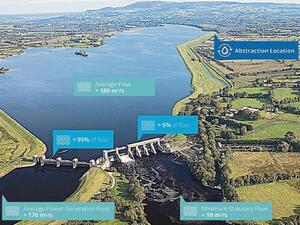
Irish Water propose to pump 300 million litres of water daily from the River Shannon at Parteen Basin (above) to meet the future water demands of the Greater Dublin area

Irish Water have said that it’s best
That they build a big pipe to the west
It’s worth it, they think
To let Dublin drink
But the locals are far from impressed

John Moynes

Graph: Irish Water

Broadsheet.ie