Recently returned after a long hiatus, Glove and Boots’ resident thespian Johnny T translates a scene from Shakespeare’s Romeo And Juliet into Brooklynese with the help of director Fafa.



Recently returned after a long hiatus, Glove and Boots’ resident thespian Johnny T translates a scene from Shakespeare’s Romeo And Juliet into Brooklynese with the help of director Fafa.


From top: protestor Colm Reddy outside Leinster House during the Dail’s Apple Tax ruling debate last week; Michael Taft
Ireland could be stuck in a reputational and diplomatic damage-zone for years.
Michael Taft writes:
There has been so much written about the Apple tax ruling. Here I look at some of the longer-term implications.
But let’s first nail down some confusions and misunderstandings.
First, the ruling is not an attack on Ireland’s 12.5 percent tax rate. As Peter Brennan of EPS Consulting stated:
‘The Government argues that there is an effort to force Ireland to increase the current rate of corporation tax. Not so . . .There is a huge difference between alleged corporate tax avoidance and the setting of Ireland’s headline rate of corporation tax . . . a ruling from the commission in 1997 clearly indicated that Ireland’s single rate of corporate tax was a general measure under EU state aid rules and was therefore legal and consistent with EU competition policy.’
Second, this is not a tax ruling as such. According to Professor Edward Kleinbard:
‘”The heart of the case is simply that Ireland gave Apple hidden subsidies in exchange for jobs. The only tax connection is that Ireland harnessed its tax system as the instrument to deliver these subsidies. Imagine Dublin promised Apple €220,000 in cash annually for every job located in Ireland.
At 6,000 or so jobs, this totals about €13bn over 10 years. This would clearly equate to an instance of state aid . . . The commission concluded that this is the deal Ireland agreed — but, instead of collecting tax at the Irish 12.5 per cent tax rate and writing cheques to Apple, Ireland forgave substantially all of Apple’s Irish statutory tax liability.”
Nor is it about large nations ganging up on small nations. Before Apple, the largest EU ruling on illegal state aid delivered through the tax system was against France and the French EDF company.
This is about illegal state aids – something that has been part of the EU since the 1951European Coal and Steel Community treaty.
While there have been great memes on social media about what Ireland could do with the €13.5 billion, we shouldn’t get carried away.
While these are legitimate metaphors, Ireland is unlikely to receive this full amount. As Professor James Stewart observes:
“…the commission also note that the amount that may be recovered by Ireland will be much lower if as a result of information “revealed through the commission’s investigation” profits are reallocated to other jurisdictions . . . In addition, the commission note the amount recovered by Ireland would also be reduced if larger sums were reallocated to the US parent to “finance research and development”.
How much could Ireland hope to get? This is speculative at this stage. People who have a much greater grasp of these esoteric international tax rules than me have stated the final figure could be as low as €2 billion but maybe €5 billion. Or maybe more. Or possibly less. Nonetheless, this could be a boon for infrastructural investment.
Nor is it the case that the government is in full control over this ruling.
Apple has announced it will appeal and this process could take years. So instead of a neat situation whereby Ireland would receive €13.5 billion if the Government accepted the ruling, the reality is that we are likely to receive much less and – even if the Government didn’t appeal – we will have to wait years on Apple’s appeal (and may end up with nothing if the appeal is upheld by the European courts).
The Government’s decision to appeal can be partly explained by the fear of two queues forming at their doorstep. The first queue concerns the ruling itself.
As the EU Commission states:
‘The amount of unpaid taxes to be recovered by the Irish authorities would be reduced if other countries were to require Apple to pay more taxes on the profits recorded by Apple Sales International and Apple Operations Europe for this period.’
It is already beginning – with Spain, Austria, Italy and France beginning to investigate what is due to them from the Apple profits. Just what any Government needs – negotiating with other countries, possibly going to court, all that snooping around our tax affairs.
The second queue may form if the EU Commission is investigating other companies potentially benefiting from illegal state aid.
It is being widely reported that the EU Commission is investigating six more cases of Irish deals with multi-national companies. And a Reuters investigation in 2013 showed that at least 74 percent of the 50 biggest U.S. technology companies, including Google and Facebook, use practices similar to Apple’s to reduce their tax bills (these are not all Irish based). So Apple may only be the beginning.
If either or both these queues start forming, Ireland could be stuck in a reputational and diplomatic damage-zone for some years.
The Dáil debate last week was conducted in the dark. TDs did not have access to the 150-page ruling (it will be published after the Government, Apple and the EU Commission agree on redactions for commercially-sensitive information – this could take months).
Therefore, it could not independently assess the ruling nor could it assess the likelihood of a successful Government appeal.
Fortune reports that:
‘Last year, the European Commission published a list of six tax rulings and 59 “measures similar in nature or effect” since 1991, which it had challenged on the basis of state aid rules. It was successful in almost all cases.’
The EU Commission has a high success rate in fighting off appeals in the European Court. The Government may know its chances are slim and are undertaking the appeal in an attempt to buy time.
What is the long-term impact of the Apple ruling on Ireland’s low-tax FDI strategy?
Technically, it could be very little. After all, the EU Commission ruling is not about tax policy; it’s about illegal state aid. And the tax provisions through which those subsidies were delivered no longer exist. In this respect, the Apple case is historical.
However, if the state were found to have made special deals with other companies this could give Ireland the image of operating an ad hoc legal and tax framework – one which business and just about everyone else would have little confidence in. That could be quite damaging.
But the biggest challenge for Ireland is that the Apple and related decisions will accelerate moves towards greater European tax cooperation and coordination.
Though hardly mentioned in Ireland, only weeks before the Apple ruling the European Parliament overwhelming passed a resolution containing a number of progressive measures to fight multi-national tax avoidance and evasion (the full text of the resolution can be found here):
EU register of beneficial owners of companies, and a global register of all assets held by individuals, companies and entities, such as trusts and foundations, to which tax authorities would have full access.
A tax havens blacklist with stronger sanctions against non-cooperative tax jurisdictions,
Action against abuse of “patent box” regimes and stricter definitions of what is allowed under transfer-pricingTax good governance rules in EU trade agreements
A common consolidated corporate tax base (CCCTB)
An EU-wide withholding tax, to be collected by member states, to ensure that profits made in the EU are taxed at least once before leaving it
Measures like these are necessary to advance corporate accountability and tax justice throughout Europe. However, Ireland continues to resist.
While this resolution found support across the political divide in the European Parliament (514 voted for, 68 against with 125 abstentions) among the Irish MEPs only Nessa Childers supported the measure; the rest opposed or abstained.
One lesson we can draw from the Apple ruling is that the only agency that can break the tax-avoidance/evasion strategies of multi-national capital is a supra-national one; in this instance, the EU. Would a single nation-state (never mind a small one) have been capable of making this ruling and making it stick? Extremely doubtful.
There is a fear that a rational, democratic and accountable corporate tax regime in Europe will undermine Ireland’s ability to incentivise foreign direct investment (FDI).
It is legitimate to ask whether Apple would have sited thousands of jobs here without the ‘tax-deal’. But such questions should not lead us into apologies for global tax avoidance, never mind our participation in it.
In the first instance, the Dáil should assert is role in this process even with the Government appealing.
The Public Accounts Committee or a special committee should hold hearings on the ruling itself, clarify the issues, assess the likelihood of a successful Government appeal and the potential for further cases down the line – in both Ireland throughout Europe.
This is supposed to be the era of ‘new politics’ with a heightened parliamentary role. Well, let’s heighten it.
But these questions should also lead us into a more profound, evidence-based debate on our future in the international marketplace and the policies to incentivise foreign investment.
That debate should start from this simple premise – what is good for FDI is also good for the Irish people: a modern infrastructure, investment in education, a culturally-diverse society, affordable housing costs, comprehensive public transport and accessible cities, strong public services (low-cost, high quality childcare) and social security (health and in-work income supports), transparent governance, recreation and leisure activities, economy-wide employee innovation and participation and so on.
And tax policy? One that supports investment, investment and more investment.
We can do this. Or we can continue to participate in a global race-to-the-bottom; and even worse. We can – just as we did during the speculative-fuelled boom years prior to the crash – continue to close our eyes to the reality around us
And hope the world doesn’t notice us.
Michael Taft is Research Officer with Unite the Union. His column appears here every Tuesday. He is author of the political economy blog, Unite’s Notes on the Front. Follow Michael on Twitter: @notesonthefront

Norwegian black metaller and town councillor Fenriz
Most metal stars who seek a thrill
Turn to bottle or powder or pill
But I’m shocked to say
That up in Norway
They’re councillors, against their own will.
John Moynes
Pic: Pitchfork

A clever anamorphic by Czech graffiti artist Milane Ramsi: his name written backwards with the background painted in to create the illusion of floating 3D typography.

The Hawe family home in Barconey, Ballyjamesduff, Co Cavan
Apart from one previous killing in the 1980s, the phenomenon of murder-suicides by parents in Ireland/Northern Ireland appears to have started around 2000.
There have been 24 incidents of completed or attempted filicide-suicides in the island of Ireland since the turn of the century. On average, there are only seven such cases a year in the United Kingdom.
So, why is this happening?
Unfortunately, because of the way in which filicide-suicide is currently dealt with it, it is almost certain that reported accounts are less complete than in the case of other crimes.
The inquest system – which is designed to focus on the cause of death of a victim rather than the motivation of a perpetrator – does not provide an adequate method of exploring the causes of filicide-suicide.
This is exacerbated by the fact that, due to the death of the perpetrator, such crimes are rarely followed by any criminal trial.
Much of the reporting and inquest proceedings involves the paying of tribute and sympathy to victims and perpetrators.
Media sensitivity and concern for surviving family members of the deceased also results in light reporting of the background to such crimes.
Overleaf, we have compiled all available information on each incident and, despite the lack of rigour in reporting these cases, some factors are notable..
The dramatic increase in filicide-suicide appears to largely coincide with an increase in the use of anti-depresssants.
Although in many cases the medical history of the perpetrators is not fully detailed, it appears that a number of the perpetrators had either recently commenced or ceased taking such medication.
A question arises as to whether or not this may have resulted in an extreme response to stresses, which might not otherwise have occurred.
The vast majority of the perpetrators were well regarded and integrated into the local community in which they lived. Most lived in rural areas and were active members of local GAA clubs and the local Catholic Church.
Something which may need to be considered is to what extent past sexual abuse of the perpetrators may be contributing to filicide-suicide in Ireland.
As with the role of anti-depressants, this is an issue which – although referenced in at least one of the cases listed – has been largely unexplored in coverage of these killings.
Without full State reports into all cases of filicide-suicides, it is not possible to ascertain what exactly is causing these crimes and take steps to prevent them occurring in future.
Such reports, which are mandatory in the United Kingdom in all cases of murder-suicides within 12 months of someone having dealt with mental health services, would not only provide information which would be of assistance in preventing future crimes but would also help the surviving family members of the deceased in understanding why exactly such crimes occurred.
Ironically, as illustrated by at least one of the cases referenced below, without a proper consideration of such crimes, these family members may not only be left without comprehension as to how such crimes occurred but may even become a target for gossip and misstatement in their local communities.
We will correct any errors.





MORE to folly.

An excerpt from a 2008 Atlantic interview with director David Lynch, designed and directed by Jackie Lay. To wit:
A lot of artists think that suffering is necessary. But in reality, any kind of suffering cramps the flow of creativity.
[soundcloud url=”https://api.soundcloud.com/tracks/282537894″ params=”auto_play=false&hide_related=false&show_comments=true&show_user=true&show_reposts=false&visual=true” width=”100%” height=”450″ iframe=”true” /]
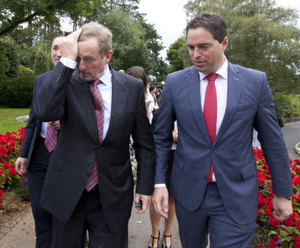
Taoiseach Enda Kenny, and Martin Hayden, chairman of the Fine Gael parliamentary party, at the party’s think-in in Newbridge, Co Kildare this morning, and the audio of an interview Mr Kenny gave to KFM Kildare this morning
On Saturday, Pat Leahy, in the Irish Times, reported that the C&AG found that hundreds of millions may have been lost in the sale of Nama’s Northern Ireland property portfolio, Project Eagle, to US investment firm Cerebrus.
It was reported that this loss may have been due to what the C&AG found to be “shortcomings” and “irregularities” in the sale.
The C&AG report is due to be published on Wednesday.
The report about the C&AG study followed a BBC Northern Ireland Spotlight programme into Project Eagle broadcast last week, which followed an earlier Spotlight programme in March – both of which made serious allegations about the Project Eagle sale.
Readers may recall how, on June 1, Taoiseach Enda Kenny told the Dáil:
“There has not been any allegation of wrongdoing against NAMA”.
In addition, on June 8, Mr Kenny told the Dáil:
“Nobody has presented me with evidence of wrongdoing by Nama”.
Further to this.
Taoiseach Enda Kenny spoke to Shane Beatty, of KFM Kildare, this morning, ahead of the Fine Gael’s knees-up think-in starting today in Keadeen Hotel, Newbridge, Co Kildare.
The C&AG report into NAMA was discussed.
From the interview…
Enda Kenny: “If I find… if I find, and our colleguess in Government, find that there is a case to be examined well then I won’t be opposed to that.”
Shane Beatty: “But viewers of BBC’s Spotlight will say we’ve already seen a case that I think we need to have an inquiry, why do we have to wait until Thursday?”
Enda Kenny: “There are two criminal investigations going on in a different jurisdiction.”
Shane Beatty: “None here.”
Enda Kenny: “None here, and the National Crime Agency in the UK have confirmed that there is no case that they have, or are in pursuit of, in repsect of NAMA down here. So, the C&AG’s report is about a ‘value for money’ audit and you, as was pointed out on many occasions… depending on the process you follow for valuations, you might get different results.
“If you, for instance, were to dispose of the properties now with the devaluation of Sterling you’d get a different result also. But I think this is an extensive report, we do need to read it, everybody needs to reflect on it. And if there are questions arising from the Public Accounts Committee’s engagment with NAMA, they are due in before them very shorty [September 22], I’m not adverse [sic] to taking action, but I need to know what is we are taking action on.
Shane Beatty: “Did you watch the Spotlight programme?”
Enda Kenny: “Yes I did, and I saw that, and I found it quiet incredible, but you know, Shane…”
Shane Beatty: “Incredible, how?”
Enda Kenny: “Nothing suprises me at the kind of activites that take place in politics. And in that sense I found it extraordinary to hear the audio report of engagements and meetings of certain personnel.”
Previously: Screech
Meanwhile, yesterday….
Labour TD and vice chairman of the Public Accounts Committee (PAC) Alan Kelly was interviewed on This Week by Colm Ó Mongáin following the reported findings of the C&AG report.
During the interview Mr Kelly said, in recent days, he was approached by a senior member of Nama ahead of Nama’s appearance before PAC on September 22.
From the interview…
Alan Kelly: The [C&AG] report on this should be released, and obviously then, Nama will come before the PAC. It’s a matter for Nama whether they want to make public statement on it, I believe they should, I believe they’ve been quite naive to a point in relation to this.
Even this week, a senior member of Nama contacted me to brief me before they met before the PAC. I redirected him to the chair of the PAC. I was not comfortable that selective briefings was the way to go to be appropriate given the situation we find ourselves in. But that just shows another level of naivety, I believe, in relation to Nama.
Colm Ó Mongáin: These briefings that were offered by Nama, how was that approach made and by whom?”
Kelly: “Ah well, I won’t, eh, get into individual, but, ah, just a call during the week to meet up. Look, I just explained the Public Accounts Committee is a different committee to every other committee, you know, it has different powers. And it wouldn’t be abnormal for other organisations to brief committee members of other committees but, in relation to this scenario, I think selective briefings wouldn’t be the way to go. And, obviously, I referred to the chairman in relation to this. But, for me, I didn’t think it was appropriately the way to deal with things.
Ó Mongáin: Is it your understanding that all members of the committee were offered these briefings?”
Kelly: “I have no idea, I was going to raise it with my committee colleagues when we meet. I doubt it, but I don’t know so I wouldn’t like to say indefinitely. But I will say this, I don’t think there was necessarily anything malicious or intentional in that way in relation to that contact… It’s another sense of naivety, I feel on the part of Nama in relation to how they do things. It gave me some concerns.”
Ó Mongáin: “Well, what did they want to tell you?”
Kelly: “Well that’s a matter for Nama. I understand that they’re in front of us in the coming weeks and I suppose they wanted to brief us on various different actions, but that would be a matter for Nama to state because obviously I don’t know because I didn’t meet them.”
Listen back to interview in full here
Transcript via Namawinelake
Earlier: ‘I Didn’t Enjoy The Election… But I’ve Got My Mojo Back’
‘Nobody Has Presented Me With Wrongdoing By Nama’
Eamonn Farrell/Rollingnews