



Kathleen Sharkey, from Tory Island, Co. Donegal, on the 2015 same sex marriage referendum.
Conor Finlay writes:
One of the most effective and emotional pleas for a Yes vote.
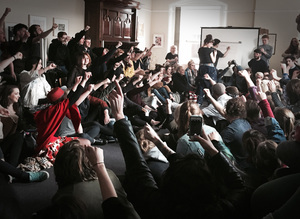
 From top: NCAD college, Dublin last month and Julien Mercille
Yes.
They are revolting.
But why?
Dr Julien Mercille writes:
Students are rising. In Quebec (Canada), Amsterdam, London and elsewhere, students are taking matters into their own hands and trying to resist austerity, neoliberalism, and the commercialisation of education.
But the media has been discreet about how it’s also unfolding in Ireland. You could almost call it ‘the propaganda of silence’.
In Quebec, students have been protesting forcefully for several years against hikes in tuition fees and austerity. The current government there is led by the Liberal party, similar to Fianna Fáil or Fine Gael. It’s implementing an austerity programme, including cuts and attacks on education, health care and social services. Like here, austerity seems only to apply to ordinary people, while corporations and the rich are not subject to the same actions by the state.
About 130,000 Quebec students were recently on strike for one day and about 60,000 for many more days. This is nothing new: in 2012, as many as 316,000 went on strike for similar reasons. The police has reacted violently, causing injuries to the protesters.
In the Netherlands at the University of Amsterdam, students have occupied buildings. They propose an alternative to managerial policies that have turned education into a service to the corporate sector.
One slogan in the protests has been: ‘We are not asking for a free university; We are asking for a free society; Because a free university in a capitalist society is like a lecture hall in prison’.
Similar events have taken place elsewhere, at the London School of Economics (LSE) and the University of the Arts in London, as well as at York University and the University of Toronto in Canada. The motives: students want to be creative, not cogs in a machine designed to serve the needs of the powerful while absorbing higher fees.

In Ireland, higher education has also suffered under austerity. The chart (above)) shows that real public expenditure per student has dropped by a whopping 27% since 2006 (Central Statistics Office data).

Meanwhile, this (above) shows that student fees have increased (Higher Education Authority data). The divergence with decreasing public funding is clear and reveals that students (and their parents) have had to assume an increasing portion of the cost of their education, a trend not unique to Ireland.
This is what the students at the National College of Art and Design (NCAD) in Dublin reacted to when they conducted a one-day sit-in on the College’s premises and sent a letter to its Director, Declan McGonagle, in which they noted that ‘the administration’s primary concern at present is the management of revenue, rather than the education and welfare of its students’.
NCAD staff back the students, stating: ‘we fully support the student concerns about management of funding, resources and student numbers… the reputation of the college is endangered by the actions of Senior Management, who have presided over a situation which incrementally places the operation and reputation of the college in peril’. Staff then ‘overwhelmingly supported’ a motion expressing ‘no confidence in the leadership of the college’.
The students have also received support from other student unions, Ireland’s biggest union, SIPTU, and academics in Ireland and abroad, who wrote that they ‘are concerned by the continued corporatisation that has consumed higher education in recent years… We urgently need another model of what higher education might be—one guided by the pursuit of learning rather than the pursuit of profit’.
They’ve also received support from the University of Amsterdam and from the University of the Arts in London.
At NCAD, student numbers have increased drastically but staff numbers have been cut: undergraduate numbers have risen by 33% since 2010 (from 780 to 1,033 students), ‘in line with the College’s ambitions’, according to NCAD’s website.
However, staff numbers have dropped by 15%; fees have increased but the extra revenues does not seem to have been directed towards improving educational facilities; there is now even a fee to see the college doctor; fees for some Masters programmes have increased from €2,850 to €3,900; and NCAD says that its core funding had decreased by 50% since 2008.
On top of that, three months ago, the Comptroller & Auditor General told the Public Accounts Committee that NCAD’s accounting practices were ‘not fit for purpose’, including failure to comply with procurement guidelines and delays in preparing its annual accounts.
How has the Irish media reacted to the protests? It simply has not talked about them in any significant way. A search in the Nexis database for news pieces covering the NCAD protests over the past month returned a total of only five short articles in the main newspapers and RTÉ news.
This is not due to a lack of resources to send journalists to investigate the situation, because it is happening right in Dublin. It is not an oversight, because activities at NCAD have been ongoing for days and anybody who cares to know would find out what is going on. It is not because the events are not important, as they are Ireland’s equivalent to worldwide student protests against austerity and funding cuts on education.
Plain and simple, this is a refusal to cover anything that denounces power, unless it becomes too big for it to be ignored, like the water charges protests. The last thing elites want is to advertise the fact that there are ongoing challenges to their rule.
@JulienMercille is lecturer at UCD and the author of The Political Economy and Media Coverage of the European Economic Crisis: The Case of Ireland (2015, Routledge). His new book, Europe’s Treasure Ireland (Palgrave), will be out in July 2015.

Ita O’Sullivan writes:
Seen in Lidl Thomas St, [Dublin] Sunday evening.

https://www.youtube.com/watch?v=WDpP5J7KHps
Irish YouTuber Grace O’Leary asks Apple to create redhead emoji.
She’s even started a petition.
Related: Ethnomojis
Thanks Alan
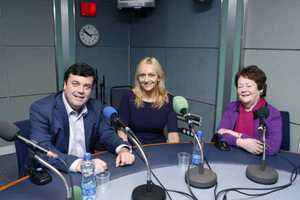
The late Fianna Fáil finance minister Brian Lenihan with his aunt Mary O’Rourke on Miriam O’Callaghan’s RTE R1 show, Miriam Meets
You’ll recall how, in January, Central Bank governor Professor Patrick Honohan told the banking inquiry that the late Brian Lenihan, then finance minister, was overruled by a senior politician on the night of the bank guarantee in September 2008.
He said he understood Mr Lenihan thought that Irish Nationwide Building Society and Anglo Irish Bank should have been nationalised.
At the weekend, the Irish Times reported that former Taoiseach Brian Cowen said there was no question that he overruled Mr Lenihan.
Further to this, RTÉ reports:
Former Fianna Fáil minister Mary O’Rourke has confirmed the family of the late Brian Lenihan has requested input into the Oireachtas Banking Inquiry.”
“Speaking on RTÉ’s Morning Ireland, Ms O’Rourke said it is a fact of life that one of the main figures in the committee’s deliberations who cannot be with them is her nephew, the late Mr Lenihan.”
She says it has struck her forcibly “that those to whom he may have confided in on some matters should be given a chance to come before the committee to speak their mind.”
“We wish to put the committee under notice that we will be following events and listening to what the witnesses will be saying internally about the late Brian Lenihan and we wish, if necessary, to render the recommendations of the committee more complete.”
…
She said she does not have papers or records belonging to Brian Lenihan; he did confide in her on many things, as he did to Conor Lenihan. “I do not have papers or records but I have a memory. I am lucky that it is a good memory.”
Family of Brian Lenihan requests input into Banking Inquiry (RTÉ)
Previously: “They Bought Into It”

‘sup?
Harcourt Street, Dublin this morning.
Damn big wig.
Thanks Ronan Mullen

This morning.
Kieran Murphy writes:
Lovely dawn over the Cooley Mountains [County Louth]…
Meanwhile…

Graeme Kelly writes:
1st Cherry blossom this morning….Malahide [Co Dublin]

Catherine McGuinness (right) and community garda Kerrie Sullivan yesterday
We’ll see whinging and quite a few tears,
As the No side face all their worst fears,
They’re bound to object,
That’s it’s just not correct,
For the guards to be nice to the queers.
John Moynes
(Pat Sharpe)

Jane Dempsey writes:
This caught my attention in Maynooth Co.Kildare and I had to share it because it seems so unusual. Is it just me or is this a little sign of frustration?