Tag Archives: Canada

This afternoon.

Had to be done.

Earlier…

Last night/this morning.

A massive trucker convoy is making its way across Canada with the intent of converging onto Parliament Hill in Ottowa, Ontario this weekend, voicing opposition to the federal government’s mandatory vaccination policies.

Meanwhile…

Last night/this morning.

Getty/RebelNews

Meanwhile…

Meanwhile…

Last night.

Meanwhile…

Um.

Getty

Mountie/Ninja Fight!

Ires Reit?

This morning

Via Politico:

Justin Trudeau will hang on to his job as Canada’s prime minister in an election victory Monday that fell short of his main objective: tightening his hold on power.

With his Liberals high in the polls, Trudeau plunged the country into an early election in August in hopes the party could gain at least 15 additional seats in the House of Commons to turn his incumbent minority into a far more powerful majority.

Instead, Trudeau returns to the Prime Minister’s Office with roughly the same number of seats his Liberals had when he called the summertime snap election.

“I hear you when you say that you just want to get back to the things you love and not worry about this pandemic or about an election,” Trudeau said in Montreal as he delivered his victory speech. “The moment we face demands real important change. And you have given this parliament and this government clear direction.”

Trudeau returns to power with minority grip on Parliament (Politico)

Getty

Meanwhile…

Russian President Vladimir Putin yesterday

This morning.

The Kremlin-loyal United Russia party has recorded an overwhelming victory in Russia’s parliamentary elections.

With all the votes tallied, the electoral commission said Tuesday that United Russia had won 49.83% of the vote. It was also ahead in 198 seats of the 225 deputies apportioned by party lists.

On Twitter, the party said it had received a constitutional majority.

Russian President Vladimir Putin thanked voters for their “trust.” United Russia will have more than two-thirds of deputies in the 450-seat lower house of parliament, known as the State Duma.

Russia: Putin’s party wins majority in parliamentary election (DW)

AP

From top: Murray Sinclair, a former judge and senator who led Canada’s Truth and Reconciliation Commission; Cross Lake Indian Residential School in Manitoba in 1940

The discovery in Canada of nearly 1,000 bodies in unmarked graves at two former residential schools for Indigenous children has set off a search for further burial sites.

Last Thursday, the Cowessess First Nation announced the discovery of what are believed to be 751 unmarked graves at the site of the former Marieval Indian Residential School on southern Saskatchewan.

An estimated 150,000 Indigenous children are believed to have attended one of about 150 residential schools that operated between the 1880s and 1996 run by either the Catholic Oblates Order of Mary Immaculate or the Church Missionary Society of the Anglican Church (Church of England).

Children were forcibly converted to Christianity, given new names and were prohibited from speaking their native languages, according to testimony given at a Truth and Reconciliation Commission which in 2015 concluded that the residential school system amounted to cultural genocide.

Via The Guardian:

Murray Sinclair who led the commission and a member of the Peguis First Nation, said:

We need to know who died, we need to know how they died, we need to know who was responsible for their deaths or for their care at the time that they died. We need to know why the families weren’t informed. And we need to know where the children are buried.

We’ve heard stories from survivors who witnessed children being put to death, particularly infants born in the schools who had been fathered by a priest. Many survivors told us that they witnessed those children, those infants, being either buried alive or killed – and sometimes being thrown into furnaces. Those stories need to be checked out.

On Friday, the Catholic Missionary Oblates of Mary Immaculate, which operated 48 schools, including the Marieval Indian residential school at Cowessess First Nation in Saskatchewan and the Kamloops Indian residential school, said it would release all documents in its possession.

“We remain deeply sorry for our involvement in residential schools and the harms they brought to Indigenous peoples and communities,” the order said a statement. “We further acknowledge that delays can cause ongoing distrust, distress, and trauma to Indigenous peoples.”

Sinclair said that church and government officials had repeatedly claimed the records have been destroyed or lost. Even when the church handed over documents to the commission, key names and locations were redacted, rendering the documents “useless” for research purposes, he said.

Canada must reveal ‘undiscovered truths’ of residential schools to heal (The Guardian)

Meanwhile…

Two more Catholic churches on reserves in British Columbia’s southern Interior burned down Saturday morning.

Lower Similkameen Indian Band Chief Keith Crow says he received a call at about 4 a.m. PT that the Chopaka church was on fire. By the time he arrived about 30 minutes later, it had burned to the ground.

2 more Catholic churches burned down in B.C.’s Interior (CBC)

Getty

Thanks Eunan

Saturday.

Alberta, Canada.

Calgary pastor Artur Pawlowski was made to kneel while being arrested for committing the crime of holding a church service, which violated Alberta’s public health orders. The pastor kicked out police from his church last month calling them ‘Gestapo’.

That’ll learn him.

Calgary COVID-19 dissidents vow to resist court order (Calgary Sun Herald)

Pic via Twitter

Social Democrats TD Jennifer Whitmore

This morning/afternoon.

Further to Tanaiste Leo Varadkar’s defence of Ceta, the free trade agreement between the European Union and Canada…

…where he hailed a report by Copenhagen Economics, commissioned by the Department of Enterprise, Trade and Employment, into the costs and benefits for Ireland arising from four recently concluded EU Free Trade Agreements (FTAs) – Canada, Korea, Mexico and Japan.

Jennifer Whitmore, Social Democrats TD and the party’s spokesperson on the environment, climate and communications, writes (full article at link below):

…There is no question but that the Ceta deal will boost trade, but the benefits are lopsided. While Irish exports to Canada are expected to be 31 per cent higher by 2030, imports from Canada will increase by 84 per cent.

The newly published study by Copenhagen Economics for the department, which cost €28,000 to produce, is being used by Varadkar as a rationale for the ratification of the free trade deal with Canada, despite the vast majority of the report comprising an analysis of three other FTAs.

To put this in context, the consolidated Comprehensive Economic and Trade Agreement (Ceta) text is nearly 1,600 pages long. The Copenhagen Economics’ report is just 79 pages – and fails to even mention the most controversial aspect of the deal, the investor court system (ICS), which gives multinationals the right to sue governments who curtail their freedom of action as investors.

Perhaps the Government didn’t have time to commission a thorough report. It had attempted to rush through ratification of this hugely complex deal after just a 55-minute Dáil debate in December. That effort only failed because a sustained public outcry about such a truncated debate forced the Government to defer it.

Now, this fig-leaf report is being brandished as evidence of the Government having done its due diligence when, in reality, it is a cursory analysis of four separate trade deals, which concludes that almost all of the cumulative economic benefits to the State flow from just one agreement, the trade deal with Japan.

It is also noteworthy, that the trade element of Ceta – which has seen the reciprocal removal of nearly 99 per cent of tariffs between the EU and Canada – has applied since September 2017. Therefore the State is already reaping the economic benefits of the deal. The element which has yet to come into force, and which is dependent on EU member state ratification, is the portion of the deal concerned with investment protection, which includes the highly contentious ICS.

In Dáil debates, when concerns regarding the ratification of Ceta are posed to Varadkar, he invariably issues a boilerplate response which includes a vague reference to a sustainability impact assessment undertaken on behalf of the EU into the entirety of the deal.

One wonders if he has ever read this impact assessment, because it unambiguously recommended that the investor state dispute settlement (ISDS) regime, of which ICS is a variant, should be excluded from Ceta and replaced with a state-to-state enforcement mechanism.

Given that the EU’s own impact assessment recommended dropping ISDS from the final deal, it is bizarre it has been retained – albeit, in a slightly improved format – as ICS. Despite these changes, the core elements of the dispute mechanism remain the same. ICS allows large corporations to leapfrog domestic and EU courts and take cases against governments to specially-created tribunals when policy decisions impact their bottom line.

Meanwhile, Ceta’s supposed ability to insulate public policy decisions from attack by investors contains an express exception. If the impact of a decision in important public policy areas is deemed excessive, investors can pursue a case against a member state, even if the policy decision was implemented in the public interest. [More at link below]

Canada trade deal comes with strings attached, Mr Varadkar (Jennifer Whitmore, Irish Times)

Leo Varadkar: Ireland needs a trade deal with Canada (irish Times, April 28)

Meanwhile…

Awkward, in fairness.

CETA?

Update:

Meanwhile…

Social Democrats TD Jennifer Whitmore TD, who is the party’s spokesperson for Climate Action and Biodiversity, said:

“With this trade deal comes a very controversial mechanism which allows companies to sue an EU member state for potential profits lost if a Government decides to change their policies or regulations.

“This will be devastating for many reasons, including in the area of health and housing, but also in in relation to the Government drafting legislation and policies to tackle climate change and biodiversity. If a company feels a Bill or policy drafted to mitigate climate change might negatively impact on their profit margin, it could technically sue the Irish Government under CETA.

Furthermore, all of this would be settled in special tribunals held outside our own justice system in a non-transparent manner. This is hardly appropriate in an age where transparency and due diligence is a basic requirement in a democracy.

“The chilling effect of this deal could be enormous as the Government is already wary of legislating strongly for climate action for fear of being held up in court. CETA will reduce the Government’s capacity for stronger decision-making, which is what we need in our fight against climate change.

“If companies can sue the Irish Government for compensation, not only will the taxpayer be out of pocket, but our ability to mitigate climate change and protect our biodiversity will be diminished. We cannot afford for that to happen.”

Previously: The Set Menu

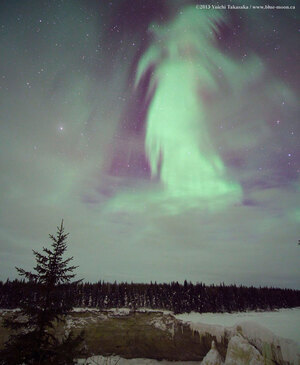
An apparently ghostly aurora recorded over northern Canada back in 2013. To wit:

Regardless of fantastical pareidolic interpretations, the pictured aurora had a typical green colour and was surely caused by the scientifically commonplace action of high energy particles from space interacting with oxygen in Earth’s upper atmosphere. In the image foreground, at the bottom, is a frozen Alexandra Falls, while evergreen trees cross the middle.

(Image: Yuichi Takasaka, TWAN)

apod