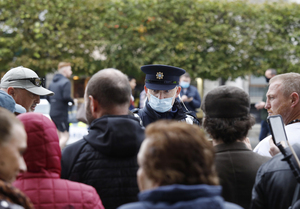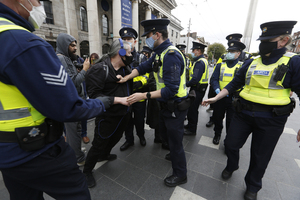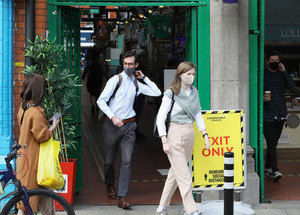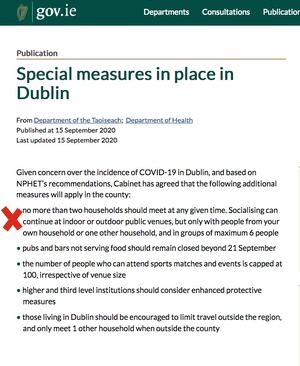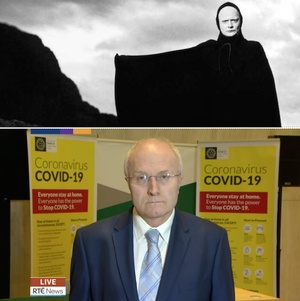
From top: ‘Death’ from Ingmar Bergman’s The Seventh Seal (1957); RTÉ News Health Correspondent Feargal Bowers
Uncanny.
Frank Armstrong, writing In CassandraVoices [full article at link below
The Irish public service broadcaster RTÉ says that ‘nine out of ten people in Ireland say RTÉ has been their main media source for accessing information on Covid-19.’
The broadcaster recently launched an initiative against fake news entitled: ‘The truth matters at RTÉ – here’s why,’ claiming:
‘Now that society is grappling with the challenges of a pandemic, and the inescapable anxiety that comes with it, the potential for manipulation of the facts is huge.’
But RTÉ has at times provided an unreliable account of the danger posed by Covid-19 to the Irish public.
Throughout the pandemic RTÉ’s Health Correspondent Feargal Bowers has pointed to the exceptional danger posed by Covid-19, which fits within what Nancy Tomes has called the “killer germ genre of journalism”.
Bower’s describes a Grim Reaper that is redolent of the character of Death from Ingmar Bergman’s Seventh Seal:
‘This virus could visit any of us, at any time, in our homes, or in work.’
‘It does not make an appointment. ‘
‘Going outside involves a certain roll of the dice.’
‘Inside you may also encounter this intruder.’
‘Like any lottery, there are things people can do to improve their chances.’
‘And hold onto the most valuable prize of all – your life.’
In fact, we are dealing with a virus with an infection fatality rate below 1% according to Nature magazine, or ‘possibly as low as 0.2% or 0.3%,’ according to Lone Simonsen, a professor of population health sciences at Roskilde University in Denmark who has worked at the CDC and National Institutes of Health in the U.S.; others such as Professor Johan Gisecke, a member of the WHO’s Strategic and Technical Advisory Group for Infectious Hazards (STAG-IH) previously suggested a figure as low as 0.1%. The IFR has varied from region to region, with New York, Madrid, London and Lombardy particularly badly hit, but in Africa, as indicated, the IFR appears to be exceptionally low.
With better treatments – especially the use of the generic drug Dexamethasone – and protection of vulnerable groups, chances of survival have improved since the early stages of the pandemic.
This seems evident from the relatively low death toll currently witnessed across Europe, including in Ireland, despite rising case numbers. Many of us also harbour T-cell immunity from other coronaviruses.
Yet Bowers has continued to make factually incorrect claims in a succession of articles, including on September 5, which stated:
‘The World Health Organization says data to date suggests 80% of Covid-19 infections are mild or asymptomatic, 15% are severe infection, requiring oxygen and 5% are critical, requiring ventilation.’
Ventilators are now used sparingly in the treatment of Covid-19, and large orders were cancelled in April. Remarkably, Bowers seems to have copy and pasted that information from a WHO Situation Report from March 6, stating:
‘…data to date suggest that 80% of infections are mild or asymptomatic, 15% are severe infection, requiring oxygen and 5% are critical infections, requiring ventilation.’
The continued use of data from March undermines RTÉ’s credibility and should be a source of embarrassment.
Covid-19 in Ireland: Elusive Facts (Frank Armstrong, CassandraVoices)
Getty/RTÉ
Meanwhile…
Oh.
Meanwhile…
Ah.
Meanwhile…
Stop it.
Meanwhile..
Uncanny.