Tag Archives: documentary

13895401_1059325730825529_6633738555529056601_n

Filmmaker John Mulvaney is one of many to turn his lens on music in Ireland, in lieu of any support for the community by the industry/officialdom.

Thus was born Fractured, a documentary series with an eye on metal and other harsh noises in Ireland, running on Metal Ireland and screening at various festivals and events throughout the past year.

The newest episode focuses on Clonmel prog/sludge outfit zhOra, and explores the band, their music, and growing/sustaining music outside of the industry in Ireland.

New episodes will appear here as they happen, also, but for now, here’s a catch-up playlist of the rest of the series so far, with eight episodes ready to watch.

Fractured

mobilecinema

The Cinemobile arriving at the Guth Gafa International Festival at Headfort House in Kells, Co Meath last year..


Restless movie theatre Cinemobile Ireland announced yesterday that it is go off the road due to lack of funding..

The truck was to travel to Headfort House in Kells, Co Meath for the tenth anniversary of  the Guth Gafa International documentary Film Festival next month.

Cinemobile Ireland was one of largest recipients of Millenium Project Funding  with a
£500,000 grant.

Anita Guidera of Guth Gafa, writes:

The mobile cinema was provisionally reserved as far back as last November and the booking confirmed in March of this year.

Guth Gafa received no advance notice before last weekend that the Cinemobile was in financial difficulty or about to cease trading.

We have been left in a really difficult situation. Guth Gafa gets underway on August 3 and will screen over 60 documentary films from all over the world and host visiting filmmakers from as far away as Australia and Canada.

If we can’t come to some arrangement, we will have just three weeks to build a 100-seater flagship venue that will do justice to the work of these filmmakers.”

Guth Gafa International Documentary Festival

Cinemamobile to Close [IFTN]

Screen Shot 2016-04-24 at 11.09.48
https://www.youtube.com/watch?v=LtN19gKGY1Y&feature=youtu.be

The trailer for a forthcoming documentary, Mary Boyle: The Untold Story, written and directed by investigative journalist Gemma O’Doherty, about the disappearance of Mary Boyle in Donegal in March, 1977.

It includes interviews with retired sergeant Martin Collins and former detective inspector Aidan Murray (top) who recall a phone call made by a politician to gardaí, during the investigation into Mary’s disappearance, and how the phone call led to certain people not being arrested or questioned.

Mr Murray remembers how, during one interview, he “suddenly got a wee nudge” from his superior officer and was effectively told to “ease off” while questioning a man.

Mary Boyle: The Untold Story will be available in full in the coming weeks.

Previously: Mary Boyle on Broadsheet.ie

To Journalists

Update: Listen to Gemma discuss Mary Boyle The Untold Story on Highland Radio [April 30]

Screen Shot 2016-04-04 at 14.42.17

A new Irish documentary inspired by the #WakingTheFeminists movement which looks at gender inequality in the Arts in Ireland – specifically after the Abbey Theatre’s Waking the Nation 2016 Centenary Programme included just one female playwright.

Director Sarah Corcoran writes:

We are currently crowdfunding and our deadline is this Friday. Today is our matchfund day, in which an anonymous funder has agreed to double any pledge made today until midnight in the hopes us pushing us closer to our target!

So whatever you give will be doubled!

We have some great perks up for grabs including a spot at a Feminist Panel in the Autumn, your name in the credits or a spot at filmmaking workshop.

Them’s The Breaks (FundIt)

Screen Shot 2016-02-25 at 11.12.13

lXn5y75u

Boats of refugees approaching Lesbos island and filmmaker Conor Maguire

Conor Maguire and Paul Webster are two freelance filmmakers based in Dublin.

They write:

In 2015, over 500,000 refugees have made their way to Lesbos island from Turkey via overloaded inflatable rafts. This represents 59% of all refugees who made their way to Greece last year. Projections are that refugee numbers making the dangerous journey across the Aegean Sea could double this year.

Lesvos is a tiny community that has found itself at the centre of a vortex: the greatest migration of people since World War Two. We wish to travel to Lesvos in March as a two-person crew to document the situation.

Against the backdrop of international stalemate, clashing ideologies, technocratic power plays, economic ruin and a war that could spark something terrifyingly large, people are showing the best and worst of humanity on one small island.

We wish to speak with volunteer and professional aid workers, local residents, on-site journalists and, most importantly, refugees to document this critical juncture in European history.

We are launching this campaign to raise €3,000 to cover only the most basic aspects of our work: transport, accommodation, insurance and food. Everything else will be covered by us.

Our aim is to create a short documentary that is as shareable and mobile as possible. We think this is an important story to cover in an unfiltered way, without politics or ideology. We hope you think so too and help make this production viable.

Those who wish can donate to Conor and Paul’s fund here

Previously: A Letter From Lesbos

A Drop In The Aegean

Pic: La Kaseta

Screen Shot 2016-01-28 at 11.55.54

A documentary featuring Jon Hynes and Sean Cahill’s 1,500km and 39-day kayak around Ireland last summer.

Cian Walsh writes:

“Broadsheet published a link last summer as Jon and Sean were attempting to paddle around Ireland starting from the Old Head of Kinsale.”

“They returned to the Old Head 39 days later, having survived huge Atlantic swells and covered in blisters. The trip was self-supported so Jon and Sean carried everything, including food and camping gear, in their kayaks.”

Fair play in fairness.

Previously: Paddle Whackers

Paddling Around Ireland

Thanks Cian

Screen Shot 2016-01-05 at 11.07.04Screen Shot 2016-01-05 at 11.32.34

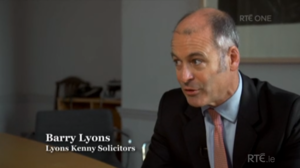
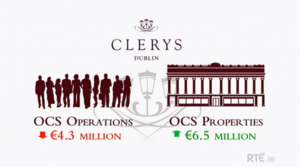
Insolvency solicitor Barry Lyons and a graphic used in RTÉ One documentary, Clerys

Last night RTÉ One broadcast an hour-long documentary, by Judy Kelly, about the closure of Clerys last year with the loss of 460 jobs.

It included interviews with former employees, such as Maurice Bracken, who had worked at Clerys for 32 years.

Bracken and the other workers – some of whom worked over 40 years at Clerys – only got the statutory redundancy of two weeks’ pay per year of service.

The documentary highlighted how many of the workers felt the Clerys building on Dublin O’Connell’s street should have been sold in order to offer better redundancies.

But it explained that in 2012, the owners of Clerys, Gordon Brothers, split Clerys into two companies – a trading company, OCS Operations, and a property company, OCS Properties.

OCS Operations paid rent under a lease to OCS Properties for the use of the building. Within two and a half years, OCS Operations, which employed the staff and managed the department store, made a loss of €4.3million.

Meanwhile, OCS Properties – which has no staff – made a profit of €6.5million.

Irish Times business affairs correspondent Mark Paul explained:

The night before Clerys was closed, a group of people assembled and they conducted a transaction that eventually led to you guys losing your jobs the next day. Natrium bought the entire structure of Clerys, so they bought the parent company and that gave them the property company and the trading company and then we know that immediately, immediately upon doing that, they sold the business that was your employer, the trading company, for €1 to Jim Brydie who was an insolvency specialist.”

“Natrium wanted the operating business to be gone from the group, they wanted it to be separated, to be pushed aside and to be left on its own. It was effectively an orphan then, it had no parent company, it had no lease, it had no money and really it had no chance of survival.”

As the trading company’s lease had expired three months previous, Mr Brydie – a former director of Anglo Irish Bank in the UK – wrote to Natrium asking it to extend his lease but they wrote back immediately saying they’d send a formal notice to quit if he didn’t get out of the building.

Mr Paul commented:

“The sequence of events that was laid out to the court, the following morning, was that they all arrived here and then one business was sold and then another business was sold and then there was a board meeting and then there was another meeting with management and each action led to the next action which led to the next action… but if all these things were planned and happened simultaneously, well then, it sort of leads you to the conclusion that maybe all this was pre-ordained. It was never doing to end any other way and, if that’s the case, before any of these meetings happened, Clerys fate was already sealed and when dawn broke, the stage was set for Clerys to be liquidated.”

Mr Bracken, and another former employee, visited insolvency solicitor Barry Lyons to get a greater understanding of what happened.

Mr Lyons had no involvement in the closure of Clerys.

Barry Lyons: “There’s no doubt in my view that it was completely choreographed but at the end of the day, there is a fundamental inevitability about this taking place. The trade is declining, losses are wracking up. Overtime, somebody says, ‘we’ve got to pull the plug’. We’ve got to take a view.

Maurice Bracken: “But there was a property there. And because of some accounting formula, they were able to separate the company from the trading company. They were able to separate this and we’ve all lost.”

Lyons: “I can’t justify that. What they did was clever, you know, they carved it out, the asset out from the trade, and there you go. I mean everyone was operating on the basis that it was a trading company. Everybody knew that a receiver was appointed. Signal number one: that is not a good sign. Ultimately the property from which it traded was worth a lot of money. So what the Gordon brothers, what they did, is they protected their investment by carving out the property. So it’s very easy to demonise them but this country would be in a far worse state had they not come along and they put their money where their mouth is and they said, ‘we think this is going to come good for us’. And so when you do that, you’re entitled to a return on your money. And I think that’s what they got and this is the fallout, what you’ve described, is the fallout from that.”

Bracken: “They did make millions. Ok, we know they made millions. But they certainly didn’t come in here to help the Irish economy, they only really ever had their shareholders in mind. No one else really cared because when they left…”

Lyons: “No, no other company has anyone other than their shareholders in mind…”

Bracken: “But I think there should be some kind of duty of care to the other stakeholders.”

Lyons: “I understand why they did what they did, it makes sense from a commercial point of view and I appreciate that it hurts but, you know, there’s an orderly process that has to be undertaken. There has to be an event that says, ‘this is now over’. That is never going to happen in a nice way.”

Bracken: “Do you actually admire the way they carried out this liquidation?”

Lyons: “Well, from one point of view, it is very cynical. Do I admire it? Well it seems to have gone off without the whole thing spiralling out of control. So, you know, maybe from that point of view, you have to say, well, it was efficient.”

Watch back in full here

Screen Shot 2015-05-29 at 11.33.54
https://www.youtube.com/watch?v=sz_24nxMM98

Of this trailer for a longer feature, John Fleming writes:

legendary Irish rocker Eamonn Dowd, based in Sweden, performs frequently around Europe with his bands the Racketeers and the Last Souls. Dublin gigs usually see him in the Leeson Lounge. Dowd was the front man with The Swinging Swine oh years ago. The full video is being entered into some short film festivals etc. Hence the trailer.

10350328_315976635252065_7913231235695275451_n

An excerpt from upcoming documentary The Queen Of Ireland, directed by Conor Horgan, who writes:

As the referendum approaches, we are busy shooting the final parts of ‘The Queen of Ireland’. The film is about Rory O’Niell and his journey from the small town of Ballinrobe [Co Mayo] to being a “national fucking treasure”.

We shot a series of in-depth interviews with Rory last Friday, and when I asked him how he’d feel if the referendum wasn’t carried, his answer was so personal and well said that we decided to release a clip from it before the vote on May 22nd. Vote yes!

(Thanks Conor Horgan)

Screen Shot 2014-08-17 at 23.02.29

Camille Hamet and Séréna Robin write:

We are two young French film makers working on a documentary about Irish women traveling to England to have an abortion. It will be broadcast on French public TV Public Sénat in December.
We just arrived in Dublin and plan to stay in Ireland for two months. We are already in touch with the IFPA [Irish Famile Planning Association], the ASN, Doctors for Choice and Senator Ivana Bacik, among others. But we are currently looking for Irish women that would agree on sharing their own personal experience of abortion. Our main challenge is to find a woman that would agree to let us follow her while she is in the process of seeking an abortion in England. Anonymity will be contractually guaranteed but we don’t even know how to reach them to discuss it. Therefore, we were wondering if it was possible to mention our project on Broadsheet. It would be very helpful. If anyone would like to help us  regarding this please don’t hesitate to contact us.at taketheboat.themovie@gmail.com.
Here is a link to the project. You can also check its Facebook page and its Twitter account.
