Tag Archives: trees

This morning.

Skerries, County Dublin.

Via Skerries:

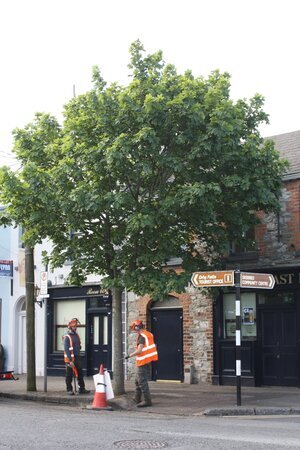
Tree cutting in process at the moment on Church Street –  One has just gone outside Nealons, one is about to go beside the Coast and three or four more will go later today. The problem is they are breaking up the pavement. Local sculptor Shane Holland has been trying to stop them. He is asking for the Council to fix the pavements instead. He has chained his van to the one outside his house…

Skerries (Facebook)

Last night: Ask A Broadsheet Reader

Miriam Delaney tweetz:

Nenagh’s Dark Road – Before and After!! Seriously, what could justify this?

Meanwhile…

Anyone?

This afternoon.

Oonagh Young Gallery.

James Joyce Street, Mountjoy, Dublin 1

In fairness.

Previously: The Eight Trees In Fade Street

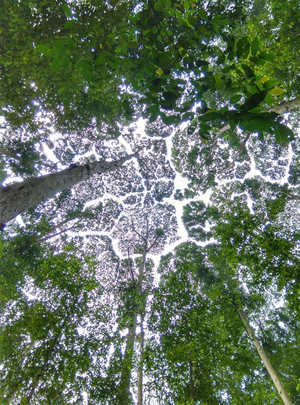
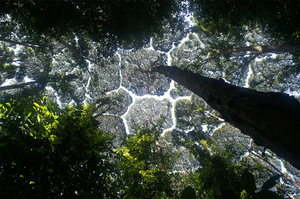
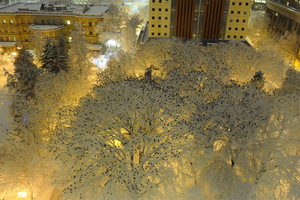
No, not digitally retouched photos but, rather, the all-natural phenomenon of Crown Shyness where the uppermost branches of certain tree species avoid each other in the forest canopy.

First discovered in the 1920s, the exact cause is unclear: whether the result of trees rubbing against one another or an active process by which the available light needed for photosynthesis is ‘shared’.

Either way, isn’t nature wonderful?

colossal

Fairview Park, Dublin 3

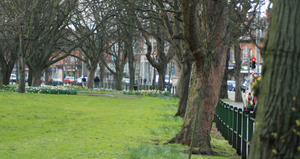
Further to fears that trees which line the footpath along the front of Fairview Park in Dublin 3 could be felled to make way for a proposed new cycleway…

Cian Ginty, on Irish Cycle, writes:

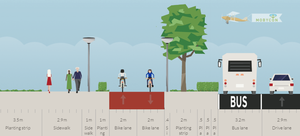
The destruction of the trees is not required for the cycle route and a better, safer, and more attractive cycle route than the one planned can be built without knocking down the trees.

The competing interests are wide-ranging. They include councilors and others who don’t want to see traffic lanes reduced, and those who think traffic lanes should be taken out before trees are cut down.

Other interests include the National Transport Authority and one of its planned bus route upgrades (to so-called BRT standard). And there’s the council officials who want an “esplanade” — translation: a shared walking and cycle path with fancy paving running along a redefined edge of Fairview park.

Then there’s the planned cycle route. Despite planning on holding Velo City in 2019, an international cycling conference, with the tagline “cycling for the ages”, the council are set against proper, Dutch-like segregated cycle paths suitable for all ages and abilities.

There’s loads of space inside the tree line for separation of cycling and walking — and this is much the same for nearly all of the length of the park. Most of the current shared surface of the footpath / one-way cycle path between the trees and the roadway can be greened, with space left for bus stops and cycling and walking crossings.

Dublin needs a high-quality cycle route and this can be provided without cutting down the trees. The current plan from the council is too low grade and does not provide for “cycling for the ages”.

At public consultation for the project a two-way cycle path was also the main preference of individuals, businesses, councillors and cycling groups. It’s not only practical, it has support.

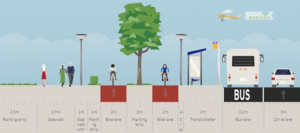
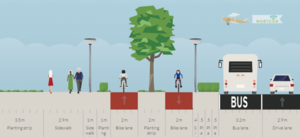
...The images below show an outline concept — note: this will work with or without changing the current roadway (for a BRT route or whatever). And also note that this is a concept, while it will fit, the measurements here aren’t supposed to directly relate to any one section (the widths vary).
Anyone?

Fairview trees could be saved with a two-way cycle path (Irish Cycle) 

Yesterday: Unfairview


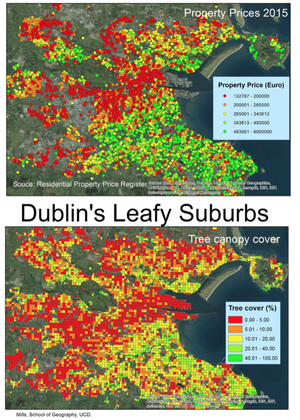
Screen Shot 2016-03-16 at 09.12.08

Dr Gerald Mills, of UCD’s School of Geography, writes:

A common phrase that conveys affluence in Dublin is ‘leafy suburb’, which describes parts of the city that are relatively wealthy and endowed with luxuriant vegetation. Does, the phrase have any basis in fact?

I have plotted the tree canopy cover of Dublin alongside a map showing the price paid for residential property sold in Dublin during 2015.

The latter information was retrieved from the Property Price Register that provides the address and the price; it does not tell you the size of the dwelling or whether it is a house or an apartment or even whether the property has a number of dwellings.

There were over 15,000 properties sold with Dublin addresses in 2015; Google Earth Pro was used to locate many (about 66%) these properties in geographic coordinates. This sample of properties is shown here with each property colour-coded according to its sale value.

I chose to divide the data into quantiles as price values are positively skewed; the greenest properties fall into the top 20% and the reddest fall into the bottom 20% in terms of price.

The patterns for canopy cover and property value show a strong correspondence; overall, it is true to say that the ‘leafiest’ suburbs are also the most valuable from the perspective of property value.

UCD School of Geography (Facebook)

Previously: Streets Full Of Trees

Thanks Reppy