Annie West tweetz:
“Right I’ve done a timeline of events…”
Previously: How Did He Get Here?





Sarah O’Connor tweetz:
Superintendent Dave Taylor back at the Garda Traffic Division this morning after DPP found he had no case to answer.
Previously: Cleared

Slow Riot – post-punk from Limerick
What you may need to know…
01. Limerick trio Slow Riot have been working away on honing their post-punk/shoegazing haze since the last time we checked in with them (coincidentally on this week last year).
02. They’ve busied themselves in the meantime, with late-2016 single Absent Dreams clocking BBC Radio airplay and earning adoring glances from U.K. and Irish music press.
03. Streaming above is new single Pink December, officially released yesterday on all major online download and streaming outlets.
04. Having done the rounds of the U.K. in the latter months of last year, they’re now hunkered down to finish their debut long-player for the label, due later this year.
Thoughts: A cavernous atmosphere takes an introspective slice of post-punk and makes something more of it, stuck halfway between grooving and sludgy tones.

Minister for Finance Michael Noonan
In case you missed it.
At the weekend…
Hugh O’Connell and Jack Horgan-Jones, in the Sunday Business Post, reported:
Michael Noonan, the Department of Finance and Nama have all been heavily criticised in a damning secret report prepared for TDs investigating the sale of Project Eagle.
Nama’s controversial €1.6 billion sale of its Northern Ireland loan book three years ago is the subject of a number of damaging conclusions in a draft working paper to be discussed by TDs on the Public Accounts Committee (PAC).
It ultimately concludes that Nama’s sales strategy could be described as “flawed” and it has been “unable to demonstrate” that it got value for the Irish state.
…The paper said it was “not appropriate” for the Department of Finance to meet with the ultimately successful bidder, Cerberus, in the days before the closing date for Project Eagle bids. It similarly states that it was “not appropriate” for Noonan or Nama to meet with Cerberus the day before the Project Eagle bid closing date – and that this could be perceived as “special treatment”.
The Public Accounts Committee will meet in private at 5pm tomorrow and then in public at 10am on Thursday.
Report: Noonan acted inappropriately – Nama sale flawed (Sunday Business Post)
Nama failed in corporate governance of Project Eagle, says draft PAC paper (Sunday Business Post)
Previously: Spotlight Falls On Noonan
Rollingnews


Old biological studies of crustacans combined with intricate clockwork mechanisms by French artist Steeven Salvat.
MORE: Mechanical/Biological


An enhanced-colour image of Jupiter’s south pole and its swirling atmosphere created by Roman Tkachenko using data from the JunoCam imager on NASA’s Juno spacecraft.



From top: Homegiving posters for Ryanair, Guinness, Apple and Tesco
Further to the debate on company towns in Ireland.
Antoine D’Alton writes:
Our mission is to persuade large and medium sized employers to build affordable homes for their employees and help make a lasting contribution towards solving our national housing crisis.
We aim to initiate a Employee Homestead Provision Bill before the Irish Parliament this year with the aim of removing unnecessary restrictions which have been placed on employees regarding employer housing provision.
We want to encourage large and medium sized employers throughout Ireland in the private and public sector to consider investing in housing projects whether it is apartment buildings or housing estates which are purpose built to serve the increasing demand for our nation’s growing workforce.
We believe that we can include large and medium sized companies in the social bargain, and encourage them to return to building homes and communities which they used to do in the past.
We maintain, that Government by itself cannot and will not solve the housing crisis on its own. We further believe that the Irish property market has been skewed in favour of speculators, property developers, financial institutions and private landlords all of whom have a vested interest in ensuring unaffordable house prices and disproportionately high rental prices prevail into the future
As it stands it has become increasingly difficult for young families and employees to find an affordable home or rental property in our cities and major towns. We understand the frustration this is causing and recognise the long-term adverse effect this will have on our economy and our nation going forward.
The current housing crisis has been caused by poor planning and ill-considered public policy. It seems our government has not learned the lessons of the financial collapse of the Irish economy in 2008 which necessitated a bailout from the European Commission, the ECB and the IMF.
We are conscious of the hardship which speculation and price gouging in the housing and rental markets is causing. We know that it is resulting in families being evicted from their homes and being unable to pay rents which are way out of sync with average household earnings.
We know that private landlords and private equity firms are basing their returns on what they assume working professionals will pay. In the city of Dublin many of those employees work for large and medium sized tech firms whose staff are effectively competing for scarce rental properties and as a consequence through higher purchasing power are displacing people who can no longer remain in those properties which have served as their homes.
Moreover, those higher rental and accelerating home prices are putting disproportionate pressures on existing employees working for large and medium sized employers.
The exorbitant costs of rents and the difficulties in finding a home is acting as a disincentive for employees coming for abroad. We know from experience that thriving companies rely on and need new personnel, without them those companies cannot grow and prosper.
We all know that Ireland provides one of the most generous tax regimes for private companies in the world at 12.5% per annum. We know that many companies who avail of that rate are not contributing their fair share to our economy nor to the common good.
In some respects their low-earning employees have no alternative but to ask the government to assist them with housing. We do not believe that the tax payer should fit the bill for the failure of profitable and well capitalised companies to provide accommodation for their employees.
We want to change the dynamics of the Irish property market, and ensure that there is home security for our growing work force in the years ahead. We know that this will have positive knock-on effects for our nation, our people and for our economy. We believe that by investing in affordable housing, large and medium sized companies will be putting down long-term roots which in turn will create long-term job security.
We appreciate that there will be people with a vested interest in not allowing our bill go forward, we know who they are and we know the damage they have inflicted on our nation in the past? If they are allowed to succeed, we know they will damage our nations future and worse the future of our children.
It is our common cause to ensure that they will not succeed in that respect.
Finally, at the most basic level, we have a very human need, one that should be affordable to all and one that is the bedrock of our society – the need and the desire to have a place we call, home. With the Employee Homestead Provision Bill, we believe we can make that a realisable objective again not just for employees of large and medium sized companies, but for all.
We need your support.
Previously: Our Kind of Town?

Rental prices increased throughout 2016 at their fastest annual pace since the website daft.ie started compiling statistics on the rental market in 2002.
Average rents nationwide rose by 13.5% in the year to December, according to the latest report from the property website.
At €1,111, the average monthly rent nationwide is at a new high, the third successive quarter with a record high according to daft.ie.
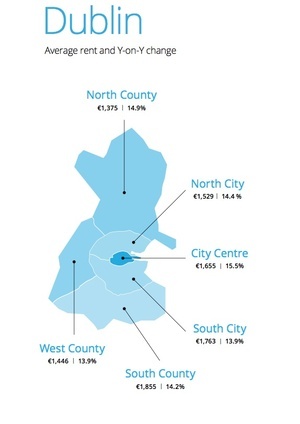
The annual rate of rental inflation in Dublin is running ahead of the national figure at 14.5%.
The average monthly rent in the capital, at over €1,650, is now almost €200 higher than the last peak in early 2008, despite the subsequent property crash and a sustained period of low inflation in the interim…
Rents increasing at record pace, report finds (RTÉ)
Graphs via Daft