Category Archives: Misc

csopalxxeaa3xz790429329

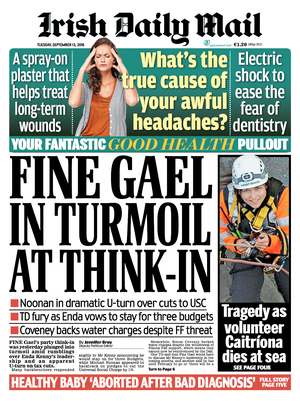
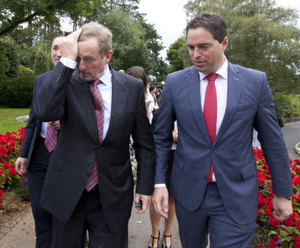
From top: Taoiseach and Fine Gael leader Enda Kenny with Fine Gael TDs and MEPs at the party’s think-in in Newbridge, Co Kildare yesterday; Kate O’Connell TD arrives.

You may recall how members of Fine Gael were to be briefed by Marion Coy, chair of the Collins Institute, at the party’s think-in yesterday – in relation to a report she carried out about the party’s poor performance in the general election.

Fine Gael TD Kate O’Connell was also to brief the party’s members about a second, separate report about the election.

Ms O’Connell and John Downing, of the Irish Independent, spoke to Sean O’Rourke this morning about the reports.

From the discussion…

Seán O’Rourke: “Kate O’Connell, you, as I said, with party colleagues, were part of a group tasked with identifying what went wrong for Fine Gael in the election which led to the loss of so many seats. You finished this election with 50 seats compared to 76 at the previous one in 2011. So, summarise your findings.”

Kate O’Connell: “Well, I suppose, yesterday what we presented was a synopsis of some of the recommendations in the report, the entire report will be published in due course. But there was various weaknesses in the campaign such as, obviously, the message, I think is well, been well discussed at this stage. That didn’t seem to resonate with the voters. We seemed to somehow lose sight of, we expected that everybody thought that it was based on the economy and they would vote for us based on the fact that, as a party, we had had brought Ireland from the brink but, as it turned out, people weren’t thinking that way. And, for some reason, we didn’t seem to get our message out there to the people. And if we did get a message out there, the people didn’t really like it. So, I suppose, there was an issue with communication of our message. To some extent, people didn’t really know why you would vote Fine Gael over perhaps other parties. So, there was a messaging issue. As there seems to have been a very, very close group of people that perhaps in control and there was very little influence from outside. There was an overuse of commercial focus groups and that sort of thing…”

O’Rourke: “Yeah, I’m just looking here, in the archive. Fine Gael spent over €200,000 of State funding on opinion polling and focus groups last year in the run-up the February election.”

O’Connell: “Yes, yeah, yes, it’s shocking really.”

O’Rourke: “Shocking that you have such money to spend or shocking that you spend it with such little effect.”

O’Connell: “Well, I mean, you’ve a pot of money to spend and, as a Fine Gaeler, we were always involved in fundraising activities and I would really like to see the money being spent and resources are scarce. It’s a big organisation…”

O’Rourke: “And on top…”

O’Connell: “Resources in the right direction.”

O’Rourke:On top of which another €100,000 of public money was spent on a website and social media services and this is just according to returns published by the Standards In Public Office Commission [Sipo]. I mean that seems to have been money down the drain?”

O’Connell: “Well, I’m sure there are some elements that worked out and I’m not privy to all the data from that research but, what I would say, is that it does seem that we didn’t get very good bang for our buck…”

Later

John Downing: “She [Marion Coy] describes the HQ structure, it’s interesting that Fine Gael’s headquarters is a street away from Leinster House and Government Buildings, yet the criticisms, one thing in common in both reports, is that this campaign was too top-down, that it was dictated by a small group at the top of the party pyramid and Ms Coy recommends a overhaul of many of the elements of the party, including research and the communications office. And she talks about electoral strategy and planning for elections done in a more inclusive manner.”

Previously: ‘I Didn’t Enjoy The Election…But I’ve Got My Mojo Back’

The John Deasy Transcript

Listen back in full here

Pic: RTE

csk5cowwcaaphq1

Joe Caslin’s mural entitled ‘Lust For Life’ in Waterford

Joe Caslin tweetz:

…After 7yrs of trying, this image is finally on this wall. Heartfelt thank you to everyone involved…

Fair play, in fairness.

Joe Caslin and A Lust for Life unite to unveil giant mental health artwork in Waterford (A Lust For Life)

Previously: Joe Caslin on Broadsheet

Thanks John Gallen

164610531-141cda5b-b231-4b3b-80e9-1e047b754d98cushnahan

From top: Former Northern Ireland Finance Minister Sammy Wilson and his pick for Nama’s Northern Ireland Advisory Committee, Frank Cushnahan

You may recall Nama’s sale of its northern Ireland property portfolio Project Eagle to US investment firm, Cerebrus.

A report by the Comptroller and Auditor General is expected to be published tomorrow and it has been reported that it has found the portfolio may have been undersold to the tune of hundreds of millions because of “shortcomings” and “irregularities” in the sale.

Last week’s BBC Northern Ireland Spotlight programme broadcast a secret audio recording of Frank Cushnahan, then a member of Nama’s Northern Ireland Advisory Committee, receiving £40,000 – in bundles of two – from property developer John Miskelly.

Readers may recall that, in 2009, Mr Cushnahan was chosen to sit on Nama’s Northern Ireland Advisory Committee by former Northern Ireland’s Finance Minister, from 2009 to 2013, Sammy Wilson.

Further to this, Allison Morris, in the Irish News, reports:

Former finance minister Sammy Wilson said he has “no intention” of watching a BBC Spotlight investigation that aired secret recordings of a man he recommended for the Nama advisory committee taking £40,000 in cash from a property developer.

Mr Wilson was on holiday when the programme aired last week, when allegations of corruption were made against his close friend Frank Cushnahan.

However, speaking to the Irish News on Monday, he said: “I haven’t and I’ve no intention of watching anything Spotlight produce, I think they’re a bunch of biased bigots”.

Sammy Wilson calls BBC ‘biased bigots’ in Nama scandal fallout (The Irish News)

Previously:  Spotlight Falls On Noonan

Very Cushy To Be Frank

Pic: Irish News

90428978

Michael Taft

From top: protestor Colm Reddy outside Leinster House during the Dail’s Apple Tax ruling debate last week; Michael Taft

Ireland could be stuck in a reputational and diplomatic damage-zone for years.

Michael Taft writes:

There has been so much written about the Apple tax ruling. Here I look at some of the longer-term implications.

But let’s first nail down some confusions and misunderstandings.

First, the ruling is not an attack on Ireland’s 12.5 percent tax rate. As Peter Brennan of EPS Consulting stated:

‘The Government argues that there is an effort to force Ireland to increase the current rate of corporation tax. Not so . . .There is a huge difference between alleged corporate tax avoidance and the setting of Ireland’s headline rate of corporation tax . . . a ruling from the commission in 1997 clearly indicated that Ireland’s single rate of corporate tax was a general measure under EU state aid rules and was therefore legal and consistent with EU competition policy.’

Second, this is not a tax ruling as such. According to Professor Edward Kleinbard:

‘”The heart of the case is simply that Ireland gave Apple hidden subsidies in exchange for jobs. The only tax connection is that Ireland harnessed its tax system as the instrument to deliver these subsidies. Imagine Dublin promised Apple €220,000 in cash annually for every job located in Ireland.

At 6,000 or so jobs, this totals about €13bn over 10 years. This would clearly equate to an instance of state aid . . . The commission concluded that this is the deal Ireland agreed — but, instead of collecting tax at the Irish 12.5 per cent tax rate and writing cheques to Apple, Ireland forgave substantially all of Apple’s Irish statutory tax liability.”

Nor is it about large nations ganging up on small nations. Before Apple, the largest EU ruling on illegal state aid delivered through the tax system was against France and the French EDF company.

This is about illegal state aids – something that has been part of the EU since the 1951European Coal and Steel Community treaty.

While there have been great memes on social media about what Ireland could do with the €13.5 billion, we shouldn’t get carried away.

While these are legitimate metaphors, Ireland is unlikely to receive this full amount. As Professor James Stewart observes:

“…the commission also note that the amount that may be recovered by Ireland will be much lower if as a result of information “revealed through the commission’s investigation” profits are reallocated to other jurisdictions . . . In addition, the commission note the amount recovered by Ireland would also be reduced if larger sums were reallocated to the US parent to “finance research and development”.

How much could Ireland hope to get? This is speculative at this stage. People who have a much greater grasp of these esoteric international tax rules than me have stated the final figure could be as low as €2 billion but maybe €5 billion. Or maybe more. Or possibly less. Nonetheless, this could be a boon for infrastructural investment.

Nor is it the case that the government is in full control over this ruling.

Apple has announced it will appeal and this process could take years. So instead of a neat situation whereby Ireland would receive €13.5 billion if the Government accepted the ruling, the reality is that we are likely to receive much less and – even if the Government didn’t appeal – we will have to wait years on Apple’s appeal (and may end up with nothing if the appeal is upheld by the European courts).

The Government’s decision to appeal can be partly explained by the fear of two queues forming at their doorstep. The first queue concerns the ruling itself.

As the EU Commission states:

‘The amount of unpaid taxes to be recovered by the Irish authorities would be reduced if other countries were to require Apple to pay more taxes on the profits recorded by Apple Sales International and Apple Operations Europe for this period.’

It is already beginning – with Spain, Austria, Italy and France beginning to investigate what is due to them from the Apple profits. Just what any Government needs – negotiating with other countries, possibly going to court, all that snooping around our tax affairs.

The second queue may form if the EU Commission is investigating other companies potentially benefiting from illegal state aid.

It is being widely reported that the EU Commission is investigating six more cases of Irish deals with multi-national companies. And a Reuters investigation in 2013 showed that at least 74 percent of the 50 biggest U.S. technology companies, including Google and Facebook, use practices similar to Apple’s to reduce their tax bills (these are not all Irish based). So Apple may only be the beginning.

If either or both these queues start forming, Ireland could be stuck in a reputational and diplomatic damage-zone for some years.

The Dáil debate last week was conducted in the dark. TDs did not have access to the 150-page ruling (it will be published after the Government, Apple and the EU Commission agree on redactions for commercially-sensitive information – this could take months).

Therefore, it could not independently assess the ruling nor could it assess the likelihood of a successful Government appeal.

Fortune reports that:

‘Last year, the European Commission published a list of six tax rulings and 59 “measures similar in nature or effect” since 1991, which it had challenged on the basis of state aid rules. It was successful in almost all cases.

The EU Commission has a high success rate in fighting off appeals in the European Court. The Government may know its chances are slim and are undertaking the appeal in an attempt to buy time.

What is the long-term impact of the Apple ruling on Ireland’s low-tax FDI strategy?

Technically, it could be very little. After all, the EU Commission ruling is not about tax policy; it’s about illegal state aid. And the tax provisions through which those subsidies were delivered no longer exist. In this respect, the Apple case is historical.

However, if the state were found to have made special deals with other companies this could give Ireland the image of operating an ad hoc legal and tax framework – one which business and just about everyone else would have little confidence in. That could be quite damaging.

But the biggest challenge for Ireland is that the Apple and related decisions will accelerate moves towards greater European tax cooperation and coordination.

Though hardly mentioned in Ireland, only weeks before the Apple ruling the European Parliament overwhelming passed a resolution containing a number of progressive measures to fight multi-national tax avoidance and evasion (the full text of the resolution can be found here):

EU register of beneficial owners of companies, and a global register of all assets held by individuals, companies and entities, such as trusts and foundations, to which tax authorities would have full access.

A tax havens blacklist with stronger sanctions against non-cooperative tax jurisdictions,
Action against abuse of “patent box” regimes and stricter definitions of what is allowed under transfer-pricing

Tax good governance rules in EU trade agreements

A common consolidated corporate tax base (CCCTB)

An EU-wide withholding tax, to be collected by member states, to ensure that profits made in the EU are taxed at least once before leaving it

Measures like these are necessary to advance corporate accountability and tax justice throughout Europe. However, Ireland continues to resist.

While this resolution found support across the political divide in the European Parliament (514 voted for, 68 against with 125 abstentions) among the Irish MEPs only Nessa Childers supported the measure; the rest opposed or abstained.

One lesson we can draw from the Apple ruling is that the only agency that can break the tax-avoidance/evasion strategies of multi-national capital is a supra-national one; in this instance, the EU. Would a single nation-state (never mind a small one) have been capable of making this ruling and making it stick? Extremely doubtful.

There is a fear that a rational, democratic and accountable corporate tax regime in Europe will undermine Ireland’s ability to incentivise foreign direct investment (FDI).

It is legitimate to ask whether Apple would have sited thousands of jobs here without the ‘tax-deal’. But such questions should not lead us into apologies for global tax avoidance, never mind our participation in it.

In the first instance, the Dáil should assert is role in this process even with the Government appealing.

The Public Accounts Committee or a special committee should hold hearings on the ruling itself, clarify the issues, assess the likelihood of a successful Government appeal and the potential for further cases down the line – in both Ireland throughout Europe.

This is supposed to be the era of ‘new politics’ with a heightened parliamentary role. Well, let’s heighten it.

But these questions should also lead us into a more profound, evidence-based debate on our future in the international marketplace and the policies to incentivise foreign investment.

That debate should start from this simple premise – what is good for FDI is also good for the Irish people: a modern infrastructure, investment in education, a culturally-diverse society, affordable housing costs, comprehensive public transport and accessible cities, strong public services (low-cost, high quality childcare) and social security (health and in-work income supports), transparent governance, recreation and leisure activities, economy-wide employee innovation and participation and so on.

And tax policy? One that supports investment, investment and more investment.

We can do this. Or we can continue to participate in a global race-to-the-bottom; and even worse. We can – just as we did during the speculative-fuelled boom years prior to the crash – continue to close our eyes to the reality around us

And hope the world doesn’t notice us.

Michael Taft is Research Officer with Unite the Union. His column appears here every Tuesday. He is author of the political economy blog, Unite’s Notes on the Front. Follow Michael on Twitter: @notesonthefront


hawefamilyhome

The Hawe family home in Barconey, Ballyjamesduff, Co Cavan

Apart from one previous killing in the 1980s, the phenomenon of murder-suicides by parents in Ireland/Northern Ireland appears to have started around 2000.

There have been 24 incidents of completed or attempted filicide-suicides in the island of Ireland since the turn of the century. On average, there are only seven such cases a year in the United Kingdom.

So, why is this happening?

Unfortunately, because of the way in which filicide-suicide is currently dealt with it, it is almost certain that reported accounts are less complete than in the case of other crimes.

The inquest system – which is designed to focus on the cause of death of a victim rather than the motivation of a perpetrator – does not provide an adequate method of exploring the causes of filicide-suicide.

This is exacerbated by the fact that, due to the death of the perpetrator, such crimes are rarely followed by any criminal trial.

Much of the reporting and inquest proceedings involves the paying of tribute and sympathy to victims and perpetrators.

Media sensitivity and concern for surviving family members of the deceased also results in light reporting of the background to such crimes.

Overleaf, we have compiled all available information on each incident and, despite the lack of rigour in reporting these cases, some factors are notable..

The dramatic increase in filicide-suicide appears to largely coincide with an increase in the use of anti-depresssants.

Although in many cases the medical history of the perpetrators is not fully detailed, it appears that a number of the perpetrators had either recently commenced or ceased taking such medication.

A question arises as to whether or not this may have resulted in an extreme response to stresses, which might not otherwise have occurred.

The vast majority of the perpetrators were well regarded and integrated into the local community in which they lived. Most lived in rural areas and were active members of local GAA clubs and the local Catholic Church.

Something which may need to be considered is to what extent past sexual abuse of the perpetrators may be contributing to filicide-suicide in Ireland.

As with the role of anti-depressants, this is an issue which – although referenced in at least one of the cases listed – has been largely unexplored in coverage of these killings.

Without full State reports into all cases of filicide-suicides, it is not possible to ascertain what exactly is causing these crimes and take steps to prevent them occurring in future.

Such reports, which are mandatory in the United Kingdom in all cases of murder-suicides within 12 months of someone having dealt with mental health services, would not only provide information which would be of assistance in preventing future crimes but would also help the surviving family members of the deceased in understanding why exactly such crimes occurred.

Ironically, as illustrated by at least one of the cases referenced below, without a proper consideration of such crimes, these family members may not only be left without comprehension as to how such crimes occurred but may even become a target for gossip and misstatement in their local communities.

We will correct any errors.

Continue reading →

screen-shot-2016-09-12-at-15-12-58

[soundcloud url=”https://api.soundcloud.com/tracks/282537894″ params=”auto_play=false&hide_related=false&show_comments=true&show_user=true&show_reposts=false&visual=true” width=”100%” height=”450″ iframe=”true” /]

Taoiseach Enda Kenny, and Martin Hayden, chairman of the Fine Gael parliamentary party, at the party’s think-in in Newbridge, Co Kildare this morning, and the audio of an interview Mr Kenny gave to KFM Kildare this morning

On Saturday, Pat Leahy, in the Irish Times, reported that the C&AG found that hundreds of millions may have been lost in the sale of Nama’s Northern Ireland property portfolio, Project Eagle, to US investment firm Cerebrus.

It was reported that this loss may have been due to what the C&AG found to be “shortcomings” and “irregularities” in the sale.

The C&AG report is due to be published on Wednesday.

The report about the C&AG study followed a BBC Northern Ireland Spotlight programme into Project Eagle broadcast last week, which followed an earlier Spotlight programme in March – both of which made serious allegations about the Project Eagle sale.

Readers may recall how, on June 1, Taoiseach Enda Kenny told the Dáil:

There has not been any allegation of wrongdoing against NAMA”.

In addition, on June 8, Mr Kenny told the Dáil:

“Nobody has presented me with evidence of wrongdoing by Nama”.

Further to this.

Taoiseach Enda Kenny spoke to Shane Beatty, of KFM Kildare, this morning, ahead of the Fine Gael’s knees-up think-in starting today in Keadeen Hotel, Newbridge, Co Kildare.

The C&AG report into NAMA was discussed.

From the interview…

Enda Kenny: “If I find… if I find, and our colleguess in Government, find that there is a case to be examined well then I won’t be opposed to that.”

Shane Beatty: “But viewers of BBC’s Spotlight will say we’ve already seen a case that I think we need to have an inquiry, why do we have to wait until Thursday?”

Enda Kenny: “There are two criminal investigations going on in a different jurisdiction.”

Shane Beatty: “None here.”

Enda Kenny: “None here, and the National Crime Agency in the UK have confirmed that there is no case that they have, or are in pursuit of, in repsect of NAMA down here. So, the C&AG’s report is about a ‘value for money’ audit and you, as was pointed out on many occasions… depending on the process you follow for valuations, you might get different results.

“If you, for instance, were to dispose of the properties now with the devaluation of Sterling you’d get a different result also. But I think this is an extensive report, we do need to read it, everybody needs to reflect on it. And if there are questions arising from the Public Accounts Committee’s engagment with NAMA, they are due in before them very shorty [September 22], I’m not adverse [sic] to taking action, but I need to know what is we are taking action on.

Shane Beatty: “Did you watch the Spotlight programme?”

Enda Kenny: “Yes I did, and I saw that, and I found it quiet incredible, but you know, Shane…”

Shane Beatty: “Incredible, how?”

Enda Kenny:Nothing suprises me at the kind of activites that take place in politics. And in that sense I found it extraordinary to hear the audio report of engagements and meetings of certain personnel.”

KFM Radio

‘Hundreds of millions lost by Nama’ in sale of Northern properties, report finds (Irish Times, Saturday, September 10, 2016)

Previously: Screech

That Nama Vote In Full

Meanwhile, yesterday….

Labour TD and vice chairman of the Public Accounts Committee (PAC) Alan Kelly was interviewed on This Week by Colm Ó Mongáin following the reported findings of the C&AG report.

During the interview Mr Kelly said, in recent days, he was approached by a senior member of Nama ahead of Nama’s appearance before PAC on September 22.

From the interview…

Alan Kelly: The [C&AG] report on this should be released, and obviously then, Nama will come before the PAC. It’s a matter for Nama whether they want to make public statement on it, I believe they should, I believe they’ve been quite naive to a point in relation to this.

Even this week, a senior member of Nama contacted me to brief me before they met before the PAC. I redirected him to the chair of the PAC. I was not comfortable that selective briefings was the way to go to be appropriate given the situation we find ourselves in. But that just shows another level of naivety, I believe, in relation to Nama.

Colm Ó Mongáin: These briefings that were offered by Nama, how was that approach made and by whom?

Kelly: “Ah well, I won’t, eh, get into individual, but, ah, just a call during the week to meet up. Look, I just explained the Public Accounts Committee is a different committee to every other committee, you know, it has different powers. And it wouldn’t be abnormal for other organisations to brief committee members of other committees but, in relation to this scenario, I think selective briefings wouldn’t be the way to go. And, obviously, I referred to the chairman in relation to this. But, for me, I didn’t think it was appropriately the way to deal with things.

Ó Mongáin: Is it your understanding that all members of the committee were offered these briefings?

Kelly: “I have no idea, I was going to raise it with my committee colleagues when we meet. I doubt it, but I don’t know so I wouldn’t like to say indefinitely. But I will say this, I don’t think there was necessarily anything malicious or intentional in that way in relation to that contact… It’s another sense of naivety, I feel on the part of Nama in relation to how they do things. It gave me some concerns.”

Ó Mongáin: “Well, what did they want to tell you?

Kelly: “Well that’s a matter for Nama. I understand that they’re in front of us in the coming weeks and I suppose they wanted to brief us on various different actions, but that would be a matter for Nama to state because obviously I don’t know because I didn’t meet them.”

Listen back to interview in full here

Transcript via Namawinelake

Earlier: ‘I Didn’t Enjoy The Election… But I’ve Got My Mojo Back’

‘Nama Has Done Nothing Wrong’

‘Nobody Has Presented Me With Wrongdoing By Nama’

Eamonn Farrell/Rollingnews

90419278

derek

From top: Independent Alliance junior minister John Halligan; Derek Mooney

Does John Halligan see his Junior Ministerial title as something that gives him a platform to speak out on issues that matter to him rather than a role coming with explicit responsibilities and duties?

Derek Mooney writes:

Though he may not realise it: John Halligan’s pronouncements over the weekend may just be a very small part of a world-wide phenomenon.

No, I am not claiming there is global movement to secure a second catheterisation (cath) lab for Waterford. What I am saying however, is that his statements, particularly his most recent ones, contain many of the elements of the decline of public language in politics that we have heard elsewhere.

I accept that Halligan and the local consultants in Waterford hospital are sincere in desperately wanting a second cath lab, but wanting something is not the same as needing it – especially when resources are not unlimited.

For that reason it was agreed as part of the Programme for Government negotiations that an independent clinical expert would be appointed to determine if the second lab was needed.

Halligan agreed to that proposal. The expert was appointed. The expert then produced a report which concludes that services should be improved but that a second cath lab was not necessary.

That is doubtless a bitter pill for Halligan to swallow, made all the more unpleasant from Halligan knowing that he had himself agreed to the process. He staked his local political credibility on the report concluding it would be necessary, indeed he told a local newspaper that it was just a “formality”.

He made a bet and he has lost it – in almost every sense of that phrase.

His response to this predicament of his own making is to take a leaf out of the political playbook of the likes of Brexit campaigner Michael Gove or even Donald Trump and conclude that the people have had enough of experts. So, he lashes out at everyone else threatening to bring all hell (I thought he was an avowed atheist) down on top of this government.

Has it occurred to Halligan or the Halligan-istas that he is potentially guilty of the same base cute-hoor behaviour he has condemned others for in the past?

If the case for Waterford is as strong as he, and the consultants in Waterford, say it is – then shouldn’t that case stand on its merits, rather than be imposed by political blackmail via threats of taking down the government?

As James Lawless, TD, Halligan’s opposite number in Fianna Fáil pointed out this week, Halligan has spoken out on almost every topic under the sun apart from those for which he was given specific responsibility as a Junior Minister: the promotion of science, technology and innovation.

While we all knew Halligan was a junior minister, I suspect that I was not alone in being a bit unsure as to what department he was assigned until Lawless reminded us of it last Friday.

Perhaps Halligan regards his Junior Ministerial title as more honorific than specific: something that gives him an elevated status, a platform from which to speak out on issues that matter to him, rather than a role coming with explicit responsibilities and duties?

To judge from his capacity to lurch from crisis to crisis it would appear that Halligan is not familiar with the great political truism of the late Mario Cuomo; you campaign in poetry, but you govern in prose. Perhaps he is, but has misheard it as you campaign in poetry, but govern in rhetoric.

To be fair, he would not be the first. Indeed, get outside of Waterford and he would be absolutely lost in the crowd as we can witness from the Brexit campaign and the ongoing US. presidential election.

Facts give way to feelings. Something is true because I feel it is… or, it should be, rather than because it can be independently and impartially verified. Everyone’s motives, bar mine, are suspect. Four legs good, two legs bad.

It is not a new trend, George Orwell was considering it back in the mid-1940s in his essay “Politics and the English Language”. It comes around like a Sine curve every couple of years and seems to be approaching its peak, once again, though this time accelerated and amplified by modern technologies.

A new book entitled: Enough Said, What’s Gone Wrong With the Language of Politics? by New York Times CEO and former BBC Director General, Mark Thompson examines the current slide in political discourse on both sides of the Atlantic.

Unsurprisingly, given the timing, Donald Trump comes in for some attention with Thompson picking up on Trump’s failings as an orator, but also pointing out that his often clumsy staccato delivery masks Trump’s deceptive I-tell-it-like-it-is “anti-rhetoric”, claiming that “This is the way generals and dictators have always spoken to distinguish themselves from the cavilling civilians they mean to sweep aside.”

Thompson also points the finger at Social Media. While I have taken issue with this argument in a previous Broadsheet column, Thompson does expand far beyond the simplistic it’s all Social Media’s fault and looks at other related factors, such as; the increasing number of people who get their news and views from partial online sources: sources which confirm their views and prejudices, rather than challenging them impartially. Score one for the MSM (mainstream media)

So, where does poor John Halligan fit in on this global trend?

Not high, but he is in there: inflated rhetoric; crude threats; convinced he alone is right; certain that everyone on the other side is duplicitous; dismissive of experts. He ticks most of the boxes, while ticking the rest of us off.

Derek Mooney is a communications and public affairs consultant. He previously served as a Ministerial Adviser to the Fianna Fáil led government 2004 – 2010. His column appears here every Monday mid afternoon. Follow Derek on Twitter: @dsmooney

Rollingnews