

From top: Minister for Finance Paschal Donohoe and Minister for Public Expenditure and Reform, Michael McGrath, at a media briefing on the July Jobs Stimulus in the Government Press Centre, Government Buildings last week; Michael Taft

Any critique of the Government’s July Stimulus should acknowledge that they had to plan it in a metaphorical fog – not knowing the duration of the public health crisis, the extent of long-term economic damage, or the most efficient measures to employ in this unprecedented situation.

Nonetheless, there are certain benchmarks we can use to assess the stimulus plan.

How much of the plan is actual additional spending (above what would have happened anyway)?How much is just re-announcing previously announced measures?

How much is deadweight (that is, subsidising activity that would have happened anyway)? How much is targeted, going to the sectors most in need?

None of these questions have black-and-white answers. For instance, measure A may be more efficient than measure B, but the former can be done almost immediately – urgency sometimes being the enemy of efficiency.

And, yes, this scheme may have deadweight, but do the benefits still outweigh the costs? Fiscal policy, especially in a crisis, is not a slide-rule. And for many measures, we may not be able to pass judgement for months or even years.

Given these caveats and the flying-in-the-fog acknowledgement, let’s see how some of the measures stack up.

Additionality and the Pandemic Unemployment Payment (PUP)

The PUP will be extended to April. However, it will be closed to new entrants in mid-September. There is no doubt this payment provided a life-line to many households.

The number of recipients reached nearly 600,000, but with businesses re-opening the numbers have fallen by half. In announcing the extension of PUP to April, Minister Heather Humphreys stated:

‘The total cost of the payment, if modified as proposed, between now and April 2021 is estimated at about €2.24 billion. This is about €380 million more than would be paid out at standard jobseeker rates (that is, if the scheme was closed as planned in August).’

I’m assuming this refers to the overall cost since the PUP was introduced (though, in truth, it’s hard to say). It suggests that while PUP has put €2.2 billion into households and the economy, ordinary social protection payments would have put in €1.9 billion.

The additionality of PUP was only €380 million, which while desirable from the household’s perspective is far less than the headline number and, so, far less stimulating.

Cut in Headline VAT Rate and Commercial Rate Waiver

The Government took everyone by surprise by cutting the standard VAT rate from 23 percent to 21 percent. This will have almost no impact on prices but will assist business cash-flow. A VAT cut is administratively simple compared to an expenditure-based subsidy with qualifying conditions.

Similarly with the commercial waiver. But since they are across the board they are not very well targeted. Many businesses that don’t need help will still benefit.

The CSO reports that 10.2 percent of enterprises had higher than normal turnover in June/July, while another 28.2 percent had ‘turnover at or close to normal expectations’. Nearly 40 percent are not in urgent need of relief, yet they will benefit from these two measures.

However, businesses that have yet to open or have substantially reduced turnover (10 percent report turnover decline of 75 to 100 percent) may get limited benefits – especially in the hospitality sector.

The VAT cut and rates waiver, at a cost of €440 and €600 million respectively, could be highly inefficient at targeting relief at enterprises which need it most, though they are relatively quick to implement.

Help-to-Buy, Staycation and Deadweight

The Help-to-Buy scheme will be enhanced. The level of support available to first-time buyers will be increased to €30,000, up from €20,000, or 10 per cent of the purchase price of the new home/self-build property. This will run to the end of the year.

The Parliamentary Budget Office found the scheme was fraught with deadweight:

‘41% [of recipients) had a loan to value ratio of less than 85%, which means that they already had the 10% deposit requirement and didn’t need the scheme to meet the macro-prudential rules. This could be seen as a deadweight loss.’

Dominic Coyle makes this excellent point:

‘What housing needs is more supply, especially of affordable homes, not further tinkering to sustain prices that are already beyond the reach of so many aspiring homeowners.’

The only good thing about this measure is that it will only cost €18 million. Hopefully, it won’t be continued.

And what about the Stay and Spend Incentive? Taxpayers spending over €625 on accommodation, food and non-alcoholic drinks between October and April can get up to €125 back through a tax credit.

How much of this money would have been spent anyway? How much new spending will it induce (especially since people won’t get the credit until 2022)? How much of this will actually stimulate anything?

Public Investment

The stimulus plan envisages €500 million in accelerated capital projects covering schools, public transport, heritage and tourism, fishery and on-farm renewable energy investments, peatlands rehabilitation, local authority housing, and town and village renewal.

The July plan goes further:

‘The Government is also committing to increasing capital expenditure in 2021 to €9.1 billion. This level of capital expenditure represents an increase of almost €1 billion or 12 percent on 2020 levels.’

This sounds impressive – an additional €1 billion for capital spending. But is it additional?
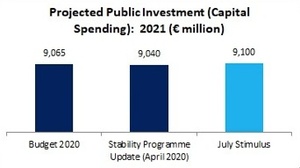
While we don’t have the numbers, capital spending would have slowed in 2020 due to the pandemic crisis. So the Government is correct in saying that their projection represents an increase over this year.

However, it doesn’t represent an increase over what was already projected – in last year’s budget and this year’s Stability Programme Update.

A smaller example of this is the provision of €15 million for peatlands rehabilitation, an important element of the overall Just Transition strategy. However, in Budget 2020 reference was made to €5 million to be spent from carbon tax revenues and a reference to €7 million under the Culture, Heritage and the Gaeltacht portfolio.

Does the €15 million announced include these already committed allocations or are they additional to them?

[Note: some enterprising TD or political party might consider exploring this whole area of additionality and re-announcing previously announced measures through Parliamentary Questions and research].

The Road Not Taken

TASC’s Shana Cohen noted:

‘This first economic litmus test for this new Government fails to impress because it does not give the sense that the new FF-FG-Green alliance is prepared to think big enough to move beyond Covid-19 to a new normal that is predicated on equality, and – more profoundly – hope for the future. Instead of generating jobs for the sake of employment numbers, the stimulus package could have hinged on linking job creation to wellbeing, climate change and economic democracy.’

One could reasonably argue that the urgency of the situation required immediate action without the luxury of longer-term thinking. Conditionalities can take time to devise and implement. Nonetheless, while a government in the middle of crisis might not be able to work out the vision thing in the short term, it could give some signals as to where it might be heading.

Take for instance the biggest subsidy – the Employment Wage Support Scheme (which replaces the Temporary Wage Subsidy Scheme). This will cost €1.9 billion, or over a third of the entire stimulus package.

Under this scheme firms which have suffered a 30 percent decline in turnover will receive a flat-rate subsidy of up to €203 or €151 per employee, per week, depending on the employee’s gross weekly pay. This is a significant subsidy.

The government could have established sectoral oversight committees comprising the relevant stakeholders in the sector: employees, employers and civil society organisations. This was proposed by the SIPTU trade union.

These committees could have monitored the roll-out and implementation of the scheme, reported back on any sharp practices, and put forward policies to improve administration of the scheme.

This would have signaled that the government was moving towards a stakeholder model which could eventually develop the type of conditionalities that Shana Cohen referred to above.

Alas, there was no proposal, mention, or even hint that the Government was looking down this road.

* * *

We have programmes which are not delivering the headline amount of stimulus as is claimed (PUP), are administratively simple to introduce speedily but not very well targeted (VAT cut and rates waiver), spending targets which are just old targets (public investment), and are full of deadweight (help-to-buy, staycation incentive).

All told, these schemes make up the vast majority of the stimulus spending. Given this, will it be enough or will we have to return to the stimulus table?

One good thing: the Government can revisit these and other missed opportunities in the roll-out of the National Economic Plan and associated sectoral initiatives in Budget 2021.

The jury is still out.

Michael Taft is a researcher for SIPTU and author of the political economy blog, Notes on the Front. His column appears here every Tuesday.

Rollingnews

From top: Dublin Airport; Paul Murphy

This afternoon.

Dáil Eireann at the Convention Centre, Dublin.

RISE TD Paul Murphy called for a vote on the lifting of the Pandemic Unemployment Payment (PUP) travel ban.

How did that go?

There  you go now.

Earlier: I’m Not Aware Of It Having Been Brought To Cabinet’ [Updated]

Ryanair CEO Michael O’Leary

Um.

At least the airlines are not operating like a cartel at this time.

That would be…

…Oh.

Rollingnews

Former taoisigh, from left: John Bruton, Bertie Ahern and Brian Cowen at a Brexit conference in 2018

Good times.

Rollingnews

An impressive short by UK based art and design studio Universal Everything in which a walking figure is observed evolving a variety of full coverage suits.

Full screen and headphones recommended. It’s quite mesmeric.

colossal

Law student Roman Shortall was stopped by Gardai at Dublin Airport; Garda statement on the incident

This afternoon.

Liveline on RTÉ Radio One.

Meanwhile…

Anyone?

Earlier…

From top: Fianna Fáil Minister for Education Norma Foley (left), Fianna Fáil leader Micheál Martin and Fine Gael Minister of State for Special Education and Inclusion Josepha Madigan; Ms Foley and Mr Martin; Minister for Employment and Social Protection Heather Humpheys

This morning.

On RTÉ’s Morning Ireland.

Education Minister Norma Foley was asked about the stopping of Covid-19 Pandemic Unemployment and jobseekers’ allowance payments to recipients who travel abroad on holidays.

Ms Foley was specifically asked “where did this come from? Was that brought to Cabinet at any point?” She was also asked if the legal change was notified to Cabinet.

She replied:

“No, I’m not aware of it having been brought to Cabinet.”

Meanwhile, last night…

Virgin Media One’s Gavan Reilly reported on comments made by Taoiseach Micheál Martin about the payment cuts as a result of checks having taken place at airports, as reported in the Business Post at the weekend and the Irish Daily Star on July 2.

It followed a bizarre sequence of events including a change to the Gov.ie website where the criteria for claiming the Covid-19 Pandemic Unemployment Payment was adjusted to include that people had to be “genuinely seeking work” to receive the PUP.

As a payment for people whose work has been suspended due to Covid-19 this stipulation of having to seek work appears to have been added to the list very recently.

(As recently as July 14, the Minister for Employment and Social Protection Heather Humphreys didn’t list this “genuinely seeking work” rule in a written answer about the PUP to Fianna Fáil TD Seán Fleming. In the same answer, she listed all the other criteria.)

In addition, the Irish version of the Gov.ie site doesn’t include this added condition of recipients having to be seeking work.

Curiously, on Sunday, the Tánaiste Leo Varadkar had told RTE that people receiving PUP had to be “genuinely seeking work”.

He also said the Department of Employment and Social Protection “gets information from the airports”, a claim denied by the Dublin Airport Authority and one which the Data Protection Commissioner Helen Dixon is now examining.

Mr Martin said he was seeking a report on the apparent change of policy regarding PUP recipients, while members of the Dublin Airport Authority are appearing before the Special Committee on Covid-19 Response this morning.

Meanwhile, yesterday afternoon.

On RTÉ’s News at One.

Minister for Employment and Social Protection Heather Humphreys spoke to Christopher McKevitt about the same matter. During the interview, Ms Humphreys was repeatedly asked if there had been a change in Government advice pertaining to PUP recipients. She continually didn’t answer the question.

Then, at the end of the interview, she said people who work in pubs whose work has been suspended due to Covid-19 don’t have to look for other work in order to receive the PUP.

From the interview…

Christopher McKevitt: “Just in relation to one item from, that emerged from the weekend, the halting of payments for some 104 people arising from their travel plans a Dublin Airport. Can you, as the minister, explain what’s happened there?”

Heather Humphreys: “Yeah well, we are at a crucial stage in relation to dealing with this virus and, as we look across the world, we see other countries re-introducing restrictions and asking people to return to lockdown and the Irish people have sacrificed so much and nobody wants to see us go back.

“In relation to travelling abroad, the public health advice is very clear. Do not travel abroad except for essential reasons and I want to be very clear. If any person intends to travel for essential purposes – for example, for health reasons, for a family bereavement, or for whatever, you know, essential reason, they have to go – you will continue to get your payment.

“And we’re asking and we’re encouraging people to holiday at home this year.”

McKevitt: “Right but…”

Humphreys: “And follow the clear, public health advice so that…and that’s so important in our battle to defeat this virus.”

McKevitt: “Indeed it is but can we just ask you on the specific point about leaving the country. OK, it’s the public health advice, not to leave the country but it is also the tradition that people are entitled to a two-week holiday how so ever they choose to spend that holiday is their own affair. Yes, there is guidance but it’s not enforceable guidance is it? So, so it seems to me that the Government has potentially penalised people on the social welfare code, for making that decision to travel, no matter how distasteful many people may find that decision of theirs to do so.”

Humphreys: “Yeah, well, the public health advice is not to travel abroad and that applies to everyone. So, for example, we have 340,000 public servants in this country and if any one of those chose to travel abroad they will not be paid for the two-week quarantine period when they return and, equally, there’s many private companies [who] have also told their staff that if they choose to go abroad, they will not be paid for the period that they have to quarantine when they come home. So we’re not trying to pick on anybody here. We are doing what is right by the country to protect our people.”

McKevitt: “Has there been a change…minister, minister, minister, sorry to cut across you but has there been a change in the Government.ie advice on receiving, or eligibility to receive the pandemic unemployment payment. Is it now the case that you must be genuinely seeking work? Because there’s quite an amount of activity on social media saying this is a new element that is being introduced to the qualifying guidelines as of this morning?”

Humphreys: “Well, as the economy has reopened up again, of course we want people to get back to work and that’s why we’re investing a huge amount of money in trying to get people back to work. But just to be clear, under normal circumstances, there is a flexibility under social welfare legislation whereby a person on jobseekers can travel abroad for up to two weeks and it doesn’t impact their payment. But the point here is that we are not in normal circumstances. We’re in the middle of a global pandemic and it is in that context and in order to protect people’s lives…”

McKevitt: “Minister…minister…”

Humphreys: “…that we have temporarily suspended the flexibility that people can continue to receive their unemployment payment when abroad.”

McKevitt: “Is there a change in the advice for the Pandemic Unemployment Payment? Let’s remind ourselves. It was for people who’d lost their job as a result of the pandemic or who’d been temporarily laid off because of the Covid-19 pandemic. That was, the expectation, for the 600-thousand-odd people who went on to it was that their job would be restored to them. Now, it seems that there is a new piece of guidance in terms of the eligibility to qualify for the PUP, that you must be genuinely seeking work. Is that the case?”

Humphreys: “Yeah, well, you always have, for any unemployment…”

McKevitt: “No…”

Humphreys: “…benefit, you always had to be, you know, to look for work and genuinely be looking for work. But I think the point is being missed here. This is the public health advice, it’s to stay at home, and, and the point is that we should be staying in Ireland and in a couple of months’ time…”

McKevitt: “But is the message, minister, is the message now to the 300,000 or the 286,000 people who are receiving the Pandemic Unemployment Payment, that they, as of this morning, must be genuinely seeking work? Is that the case now?”

Humphreys: “Well for some whose industry hasn’t opened back up again, obviously if you work in a pub, you know, you’re looking to get your job back there again. But, for others, they should be looking for work and that’s what most people on PUP want to do, they want to get a job, they don’t want to be on the payment, they want to get back to work. But I just want to be…”

McKevitt: “No, but supposing they’re working for a company that can no longer afford to employ them. Is it the case now that they shouldn’t necessarily be looking forward to returning to their old job but should be seeking new work in a different work environment?”

Humphreys: “Well unfortunately, yeah, unfortunately, there are going to be people who won’t be able to go back to their old jobs…”

McKevitt: “And is that new advice as of today?”

Humphreys: “Well, no, it’s not new advice. Obviously if you can’t get back to work, you need to, most people want to get back to work, they don’t want to stay on the unemployment payment and that’s why I have extended it. You know, last week, in the jobs stimulus, in relation to the payment, instead of reducing the payment to €203 in August, as originally planned, the Government has decided to take a fair approach and extend the payment until April and that is because we do not want anyone to suffer a cliff-edge reduction in their payment.

“So we’re not telling people you know, that, to stay at home, we want them to come back to work and that’s why we’re investing €200million in back-to-work initiatives and job incentive programmes.”

McKevitt: “If we were to return to phase two, arising from perhaps a second wave, and people had to return, people who had returned to work having received the PUP, were to go back onto the PUP scheme again, would the advice be to genuinely seek work with an alternative employer?”

Humphreys: “Well, if, of course, if we go back on to the, you know, if we go backwards, and we hope, we don’t go backwards, that’s the whole point of following the public health advice, that’s the whole point of asking people to stay at home this year, because the safest thing you can do is stay at home. But you’re looking at a situation that may or may not occur.

“But the point is, if you’re on the public, the unemployment benefit at this point in time, if you don’t have a job to go to, then you should be actively looking for other work. And, you know, if your job is no longer there. In the case of some sectors, for example, if you work in a pub, we are hoping that you will be able to go back to your job so you don’t have to be looking for work in that situation. But if you find that you’re going to be permanently unemployed because your job isn’t there then you should be looking for work and that’s why we have invested all of this money in a job activation programme.”

McKevitt: “Many thanks, Minister for Social Protection and Employment Affairs Heather Humphreys.”

Meanwhile…

Meanwhile…

Meanwhile…

Listen back in full here

This afternoon.

Nassau Street and Merrion Square, Dublin 2.

Coach drivers form a bus convoy in a ‘Honk for Hope’ protest at the lack of support’ from the Government, as they say that the majority of their work has gone since the lockdown.

Sam Boal/RollingNews


Paul writes:

Please Share! This is a song my son Jude made as part of a campaign to stop his school – Firhouse Educate Together Secondary from being moved to City West. This would involve a journey of an hour to an hour fifteen each morning and afternoon.

Jude is on the Autism Spectrum and has had various difficulties over the years. Jude loves this school – it is amazing in so many ways. If this goes ahead I’m not sure that it will be possible for him to continue there.

Petition here

Thanks James M Chimney

Broadsheet.ie