
From top: The Stag’s Head, Dublin; Tara Kerry of Fáilte Ireland

This afternoon.

Tara Kerry, registrar and Accommodation Manager at Fáilte Ireland, spoke on RTÉ Radio One to Claire Byrne about the new pub guidelines.

Ms Kerry was as clear as a freshly poured stout.

Claire Byrne: “Where does Failte Ireland stand on this notion, if you go to a pub, you have to spend €9 on a meal?”

Tara Kerry: “Well there’s an interesting story behind that. The €9 meal, just to give you a bit of context on it. The value of a meal as set out by ministerial order, under Section 9 of the Intoxication Liquor Act 1962. But in 1979, this is where it gets interesting, in the act was amended to reflect the rate of two punts, two pounds in the day, which was seen as an appropriate charge for a substantial meal.

“Now, in 2003, the then Minister for Justice Michael McDowell updated the act under statutory instrument to reflect the equivalent value of the day in 2003 of €9. Now that €9 still stands under the act today. So €9 is what is in the act so €9 is what actually going to be required for a substantial meal.”

Byrne: “So what if you go into a smaller pub and they’re serving soup and sandwiches? And it’s €9?”

Kerry: “Well, if you look, a lot of bars, it would cost, in or around the €9 but again, we have to follow the law of the land on this. And €9 is the price. So they might end up having a cup of coffee with their meal aswell to make it the €9-plus.”

Byrne: “OK, and will you have to buy €9 or does it have to be offered to you?”

Kerry: “No you would have to buy it. That is our understanding of the act, you have to buy it.”

Byrne: “OK. And who will be responsible for policing that?”

Kerry
: “Again, that is one of the other areas that we are seeking clarity on...But can I say to you, though, one of the things is, and having a wide experience of the industry myself, I’ve grown up in the industry and worked in it for most of my life. I firmly believe that business owners who have the best interest of both their customers and employees at heart, will actually self-police this themselves.”

Byrne: “Because there was a suggestion this morning that you might have a group that would spend 90 minutes in one establishment, somebody buys a meal for €9 and then they pop along to the next one and somebody else buys a meal for €9, ensuring that they have a good, long chunk of drinking time.”

Kerry: “Well I think that the public now, on the back of where we have been for the last 13 weeks, will actually, there’s obviously going to be exceptions to the rule but I do think that people will honour what is actually in place and the importance of allowing businesses to reopen.

“Because these food operations have been closed for a substantial period of time and now to have the opportunity to reopen is fantastic. It’s great for employment, it’s great from a Revenue perspective. And I think that both owners and customers will be compliant.”

Later

Byrne: “Will that €9 meal requirement be removed for pubs after the 20th of July?”

Kerry: “It will.”

Byrne: “So all pubs will be allowed open after the 20th of July?”

Kerry: “Well it’s based on the current advice that we have as yet. Unless something changes on the government’s roadmap to reopening.”

Byrne: “And what about contact-tracing measures then. What actions will pubs have to take to ensure that they’re ready for contact-tracing, should they need to do it?”

Kerry: “Another area that we are actually seeking clarity on because obviously there are GDPR issues related to it. So we just want to find the best method for that. Because obviously public health has to be taken into account.

“And the pre-booking element, if that is to be taken up by businesses, will assist in that because if you were to get, and this is our suggestion, if you were to take just the lead booking of a group, rather than each indivduals, we also seek clarity on how long that information will have to be retained for.”

Byrne: “There’s a real concern amongst some business owners that they’re just going to miss out on so much passing trade because of that pre-booking requirement.”

Kerry: “Well the thing about this is, if you read through the document, basically it’s stating that you can still take walk-ins but you would have to retain the two-metre distancing. The pre-booking is one of the caveats for the one-metre distancing.”

Byrne: “OK, so if you are operating with one metre, you will have to take pre-booking.”

Kerry: “That’s exactly it yeah.”

Byrne
: “OK. Even if it’s two minutes before they sit down?”

Kerry
: “Again that would be down to each operating business and how they actually operate their booking systems.”

Um.

Listen back here

Rollingnews

The Swedish Railway Orchestra – What’s Going On?

Dancing with tears in my eyes.

Workman’s Club DJ Rob Smith (top) returns with the third single from his eponymous album, due in July.

The video stars actor Paul St Leger communing with nature and is directed by Conor Waters.

Proceeds go to Ireland’s frontline workers.

Nick says: Swede dreams.

The Swedish Railway Orchestra

Who finds his way to these Parnassian islands?

Rob Cross writes:

My restored and colourised T. J. Molloy photo of Dublin‘s Grand Canal in the Winter of 1938 with Baggot Street Bridge [Dublin 2] in the background and the row of trees on the right is now where the Maxol Garage on Mespil Road is located…

Needs ducks.

UPDATE: Location in dispute (see comments).

Last night.

Enniscorthy, County Wexford.

Don’t say we didn’t warn you.

IKEA, Firhouse, Dublin

This morning/afternoon.

State aid.

For IKEA?

Via RTÉ:

IKEA said it received aid from Belgium, Croatia, the Czech Republic, Ireland, Portugal, Romania, Serbia, Spain and the United States but did disclose the sums.

Several of the countries have already been reimbursed, Ingka said, without specifying which ones nor the sums involved.

In a statement, Mr Oncu said IKEA had accepted the money “at the height of the pandemic to secure livelihoods and employments”.

Hmm.

Anyone?

IKEA to return state aid received during Covid crisis (RTÉ)

Rollingnews

Sunrise doesn’t normally look like this.

Because the moon’s not normally in the way, as it was on the morning of May 10th, 2013 when seen from Western Australia. To wit:

At times, it would be hard for the uninformed to understand what was happening. In an annular eclipse, the Moon is too far from the Earth to block the entire Sun, and at most leaves a ring of fire where sunlight pours out around every edge of the Moon. The featured time-lapse video also recorded the eclipse through the high refraction of the Earth’s atmosphere just above the horizon, making the unusual rising Sun and Moon appear also flattened. As the video continues on, the Sun continues to rise, and the Sun and Moon begin to separate. This weekend, a new annular solar eclipse will occur, visible from central Africa, the Arabian Peninsula, and a narrow band across Asia, with much of Earth’s Eastern hemisphere being able to see a partial solar eclipse.

(Video: Colin Legg & Geoff Sims; Music: Peter Nanasi)

apod

This morning/afternoon.

FIGHT!

Earlier: The Oppo

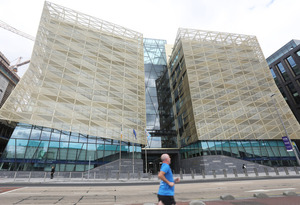
The Central Bank, Dublin

‘Ragamuffin’ writes:

The Atlantic magazine this month has an interesting article entitled “The Worst Worst Case Scenario” (or for the online version “The Looming Bank Collapse” ) by UC Berkeley Law Prof Frank Partnoy.

In the article he outlines the possibile scenario in which the coronovirus crisis leads to another 2008 style recession, except this time it would be worse.

He explains that the last financial crash was largely caused by bank’s over investment in CDOs:

“The financial crisis of 2008 was about home mortgages. Hundreds of billions of dollars in loans to home buyers were repackaged into securities called collateralized debt obligations, known as CDOs.

In theory, CDOs were intended to shift risk away from banks, which lend money to home buyers. In practice, the same banks that issued home loans also bet heavily on CDOs, often using complex techniques hidden from investors and regulators.

When the housing market took a hit, these banks were doubly affected. In late 2007, banks began disclosing tens of billions of dollars of subprime-CDO losses. The next year, Lehman Brothers went under, taking the economy with it.”

This process of contagion and collapse was memombarbly explained by Ryan Gosling’s character using Jenga blocks in The Big Short (2015).

According to Partnoy, the current threat is CLOs, which seem to share more than just a similar name with CDOs:

“After the housing crisis, subprime CDOs naturally fell out of favor. Demand shifted to a similar—and similarly risky—instrument, one that even has a similar name: the CLO, or collateralized loan obligation. A CLO walks and talks like a CDO, but in place of loans made to home buyers are loans made to businesses—specifically, troubled businesses. CLOs bundle together so-called leveraged loans, the subprime mortgages of the corporate world.

These are loans made to companies that have maxed out their borrowing and can no longer sell bonds directly to investors or qualify for a traditional bank loan. There are more than $1 trillion worth of leveraged loans currently outstanding. The majority are held in CLOs.”

Partnoy warns that if the leveraged loan market collapses, many banks will have liabilities greater than their assets. And due to the current Covid 19 situation…

“…the outlook for leveraged loans in a range of industries is truly grim”.

He warns that if another financial crash is  looming, politicians will be under tremendous pressure to NOT bail out the banks, due to citizen’s anger at lessons not being learned by banks in 2008, adding:

And then, sometime in the next year, we will all stare into the financial abyss. At that point, we will be well beyond the scope of the previous recession, and we will have either exhausted the

remedies that spared the system last time or found that they won’t work this time around.”

Partnoy summary at the end of the article calls for major reforms of our financial system, whether the crash happens or not:

“It is a distasteful fact that the present situation is so dire in part because the banks fell right back into bad behavior after the last crash—taking too many risks, hiding debt in complex instruments and off-balance-sheet entities, and generally exploiting loopholes in laws intended to rein in their greed. Sparing them for a second time this century will be that much harder.

If we muster the political will to do so—or if we avert the worst possible outcomes in this precarious time—it will be imperative for the U.S. government to impose reforms stringent enough to head off the next crisis. We’ve seen how banks respond to stern reprimands and modest reform. This time, regulators might need to dismantle the system as we know it.

Banks should play a much simpler role in the new economy, making lending decisions themselves instead of farming them out to credit-rating agencies. They should steer clear of whatever newfangled security might replace the CLO. To prevent another crisis, we also need far more transparency, so we can see when banks give in to temptation. A bank shouldn’t be able to keep $1 trillion worth of assets off its books.

If we do manage to make it through the next year without waking up to a collapse, we must find ways to prevent the big banks from going all in on bets they can’t afford to lose. Their luck—and ours—will at some point run out.”

I have to admit, I have no expertise in financial issues. So by the end of the article I was hoping CLOs were an American phenomenon, and that Irish banks would not be so foolish to get involved in this market, after the last devastating collapse.

I googled CLO Ireland and found  this Irish Times article from last December titled “Central Bank warns on Dublin’s €78bn company loans hub” .

The article by Joe Brennan states:

“Ireland’s growing role as a host to esoteric vehicles for repackaged loans of highly indebted companies internationally could see it caught up in an international financial shock if corporate default rates spike. US and British private equity firms and asset managers have driven a boom in collateralised loan obligations (CLOs) vehicles in Ireland in recent years.

These repackage pools of corporate loans into bonds that are sold to investors. Total assets in Irish-based CLOs spiraled to €78 billion in first quarter of 2019 from €15.7 billion five years’ earlier.

An estimated two-thirds of the outstanding value of European CLOs is now domiciled in the Republic, the Central Bank said in a paper published on Friday on Ireland’s market-based finance, or shadow banking, industry.”

Brennan goes on to play down the risk CLOs pose to the Irish economy:

“Only a tiny portion of non-bank finance assets in Ireland relate to the domestic economy…While the prospect of an entity in the International Financial Services Centre (IFSC) imploding would cause more reputational damage than a direct cost for Irish taxpayers, the new Central Bank governor Gabriel Makhlouf has set a priority on assessing the risks in the sector, including parts, such as CLOs, that are not regulated.”

I hope Joe Brennan is right, but would the main learning from 2008 not be that if the jenga bricks begin to fall in America, then the whole world (including Ireland) is coming down too?

It would seem to me that Ireland should be doing more to regulate CLOs if we are the European leader in their sale. I would be very interested to Ask A Broadsheet Reader what they make of this.

Rollingnews

Meanwhile…

Fight!

Update:

Sinn Féin TDs Chris Andrews and Eoin Ó Broin arrive at Leinster House this morning

Earlier.

Kildare Street, Dublin 2.

Meanwhile…

Speaking on Newstalk’s Pat Kenny show, Ms [Mary Lou] McDonald said that the proposed new government would leave Sinn Féin in a very strong political position.

“They may succeed in slowing down the very necessary change that we need in our society but they won’t stop it,” she said.

…Sinn Féin would provide “a very coherent, a very progressive, a very enlightened opposition” throughout the lifetime of the next government. “We will deliver on the mandate for change that we were given,” she said.

Ms McDonald referred to Fine Gael and Fianna Fáil as Tweedle Dum and Tweedle Dee and said that they were determined that “come what may” Sinn Féin would be kept out of government.

McDonald: Fine Gael and Fianna Fáil ‘clubbed together’ to keep Sinn Féin out of government (Irish Examiner)

Rollingnews

Broadsheet.ie