


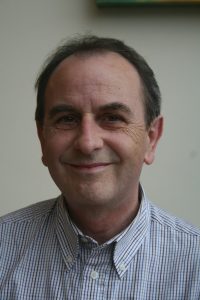
 From top: the entrance to St. Michael’s Hospital, Dun Laoghaire, County Dublin where Covid-19 testing is taking place; Eamonn Kelly
The coronavirus impact on the economy is having the effect of achieving something that was only theoretical a few short weeks ago: the necessity to halt capitalism’s perpetual demand for spending, consumption and growth.
The coronavirus has offered an opportunity to radically change the capitalist paradigm.
Cash is the lifeblood of an economy. But if it can’t come from free market trade, as is happening now, where will it come from? Will the economy just bleed out and die?
David McWilliams, in the Irish Times, writes that this problem is exacerbated by panic, leading to cash hoarding, much like shopping hoarding.
He offers a radical solution, sourced to Milton Friedman, for such situations, writing:
“The Central Bank of Ireland should print money and deposit free cash into every citizen’s account and every business account.”
This of course would be a short-term measure, but even the concept opens everyone’s eyes to new economic possibilities, particularly in his analysis of the meaning and worth of cash in a deflating economy.
McWilliams points out that the “normal” way to inject cash into an ailing economy is to inject it into the banks, saving the banks, as in 2008, who then dispense it back out into the economy. Notice that banks get “free money” and no one flinches.
This other method, proposed by Friedman, involves cutting out the bank middle-men and putting cash straight into people’s accounts, to offset panic and a cash hoarding wave that would lead to a runaway self-perpetuating loop, bleeding out the economy.
Obstacles to Growth
What is also becoming apparent through the coronavirus crisis is that the global system of capital has two main problems, identified by Prof Pierluigi Viale, the director of infectious diseases at Sant’Orsola-Malpighi Polyclinic in Bologna, in a different context.
In a warning to other countries to act immediately against the virus he identified the two main obstacles to radical action.
“The problem is politics and economy,” he says.
These are also, coincidentally, (or maybe not) the two main obstacles to action on climate change.
Professor Viale said:
“It is not easy to convince a nation to sacrifice. I am sure that in a few days they too will start moving, they have no choice. Sooner is better than later”.
The exact same conundrum faces the world in terms of climate change, the only difference being that the time frame for action with climate change is longer, offering space for denial and inaction. But the core obstacles of economy and politics are precisely the same ones.
We saw it here and in Britain and the US in the early days of the virus (ten days ago?!) when the politicians were still prioritising the economy over people’s health by seeking to minimise the deadly nature of the virus.
This again is a mirror of the political classes’ reaction to climate change, putting the economy first, when it is patently clear that you can’t have an economy without a world to run one in.
In this respect, politics and economy, as they are currently shaped by neo-liberals, are actually obstacles to growth in terms of fresh thinking, the very thing required to tackle climate change.
The differences between neo-liberal core beliefs and practical common sense have been thrown into stark relief by the pandemic, with neo-liberals initially revealing their natural ideological preference for the health of the economy over the health of the public.
But this ethical miscalculation was corrected by the nature of the virus itself, which immediately began to demonstrate that public health must precede economic health.
That a virus doesn’t observe borders or class preferences. That you can’t have business as usual if public health is under threat. That the economy too will eventually bleed out unless the political class act to protect public health.
The exact same rules apply to action on climate change. Public health and climate health must be prioritised over short term economic measures.
We saw this anomaly here, in its micro form, when the Fine Gael government were pointing to “healthy” growth figures in the economy, yet homelessness was at crisis point and steadily rising and children in hotels were experiencing measurable stunted growth.
That stat-driven type of economic approach has now been revealed as just a clean bureaucratic way of eating your young.
Personal Financial Security
When it finally became clear, even to neo-liberals, that mass closures of businesses for a long period of time – maybe even months – would be necessary to contain the virus, the first realisation was; what are people going to do for money? If capitalism can’t create cash, if only temporarily, how are people supposed to live?
The answer came hot on the heels of the question: State intervention, the very thing that neo-liberals and late stage capitalists had been opposing and rolling back and undermining for so long.
Fringe ideas, like basic income, which had gradually been becoming more mainstream with the realisation of capitalism’s adverse contribution to climate change, now took centre stage as one of the more practical ideas to deal with the necessary closures to contain the coronavirus.
Long-time proponents of universal basic income such as Andrew Yang called for a change of thinking around the concept of economy; identifying, as David McWilliams has done, “personal financial security” as a key measure to deal with the crisis.
Said Yang:
“Treating this as a pandemic is one thing. Treating this as an imminent economic depression and societal catastrophe spurred by a pandemic is another. You should flood the zone with buying power and a sense of personal financial security as fast as possible.”
This concept of personal financial security for all is the exact opposite to the concept of engineered scarcity that the neo-liberal agenda promotes in order to encourage continued and unnecessary consumption and corresponding political weakening of adversaries.
Again, the virus invites, almost as an afterthought, an interrogation of neo-liberal politics that finds its basic concepts desperately wanting when it comes to considerations of the public good.
Once neo-liberalism is disarmed in this way, as it has been in recent weeks, alternative thinking leads inevitably towards solutions based on the concept of social security, which is also a necessary re-think in the inevitable winding down of capitalism to allow for climate recovery.
The coronavirus and the restrictions imposed by the pandemic, offer an opportunity for real change.
A New Paradigm
The virus, with its short time frame demanding immediate action, is a slap in the face to capitalist complacency, in comparison to climate change’s slow deterioration, which can be put on the long finger, seemingly indefinitely, until a restriction is imposed by the elements.
When a disease is slow moving – and late-stage capitalism’s contribution to climate change has been described as a disease by some commentators – it is more amenable to denial.
The virus doesn’t leave any space for denial. Even the drinkers and race-goers who attempted to continue as normal were quickly corrected by the speed of the viral spread.
Every measure employed to combat the virus will be needed to combat climate change, but in a less drastic form. The virus has provided a revelation really as to how capitalism might be amended and curtailed to give the climate some breathing space for recovery.
Old Dangerous Ways
The only problem now, as Naomi Klein has noted, is that the old right-wing orders will be tempted by the virus crisis to behave primitively, by using the opportunity to restrict democratic freedoms and consolidate their economic power.
The old strategies designed to perpetuate the late capitalist business model of endless consumption in a finite system may continue to be pursued; ignoring the valuable lessons demonstrated by the virus crisis and condemning the world to climate catastrophe.
Already in the United States the old corporate models that always result in bailouts for corporations, coupled with opportunistic attacks on social security, are underway in what Naomi Klein refers to as old ideas lying around waiting for the right social conditions to allow them to be enacted.
It could be that the coronavirus is the wake-up call that late-stage capitalism needs to radically amend global financial systems in the interests of climate repair.
A last gasp opportunity to change the capitalist paradigm and to question the twin obstacles of neo-liberal politics and economic prioritising that prop up the old destructive system.
But the danger of being duped by wily neo-liberal politicians into exchanging freedoms for a sense of security will likely continue. That’s the game after all.
Eamonn Kelly is a freelance Writer and Playwright.
Previously: Eamonn Kelly on Broadsheet

15 Italians who were in Dublin for flight assistant training with Ryanair have contracted #Covid19. They flew from Bergamo and they now under treatment here. #COVID19ireland https://t.co/OwOZnNvNe3
— Angelo Bottone (@angelo_bottone) March 19, 2020
Merda.

Minister for Education Joe McHugh
This morning.
The Minister for Education Joe McHugh announced that Leaving Cert students studying languages will receive full marks for the oral section of exams that were due to be held in Irish and modern European languages.
The oral exams were due to begin on March 23 but have now been cancelled.
Students will also get full marks for their oral exams in Leaving Cert Irish and French, German, Spanish, Italian, Russian and Japanese; practical performance tests in Leaving Cert Music; practical performance tests in Junior Cert Music and Home Economics.
Journalist Richard Chambers, of Virgin Media News, asked Mr McHugh, in light of the move, if students will still be able to change their exam level, lending to gaining more points, and he said no, explaining:
“To be very clear, we’re going to get rid of all that excitement around that. That won’t happen because you’re correct in saying, on the morning of the exam, people can make the change. Normally I think it’s about 10% go from higher to lower and there is a small cohort that go from ordinary level to higher level, but the people made the decision.
“The CAO has that decision, that’s the one that stays, where they’ve indicated their preference for higher or ordinary, that’s the one that sticks. So that option is not there.”
Watch the press conference back in full here
Earlier: He Brought You The Gathering

EU’s Brexit negotiator Michel Barnier
Je tiens à vous informer que j’ai été testé positif #COVID19. Je vais bien, le moral est bon. Je suis naturellement toutes les instructions, tout comme mon équipe.
Mon message à tous ceux qui sont touchés ou actuellement isolés: nous nous en sortirons ensemble !. #chacunpourtous pic.twitter.com/NxMCjfseSb— Michel Barnier (@MichelBarnier) March 19, 2020
I would like to inform you that I have tested positive for #COVID19. I am doing well and in good spirits. I am following all the necessary instructions, as is my team.
For all those affected already, and for all those currently in isolation, we will get through this together.
— Michel Barnier (@MichelBarnier) March 19, 2020
This morning.
The EU’s Brexit negotiator Michel Barnier, 69, has announced, via Twitter, that he has tested positive for Covid-19.
Coronavirus live news: EU chief Brexit negotiator Michel Barnier tests positive (The Guardian)

John Concannon (left) and chief medical officer Tony Holohan
Good morning everyone 👋🏻
Big day ahead:
9am-All Gov Depts meet to share info
FYI -3 media briefs:
11am-Education
3pm-Business
5:30pm-Health
I am INCREDIBLY proud to be working alongside Tony. Unquestionable integrity, decency – & yes- a really decent sound guy too!💪🏻🇮🇪 pic.twitter.com/k1CGB1jsBl
— John Concannon (@JCGalway) March 19, 2020
This morning.
“Communications guru” John Concannon, formerly of the Strategic Communications Unit, Creative Ireland, The Gathering, Discover Ireland, the Wild Atlantic Way, and Fáilte Ireland, begins his new role of managing the State’s communication on Covid-19.
Meanwhile….
https://twitter.com/JCGalway/status/1240392532649037825
What are they building?
Anyone?
UPDATE:
Journos/broadcaster and especially spin doctors dont get it. IF THE MESSAGE IS STAY HOME IT APPLIES TO YOU TOO. Don’t put our CMO at risk! pic.twitter.com/5muE0gawxF
— ProfJohnCrown (@ProfJohnCrown) March 19, 2020
Two-Hander
at
https://www.youtube.com/watch?v=kk7SrLODSFA
Artist Colin Darke can draw with either hand.
And not just either, both simultaneously.
And not just both simultaneously, both simultaneously drawing different parts of the same thing.
More of his time lapses here.


Went downstairs there and my wee girl pointed at the TV said “that man looks terrible. Does he have Coronavirus”
“No” I said. That’s Bob Geldof. He always looks like that”
— Paul McGinley (@SpeccyPaul) March 19, 2020
Ah here.
This morning.
BBC News.
Bob Geldof said he doesn’t have the coronavirus but will self-isolate anyway apart from a pre-planned family gathering.
What a complete character.
Meanwhile…
Wow. Media covering the Coronavirus. Propaganda at its finest. pic.twitter.com/8AueSWaEGx
— Kambree (@KamVTV) March 18, 2020

This morning.
In Ballincollig, Co Cork.
Ballincollig Credit Union tweetz:
“Each Friday going forward, we are prioritising time in our office for elderly and vulnerable members from 9.30am to 11.00am. We ask that the rest of our members would respect this allocated time. Thank you for your continued support.”
Previously: Nan’s Gone To Iceland [Updated]
UPDATE:
Meanwhile…

Via Lidl


Um.
This afternoon.
Emergency legislation – The Health Preservation and other Emergency Measures Bill – will be passed in the Dáil.
The title of the bill states:
“An Act, to make exceptional provision, in the public interest and having regard to the manifest and grave risk to human life and public health posed by the spread of Covid-19 and in order to mitigate, where practicable, the effect of the spread of Covid-19, to amend the Health Act 1947 to make provision for the Minister for Health to make regulations prohibiting or restricting the holding of certain events, access to certain premises and to provide for enforcement measures; to provide for powers for certain medical officers of health to order, in certain circumstances, the detention of persons who are suspected to be possible sources of infection of Covid-19 and to provide for enforcement measures in that regard; and to confer on the Minister for Health the power to designate areas as areas of infection of Covid-19 and to provide for related matters; to amend and extend the Social Welfare Acts to provide for amendments in relation to entitlement to illness benefit for persons who have been diagnosed with, or are a probable source of infection of, Covid19; and to provide for amendments in relation to jobseeker’s benefit and jobseeker’s allowance to mitigate the economic effects of the spread of Covid-19; and to provide for related matters.”
The bill can be read in full here
Reduced Dáil gathering to pass emergency legislation (RTÉ)
UPDATE:
UPDATE:
Health Minister Simon Harris has proposed that the detention powers of the new Bill remain in place until November 9th. @rtenews
— Sandra Hurley (@sandra_hurley) March 19, 2020
UPDATE:
The Health Minister @SimonHarrisTD says the emergency legislation before the Dáil “will cover private gatherings” ie the capacity to shut down house parties where social distancing is not being observed. Replying to @DenisNaughten @rtenews
— Paul Cunningham (@RTENewsPaulC) March 19, 2020