



This morning (7.30).
Dame Street, Dublin 2.
Dublin Bus train? Or camera trickery?
We may never know.
Thanks Shane Fitzgerald

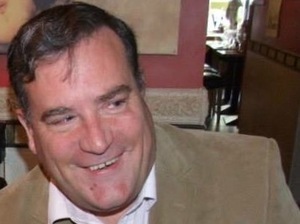
From top: Dublin city centre yesterday; Dan Boyle
Two distinct political approaches have accompanied the international reactions to the novel coronavirus crisis.
The political philosophy holding most influence in how responses are being determined can be identified by which of these two questions are being asked, in what intensity, and to what degree of prioritisation.
The questions are ‘How does this crisis affect our people?’ or alternately “How does this crisis affect our economy?’.
It is fairly obvious that the administrations in the US and in the UK, have been asking themselves the second question first, most loudly and most regularly.
Any policy response to a pandemic will bring about huge societal adjustments. To anticipate such responses in purely financial terms is particularly misanthropic.
The follow through questions asked by these administrations seem to have been solely based on economic impact.
In the circumstances we all find ourselves now, no approach is going to be without difficulty. To make achieving success that more difficult because of ingrained philosophical hang ups, will rightly be seen as especially wrong.
The first response to this public health crisis in the US and UK has been to seek to limit the role government can and should play.
The underlying ‘values’ behind this belief is a perverse understanding that the more government/public agencies become involved, the greater the damage they are likely to cause.
The definition of this damage is informed by a secondary principle – the business of business should be largely unaffected.
While they will proclaim otherwise, these theories are callously indifferent to human health and life.
Few would argue that we be indifferent to the economics of any health crisis. But to give potential economic consequences such a priority is unfair to most people in those societies.
In Ireland we have had a government, now in a caretaker capacity, that has been similarly wedded to market principles. This adherence has seen housing provision become further and further detached from public need.
It has also made the achieveing of a health service, which was truly public and which the public has confidence, much more difficult to attain.
However in its approach to how this virus is impacting Ireland, the government is operating a far more people centred approach.
It is an approach that hasn’t been without flaws and won’t be without difficulties, but it is an approach that it is founded on better principles.
It would be better if our new government could be formalised. Like Eamon Ryan I believe that a national government would be best placed to deal with the scale of the predicament we face.
Even if not possible, the default setting should be to continue to support the government as it is constituted on the course it is currently following.
To seek to create a new government, formed on a crude majoritarian basis, that would divide rather than continue to involve the Dáil, would be precisely the wrong action to take as we seek to collectively tackle this crisis.
The approach to date has been, thankfully, politics free. The support our public services and agencies need has to engage our entire political system acting unambiguously towards a single focused goal.
Forming a new government in Ireland, especially a government that could be tempted to reassert market principles to social policy areas, is something that shouldn’t be encouraged until we can get this virus under control.
Dan Boyle is a former Green Party TD and Senator and serves as a Green Party councillor on Cork City Council. His column appears here every Thursday. Follow Dan on Twitter: @sendboyle

US Democrat Presidential hopefuls Joe Biden (left) and Bernie Sanders during a CNN debate on Tuesday night
Lately there’s been some concern
About Primaries, later we’ll learn
If Sanders will go
And leave the race to Joe
Or if he’ll continue to Bern
John Moynes
Getty


MORE to follow

The votes are in.
Last month, with a copy of Irish journalist David Diebold’s new flash memoir This Is How We Dance up for grabs, we asked you to nominate your favourite memoir.
You answered in your tens. But there could only be one winner.
Third place:

Just Kids by Patti Smith
Ger Siggins writes:
It’s a powerful story of love, art, music and death in 1970s NYC, told by one of the giants of modern music who knows how to tell a story. Can’t remember a memoir I ever wanted to read twice. Magic.
Runner-up:

Love Is A Mix-tape by Rob Sheffield
Catherine Vaughan writes:
A memoir of his relationship with his wife from first meeting, to her death, told through the mix-tapes they made for each other. Recommend by a friend, I expected a sort of real-life High Fidelity. I did not expect the level of snotty bawling while reading the last few chapters, as he described how Renee died suddenly in his arms from a brain aneurysm…
Winner:

Down and out in Paris and London by George Orwell
nicorigo writes:
In this two-part memoir, George Orwell tells us about his living in extreme poverty and squalor in the two capital cities between 1928 and 1929. Vividly sordid, full of bombastic characters, his truculent writing takes you from shabby hotels to miserable lodging houses, from sleeping rough in London to the dampest spikes. A compelling read.
Thanks all.
Previously: Win Nick’s Free Stuff


A beautifully designed short by illustrator and director Tuna Bora and animator Jonathan Djob Nkondo about a girl who discovers that the only thing that truly exists in a world that cannot be trusted, is her own self.

Advertisements for property to let
This afternoon.
The Irish Property Rights’ Association released the following statement:
“Stephen Faughnan, Chairman of the Irish Property Owners’ Association, has stated that all tenants who find themselves in the unfortunate situation of losing their jobs should be afforded access to the existing HAP scheme.
“He stated that the Government need to put the resources and structures in place to deal with the likely requirement for this support and that the IPOA’s members are happy to work with tenants who need to move to the HAP system.
“This will necessitate cutting through the red tape that currently exists with the HAP system to ensure that tenants and landlords don’t suffer irreversible hardship from the C-19 crisis.”
Anyone?
Via Paul O’Donoghue
How Many?
at
The HSE has told @VirginMediaNews it has received 24,000 expressions of interest in the first 24 hours since launching the recruitment drive for frontline healthcare workers to tackle #Covid19 #Coronavirusireland
— Zara King (@ZaraKing) March 18, 2020
In fairness.
Yesterday: Cometh The Hour